The passage this message was preached from, in full, with every other passage it reached for.
Leviticus 9:18-24read aloud by congregation members, describing Aaron's sacrifices and the fire from God consuming the burnt offering
18 He also killed the bull and the ram, the sacrifice of peace offerings, which was for the people: and Aaron’s sons delivered to him the blood, which he sprinkled around on the altar,
19 and the fat of the bull and of the ram, the fat tail, and that which covers the innards, and the kidneys, and the cover of the liver:
20 and they put the fat upon the breasts, and he burned the fat on the altar:
21 and the breasts and the right thigh Aaron waved for a wave offering before Yahweh, as Moses commanded.
22 Aaron lifted up his hands toward the people, and blessed them; and he came down from offering the sin offering, and the burnt offering, and the peace offerings.
23 Moses and Aaron went into the Tent of Meeting, and came out, and blessed the people: and Yahweh’s glory appeared to all the people.
24 Fire came out from before Yahweh, and consumed the burnt offering and the fat upon the altar. When all the people saw it, they shouted, and fell on their faces.
read aloud by congregation members, describing Nadab and Abihu offering unauthorized fire and being consumed by fire from God
1 Nadab and Abihu, the sons of Aaron, each took his censer, and put fire in it, and laid incense on it, and offered strange fire before Yahweh, which he had not commanded them.
2 Fire came out from before Yahweh, and devoured them, and they died before Yahweh.
3 Then Moses said to Aaron, “This is what Yahweh spoke of, saying, ‘I will show myself holy to those who come near me, and before all the people I will be glorified.’” Aaron held his peace.
4 Moses called Mishael and Elzaphan, the sons of Uzziel the uncle of Aaron, and said to them, “Draw near, carry your brothers from before the sanctuary out of the camp.”
5 So they came near, and carried them in their coats out of the camp, as Moses had said.
6 Moses said to Aaron, and to Eleazar and to Ithamar, his sons, “Don’t let the hair of your heads go loose, and don’t tear your clothes; so that you don’t die, and so that he not be angry with all the congregation; but let your brothers, the whole house of Israel, bewail the burning which Yahweh has kindled.
cited loosely as the passage where the nations shake their fist in rage at God
1 Why do the nations rage, and the peoples plot a vain thing?
2 The kings of the earth take a stand, and the rulers take counsel together, against Yahweh, and against his Anointed, saying,
3 “Let’s break their bonds apart, and cast their cords from us.”
4 He who sits in the heavens will laugh. The Lord will have them in derision.
5 Then he will speak to them in his anger, and terrify them in his wrath:
6 “Yet I have set my King on my holy hill of Zion.”
7 I will tell of the decree. Yahweh said to me, “You are my son. Today I have become your father.
8 Ask of me, and I will give the nations for your inheritance, the uttermost parts of the earth for your possession.
9 You shall break them with a rod of iron. You shall dash them in pieces like a potter’s vessel.”
10 Now therefore be wise, you kings. Be instructed, you judges of the earth.
11 Serve Yahweh with fear, and rejoice with trembling.
12 Give sincere homage to the Son, lest he be angry, and you perish on the way, for his wrath will soon be kindled. Blessed are all those who take refuge in him.
read aloud by a congregation member about servants who know the master's will being held to greater account
47 That servant, who knew his lord’s will, and didn’t prepare, nor do what he wanted, will be beaten with many stripes,
48 but he who didn’t know, and did things worthy of stripes, will be beaten with few stripes. To whomever much is given, of him will much be required; and to whom much was entrusted, of him more will be asked.
read by Pastor Brian connecting the Old Testament sacrificial system to Christ offered once for all to take away sins
27 Inasmuch as it is appointed for men to die once, and after this, judgment,
28 so Christ also, having been offered once to bear the sins of many, will appear a second time, without sin, to those who are eagerly waiting for him for salvation.
The message in order, in a few minutes of reading.
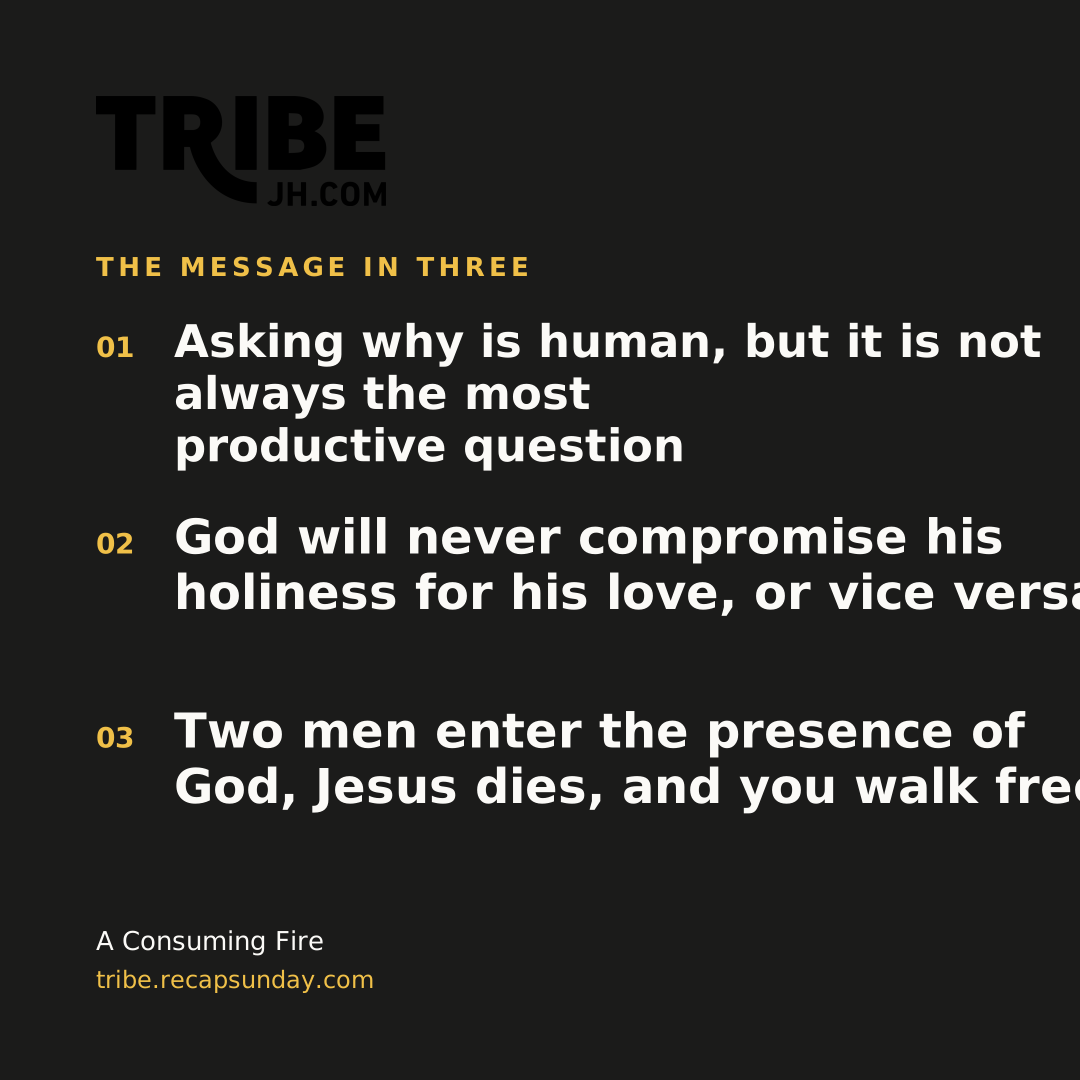
Week two of "Two Men Enter, One Man Leaves" stayed in Leviticus, moving through the ordination ceremony of Aaron's sons and into the moment fire blazed out from God and killed Nadab and Abihu on their first day as priests. Brian used those two fires side by side, one that produced worship and one that produced death, to press into a single question: how does a God who is perfectly holy express love for people who are not? The answer, he said, is the whole reason Jesus matters.
What was said
Brian opened by framing the series. Leviticus is the graveyard of Bible-in-a-year attempts, but it is not a book of arbitrary rules. It is a divine blueprint for holiness, a record of the extraordinary lengths God goes to in order to have relationship with his people. Reading it with that frame changes everything.
The congregation read through the end of Leviticus 9, where fire from God consumed the burnt offering and the people shouted and fell on their faces, and then straight into chapter 10, where Nadab and Abihu offered unauthorized fire and were immediately killed. Brian pointed out that these events sit on the same page, produced by the same God, and that the first honest question most people ask is simply: why?
He said that question is a normal human question, and you should give yourself permission to ask it. But it is not always the most productive question. God does not owe anyone an explanation for anything he does, ever. That is hard to sit with, but it is a foundational truth about his nature and character.
A more productive question, Brian argued, is the one Michelle offered: Lord, what do you want me to learn about you in this situation? That question comes from a posture of humility rather than protest, and it is the kind of question that moves toward conversation and relationship rather than looping in frustration. He said God delights in giving understanding, even though he owes none.
From there Brian built the definition that held the rest of the sermon together: the God of the Bible is a consuming fire who will never compromise holiness for love. He will not make exceptions. He cannot make exceptions. If he did, he would be less than perfect, and a less-than-perfect being cannot be God.
That creates a genuine dilemma. All have sinned and fallen short of the glory of God. His eyes are too pure to look at sin. His standard is holiness, and none of us can meet it. So how does a holy God express love for a sinful people without violating his own character? Brian said plumbing the depths of that question is one of the most valuable things a person can spend a life on.
The answer is Jesus. Two men enter the presence of God. Jesus dies. You walk free. His sacrifice does not merely cover sin, Brian said, it erases it. And because he had no sin of his own, death could not hold him. He is alive now, and he is coming again, not to deal with sin a second time but to bring the fullness of salvation to those who are waiting for him.
Touch points
Things you could actually do this week.
Read Leviticus 9 and 10 this week and sit with the question Brian raised: what does this passage teach you about who God is, rather than just asking why he did what he did?
The next time you catch yourself asking God 'why did you let this happen,' try replacing it with 'Lord, what do you want me to learn about you in this situation?'
If you need prayer for something you are carrying right now, reach out to Michelle and Ron or anyone on the Tribe prayer team rather than sitting with it alone.
Think of one area of your life where you have not yet given God permission to work, and spend some time this week asking him specifically to move there.
Come back next Sunday and keep working through this series, because Brian said this conversation about the consuming fire is one worth spending your life on.
Doing a Bible study?
Here is a guide we have prepared for you: the passages
in order, questions for the group, and room to write.
Brian said that asking God 'why' is a normal human question but not always the most productive one. When have you found yourself stuck in that 'why' loop, and what eventually shifted your thinking?
Michelle suggested reframing the question from 'God, why did you do this?' to 'God, what do you want me to learn about you in this situation?' How hard is that shift to make in the middle of real pain, and what gets in the way of it?
Pastor Brian abrió esta segunda semana de la serie "Two Men Enter, One Man Leaves" introduciendo el libro de Levítico, un libro que mucha gente abandona cuando intenta leer la Biblia completa. A través de Levítico 9:18-24 y 10:1-6, la congregación vio dos caras del mismo Dios: el fuego que consume la ofrenda y produce adoración en el pueblo, y ese mismo fuego que mata a Nadab y Abiú cuando se acercan a Dios con una ofrenda no autorizada. Pastor Brian señaló que preguntar "¿por qué, Dios?" es una reacción humana normal, pero no siempre la más productiva. Una pregunta más fructífera, surgida de la conversación con la congregación, es esta: "Señor, ¿qué quieres enseñarme sobre ti en esta situación?"
El hilo central del sermón fue que el Dios de la Biblia es un fuego consumidor que nunca va a comprometer su santidad por amor. Eso crea un dilema enorme para la humanidad, porque todos hemos pecado y estamos lejos de su estándar de santidad. Dios no puede simplemente hacer una excepción, porque si comprometiera su carácter, dejaría de ser Dios. La pregunta que quedó abierta fue: ¿cómo puede un Dios perfectamente santo expresar su amor por un pueblo pecador sin violar su propia naturaleza?
La respuesta llega en Hebreos 9:27-28: Jesús entró como ofrenda, murió una sola vez por todos, y así el dilema quedó resuelto de la manera más brillante posible. Dos hombres entran, uno sale. Jesús paga el precio, nosotros quedamos libres. Pastor Brian cerró recordando que Jesús no solo murió, sino que resucitó y volverá, y que la adoración genuina es la respuesta natural de quien ha entendido lo que eso significa.
---
Pasajes bíblicos usados:
Levítico 9:18-24
Levítico 10:1-6
Salmos 2 (mencionado de memoria, sin cita directa)
Lucas 12:47-48
Hebreos 9:27-28
Read the full transcript8,220 words
We thank you for who you are and we thank you that we can gather like this and worship you freely this morning. As we come before you, we just ask that your presence would fill this place. That we would let you speak to us and tell us who we are today as we sing to you. That as this first song, who am I that the highest king would welcome me, that that would just be a reality, that we would realize that you inhabit the praises of your people this morning. That we wouldn't just check a box and sing some songs and and hear a message, but we would really encounter you.
That's our that's our goal today. And we know that that's your heart and your desire today to connect with us. So have your way in this place today in Jesus name. And everybody said, amen. Amen.
And declare this I'm chosen but we thank you for that truth. We thank you that there is room in your house for your children, all your children. And maybe we didn't have the greatest earthly dad Maybe we didn't even know an earthly dad. But Lord, you love your children. You love your children enough to speak, to enough to discipline.
We just declare who you are, how great you are. We worship you king of kings and lord of lords, the name above every other name. Sing a splendid, splendor of the king. You are. We're here for you.
Yes, lord. We just tell you we're here for you. We're here to meet with you today. We just fix our eyes and fix our heart on you. You are so worthy that no matter what's going on in our lives today, all we have to do is lay it at the foot of your cross and lift your name on high.
That's our role. That's our job. Not to try to control it, not try to sort it out, but bring it to you and be obedient to you and worship you. We'll just tell you this morning, we're here for that reason, to worship you. Oh, we declare in this place today that you are all together.
Lovely that you are all together worthy. We give you all the praise and all the glory in this place. Thank you. Thank you for the freedom to come and gather like this and sing in your name and sing to you. Invite your presence here today.
That each and every one of us would meet with you today. We're here to worship you. In Jesus name, the strong son of god and everybody said, amen. Great worshipers in here. It always heats up like right mid worship.
The temperature rises. Bringing the fire. Bringing the fire. There's some coffee up here too if you wanna fill up your coffee and get out your Bibles.
Hi. Good morning. Great to see y'all. You found us here at the TMC if you're new or visiting or somebody cajoled you into coming. This is our our little living room.
Small, cozy, burns hot, though. Let's see here. What do I have? Okay. So this week, we're we're calling this week two of a series of conversations that we're in together.
And in this series of conversations, in this series of conversations, we're talking we're bouncing back and forth between the New Testament and everybody's favorite Old Testament book of the Bible, which is Leviticus. Leviticus. Jeez. And so as we as we said last week, Leviticus is usually the graveyard of people trying to read through the Bible in the year. They get to Leviticus and they just get dried out, burned out, bogged down, confused.
Why is all of this in there? And as I mentioned last week, I have two goals for us as we you can put up that that title slide. Two goals for us as we get into this series of conversation. My first goal is I want I want you to see and encounter the beauty, the beautiful and terrifying experience of entering into the combat arena with Jesus, and I'll explain that in just a moment. And I want you to see the beauty of the book of Leviticus in the incredible links that God goes through to have relationship with us.
So we're titling this series of conversation called Two Men Enter, One Man Leaves. And if you remember from the old Mad Max movies how many of you remember Mad Max Beyond Thunderdome? Okay. Yep. So that's that's my inspiration for this series of conversations.
Two men enter, but somebody is going to die. It's kill or be killed in the Thunderdome. And it's challenging for us to think or consider that same if you take that quote from the movie and turn it into an axiom or a principle or a precept, it applies really, really well to the kingdom of god and our relationship with the lord. Two men enter, one man leaves. Somebody is going to have to die.
And so with that in mind, as we get into today's conversation, and I really would like this to be a conversation. So if you're new or just visiting with Tribe, there's already all kinds of new things that you're experiencing here this morning. You're not experiencing pews. You're in a living room. And also our format of conversation is just that.
I want it to be a conversation. I wanna hear from you. What are your thoughts? What are your questions? What are your comments?
What are your connections? We have a mic in the room. Of course, we could hear you even if you're all the way back in the VIP section. The no. Not the closet.
The VIP section. Anybody with a MAGA hat gets to sit there. Take that any way you will. Alright. Alright.
Alright. Alright. Alright. This is what I get for opening a can of worms. And I've lost my train of thought.
So if you have questions, comments, or connections, if you just raise your hand, Kat has a mic, and we'll get the mic to you so that you can share into the mic. Of course, we could hear you right where you are. I mean, if you lean forward, you're on the worship team but the reason why we use the mic is so that all of our families that are traveling or watching the live stream or wanna go back and and revisit our conversation, it's recorded here. And so that's why we have the mic so we it can pick up your voice. But if you oh, here's here's the ground that we covered last week.
I have a quote. I'll put it up here on the screen. Leviticus, the book of Leviticus is a divine blueprint for holiness, showing Israel and really us how to create a sacred environment where god can dwell among his people. A lot of times when we read from the Old Testament, just in general, we're like, oh, where am I? And we can kind of hang with the narrative portions of the Bible.
King David did this and then King David did that and then this happened and and then that happened but when we get to the major prophets, the minor prophets, or other books of the law like Deuteronomy and specifically books like Leviticus, it can be like, why is this even in here? Especially if I'm a Jesus follower and I live under the new covenant. Like, why is this in here? Well, no single word or even punctuation mark is wasted or is superfluous or is there just for, like, no reason. It's not like the author had to fill a specific word count for the assignment.
It's in there for a reason. And if it's in there for a reason, God must have something to say and to speak to us. And so part of this series is to introduce you to a really incredible and beautiful book, if you have the right frame of mind to get into this book. This definition helps calibrate our expectations and our perspective. When I look at the book of Leviticus, instead of like a whole bunch of like rules on mildew and emissions and animals that you can't eat like, well, I was going, I was going to have bat for lunch today but well, Leviticus says, no bat.
So, bats are off but. Think of Leviticus as a divine blueprint for holiness. This is God's standard for how to approach a right relationship with him. And if you're already like, but but but wait, I have issues with that. Oh, that's challenging to me.
Is that right? If you're already feeling a little bit of like, good, that actually means that the book of Leviticus is doing its job.
Leviticus is my favorite bible book for the next forty five minutes.
There we go. Maybe just thirty five minutes. So let's get into let's get into the book of Leviticus. And would you put that next slide there? Okay.
Leviticus thirty five thirty two. Let me know when you get there.
There's not. There's only 27 chapters. You need 25?
Leviticus thirty five thirty. Guys, I'm so sorry. That's not the address of the bible. That is the final score of the Lady Bronx varsity game this past weekend, dominating their despicable rivals. Was that what is it?
Put Riverton. Lady Bronx beat Riverton 35 to 32. Incredible. What was the next what was the next slide I have up there? Oh, breaking their 79 game losing streak.
Amen. Amen. That's what that
is. Yes.
Two teams enter. One team leaves. So good job, Lady Bronx. Alright. Now let's see if I can get it right.
Leviticus. How about that? Leviticus nine eighteen through 24 and then we carry into chapter 10 verses one through six. So, let's do this. Why don't we take turns reading from the book of Leviticus?
So, Kat has the mic and whoever would like to start, just kick us off in chapter nine verse 18 and then we'll go all the way to chapter 10 and then end excuse me. Yes, chapter 10 verse one through six.
I'm reading from ESV in case anybody wanted to know. Okay. Then he killed the ox and the ram and the sacrifice of peace offering for the people. And Aaron's sons handed him the blood, and he threw it against the sides of the altar. But the fat pieces of the ox and of the ram the and but the fat pieces of the ox and of the ram, the fat tail and that which covers the entrails and the kidneys and the long lobe of the liver.
They put the fat pieces on the breasts and he burned the fat pieces on the altar.
Quick pause. Fat pieces, blood, ram, breasts, lifting, burning. Yep. There's a lot to the book of Leviticus. But as a quick side pause, did anybody grow up with sheep?
Okay. So a tail, is it short and skinny? Is it long and fat? What's a sheep tail look like, just really quickly? Long.
Medium. Short. Long. Medium. All right.
Alright. Then then I ask you an anatomical question. Alright. So our our American idea of a sheep is very different than sheep around the rest of the world and sheep in the wild. So our sheep have their tails trimmed so that they're nice and cute and they fit great on like a birthday card or Valentine's, I don't know, Easter card, Easter.
But real sheep have more like a beaver tail flap as a tail. Oh, yeah.
He's bringing that fat tractor.
Brian's like Brian's like, Sheep fat tail. Is 25. Okay. So there we have it. Let me let me see, Brian.
Oh, but but even that alright. So you get credit for long.
Hold it in front of the livestream.
Okay. Yeah. Brian, this is for all of okay. But that sheep tail that sheep tail has been manicured. Look for, like, a real sheep tail.
Oh. Oh. If if you Google will even allow you to look that up. I don't I don't know. They are they are fat and flappy like a like like a beaver's flap tail.
Okay. Okay. Okay. Okay. Now we're talking.
Safe. Yeah.
Show the VIP room.
Okay. So the only way the only way I know this I I don't have any type of enemy animal husbandry skiller background. But we spent about two and a half months in the country of Mongolia several years ago. And all of the sheep are just kind of wild and undreamed. And the tail itself is a tremendous source of fat because we don't think of tails as fat and so as you're reading the book of Leviticus, it's helpful to know like some anatomy here and there.
And now that we're all thinking about fatty sheep tails, let's see if we can continue reading. Burn the fat of the tail. Okay. Here we go.
Okay. I'll go up to verse 20. They put the fat pieces breasts, and he burned the fat pieces on the altar. But the breasts in the right thigh, Aaron waved for a wave offering before the Lord as Moses commanded. Then Aaron lifted up his hands toward the people and blessed them.
And he came down from offering the sin offering and the burnt offering and the peace offerings. And Moses and Aaron went into the tent the tent of meeting. And when they came out, they blessed the people. And the glory of the Lord appeared to all the people. And fire came out from before the Lord and consumed the burnt offering and the pieces of fat on the altar.
And when all the people saw it, they shouted and fell on their faces.
What do you think that shout was like? Were they like, ah, and fell down frightened? Or was it an awe and reverence in like, oh, how many of you were at any kind of group gathering for the if you were in the zone of totality for the eclipse that happened here in, is it '17 or '18? 2017. '17.
How many of you were with a group of people and in the zone? Like, could you hear people? People were shrieking and, like, it was all kinds of emotions. People were emoting. Don't think necessarily fear because of our modern scientific minds and our actual understanding of what is happening, but people were going crazy.
There was a little fear too, though. Yeah.
It was a little freaky.
Yeah. When everything stopped and the temperature changed and it got dark. Yeah.
If you ever are near a solar eclipse and you get to, like, can, like, go to the zone of totality, it's crazy. There are people, like, I I met a guy who was an eclipse chaser, and he's like, yeah. This is my thirtieth. Never get tired of it. He goes to Brazil and South Africa, Siberia, like, just chasing total eclipses.
So it's pretty that's kind of what I imagine. Let's hand it off, and we'll keep reading. I think we're ready for
Chapter 10.
Yep. We're ready to go to chapter 10, verse one through six.
Okay. You ready? Because this next part's pretty crazy too. Aaron's Already. Yeah.
Cue it. Aaron's sons, Nadab and Abihu, were taking their censors, put fire in them and added incense. They offered unauthorized fire before the Lord, contrary to his command. So fire came out from the presence of the Lord and consumed them, and then they died before the Lord. Moses then said to Aaron, this is what the Lord spoke of when he said, among those who approach me, I will be proved holy.
In the sight of all the people, I will be honored. Aaron remained silent.
Wanna read it?
Nice one? No?
No. I didn't.
Just yeah. Just take us to six.
Okay. Moses summoned my Mishael and Elzafan, sons of Aaron's uncle, Uzziel, and said to them, come here. Carry your cousins outside the camp away from the front of the sanctuary. So they came and carried them, still in their tunics outside the camp as Moses ordered. Then Moses said to Aaron and his sons, Eleazar and Ithamar, do not let your hair become unkempt and do not tear your clothes, or you will die.
And the Lord will be angry with the whole community, but your relatives, all the Israelites, may mourn for those that the Lord has destroyed by fire. Woah.
So really intense. And when I first read that, the immediate question that came to mind, when Nadab and Abihu enter into the tabernacle, which is a really churchy word of saying tent or designated area that was temporary and movable that was set up and taken down every time Israel moved that housed the ark of the covenant where the presence of the lord dwelt to go in to meet with the Lord when Nadab and Abihu entered into the tent, fire blazed forth, and killed them both dead. Wow. When I read that, the first question that came to my mind was, why? Why he do that?
Why does that happen? Why did God kill these two guys? They've just been ordained and if you didn't if if you have familiarity with the book of Leviticus, god gives Moses these instructions for building the tent, for decorating the priests like they have a uniform, an outfit. There are various things that happen within this tent walled compound. There were utensils, there was wash basins, there was like a big barbecue grill, there were various items in the tent, and there were all kinds that god gave to Moses to to institute the temple sacrificial worship system that Aaron then was supposed to carry out.
God gave Moses all of these instructions and then Moses performed them with Aaron watching and then god tells Aaron. Now, get Aaron and his two sons all dressed up and there's this big elaborate ceremony to get them dressed up And if you notice, or excuse me, Moses makes the first sacrifice, then he tells Aaron what to do, and then Aaron does it, and God has stepped back, and then there's this great seven day feast and festival where the newly ordained priests, Aaron and his two sons, Nadab and Abihu, have to sit right at the at the like, in that tent compound for seven days. It's a seven day party. And now in chapter 10, the first work week begins. And the first day on the job, Nadab and Abihu get themselves killed.
Like, Osha was really upset. Zero days without incident. They've to start all over. So when I read that, I asked, why? Why would God do that?
And here's a takeaway. Asking that question is a normal human question for us to ask. God, why did you when it comes to your own life? Why didn't I? Why did you?
Why? Why did you? But it is not always the most productive question to ask. Give yourself allowance to be human because you are. When something happens in our life, our first tendency, if we have a relationship with the Lord, is to say, God, why did you?
Fill in the blank with whatever it is that you're wrestling with. It's a normal question to ask. Give yourself allowance to ask that question. Realize it is not always the most productive question to ask. And why is it not always very productive to ask that question?
This has to do with the nature and character of God.
This is a little different than I think what you're fishing for, but the reality is him being all knowing as well. Maybe he could answer why, but it would literally take years to explain because of his all knowing. There's all sorts of different components that brought you to that that could be hundreds, thousands, or whatever. And I think that And that's that's not productive either.
Yeah. In order for me to explain this, I would have to blow your mind. Because there's so many interconnections and things that he's up to and doing. All right. That's a really great answer.
I hadn't quite thought about that. Michelle, what do you think?
I think sometimes for me, it's more productive to say, instead of asking God why, ask him what do I need to know? What are you trying to teach me?
Michelle, Michelle, Michelle, it's in my notes.
Long tail, fat, what?
Yes.
Along that same line, I think it's like another productive question is why did I do that or why do I want that? Because you have a situation here that it's like, God is literally speaking to them. There's no angels, there's no messengers, God is telling them what to do, and they did something that was not sanctioned by him. They took it upon themselves to do something.
Mhmm.
And And I think that speaks to a heart like if God has this reaction, to me that says there's a heart posture there, that wasn't right. And so it's like, why did I do that? Is it pride? Did I want to prove something? Do I want to like, yeah, do I want control or whatever?
Because I think that that will tell us why things are happening more than asking God why he did that.
Okay. That's great. Or why he didn't. So the bottom line thing that you need to know about the nature and character of God is that he is God and you are not. He does not owe you an answer for anything he does ever.
He don't owe you nothing. You can't manipulate him. You can't sweet talk him. You can't get mad and hold your breath until he doesn't owe you any answers for anything ever. That is really hard for us as humans to get into our brain.
Why did you? I believe it's Psalm two that says, The nations shake their fist in rage. It's funny how people will not bend the knee of their life to god, but man, they are quick to give him credit for catastrophe, calamity, and when bad things happen to their life. Why did God do this to me? Oh oh, now?
Oh, now you wanna now you wanna bring him into this? And God's like, what? Me? And so it's really important to understand two things about this. Number one, it's a normal human question to ask why.
It's okay. Don't be like, Oh, Pastor Brian, did you ever ask why? As you're going through something deep and vexing and perplexing. The Bible says that God knows that we are simply dust. So he knows our minds, he knows our psyche, he knows how we work, he knows that we want to ask, why God, why?
But the next takeaway in this particular moment is to come to an understanding in the best way that your mind and emotions can that God does not owe me an answer at all. There's no pleading with him. Okay. Fine. Or, like, don't go away.
I'll I'll I'll tell you. I'll tell you. There's no manipulating him. God delights in explaining things to us or giving us understanding. He delights in that, but he doesn't owe us that.
What are you thinking? Over here, Kat. Oh, alright. So, Nancy, is your comment still relevant? Yes.
Of course. Then grace us with your words. A
lot of times with the why question, if we just give it time, we will know why. Ah. He will reveal to us why when we think it's got to be this or that, and he says no or something happens. I think if we wait and just wait on him, we'll be revealed as to why.
So true and really good. And this is not where you went, but let me just caution you really quickly about a dangerous trap that new Christians get into. And being a new you can be a new Christian having gone to church for twenty five years. Right? A new Christian is a baby Christian, and a baby lacks maturity.
Maturity is measured by obedience, not by church attendance or bible verses memorized or or amount of dollars tied. Obedience or age in a person. New Christians, baby Christians, immature Christians oftentimes say or have read or have been told that God answers prayers in three ways. And what are the three ways that God answers prayer? Yes.
No? Wait. Wait. I hate that. Because watch, watch, Watch.
I'll show you really quickly why I hate that so much. Oh, two liter Coke, should I do this or that whatever and you pray to this. If the thing that I'm praying for happens, then the answer was a yes. If the thing that I was praying to the two liter two liter soda bottle, two, doesn't happen, then the answer was
Or wait.
Or wait. And then if after an extended period of time it finally happens, I guess the answer was wait. Yes, no, or wait. Disgusting. Because we have now reduced the nature and character of god to nothing more than an inanimate object that we pray to.
Put that back. Let Coke let Coke just be Coke. Is that helpful to anybody? Have you ever heard that preached? I've heard it preached.
Where's the personality of god? Who was talking oh oh, joy. Was it it's a two liter soda bottle cannot explain to me the intricacies. Two liters soda bottle cannot help me to impart supernatural wisdom because it doesn't have the capacity to because it's an inanimate object. Yeah.
Oh, oh, wait, wait, Is your comment still relevant? Sorry. You can say this. I want to go back to what you said a moment ago, and then we're all queued up.
At the time, it was much more relevant. It'll make sense. I just was thinking about when you're asking God, like,
oh my gosh, why did
you let this happen? And maybe you approach it with the heart posture of anger or almost kind of like resentment or like a one v one. I think he's not going to reveal that because of the hardened heart. But if you come to him and you're like in a heart posture of actually wondering why it happened because you wanna learn and you wanna grow, I think he's gonna be a lot more likely to reveal that to you. I think there's two different ways to ask why.
Oh.
So so we could we could calibrate the question to come from a place of humility. Yes. Instead humorous. Of I
think he's a lot more likely to, and obviously not always, but I think he's a lot more likely to reveal things when our heart posture is in a submissive stance.
Yeah. That's great. Renee and then Brian.
Renee. Thank you. Oh, I'm just what strikes me is the fact that, you know, God is teaching him who he is. And just like my comment about last week about Leviticus, if that's the word of God and he is holy. Yeah.
And he's teaching them and us what it means to reverence him in his holiness. And these guys were yes. They were anointed to carry on the torch, if you will, but it was assigned to Aaron alone to do the incense. Not them. Not anybody else.
It wasn't their job. And because they blatantly disobeyed the Lord and they were the leaders as well, that's why he held them to a higher account. And I feel like, Gretchen, what you what you added was well, so okay. This scripture came to mind. I'll go there first.
This
is, Luke twelve forty seven and forty eight. Bless you. Mercy. The servant who knows the master's will and does not get ready or does not do what the master wants will be beaten with many blows. Why?
Well, because you screwed up. It was your pride. It was your disobedience. It was your whatever. Or it could be somebody else's Mhmm.
Disobedience that caused this
Oh.
Pain and whatever whatever. Or who knows? We don't know. Anyway, but the one who does not know and does things deserving punishment will be beaten with few blows. From everyone who has been given much, much will be demanded.
And from the one who has been entrusted with much, much more will be asked. And so, I mean, we're kings and priests through Jesus. We we have a mandate on our lives. And if we're being disobedient, we can expect some consequences. That's all there is.
I like that. If we're disobedient, we can expect consequences. The Bible says, Zoe I mean, will you hand me yes, Zoe. Will you hand me my glasses? Thank you, Zoe.
I'll let you in a second. The Bible says that the Lord disciplines those he loves. In preparation for this conversation this week, I was thinking about that in times when I've been disciplined by the Lord. And I was like, oh, Lord, please take it easy on me, but thank you. Thank you for your hand of discipline on me.
And the the Bible says that he rewards in the New Testament, he rewards obedience and maturity with pruning. Yay. This is how the kingdom of God works. Here we go. We need to tie oh, good.
Thank you. We need to tie these two passages together. What is the common aspect or element between these two passages? Look with your eyeballs in your bible. Fire from God.
You're right. Both of these passages, fire blazes forth, which is the title of this morning's conversation that I know you've been dying to put at the top of your notes this morning. This is two men enter, one man leaves week two, the consuming fire. The God of the Bible is a consuming fire. Leviticus chapter 10 verse 24 says, he is the fire that blesses us and produces worship in our hearts.
When we encounter the all consuming fire, Worship is the natural human response because he's so amazing and so incredible. However, how can we ascribe descriptive words, adjectives, like amazing and incredible when literally on the same page, a few verses later, we encounter the god of Leviticus sorry, nine twenty four, and then the god of Leviticus chapter 10 who kills two of Aaron's sons. How do we reconcile those two events or thoughts?
I think whenever we read 10, we think of a god that is cold and distant and just like goes straight to punishment. But through nine, we see that he wants to bless his people, but because God is God and because of what he said. Sorry. I don't like talking this thing.
You're doing great. You're doing great.
I will be proved holy. I will be honored. It's not that he never wants to hurt us. He loves us. But he's like, I'm a 100% good.
I'm a 100% holy. I never change. So nine and ten, they're the same God. And, like, he's acting the same.
Okay. How about we take your words and put them on the screen for a more comprehensive definition? The God of the Bible is a consuming fire who will never compromise holiness for love. You said that. But it was in my notes here.
I think about similar to like the sun, Not the sun Jesus, but the sun. It's like s u n. Yes. S o yes. Not s o n.
We need the sun. It's good. It warms our planet. It's all the things. We need it.
But it's also dangerous. Like, get too close to it and you'll get burned and I feel like Leviticus Unless
you go at night.
Dad joke. I feel like Leviticus is God's
Come on.
I know. I know.
I got no eyebrow wiggle.
Dang it. That Leviticus is like his love poured out because they if they're not holy and set apart, they can't be in his presence. So even though Leviticus seems like a ton of rules, that's his way of saying, hey, I want you to be close to me. I'm gonna give you all these ways to be close to me. You know?
And so I think of his all consuming fire like the sun. It's beautiful and good and needed, yet it can burn you.
Yeah, that's great.
Not because of he's mean.
Not because he's mean, vindictive, grumpy. A moment ago, we talked about the normal human question to ask, why would this happen? Michelle already started running down that road. But a question that is more likely to elicit not just an answer, but conversation because you can't have conversation without relationship. Otherwise, that's called online dating and a great question to ask is, Lord, in this horrible, awful situation that I find myself asking why, the question that I want to propose to you, Lord, is what do you want me to learn about you in this situation?
What are you trying to teach me? What would you like to teach me from this? When we just asked the question, why'd you kill Aaron's two sons? We do get an answer in the text. But it's easy to get stuck in this loop and in this trap.
Why? Why? Why? Why? And then when he doesn't answer, it would be like looking for Santa Claus or Christmas decorations in July.
Well, there's no Christmas Christmas isn't celebrated in The United States. Wait, what's half Christmas? Is it in July? Okay, so don't look in July. How about August?
I've come to America and all I see Christmas, Christmas, Christmas, Christmas. The United States is so big on Christmas. Christmas, Christmas, Christmas. Well, I was here for an entire month, and I didn't see no Christmas. No mangers, no snow, no Christmas trees, no Christmas decorations.
I got no eggnog. I looked in every aisle of the grocery store. There's no Christmas. You're just looking in the wrong place. We could ask God all day long until we're blue in the face.
Lord, why? Why? Why? Why? Why?
And he's like, I don't owe you an answer. But when we ask, oh, this is so hard, and I wanna ask why, and I'm asking why, he he he he doesn't like he's not like, la la la la. He's just like, let's ask a more intelligent question. Come on, babe. Come on, baby girl.
Come on. Let's let's talk about this. Lord, what would you have me to learn about you in this situation? That will get him to lean towards the edge of his seat. He'll tell the angels, Did you hear that question that she just asked?
In the midst of her pain, in the midst of his confusion, in the midst of all that he's going through? He asked me what he could learn about me? Oh, note of this, angels. The God of the Bible is a consuming fire who will never compromise holiness for love. We're gonna we're gonna tie some things together and start to land the plane here with this.
This is a great, more comprehensive definition for us. However, it creates a dilemma for humanity. What dilemma do you see is created by this definition? You you might have been tiptoeing around it, whether you knew it or not. What is the dilemma that's created by this definition?
There can't be exceptions?
Oh, there can't be exceptions. You asked that as a question. And the answer is no, there cannot be exceptions. There will never be exceptions.
The dilemma for us as human beings is it doesn't matter how much he loves us. He can't compromise his holiness to he can't violate his holiness.
I can't finish it. You're you're right on the edge. You're right on the edge. You're right on the cusp. He loves us.
He loves us. What is let's yeah. Kick it back to Connor there. Running the media booth. What are you what are you what is the dilemma?
The dilemma is that we will never be holy. So he can't love us. He can't. Unless there's something to bridge the gap.
Why?
I almost didn't say the last
I was like, Ellie, Ellie, get to him. Why can we not be holy?
For all have sinned and fallen short of the glory of God.
Because all have sinned and fallen short of the glory of God. We have a terminal condition called sin. The Bible says that the eyes of the lord are too pure to even look at sin. The Bible says that god is pure light and within him, there is no darkness whatsoever. So the dilemma is, how does a God that is perfectly holy and his standard is holiness, how does he express his love for us as a consuming fire without compromising his holiness?
Now, just let that question sink before you run off to your answer. And Connor, you're right. And I this is not directed at you, but so many of us just race down the lane with our churchy Sunday school answer. Let that sink in for a moment. How does a holy God express his love for a sinful people without violating or compromising an additional character attribute of his holiness?
Just let the question sink in, because plumbing the depths of the answer to that question is probably one of the most valuable and noble things you can spend your life on. Last verse. Let's go to the New Testament. Hang a right in all the way to Hebrews. Hebrews chapter nine oh, yep.
I got it right here. Hebrews chapter nine verse twenty seven and twenty eight. And just as each person is destined to die once and after that comes judgment, sorry, reincarnation, You get one shot at this life. So also Christ was offered once for all time as a sacrifice, Leviticus, Old Testament, to take away the sins of many people. And he will come again not to deal with our sins, but to bring salvation to all who are eagerly waiting for him.
So here's the idea. Two men enter. One man leaves. How does God express and demonstrate love for us and not just love like some cold, emotionally stunted father that tells his kid once, hey, I love you, and if something changes, I'll let you know. He's only said it once.
That's not the kind of dad that the God of the Bible is. He is a consuming fire who is passionate about his relationship with us. He loves us. He loves us. He loves us.
He loves us. He loves us. But he is also a being of high principle and character that will never compromise. He will never compromise one attribute of his character for the expense of another. Well, I love Sarah so much.
I love her. She's literally my favorite. Yeah. But she's she's broken my standard the moral law. The Bible says that the wages of sin is what?
Death, eternal forever separation from him. If god was like, just this one to make an exception. He would compromise his nature and character. If he compromises his nature and character, he's less than perfect. And if he's less than perfect, then that means that he can't be god.
So how how does he express holiness and love? As Connor said, there needs to be something that bridges the gap. This is why you are or you should be a Jesus follower. Praise god for Jesus. Praise God for the brilliance of the Lord.
The most incredible dilemma in the history of the universe required the most brilliant solution ever conceived. Two men enter the presence of God. Jesus gives his life, sheds his blood on your behalf. He dies. You get to leave.
Walk free and or have that relationship with the Lord. Two men enter. One man leaves. Jesus lays down his life as an offering for sin. Not to just cover over your mistakes and boo boos, but to literally erase them.
And if that doesn't deserve great admiration admiration and thankfulness. You either have a hard heart and or you're you're still lost. The Bible says, Jesus himself says, those that have been forgiven little, love little. Hey. Thanks.
It's cool you figured that out. Plot twist. But if you've experienced and encountered that wisdom, everything changes. Worship naturally comes up and out of your heart. Two men enter.
One man leaves. You are free. And the good news is if you don't hear it as more than once a year at Easter, the good news is that because he had no sin, he didn't just die and we just are like, well, thanks for you doing that. But what is he today? Now, let's do we don't need the mic for this.
But let's just as we continue to worship, let's just, as you feel led, offer up a personal prayer of praise and worship to God the Father, Jesus, his only begotten son, thanking him, praising him in light of what we have talked about here today. So anybody who would like to, you can just have to stand up, but maybe just a couple of prayers lifted up as a pleasing aroma to you. Thank you, Jesus. Just before we worship the lord one other way, would you put up that verse in Hebrews one more time, please? He will come again to bring salvation.
If you're like, but ain't I already saved? Yes. You're already saved. But the fullness of your salvation to be grabbed ahold of, experienced. Your salvation is so complete that your your assignment on this planet will be done, and you get new equipment for your new assignment.
That earth suit that you've been walking around in in the blink of an eye will no longer be needed. So you get a new heaven suit for the new assignment that you will partner with Jesus in carrying out on planet Earth, a resurrected glorified body that never gets tired in the skin track. He will come again. We praise you and we worship you and we long for the day when you will come again. Jesus.
Take just a moment more and talk to him from your own heart about whatever it is that he may want to deal with you on.
I thought it was fun that Brian this morning talked about the struggles that people have reading the bible in a year that when they hit Leviticus. And most people that are doing a chronological plan this year, this is the time for Leviticus. Like, is, like, I'm, like, right in the middle of it. Right now, I'm doing it too. Yeah.
Exactly. All all by all by plan. You know. And one of the big picture things I've been thinking about reading through Leviticus is where the Israelites came from before and how that influences the punishments that we see or the rules that God is laying out because they spent so long in a place that was so far from God. That God was like, I need to reset the culture.
And it reminded me of a handful of years ago, CU Boulder has a football team. They were absolutely terrible. 2022, their record was one and eleven. They were so bad. Dion Sanders came in the next year as the head coach and fired like half the staff.
Anybody that wasn't with the program of building something new, he was like, yeah, cool. And I feel like Leviticus has a big picture, has a lot of those those themes of the people that are not with the program of what God has, or like, we are building this. And the word that that brought up for me is that because we don't have to live under all of those laws and because God, I'd say, is kinder to us than he was to the Israelites because there's some differences there, is that God often, circumstances because he will sometimes, but he often waits for us to give him permission to consume an area of our life. There are times where he will operate and, like, take over, but there are a lot of times where we have to ask and give permission for him to consume and for him to come and purify areas of our lives. And a great area to practice that is with our finances.
And what I'm getting at with all of this is that whether you're newer to it or if you have areas of your life that you're not letting that consuming fire come, this might be an area where you might just have to be like, hey, God, like 10% isn't a number anymore. You tell me how much. Because God will then be able to come in, purify you, and reset that culture, reshape it just like he was with the Israelites, just like Dion was with the team in Boulder. Because he needs we need to give him permission to be able to reshape our hearts. And like Brian said, like, just showing up to church and just checking the boxes is not the same as giving him permission to consume your whole life.
So bow your heads and pray with me as we pray over the offering. Father God, we surrender all to you. We need so desperately need your consuming fire, God. May our lives just be burnt up for your purpose. And God, as we seek to obey you in every area, God, here is one small portion of our life.
An act of trust and an act of obedience in the work that you can and will do in and through us. Use us, God. Use our finances to glorify and build your kingdom. We pray this all in Jesus name. Amen.
Few ways to give. We've got a little black box outside the door downstairs. You could drop cash or check-in there. You can give through the website, tribejh.com or you can give through your smartphone by starting a new text to 84321. Just send any dollar amount.
If it's your first time, you'll have to do a little bit of setup, but after that, it's just as easy as texting a friend. A couple announcements. If you guys wanna get involved with serving here, now that we're kinda back at the TMC for a while, we've got tribe kids to serve with. We've got some setup and greeter team to serve with. You can talk to Alyssa.
You can talk to Brian. You can talk to Kelsey downstairs and get involved because it's a great way to get plugged into the community here. We will be having prayer in the back room for those who need it. And, yeah, it's just a joy to get to see all your faces here every Sunday. Yep.
Brings so much joy to me. So, b, you wanna come praise out? Yeah. Let's go.
Let's be the big c church together. Michelle and Ron, y'all are on for prayer today, so we wave your hand. Right? Yes. No.
They are. So when when we dismiss in the melee of people, you you two work your way to the VIP Room. And if there's anything that you need prayer for, as Connor just said, they would love to agree with you in prayer. Alright? Stand up.
Would that be alright if I prayed for you? Lord Jesus, thank you. Thank you. Thank you. Thank you.
Thank you for your brilliance. Thank you for your goodness demonstrated towards us. Thank you, Lord, that that you died, paid the price so that we could have right relationship with you. And then in your brilliance and in your amazingness, you rose from the dead and you are alive. So two men entered, two men leave.
Jesus, we love you. I command a blessing over each and every person here this morning. Give us a great week, Lord, and give us just a few more weeks of winter endurance before the s word arrives, which we're all looking forward to. Thank you for the great win spring. That's the s word.
But it's too early to say it yet. I'm praying. Lord Jesus, we love you. Thank you so much. We pray these things in Jesus' name, the strong son of God's name.
And everybody said, amen. I love you guys so much. Have a great week. Good job, lady Bronx. You got this.