main passage read aloud, disciples in grain field and healing of withered hand on Sabbath
1 At that time, Jesus went on the Sabbath day through the grain fields. His disciples were hungry and began to pluck heads of grain and to eat.
2 But the Pharisees, when they saw it, said to him, “Behold, your disciples do what is not lawful to do on the Sabbath.”
3 But he said to them, “Haven’t you read what David did, when he was hungry, and those who were with him;
4 how he entered into God’s house, and ate the show bread, which was not lawful for him to eat, neither for those who were with him, but only for the priests?
5 Or have you not read in the law, that on the Sabbath day, the priests in the temple profane the Sabbath, and are guiltless?
6 But I tell you that one greater than the temple is here.
7 But if you had known what this means, ‘I desire mercy, and not sacrifice,’ you wouldn’t have condemned the guiltless.
8 For the Son of Man is Lord of the Sabbath.”
9 He departed there, and went into their synagogue.
10 And behold there was a man with a withered hand. They asked him, “Is it lawful to heal on the Sabbath day?” that they might accuse him.
11 He said to them, “What man is there among you, who has one sheep, and if this one falls into a pit on the Sabbath day, won’t he grab on to it, and lift it out?
12 Of how much more value then is a man than a sheep! Therefore it is lawful to do good on the Sabbath day.”
13 Then he told the man, “Stretch out your hand.” He stretched it out; and it was restored whole, just like the other.
14 But the Pharisees went out, and conspired against him, how they might destroy him.
the accuser of the brethren cast down, overcome by the blood of the Lamb
10 I heard a loud voice in heaven, saying, “Now the salvation, the power, and the Kingdom of our God, and the authority of his Christ has come; for the accuser of our brothers has been thrown down, who accuses them before our God day and night.
11 They overcame him because of the Lamb’s blood, and because of the word of their testimony. They didn’t love their life, even to death.
parable of the swept house, demon returns with seven others, used to frame Jonathan Cahn's Return of the Gods premise
43 When an unclean spirit has gone out of a man, he passes through waterless places, seeking rest, and doesn’t find it.
44 Then he says, ‘I will return into my house from which I came out,’ and when he has come back, he finds it empty, swept, and put in order.
45 Then he goes, and takes with himself seven other spirits more evil than he is, and they enter in and dwell there. The last state of that man becomes worse than the first. Even so will it be also to this evil generation.”
widow's two mites contrasted with Pharisees giving gold, Jesus tells disciples she gave more than all of them combined
41 Jesus sat down opposite the treasury, and saw how the multitude cast money into the treasury. Many who were rich cast in much.
42 A poor widow came, and she cast in two small brass coins, which equal a quadrans coin.
43 He called his disciples to himself, and said to them, “Most certainly I tell you, this poor widow gave more than all those who are giving into the treasury,
44 for they all gave out of their abundance, but she, out of her poverty, gave all that she had to live on.”
The message in order, in a few minutes of reading.
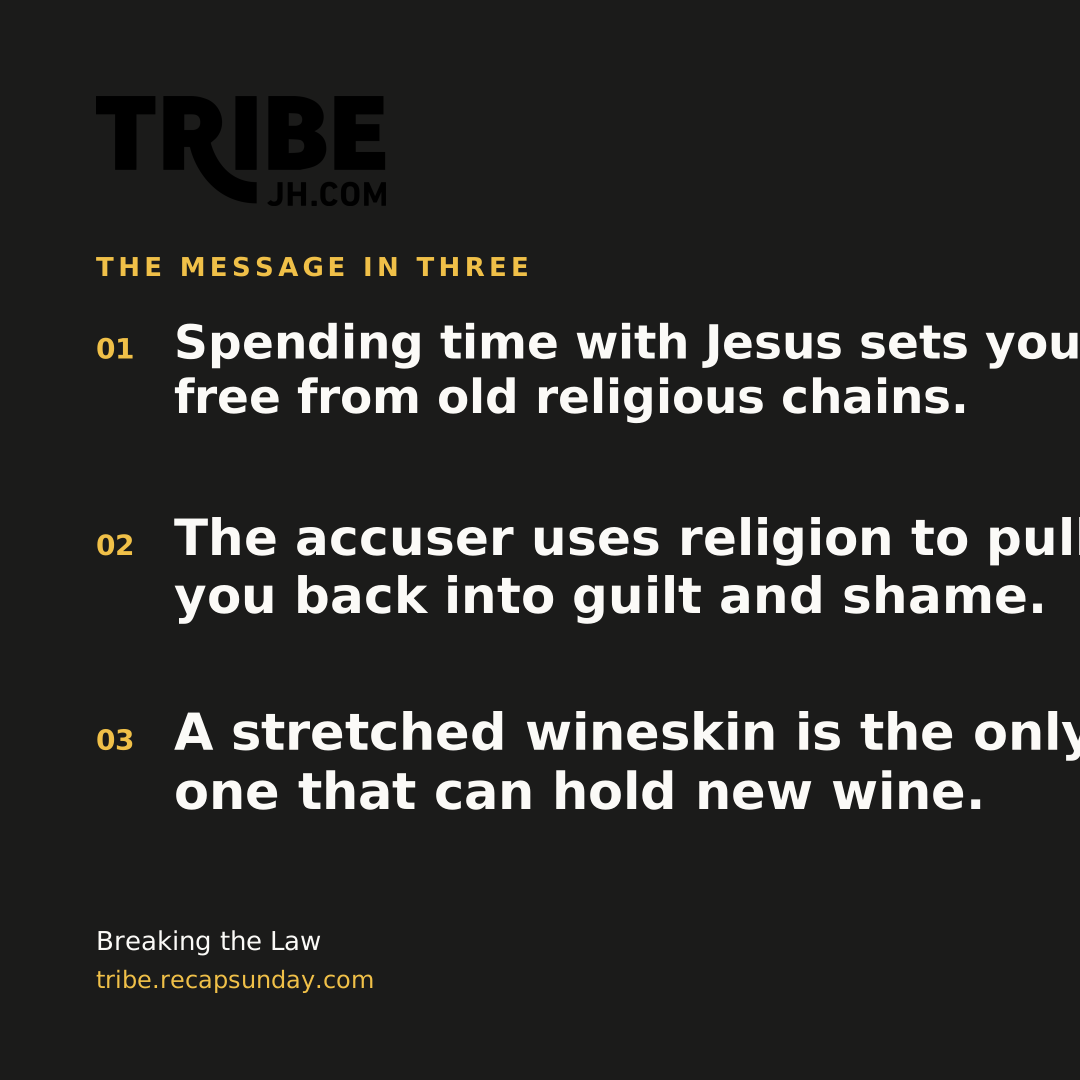
Brian opened Matthew 12:1-14 and asked the congregation to sit with two linked scenes, Jesus' disciples picking grain on the Sabbath and Jesus healing a man's withered hand in the synagogue, under the title "Breaking the Law." Together the scenes pressed a single point: time spent with Jesus produces freedom, and that freedom will always look like lawbreaking to a religious wineskin that has no room left to stretch.
What was said
Brian started by asking people what they actually pictured when they imagined the disciples walking through the grain field. Responses pulled in different directions. One person saw a foreshadowing of communion, the wheat connecting to Jesus' body. Another saw ordinary people just trying to eat, set upon by the religious establishment the moment they relaxed. A third noticed that the disciples, good Jewish men all, would have grown up thinking exactly the way the Pharisees thought, which made Jesus leading them through the field and apparently going first all the more striking. Brian tied that to an Old Testament provision requiring farmers to leave the edges of their fields unharvested so that the poor could glean with dignity, pointing out that the disciples eating grain like that were not living comfortably.
Brian then moved to the second scene, where Jesus does not wait for another day or another town. He walks straight into the Pharisees' own synagogue, finds a man with a withered hand, and heals him while he is still in the middle of answering his accusers. Brian noted the style of it: Jesus addresses the Pharisees, the miracle is already happening, and only when he is done making his point does he tell the man to hold out his hand. Verse 14, where the Pharisees immediately begin plotting to kill him, landed with weight in the room.
Brian connected both scenes to a theme the church has been carrying through the end of last year, the image of new wine and new wineskins. The point Jesus is making, Brian said, is not that rules do not matter but that the Pharisees' wineskin had no capacity left to hold what Jesus was pouring out. Their only move was to insist he conform to the container rather than let the container be remade. A congregant drew a connection to Revelation 12, where the accuser attacks the brothers day and night, and Brian picked that up directly, saying that some people in the room have begun to walk in real freedom and the same accuser shows up to remind them of past failures and drag them back into guilt and shame. That voice, Brian said, is a liar.
Brian then shifted to a practical question: how do you actually grow a new wineskin? He worked through a reading and listening list he said has stretched him more in the last couple of years than in the previous two decades of following Jesus. He named books by Michael Heiser, David Pawson, Art Katz, and Joel Richardson, a teaching series through the FAI app under the Maranatha Global Bible Study, the Blurry Creatures podcast, and two documentary film series from FAI called Sheep Among Wolves and Covenant and Controversy. He was clear that none of these are without bones, and that the Holy Spirit in a person is enough to know when to spit one out.
Brian brought it back to the text to close. The disciples, he said, had some kind of transformative encounter with Jesus that let them walk through a wheat field and not be paralyzed by religious constraint. Two thousand years later the same thing happens. He said he is not particularly moved by how much someone knows about Jesus, but he is drawn to people whose lives have clearly been changed by spending time with him, because that is what he wants for himself. Freedom, he said, is the consistent mark of a person who has actually been with Jesus.
Touch points
Things you could actually do this week.
Pick one book from the list Brian shared, whether Michael Heiser, David Pawson, Art Katz, Joel Richardson, or Jonathan Cahn, and order or download it this week.
Download the FAI app and find the Maranatha Global Bible Study end times series to start working through it.
If you are new to Tribe or new to Jackson, introduce yourself to Connor or Ella this week about the young adult ministry.
Sign up for the Meet the Tribe dinner on January 22 if you are considering calling Tribe home.
Pray specifically this week for the safe return of the remaining hostages, including the infant who had not yet been released.
Doing a Bible study?
Here is a guide we have prepared for you: the passages
in order, questions for the group, and room to write.
Katie talked about worshiping in spirit and truth by letting your spirit connect with God's spirit and standing on the truth of his word regardless of how you feel. What does that actually look like for you on a Sunday morning when you walk in carrying something heavy?
Brian asked everyone to picture the scene in the grain fields and several people shared very different things they noticed, from the disciples being poor and hungry to the heartlessness of the Pharisees. What detail stood out to you, and why do you think that particular thing caught your attention?
Brian comenzó la mañana hablando de dos momentos del capítulo 12 de Mateo: los discípulos recogiendo trigo en sábado y la sanidad de un hombre con la mano paralizada en la sinagoga. En ambos casos, los fariseos acusaron a Jesús de violar la ley, pero él les respondió que la misericordia vale más que el sacrificio, y que él mismo es el Señor del sábado. Lo que Brian quería que viéramos es que pasar tiempo con Jesús nos libera de las cadenas de una religiosidad rígida y vacía, igual que los discípulos aprendieron a caminar en libertad estando cerca de él.
Esa libertad no es licencia para hacer lo que uno quiera, sino una transformación real que se nota en la vida de una persona. Brian dijo que no le impresiona cuánto alguien sabe sobre Jesús, sino si su vida ha sido cambiada por haberlo encontrado. El enemigo usa la culpa y la vergüenza para hacernos creer que no merecemos esa libertad, pero es un mentiroso. La imagen que usó fue la del odre nuevo: así como el vino nuevo necesita un odre nuevo que pueda expandirse, nosotros necesitamos estar dispuestos a que Jesús estire nuestra manera de pensar y de vivir.
Para terminar, Brian compartió una lista de libros, series de enseñanza, películas y podcasts que a él personalmente le han ayudado a crecer y a ver las cosas desde nuevos ángulos. Algunos tratan sobre el tiempo del fin, el papel de Israel en la profecía bíblica, y lo sobrenatural según las Escrituras. Los mencionó como recursos para seguir estirando el odre, no como doctrina definitiva, y animó a la congregación a leerlos con discernimiento, aprovechando lo bueno y dejando lo que no cuadre.
---
Pasajes bíblicos usados
Mateo 12:1-14
Juan 4 (adorar en espíritu y en verdad)
Apocalipsis 12:10-11
Mateo (la parábola de la casa barrida y los siete espíritus)
Mateo (la ofrenda de la viuda)
Read the full transcript10,181 words
Christine Schuler's in the house, everybody. You know how you have one friend who brings all the joy and volume? Let's stand together. We're gonna teach you a new song this morning. Everybody say good morning to Katie.
She's gonna lead us in some worship today and she has anointing and favor of God on her for that this morning. So, Lord Jesus, we come before you this morning and we just ask you today that you would help us to connect really truly, really truly connect with you today. That we would worship you this morning. Like it says in John, that we would worship you this morning in spirit and in truth. Help teach us this morning what that actually looks like.
In Jesus' name, amen. I was thinking about this morning, I woke up and I had this song on repeat because it's new, so I
have to, like, commit it to memory. So it
was just on repeat before I went to bed, repeat this morning, and I just kinda dug in this morning in the word of what does it mean to worship in spirit and truth.
It's kind of a a not a concept that like we use.
Oh, I'm gonna do that, you know, with all my might or I'm gonna do that, you know, in a certain way. But I'm gonna do that in spirit. I'm gonna worship in spirit. And as I was just praying this morning, just felt like the Lord remind us of what else that scripture says. It it says that the Lord is spirit, so we have to worship him in spirit.
That's how we connect with him. Our spirit connects with his spirit. So how do we do that? And how do we connect our spirit this morning in worship? And I think that for me, I just I just say, Lord, I wanna hear your voice today.
I wanna interact with your spirit today. So help me to lay aside my flesh this morning, the distractions because I truly wanna connect with you. My spirit longs longs this morning to connect and talk with you this morning. And to worship you in truth, Lord, it's to stand on the truth of who he is this morning. So regardless of how you feel or what you come in here with, you worship him in the truth of his word, the truth of who he is this morning.
All the promises in his word, that's what you stand on this morning. You stand this morning on the truth that he longs for none to perish but for all to come into the glory. Right? You're you're worshiping him for and standing in the gap for your unbelieving family, for your friends, for people who need healing and you stand on the truth of what his word says, call that to mind while you're worshiping and stand on that. Worship in truth today that he's here.
His word says that wherever two or more are gathered, he's there right in the midst. We worship on that truth this morning. Then as we worship, he's here, guys. He's here. So just let the promises and let your spirit just rise.
And we're gonna worship him in spirit and in truth today. Amen? Alright. Well, we're gonna teach it to you. It goes like this.
The chorus goes, Jesus, we
are here. We're here for you. We've gathered in this place to honor you melody is really simple to worship to worship you in spirit and in truth Oh Jesus, oh Jesus, we are here, we're here for you. Alright, let's try that. Oh Jesus, we are here, we're here for you.
You got it. We're gathered in this place. We're gathered in this place to honor you,
to worship you in spirit
and truth, to worship you in spirit and in truth. Oh, Jesus, we're here. Oh, Jesus, we are here. We're here for you. One more time.
Jesus, we are here. We're here for you. Just let your spirit rise. We've gathered in this place to honor you, to worship you in spirit and truth, to worship you in spirit and in truth. Jesus, we're here.
Oh, we are here. We're here for you. You got it? It's pretty simple
and then there's a couple verses and you know I just need to make this disclaimer. You know it's okay to clap in church. Right? You know it's okay to you know dance a little in church and especially this church because I'm pretty sure a lot of dancing and a lot of clapping do a lot things other than the Lord happens in this building. Right?
So you have permission to worship freely today. Come on. Let's worship him.
Oh Jesus oh Jesus we are here to win for you come on oh we're here for you
Okay. Come on. Put your hands together. Here we go.
In spirit and in truth. Oh, Jesus. Oh, Jesus. We are here. We're here for you.
Oh, Jesus. We are here. We're here for you. You and you alone, we've gathered in this place to honor you. Oh, To worship you in spirit and in truth.
Jesus. We're here for you. You and you alone. We're in this place to honor you. Oh, yeah.
To worship you in spirit and in truth. Oh, Oh, We are here. We're here for you. Say that again, Jesus. Oh, Jesus.
We are here. We're here for you. Oh, to meet with you. We gathered in this place to honor you, you and you alone, to worship you in spirit and in truth. Oh, Jesus.
But Jesus we are here we're here for you in spirit and in truth. Oh, we praise you. Jesus, we are here. We're here for you. Sing Jesus.
Jesus, we are here. We're here for you.
We've gathered in this place. Sing it out.
We've gathered in this place to honor you, to worship in spirit and truth, to worship you in spirit and in truth. Yes, Lord Jesus. Jesus, we are here. We're here for you. Jesus.
Jesus, we are here. We're here for you. It's why we came today. We've gathered in this place to honor you. Oh, to worship, to worship you in spirit and in truth.
Jesus. Oh, we are here. We're here for Here I am to bow down. Here I am to say that you're my God. You're all together lovely, together, all together, honor, fall to me.
Just tell him, here I am. Here I am to worship. All together all together wonderful to me. Oh, you're worthy, worthy.
Just take a minute and just acknowledge how worthy he is.
Of all of our praise and all of our cries of lament too. You're worthy of it. Jesus, come. Come into this room. Come into our hearts.
Come into this valley.
One more time, sing holy. Holy, holy, holy,
Lord, we come today to behold you, to adore you. And one way that we can do that is just by honoring your presence in this place. We adore you. We behold the fact, the fact that you are here today. That your holy spirit is here moving in us and through us and among us.
And Lord, if we could really grab a hold of what that means when we're in your presence, that we're fully known today. We're fully known. There's no hiding. There's no need to, but to just be fully aware of your presence in this place and how that can change us. We adore you today by honoring your word that's gonna be preached today.
Let your word transform us. Let your presence transform us today. Let's take one more minute in this holy place. We have consecrated this place. He has consecrated this place by his presence.
Let's take one more one more moment to just acknowledge your desperate desperate need for him today. Lord, we tell you we need you. You are welcome here. Come have your way in this place today in us, in our conversations, in our hearts, in our spirits today that we would leave here changed. Let us be obedient today to whatever it is that you're speaking to us.
That we would have ears to hear and that we would be obedient to you and you alone. We tell you we love you Jesus. And everybody said, amen. Well, he's here today, y'all. Did you know that?
Yes, Nancy. Yeah. Do you have the microphone?
Say it again.
The trees are buried in snow, but in the spring, gonna pop right back up. And I said that's because of their roots. And what we're doing right now, we're digging our roots in him. Yes. The word is our roots, but when we praise and worship and we get these songs in our head no matter where we are, we're digging our roots deeper in him.
And just like those trees, we can spring back, you know, even when we're down, when we're crushed with snow or whatever. His because of our roots and their depth, we can beat it. We can come above it. And this kind of worship just digs those roots deeper. Mhmm.
So thank you for this worship.
Yes. Thank you, Katie. Will you pray that over us?
Oh, Jesus, thank you so much for bringing each of us here today, God. We're not here by accident, Lord. You wanted each one of us here to hear this word, to fill this worship, Lord, to dig our roots. And we thank you, God, for the opportunity to be here. Don't ever let us take it for granted.
I pray that every person in here, Lord, we all came in with troubles. We all have issues. We all have something, God. But when we leave this place today, God, let us feel that our roots have dug a little bit deeper and that we can we can keep moving forward and keep walking because of you. In Jesus' name, amen.
Amen. Okay. I'm not sure if there's any left, but there were homemade breakfast burritos back there made made with love. So you better raise back there, fill up your coffee, get out your bible, get out your pen, take notes what the holy spirit is sharing with you today, and we're gonna honor the lord by getting in the word together.
Right. You kids settle down, and that goes for you young adults also. Alright. Good to see everybody. Great to see everybody today.
Thank you for the little breakfast burrito bites. So good. Thank you. And thank you, Katie, for leading worship with us this morning. So good.
You all have already said one thing, but looks like you're going again anyways. Alright. Who? Leah standing up. Oh, Leah.
We want Leah to stand up.
Breakfast made
by burritos were made by and she has a food truck called Leah's yummy no.
Down down Leah's?
Oh, yeah. Down Honey. That was close. Thank you, Leah, so much. Okay.
Katie, let's talk really quick. The song that you sang as a tag to Revelation's song about Yahweh, was that something that you had prepared, or did that just come up out of your heart?
This morning, I was singing a revelation song and it just came out. I thought it was just for that moment, but then I remembered it, and I sang it again.
Alright. We can all agree that that needs to be developed into a tribe worship song. Right?
Oh, we're owning it.
Yeah. Copyright. So get together songwriters, and what you sang as a tag is a great chorus to to add some verses and a bridge to and other lyrical terminology too. But alright? Can you develop that?
Let's do it. There there's some oil on that. It's beautiful. Okay. In your seat, there's a connect card.
If you are new or visiting, we'd love to have a record of your visit. If you have some lyrics for a worship song, you can also write those down as well. And that can go in, there's a little box right by the swinging saloon doors. There's opportunity to if you have a prayer request, we take these very seriously. We pray over them on Monday at staff meeting.
And so if you're if there if there's a prayer request or a praise report, that's great. You can write that down. Also, if you consider Tribe Home and you would like to know more about what we're regularly doing, you can sign up for the text blast. We send that out about once a week to let you know various things, happenings, what's going on at Tribe. And then if you are a young adult that is new to either Tribe or new to Jackson, We have a vibrant young adult ministry.
Where is Connor? Connor's right there. Ella is right there. They are Maui, and they help lead tribe young adults. And so they would love to meet you afterwards, and you can just check that box, and we'll make sure to have somebody from our young adult team reach out to you.
Let's see what else do I have. Oh, let's open up our Bibles to Matthew chapter 12. And while we are waiting for that page to load, we got a whole lot more room on our phones because we've all deleted TikTok because it's just, like, not there anymore. I tried opening the app, like, five times.
Never had it.
I know. This is much better human than me. Never went there. But for the rest of you degenerates, I literally tried opening TikTok five times thinking, like, well, maybe this time. Well, maybe this.
And I'm like, what the heck? We'll see. What chapter is Matthew? Matthew chapter 12. Sorry.
I miss you, my Chinese spy. What what more data do you want to just give me TikTok back? Please. Big things happening this week. We have an inauguration tomorrow.
Please, please be praying for safety over the inauguration. Lots of people traveling from around the world and all over the country to Washington DC for big historic event, the peaceful transition of power that happens according to our democracy. But please be praying for peace and safety over all of the different things that are going to happen this week. Also, we're getting more and more reports of onesies, twosies, and small groups of hostages being released and reunited with family. We call God, God.
His only begotten son is Jesus. We call him Lord. We call him Lord Jesus. We call him God. In a conversational, reverent term that Jewish people use, they call him Hashem.
So thank you, Hashem. Thank you, Hashem, for your steadfast faithfulness. Thank you, Lord, that you call the stars forth by name, and they sing your praises. You place each one of the stars in the galaxy and in the universe, And you know when even a sparrow falls to the ground. From the macro down to the micro, the location and the condition of every single hostage is known to you, and you know them intimately.
Great Hashem, we ask that you would be with them, that they would feel a tangible measure of your presence as their release is being orchestrated. We ask that nothing would interrupt the safe return of the hostages reunited with husbands and wives. There is a, at the time of their abduction, a nine month old baby. We ask for the safe has that baby been returned yet? Do we know?
Not yet. We ask for the safe return of that infant to be reunited into their mom and dad's arms. Father, hostages that have lost their lives, that, families and loved ones that don't yet have closure. God, we ask for a dignified return of their remains so that that family can have closure and begin to grieve and heal. And, Lord, we ask for your healing over the entire land.
One of the great prophecies of the returning Messiah is the renewal of all things. Will you set wrong things right? Will a wave of justice and mercy flow through that land? Heal the scars. Heal the wounds that have been inflicted.
We thank you, Jesus. Everybody said, amen. Matthew chapter 12. And could I have somebody please read? You don't have to read all of it, but we're going to go from verses one through 14.
And if you would take a few verses and then pass it on, and we'll let somebody else read a few more verses. We have a mic in the room. The mic is so that we can hear you in the room and also so that, all of our families that are traveling and out of town can tune in and watch the livestream. And we also, if you haven't picked up on this yet, I really want this to be a conversation where you interrupt me once you raise your hand, as you've done. And you can contribute as many times as you want, and you don't have to say, I've got just one thing to say real quick.
You can say more than one thing. It's you're allowed, Nancy, especially if you keep bringing such yummy breakfast for us. Listen to her. She's just yammering away at me. I didn't hear it, but she doesn't have the mic right now.
But if you have if you have questions, if you have comments, if you have connections, like, if you if you just raise your hand, we wanna get the mic to you so that we can have a collaborative effort of digging into God's word together. Okay? So with that in mind, are you gonna kick us off and read a little bit? Thank you. My first time here.
Okay. Not your first time here. Reading. Reading. Oh, it's your first time reading?
Here.
Oh my gosh. No pressure.
Matthew 12. Here. This is from the NIV. At that time, Jesus went through the grain fields on the Sabbath. His disciples were hungry and began to pick some heads of grain and eat them.
When the Pharisees saw this, they said to him, look, your disciples are doing what is unlawful on the Sabbath. He answered, haven't you read what David did when he and his companions were hungry? He entered the house of God, and he and his companions ate the consecrated bread, which was not lawful for them to do, but only for the priests. Haven't or haven't you read in the law that on the Sabbath, the priests in the temple desecrate the day And yet, are innocent? I tell you that one greater than the temple is here.
If you had known what these words mean, I desire mercy, not sacrifice, you would not have condemned the innocent, for the son of man is Lord of the Sabbath.
If you're taking notes this morning, you can write the, at the top of your notes the title of our conversation this morning called Breaking the Law. I'm sorry, what? Oh, yeah. Oh, we didn't get to fourteen? Oh, yeah.
Let's keep going. Sorry. Sorry. Sorry. Yeah.
Sorry. Keep going. But if you want to write the title of the conversation in the middle of us reading, that's the title of our conversation this morning. Let's keep reading. Thank you.
I read nine through 14.
Alright. I'm
reading from the New
King James
Version. So now when he had departed from there, he went into the synagogue. And behold, there was a man who had a withered hand. And they asked him saying, is it lawful to heal on the Sabbath that they might accuse him? Then he said to them, what man is there among you who has one sheep?
And if it falls into a pit on the Sabbath, will not lay hold of it and lift it out? Of how much more value is a man than a sheep? Therefore, it is lawful to do good on the Sabbath. Then he said to the men, stretch out your hand. And he stretched it out, and it was restored as whole as the other.
Then the Pharisees went out and plotted against him how they might destroy him.
Wow. Verse 14, plot twist. So there's a lot to unpack in these few verses to get the most out of what Jesus is driving at and what the biographer Matthew wants to highlight to us. But let's set the let's set the scene. There are two major events that are happening.
The first one unfolds in the midst of a wheat field. The second event unfolds right in the midst of the synagogue. And the connection between the two different events, we can already begin to like make some connections, put the pieces of the puzzle together. But when we look at these two events together, it helps to drive home the point and the very important principle that Jesus is making here. So let's dive into the first event, the disciples in the grain field.
This is the first opportunity for me to check-in with you and ask you, as you see the words on the page, the story unfolding in front of you with Jesus walking through the grain fields and his disciples picking some of the grain, rubbing it in their hands, separating the wheat from the chaff, and then throwing the kernels of ripe wheat into their mouth to chew on as a snack, I would love to hear from you. How do you picture this scene unfolding in your mind's eye? What elements of this story does your imagination focus on? What picture do you paint? I'd love to hear what's in your imagination about these events.
I picture it they're walking through the fields, I picture it as a foretelling, almost like a prophecy. So the wheat field is like the harvest. Right? And they're walking with Jesus through the harvest. And it's also prophesying.
They're they're eating the the wheat, basically. And it's like, is my bread. Do this in remembrance of me. It's a it's a foretelling of what he's he's actually going to do. It's a beautiful thing because his body is healing, and I don't know.
That's how I picture it.
Wow. So as you read this story, your mind is making all kind of hyperlinks to the prophecy of Jesus. The the harvest the fields are ripe for the harvest, but the workers are few. And the eating of the grain is eating and partaking of his body. Okay, so you're thinking of hyperlinks as you look at this.
I love it. I love it. What are some other maybe just little details that you see in your mind's eye as you read this passage?
Well, the first time that we read it, I let's just pretend a godspell moment Okay. As far as they're all walking through the fields eating kind of like friends in passing. Right? And then they're automatically judged by the Pharisees. So that's, you know, we're just minding our own, and then, you know, then you're targeted.
Yeah. So so what you see is these guys are just trying to live their life, and here come these Karens. No offense, Karens. Okay? Okay?
I like it. How about some other maybe details in just your imagination? Here's why we're we're why we're doing this particular exercise. The more you can activate your holy sanctified imagination and picture picture the scene, the more of a canvas you create for the Holy Spirit to take his brush and fill in details and picture, like whether it's hyperlinks or things that you're you're seeing in the text. And so here at Tribe, you know this about me, I always want you to use your imagination.
Not to develop doctrine, because that's a great way to, like, end up in a cult, but to fill in and to help you make the story come alive and engage with it. Yes. Janet, here comes the mic.
Thank you.
I see it just a picture of peace, of of Jesus with his disciples, and they're walking through this wheat field. And he's sharing. He's teaching them, and and they're picking up kernels of of grain. So it's it's feeding them physically, but it's also feeding them spiritually. And I can just see the Pharisees thinking, it shouldn't be that much fun.
It shouldn't be that peaceful. Yes. He shouldn't even be teaching or talking to them. And so I think there was maybe some jealousy.
I can I can maybe see that in the text right behind you?
I don't know this for sure, but I feel like eating that would be gross. Like, I don't think it tastes good. So like because it's like eating grass, you know? Like, wheat is like a grass when you eat it raw. And so my thought is, like, how hungry they must have been to be eating that, like, that that was their snack.
And so then that leads me to the heartlessness of the Pharisees for like, you're hungry. Don't do even this with your fingers to separate the grain to eat it. You know, like, I don't it just speaks to their heartlessness that they don't care enough about the people even if they're starving.
Now, that brings up a great point that I want to draw your attention to regarding an Old Testament law about gleaning wheat from the wheat fields. Does anybody know that law or that accommodation in the law about harvesting? So so Ruth exemplifies that law, but there is a law in the Old Testament given to farmers that says, when you harvest your fields, don't don't be greedy and harvest all the way to the edge of your field. But God instructs farmers to harvest up until not the very edge. And the purpose of not harvesting all the way to the edge is what's the purpose in that?
Leave some for others. Leave some for others. It was God's establishment of, really, a welfare system. Not just free handouts, harvest to the edge of your fields, and then you gotta go give to somebody what that hasn't worked at all. There needs to be some effort demonstrated by those in need, but they are allowed there's a provision in the law that allows for them to have some dignity of work and gain some food to fill their bellies by going around and harvesting the edge of the fields.
And if you own a business, it's a great example of setting a precedent for being generous in your business. As long as the product or goods or services that is coming from your business is better or equal value to what you're charging, that business is going to prosper and flourish because you're not being so greedy to wring every last cent out. And when we see the disciples walking through their grain fields and they're rubbing the if the grain is ripe, what happens? What needs to happen? You gotta harvest it.
You gotta harvest it really quick so that it can dry out, and then you go through all of the the process of it. So the fact that they were walking through grain fields and getting picking some of the heads of wheat tells us exactly what you're thinking. Jesus' ministry team wasn't, like, rolling it down. They weren't, like like, living it up in the lap of luxury. They were hungry.
They were harvesting grain like poor people. And here and then here come the Karens. Anything else that you you see in that, and we're gonna we're gonna talk, about this, and then we're gonna go to the next story and then tie them both together. Liz? Oh, oh, over here.
I mean, each of the disciples would have been, like, good Jewish men, so they would have probably, before they met Jesus, been in line with how the pharisees would have thought about it. So I love the detail where it's like Jesus led them through the grain field because Jesus knew they were hungry. And I kind of like imagine Jesus picking it first and being, like, it's totally okay to do this, like, paving the way. And it kinda, like, reminds me of how, like, we'll learn we'll learn things or, like, new wineskins harkening back to the previous series. And then the world just kind of tries to be like, actually, no.
Or, like, legalism tries to be like, actually, no. You have to go back. And Jesus is like, no. Just take, eat, and enjoy.
Woah. What if the re the historical reality of that scene included the disciples watching with wide eyed amazement at Jesus walking along the path, probably not, like, through the, like, the midst of the field, like a scene from Interstellar, but they're walking along the path and there's, you know, within easy reach grain. Imagine the disciples wide eyed watching Jesus just sweep through, scoop up, and then he does it. And the disciples are like, you crazy, but I'm hungry. And look at this.
It is not in the text, but that and then the pharisees, they don't have the guts to call out Jesus, but they'll pick on his disciples. Wow. Fascinating. Then we see Jesus. He's like, we're gonna do this?
Really? You're gonna you're gonna call out my crew? They're hungry. Alright. You started this, and then he marches right to the synagogue.
And then in the synagogue, there is a man with a withered, a paralyzed, a deformed, an injured hand. And if his rebuke in verses three through eight were not enough, look in verse nine. Then Jesus went over to their synagogue. Dude, he is like the Jesus if if you only have an image of Jesus as, like, the good shepherd bouncing the little children on his knees and being sweet and meek and mild, you're you're missing out on the on
a
fuller, more robust picture of Jesus. That dude loved a good fight. He goes over to their synagogue, not a synagogue, not next week, not in the next town. Verse 10, where he noticed a man with a deformed hand. The Pharisees asked Jesus, does the law permit a person to work by healing on the Sabbath?
Now they're trying to set him up. He steps right in the bear trap, and he's like, oh, you're catch it with his hands. They were hoping he would say yes so they could bring charges against him. And then he answered, if you had a sheep that fell into a well on the Sabbath, wouldn't you work to pull it out? It's a rhetorical question because the obvious answer is yes.
Of course you would. And how much more valuable is a person than a sheep? Yes. The law permits a person to do good on the Sabbath. Then he said to the man, I love his I love his flare.
The miracle was happening in the midst of while Jesus was talking. The disciples are like eyes locked on Jesus, like trying to trap him with every word. And he's so slick. His style his style is just so awesome. Because the miracle was happening while he's like, he's looking at the pharisees talking to them, but the miracle is happening to this guy.
So that by the time he's done setting the the pharisees in their place, he's like, oh, yeah. And by the way, dude, show us your hand. Bam. Healed.
It's like boss.
It's like undercover boss. Well, give her the mic because I need you to connect the dots for me. I think I know where you're going with this, but just tell me.
Yeah. I don't know. I just picture, like, they're, you know, they're they're walking, and they grab some grain, and the Pharisee's like, like, you know, you were breaking the law. And literally, he's the fulfillment of the law.
Okay. Yes. Okay. Yes. Yes.
Like, undercover boss. You know, they're like, you can't do that. The boss says we can't. And he's like
Yeah.
I am the boss.
I am the boss. I am the boss. Okay. I love it.
I love the temple.
I love it. Mhmm. So the man held out his hand, and it was restored just like the other one. Now, you know, on, like, Mad Libs where you can, like, fill in words and it makes a funny story? Imagine a modified bible Mad Lib where you could fill in verse 14.
And the Pharisees were filled with wonder and amazement. And the Pharisees repented of their critical attitude. And the pharisees dropped to their knees and praised God. And the pharisees with wonder examined the man's hand. But the Bible's already written.
And then the Pharisees called a meeting to plot how to kill Jesus. This conversation that we're having this morning is related to a theme, a topic that we have been on for for most of the end of the fall, and it has to do with new wine and a new wineskin. And if you are new to God's stuff, if you're new to church, that sounds so churchy and unfamiliar. New wine and new wineskin. But the Bible talks about the new thing that God is doing in in a metaphor like a new wine.
The new thing that God is doing is like new wine that he's pouring out. And containers in those days for wine was wineskins so that they would they would process the grapes, add the ingredients, put it into a new wineskin, and as it fermented, the wineskin would expand. And as the wineskin expanded and and time went on, the wine fermented the the grape fermented, it turned into wine, then you could uncork it, you could drink the new wine. But every new batch of wine required a new Wineskin. Wineskin because once the wineskin stretched and expanded, it couldn't contract and go back.
And if you were to try to fill an old wineskin with new wine as the wine fermented, the wineskin was stretched beyond the bounds that it could hold. The wineskin would split, and then you would lose what? The new wine and the old wineskin. So Jesus talked a lot about that as a metaphor for our capacity, our ability to adapt, to grab ahold of, to be transformed by new things that he is doing in our life in new places that he wants to take us. And just in case there are any Pharisees in the room, I'm not talking about new in terms of extra biblical.
Okay? So get over it. These two stories hold a powerful principle. There was something about and, I I think you were you were onto it. There's something transformative and powerful that happens when we spend time with Jesus.
I'm not talking about religious dogma, trying to be a good person. But we spend time with him, he'll challenge us. He will stretch our wineskin. But there is liberation, and there is freedom always is associated with spending time with Jesus. I wrote this down, and you can write it down too.
Being with Jesus sets us free from constraints of an old religious wineskin. Being with Jesus sets us free from the constraints of an old religious wineskin. As evidenced by what we saw the disciples doing, walking along. They were good Jews. They knew that to even touch ahead of that wheat would be breaking the religious law.
Don't do any work on the Sabbath. Keep it holy. And, certainly, don't do any farming. Don't do any harvesting as if they were out there, like like, really working. The disciples the Pharisees did not have the flexibility in their wineskin to contain the new wine of freedom of the example that Jesus was setting, resulting in, well, we're not gonna change.
He needs to change. Let's figure out a way that we can unalive him. Did I see your hand up, or were you just absorbing?
No, it just reminds me
so much. Here comes a Mike Brad over your left shoulder.
Now while you're talking, just remind me a lot of Revelation, twelve ten eleven because Satan accuses through religion and is he hasn't changed. And I'll just read two verses of that for me. Then I heard a loud voice saying in heaven, now salvation and strength and the kingdom of our God and the power of his Christ have come. For the accuser of our brethren who accused them before our God day and night has been cast down. And they overcame him by the blood of the lamb and by the word of their testimony.
And they did not love their lives to the death. You know, and it's just so cool because Jesus came to provide mercy, to seek these people out, to deliver. And all Satan wants to do is accuse and create division and put down. So it's just so awesome because we have so much access because who Christ is.
That's it. Can I have that mic? I gotta preach for a second. That's good. That's good.
Oh, that's so good. So listen. Listen. Listen. Some of you have spent just enough time around Jesus that you are beginning to experience freedom in your life.
And in freedom, you're you're gonna have to fill in the blanks on this, but in freedom, you have reached out to grab a hold of some sheaves of wheat, but that accuser has says, what are you doing? And tries to bring you back into bondage of guilt and shame and spit ups. And it is the accuser of the brethren. It is that dirty devil that would try to tell you, how dare you take a step into freedom. No.
No. No. No. No. Who do you think you are?
And then he reminds you of how you've messed up and how you've blown it, and and he tries to get you to agree with him that you really aren't worthy to be able to walk along and and walk in freedom of being able to harvest some grain, roll the wheat in your fingers to separate the wheat from the chaff, and throw back a little snack. That dirty devil, he is a liar. He's a liar. So we're gonna take just a few moments. I have to hold my breath as I go from one mic to another.
Expanding our wineskin, stretching our wineskin. I want to share with you, you can maybe if you have a really fast pen, you can, write these down. Maybe you want to take a picture of them. Some of these already could be incorporated into your library and built into your life. But over the last couple of years, I really feel like the Lord has been challenging me and stretching my wineskin unlike he has done in twenty plus years of of walking with him.
And I just wanna take a few moments to share with you some of the things that have stretched my wineskin to help make room and adapt to the new things that the Lord is what I what I know he's doing in my life and what I believe he has is doing at Tribe and around the world. And so these are some of Brian's like top wineskin stretchers. And these are some of the ways that you can help develop and grow a new wineskin. So I have most of them are books, but then a couple of film teaching series and podcasts. Let me start with the books.
And just like with anything, a couple of disclaimers. Number one, with any of these authors, any of these books, you've got to eat the meat and spit out the bones. There's gonna be bones in every single book or thing that you watch or listen to. But you have the Holy Spirit living inside of you. He'll tell you, oh, a little bit of a bone.
Don't choke on it. Just spit it out and get the most out of the meat. I would not serve you anything that was more bones than meat. Okay? Let's start with the books, Trinity.
Here are some books. These are three books by one of my favorite authors, Michael Heiser, The Unseen Realm, Supernatural, and Reversing Hermann. And I won't go into a big description of all these, because there's a good number of books to get through. Supernatural is a Reader's Digest version of a bigger volume of the unseen realm. And reversing Hermann, talks a lot about, perhaps some of either the prehistory or history that is happening in the book of Genesis that Genesis doesn't focus too much on but just touches on.
But Michael Heiser is a great scholar and super wise, and he's really dry but very engaging, if you can have both of those at the same time. Now everybody's spiritual teacher granddad would be this next author. His name is David Pawson, and a lot of books. These are three of my top wineskin stretchers. When Jesus Returns, David Pawson takes several different options for how and when and the manner in which he returns.
He presents several different options and then says, here's what I believe lines closest with Scripture. His walk through the book of Revelation is is thoughtful and insightful and inspired. And if you really just want to, like, stretch your wineskin, you jump into this short book, Once Saved, Always Saved, question mark? Like, that'll really twist your religious undies into a bunch. So we have Michael Heiser.
We have David Pawson. The next author is a Brooklyn Jew who got saved. His name is Art Katz. Have any of you well, let me ask this. How many of you have heard of Michael Heiser?
Yes. How many of you have heard of David Pawson? Okay. Art Katz? Oh, yeah.
Right. Yeah. I was like, what? Okay. Yeah.
Alright. Yeah. I get it. I gave him that book. Have you got a chance to start it?
Is it challenging? Yeah. It'll stretch your mind, skin. So it's called the final mystery. So Art Katz is, he grew up Jewish and then, turned his back on the Lord, lived like a very, very, very rowdy crook.
There's a line from an old cross movement rap song that said, whoever thought that the cross would look good, whoever thought that Whoever thought that a lost crook would get brought to the point where the cross looked good? There it is. Whoever thought that a lost crook would get brought to the point where the cross looked good? That's Art Katz. He got saved, and this particular book speaks of the role of Israel in the generation of the Lord's return and Israel's role in the coming messiah and the millennial reign of the messiah, and every sentence just drips with with sorry to use a churchy phrase, just the anointing of God on it.
And it's challenging, and it's good. So Art Cats. There's another slightly disreputable author that I want to put up here on the screen next. His books are really good. His jokes are really bad.
He's written a lot of books. I think each one of these is a New York Times bestseller, incredibly. When a Jew Rules the World. Sinai so When a Jew Rules the World talks about the millennial reign of Jesus from Jerusalem. Sinai to Zion talks about a bunch of Old Testament prophecies, and he paints a beautiful picture that the return of Jesus will look much like the coming of the Lord on Mount Sinai and how in glorious triumphal procession leading the Idea forces that there will be a procession from Sinai rescuing Israeli refugees and then bringing them into triumphal procession into Jerusalem, liberating Jerusalem, and establishing his his kingdom there.
The book is amazing. And then the last one, the Islam Islamic Antichrist. If you grew up on the Left Behind series like like I did, how many of you just devoured the Left Behind series books? Yep. Yep.
Oh, yeah. It was all about those. What was the name of the of the Eastern European Antichrist? Nicolai So so Timothy LaHaye portrays the Antichrist as a resurrected Roman empire. And, in his popular series where the rapture happens before the tribulation, this antichrist figure, Nicolai Carpathia, rises up.
That is not the direction that Joel Richardson goes. He suggests, using a lot of academic research and study and historical records and biblical references, that the Antichrist could be a revived Ottoman Muslim empire. Read that book. Stretch your wineskin. Okay.
Another author. This is the only book that I've read from him. I don't know what you think of this author in general, and I can't vouch for his entire ministry. But I read this book, and boy, did it stretch my wineskin. Come on, Trinity.
Next one. The oh, do I not have do I not have a book by Jonathan Cahn on no? The book the book by Jonathan Cahn is called Return of the Gods. I didn't put that in there. Is there a slide with it?
Alright. I'm not too big to apologize, but I'll tell you after church. So one more book. It's by an author called Jonathan Cahn, and the name of the book is called Return of the Gods. And we were talking about this with Leo and Darcy maybe last year or so.
Right? And I usually like to some books I like to have like the paper, the book book, and then I underline and go back and reference it. Return of the Gods, I just crushed on audiobook while I was on the skin track last winter. And and it's it is fascinating. It speaks his whole premise is, from a parable that Jesus tells in Matthew about when the house is swept clean, the demons go out and wander around in dry places.
When they find no place to land, they come back. They find the house swept clean. They go get seven of their friends, move into the house, and the condition of that nation is worse than the start and that our nation was established on biblical principles and values. And then throughout our history, we've pushed God out of the nation, inviting in iniquity embodied by these territorial spirits that Israel dealt with in the Bible that we are seeing reemerge in our day and age. It is it's a very interesting, fascinating read.
It's a good one. Okay. Let's keep going. Films. You've heard me talk about this organization and these films a lot.
What's the next one, Trinity? Oh yeah, teaching series. Okay, teaching series. So if you I didn't have time to put up a bunch of slides, but just listen to me now, believe me later. If you go to the App Store, unlike TikTok, this app is still available.
And if you download the FAI app, FAI Frontier Alliance International app, There it is there's so many resources. It's so much teaching on this one app. But if you go to the teaching and if you go to the Maranatha Global Bible Study, and then from there, you can go to the end times study, and it is such a wineskin stretcher. That would be a teaching series. What do I have next, Trinity?
Okay. Podcasts. How many of you are familiar with this podcast? Blurry creatures. How many of you are familiar with it, but you're like, I don't know if I want to admit that quite yet?
Yep. There was one head. Yep. I hear you. I hear you.
So if you go to the next slide about that podcast trinity, that's how it looks, and you can find it. That will really stretch your wineskin. Eat the meat. Spit out the bones. But the idea behind this podcast, it's two Christian guys that started, like, talking about Bigfoot.
And, like, what's the deal with Bigfoot? And they published these podcasts about their conversations about Bigfoot, and it grew and it expanded. They've had Doctor. Michael Heiser on there. They talk about a lot of wild topics.
But this is the only podcast like this that I would recommend to you because at the end of the day, I trust these two guys and where they're going. They don't get off They go into the weeds, but they don't get too far off base. And it's always whether they're the people that they interview Not all of the people that they interview are Christians. But those two men have a very solid faith in Jesus, and I trust their relationship with Jesus. I trust where they go with the conversations, and I trust them enough to be able to share it with you.
But they will stretch your wineskins, talking about firsthand eyewitness accounts of, like, alien craft retrievals, supernatural encounters, the supernatural realm, angels. Nephilim. Nephilim. She's in it. It's in the bible.
Did I have anything else, Trinity? No? Okay. How did this slide not make it in here? But film, it's not on there.
This is the last thing I was going to say. There are a couple of films that you can check out to watch and to to help further stretch your wineskin. This is related to FAI, Frontier Alliance International. The first documentary film series is called Sheep Among Wolves, and it is about the rapidly growing underground church in Iran that's being led not by people like me, but by women, untrained in seminary, no Bible degrees, but just have encountered Jesus, tasted the goodness of the wheat that comes from a relationship with him, and are leading the, the fastest growing church movement in the world. So the film series is called Sheep Among Wolves.
The Last Wineskin Stretcher is another documentary film series by the same people, FAI, and it's called Covenant and Controversy. Covenant and Controversy. And it speaks of of the people, the land, the city of the great king, and God's covenant love, and how we, as a global Christian community, fit into that picture. So those are some wineskin stretchers. I am happy to have coffee with any of you to discuss these.
Once you read the book, once you watch one of those teaching series, if you have questions, if you want to lock horns about them, I'm happy to do that. I know that that's how some of you learn and really grab a hold of the material is by arguing it. That's great. I'm happy to listen to and we can have a dialogue about any of those things. And I wanted to give you a bunch of those things so that maybe just one of those resources would resonate with you and you would follow-up with it.
Okay? Let's we're going to land the plane soon here. I'd like to invite the worship team to come up. And then I want to tie these wine skin stretching things with the conversation that we're having about Jesus in the wheat field. You can see the disciples have a whole new wineskin that allows them to receive the new wine that Jesus is pouring out of freedom.
They had some type of transformative encounter with Jesus that allowed them to walk through the wheat fields and not be confined or constrained by those by the religious dogma of the day. And two thousand years later, he's still doing the same thing. When we meet with him, when we spend time with him, when we encounter him, we cannot help but to be set free. That's really the mark of a person that has spent time with Jesus. Their life is different.
You can tell me all until you're blue in the face, all kinds of things that you that you think would impress me that you know about Jesus. And and it's really not gonna have much effect on me. I I really don't care how much you know about Jesus. But when I see evidence that you've spent time with Jesus resulting in a transformed life, that gets my attention. That's like for me personally, that's what I'm attracted to.
I love being around people that have spent time with Jesus. Their life has been transformed, and they have been set free because I want that. Jesus set us free and help us to live a life that demonstrates the freedom that we can experience being released from entrenched old religious dogma. We just wanna meet with you. The rest of the world was will say we're breaking the law, but we know that as we follow you, we're walking in freedom.
Set us free from our chains, and help us, Jesus, to actually walk out a transformed life. Help us.
Let's just sing that.
Help us, Lord. Help us. That's what we want, Jesus. Open your heart.
Let's stand together.
Thank you, Lord. Let's stay standing as we worship the Lord one one more way just before we leave here, and I'm gonna ask Ella to come forward with the mic. And would you hand the mic to Amanda? She's gonna lead us in just one more way of worshiping the Lord while we're standing, and then we'll scoot out of here.
As we just stay in
this attitude of worship just a moment longer. So we have, worshiped him by honoring his word, by singing to him, by our heart posture towards him. And corporately, we're together as a local church called tribe, we worship him with our offering and tithe. That's some hard earned money that we make, and we give it to him because money, no matter what you think of it, the bible is clear that it can be something that grips your heart, and that is regardless of how much or little you have. And so because God knows that, he asks us to give a portion of that to him as an offering to him to say, I love you and I trust you, and you're more important than the importance of what I think I need with this money.
And so it goes to do the work of the ministry to your local church, and that's what it is practically. But, really, it's a heart posture of praise and of thanks. And you just say, Lord, what do you want me to give? Only you know what would grip my heart. What do you want me to give today?
And so practically speaking here at Tribe, you can give on our website, tribejh.com. We don't pass buckets. There's a little, wooden box by the saloon doors with our logo on it if you have cash or check. That's also the place you wanna put those connect cards. But other than that, our, smartphone is the best and easiest way to give, and that way you just start a number to 84321.
You can see the instruction on your screen, And you just type in the amount you wanna give. But let this be such a personal thing between you and the Lord. Don't do it to appease Brian. Don't do it to appease tribe or anything. That is just between you and the Lord.
Jesus was telling his disciples they were in the temple in the New Testament, in the gospels, and he says, look at these pharisees. They were coming by, they were dumping gold into the into their swinging saloon door little box, dumping in gold, making sure it was clinking. You can read this in the New Testament. Making sure everyone saw and heard, look. We're giving.
Look. We're giving. And it was money. It was valuable. They probably, you know, bought new stuff for with it.
But then one little woman comes by, and she gives two mites, which I think is less than a penny. And Jesus tells his disciples, and this is for us to pay attention to, he says, that woman just gave more than all of the pharisees combined. And that really, really blew their mind as it should. And what that tells me, and that's what we believe at Tribe, is that it's a heart posture between you and God. This is just a local avenue, a local channel, but it's between you and the Lord, and it's an it's a way to worship him and a way to sacrifice to him.
So with that in mind, let's pray. Heavenly father, thank you so much for who you are. Thank you for your faithfulness. You do not fail us no matter what circumstances say, no matter what the world says. God, you and you alone are our most faithful.
You never change. The Bible says you're the same yesterday, today, and forever. You've always been faithful. So, Lord, as we bring a portion of our tithe and our offering, whether it's now or later, when we give that, Lord, let it just be a special moment between us and you. Yes.
Practically, it goes to do the work of our local ministry and beyond to the ends of the earth as we say. But spiritually, it's an act of worship between us and you, and what an honor it is to give. We thank you for it. Thank you for all the tithes and the offerings, Lord, that it will be stewarded well, and every single penny will go to do the work of the ministry in the exact way that you would have us do it. We thank you for everyone here today and for our hearts as they turn to you in this one act of worship among others.
In Jesus' name, amen. Amen.
The
main announcement that we have just before you get out of here is, on this table over here, we have some good old fashioned paper sign up sheets. If you consider tribe home and you wanna contribute to this family, there are ways that you can serve. We have prayer team, hospitality team, tribe kids.
And then meet the tribe dinner this week.
Oh, and then meet the tribe dinner this week. If you call tribe home, this is a great way for you to get introduced to us, for us to get introduced to you. January 22. Second, we're having a meet the tribe dinner. And so I'd love for you to sign up.
If you're new to Tribe and wanna call Tribe home, we talk all about the history of the church, our testimony. We get into the nitty gritty of, like, the governance of the church. You can ask any questions about the church. There's nothing off limits, and it's a great way to get engaged and, like, make that commitment to calling tribe home because we don't do membership here. The last thing is this, Matt and Renee, would you raise your hands?
And then the wolves, would you please raise your hands? Lanisha, who leads our prayer team ministry, have asked if they would stick around and be available for you after service. If there's anything that you need prayer for, they would love to pray for you. So just make your way over to them, and they would love to pray for you. Can I pray for you really quickly?
Yes.
Lord Jesus, thank you so much for today. Thank you for freedom's sake that you set us free. Jesus, thank you that you love us so much not to leave us where we are, but you continually challenge us inviting us contrary to what people would believe to break the law, to break the law of religious dogma that has no place with freedom. We break the chains of what the enemy would try to put on us, guilt and shame and and reminding us of our past, and we grab a hold of the wonderful beautiful wine stretching future that we have for you. I command a blessing over each and every member of our tribe family here today.
Jesus, we tell you that we love you, and thank you for bringing the hostages home. We pray these things in Jesus name, the strong son of God. And everybody said, amen. I love you so very much. Have a great week, and remember, you got this.