1 Blessed is the man who doesn’t walk in the counsel of the wicked, nor stand on the path of sinners, nor sit in the seat of scoffers;
2 but his delight is in Yahweh’s law. On his law he meditates day and night.
3 He will be like a tree planted by the streams of water, that produces its fruit in its season, whose leaf also does not wither. Whatever he does shall prosper.
4 The wicked are not so, but are like the chaff which the wind drives away.
5 Therefore the wicked shall not stand in the judgment, nor sinners in the congregation of the righteous.
6 For Yahweh knows the way of the righteous, but the way of the wicked shall perish.
1 Why do the nations rage, and the peoples plot a vain thing?
2 The kings of the earth take a stand, and the rulers take counsel together, against Yahweh, and against his Anointed, saying,
3 “Let’s break their bonds apart, and cast their cords from us.”
4 He who sits in the heavens will laugh. The Lord will have them in derision.
5 Then he will speak to them in his anger, and terrify them in his wrath:
6 “Yet I have set my King on my holy hill of Zion.”
7 I will tell of the decree. Yahweh said to me, “You are my son. Today I have become your father.
8 Ask of me, and I will give the nations for your inheritance, the uttermost parts of the earth for your possession.
9 You shall break them with a rod of iron. You shall dash them in pieces like a potter’s vessel.”
10 Now therefore be wise, you kings. Be instructed, you judges of the earth.
11 Serve Yahweh with fear, and rejoice with trembling.
12 Give sincere homage to the Son, lest he be angry, and you perish on the way, for his wrath will soon be kindled. Blessed are all those who take refuge in him.
read as God's first promise of an offspring who will bruise the serpent's head
15 I will put hostility between you and the woman, and between your offspring and her offspring. He will bruise your head, and you will bruise his heel.”
read to show God calling Abram and promising to make him a great nation
1 Now Yahweh said to Abram, “Leave your country, and your relatives, and your father’s house, and go to the land that I will show you.
2 I will make of you a great nation. I will bless you and make your name great. You will be a blessing.
3 I will bless those who bless you, and I will curse him who treates you with contempt. All the families of the earth will be blessed through you.”
4 So Abram went, as Yahweh had told him. Lot went with him. Abram was seventy-five years old when he departed from Haran.
5 Abram took Sarai his wife, Lot his brother’s son, all their possessions that they had gathered, and the people whom they had acquired in Haran, and they went to go into the land of Canaan. They entered into the land of Canaan.
read to show God reaffirming his promise to childless Abram and counting his faith as righteousness
1 After these things Yahweh’s word came to Abram in a vision, saying, “Don’t be afraid, Abram. I am your shield, your exceedingly great reward.”
2 Abram said, “Lord Yahweh, what will you give me, since I go childless, and he who will inherit my estate is Eliezer of Damascus?”
3 Abram said, “Behold, to me you have given no children: and, behold, one born in my house is my heir.”
4 Behold, Yahweh’s word came to him, saying, “This man will not be your heir, but he who will come out of your own body will be your heir.”
5 Yahweh brought him outside, and said, “Look now toward the sky, and count the stars, if you are able to count them.” He said to Abram, “So will your offspring be.”
6 He believed in Yahweh, who credited it to him for righteousness.
read to show God promising a son to hundred-year-old Abraham through Sarah
15 God said to Abraham, “As for Sarai your wife, you shall not call her name Sarai, but her name will be Sarah.
16 I will bless her, and moreover I will give you a son by her. Yes, I will bless her, and she will be a mother of nations. Kings of peoples will come from her.”
17 Then Abraham fell on his face, and laughed, and said in his heart, “Will a child be born to him who is one hundred years old? Will Sarah, who is ninety years old, give birth?”
18 Abraham said to God, “Oh that Ishmael might live before you!”
19 God said, “No, but Sarah, your wife, will bear you a son. You shall call his name Isaac. I will establish my covenant with him for an everlasting covenant for his offspring after him.
20 As for Ishmael, I have heard you. Behold, I have blessed him, and will make him fruitful, and will multiply him exceedingly. He will become the father of twelve princes, and I will make him a great nation.
21 But my covenant I establish with Isaac, whom Sarah will bear to you at this set time next year.”
read to reveal God's character and name Yahweh to Moses on Sinai
6 Yahweh passed by before him, and proclaimed, “Yahweh! Yahweh, a merciful and gracious God, slow to anger, and abundant in loving kindness and truth,
7 keeping loving kindness for thousands, forgiving iniquity and disobedience and sin; and who will by no means clear the guilty, visiting the iniquity of the fathers on the children, and on the children’s children, on the third and on the fourth generation.”
8 Moses hurried and bowed his head toward the earth, and worshiped.
read to show God choosing the lowly shepherd boy David over his brothers
6 When they had come, he looked at Eliab, and said, “Surely Yahweh’s anointed is before him.”
7 But Yahweh said to Samuel, “Don’t look on his face, or on the height of his stature, because I have rejected him; for I don’t see as man sees. For man looks at the outward appearance, but Yahweh looks at the heart.”
8 Then Jesse called Abinadab, and made him pass before Samuel. He said, “Yahweh has not chosen this one, either.”
9 Then Jesse made Shammah to pass by. He said, “Yahweh has not chosen this one, either.”
10 Jesse made seven of his sons to pass before Samuel. Samuel said to Jesse, “Yahweh has not chosen these.”
11 Samuel said to Jesse, “Are all your children here?” He said, “There remains yet the youngest. Behold, he is keeping the sheep.” Samuel said to Jesse, “Send and get him, for we will not sit down until he comes here.”
12 He sent, and brought him in. Now he was ruddy, with a handsome face and good appearance. Yahweh said, “Arise! Anoint him, for this is he.”
13 Then Samuel took the horn of oil, and anointed him in the middle of his brothers. Then Yahweh’s Spirit came mightily on David from that day forward. So Samuel rose up and went to Ramah.
read to show God promising David that an offspring will establish an everlasting kingdom
8 Now therefore tell my servant David this, ‘Yahweh of Armies says, “I took you from the sheep pen, from following the sheep, to be prince over my people, over Israel.
9 I have been with you wherever you went, and have cut off all your enemies from before you. I will make you a great name, like the name of the great ones who are in the earth.
10 I will appoint a place for my people Israel, and will plant them, that they may dwell in their own place, and be moved no more. The children of wickedness will not afflict them any more, as at the first,
11 and as from the day that I commanded judges to be over my people Israel. I will cause you to rest from all your enemies. Moreover Yahweh tells you that Yahweh will make you a house.
12 When your days are fulfilled, and you sleep with your fathers, I will set up your offspring after you, who will proceed out of your body, and I will establish his kingdom.
13 He will build a house for my name, and I will establish the throne of his kingdom forever.
14 I will be his father, and he will be my son. If he commits iniquity, I will chasten him with the rod of men, and with the stripes of the children of men;
15 but my loving kindness will not depart from him, as I took it from Saul, whom I put away before you.
16 Your house and your kingdom will be made sure forever before you. Your throne will be established forever.”’”
read as prophecy of a child born whose government and peace will have no end on David's throne
6 For to us a child is born. To us a son is given; and the government will be on his shoulders. His name will be called Wonderful, Counselor, Mighty God, Everlasting Father, Prince of Peace.
7 Of the increase of his government and of peace there shall be no end, on David’s throne, and on his kingdom, to establish it, and to uphold it with justice and with righteousness from that time on, even forever. The zeal of Yahweh of Armies will perform this.
read as prophecy of one like a son of man given an everlasting dominion and kingdom
13 “I saw in the night visions, and behold, there came with the clouds of the sky one like a son of man, and he came even to the ancient of days, and they brought him near before him.
14 Dominion was given him, and glory, and a kingdom, that all the peoples, nations, and languages should serve him. His dominion is an everlasting dominion, which will not pass away, and his kingdom that which will not be destroyed.
read as prophecy that a ruler would come forth from Bethlehem to shepherd Israel
2 But you, Bethlehem Ephrathah, being small among the clans of Judah, out of you one will come out to me that is to be ruler in Israel; whose goings out are from of old, from ancient times.
3 Therefore he will abandon them until the time that she who is in labor gives birth. Then the rest of his brothers will return to the children of Israel.
4 He shall stand, and shall shepherd in the strength of Yahweh, in the majesty of the name of Yahweh his God: and they will live, for then he will be great to the ends of the earth.
5 He will be our peace when Assyria invades our land, and when he marches through our fortresses, then we will raise against him seven shepherds, and eight leaders of men.
read as the account of Jesus' birth from the Holy Spirit and the naming of Emmanuel
18 Now the birth of Jesus Christ was like this: After his mother, Mary, was engaged to Joseph, before they came together, she was found pregnant by the Holy Spirit.
19 Joseph, her husband, being a righteous man, and not willing to make her a public example, intended to put her away secretly.
20 But when he thought about these things, behold, an angel of the Lord appeared to him in a dream, saying, “Joseph, son of David, don’t be afraid to take to yourself Mary, your wife, for that which is conceived in her is of the Holy Spirit.
21 She shall give birth to a son. You shall call his name Jesus, for it is he who shall save his people from their sins.”
22 Now all this has happened, that it might be fulfilled which was spoken by the Lord through the prophet, saying,
23 “Behold, the virgin shall be with child, and shall give birth to a son. They shall call his name Immanuel”; which is, being interpreted, “God with us.”
24 Joseph arose from his sleep, and did as the angel of the Lord commanded him, and took his wife to himself;
25 and didn’t know her sexually until she had given birth to her firstborn son. He named him Jesus.
read as the nativity account including the shepherds and the angels' announcement
1 Now in those days, a decree went out from Caesar Augustus that all the world should be enrolled.
2 This was the first enrollment made when Quirinius was governor of Syria.
3 All went to enroll themselves, everyone to his own city.
4 Joseph also went up from Galilee, out of the city of Nazareth, into Judea, to David’s city, which is called Bethlehem, because he was of the house and family of David;
5 to enroll himself with Mary, who was pledged to be married to him as wife, being pregnant.
6 While they were there, the day had come for her to give birth.
7 She gave birth to her firstborn son. She wrapped him in bands of cloth, and laid him in a feeding trough, because there was no room for them in the inn.
8 There were shepherds in the same country staying in the field, and keeping watch by night over their flock.
9 Behold, an angel of the Lord stood by them, and the glory of the Lord shone around them, and they were terrified.
10 The angel said to them, “Don’t be afraid, for behold, I bring you good news of great joy which will be to all the people.
11 For there is born to you today, in David’s city, a Savior, who is Christ the Lord.
12 This is the sign to you: you will find a baby wrapped in strips of cloth, lying in a feeding trough.”
13 Suddenly, there was with the angel a multitude of the heavenly army praising God, and saying,
14 “Glory to God in the highest, on earth peace, good will toward men.”
15 When the angels went away from them into the sky, the shepherds said to one another, “Let’s go to Bethlehem, now, and see this thing that has happened, which the Lord has made known to us.”
16 They came with haste, and found both Mary and Joseph, and the baby was lying in the feeding trough.
17 When they saw it, they publicized widely the saying which was spoken to them about this child.
18 All who heard it wondered at the things which were spoken to them by the shepherds.
19 But Mary kept all these sayings, pondering them in her heart.
20 The shepherds returned, glorifying and praising God for all the things that they had heard and seen, just as it was told them.
The message in order, in a few minutes of reading.
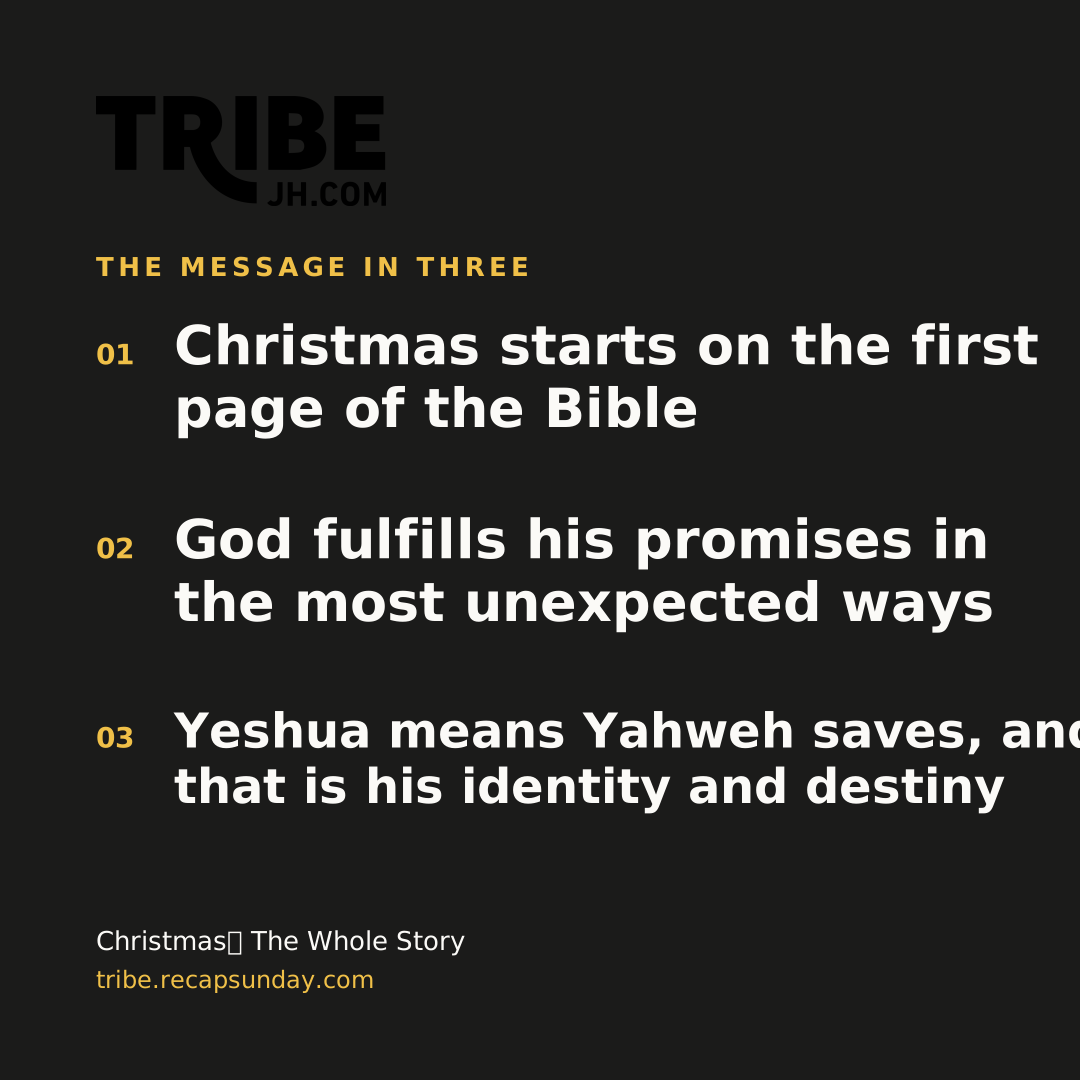
Colson, one of the leaders in Tribe's young adults ministry, brought the Christmas message this Sunday. He walked the room through the whole arc of the Hebrew Bible to make the case that the story of Christmas does not begin in Bethlehem but on the first page of Genesis. His central point: the birth of Jesus is the fulfillment of promises God had been making to his people for thousands of years, and it arrived in the most unexpected way possible.
What was said
Colson opened by asking everyone to set aside their modern Christian familiarity with these stories and try to hear them as an ancient Israelite would, someone who received them by word of mouth, through parents and rabbis, with no Bible on the shelf and no phone in the pocket. From that vantage point, the weight of what God promised, and how long the people waited, lands differently. He introduced a recurring pattern he said runs through the Old Testament: an Eden-like setup, some violence or transgression, a chosen one who is rescued and intercedes, and then a covenant God makes with his people.
He traced that pattern from the very beginning. In Genesis, God creates and humanity immediately fails. In Genesis 3:15 he said God makes the first Christmas promise, that an offspring will come who will bruise the head of the serpent. That one verse, Colson argued, is where Christmas actually starts. The felix culpa idea he raised, the "fortunate fall," was not to excuse Adam and Eve but to point out that the fall created the need for the rescue that the whole rest of the Bible is moving toward.
He carried the pattern forward through Noah, Abraham, Moses, and David. Each time, God's chosen person is unexpected. Noah floats on an ark, and Colson noted the Hebrew word for that ark is the same word used for the basket Moses floats in as a baby. Abraham laughs at the promise of a son at a hundred years old, and Sarah laughs too, yet Isaac is born. Moses is raised in Pharaoh's house and has a speech problem, yet he becomes the one who leads the Israelites out. David is the youngest, the stinky shepherd boy nobody picks, yet Samuel anoints him. God's pattern, Colson kept saying, is to choose the person you would not choose.
The covenant God makes with David in 2 Samuel 7 became a pivot point in the message. God promises David that through his offspring a kingdom will be established forever. Colson said that promise is essentially the same promise God made back in Genesis 3, restated and narrowed to a specific family line. The prophets in Isaiah and Daniel then sharpen it further: a child will be born, a son given, whose name will be called Wonderful Counselor, Mighty God, Everlasting Father, Prince of Peace. By the time the Hebrew Bible closes, Colson said, the ancient Israelites are expecting something obvious and powerful, a warrior king who will crush Rome and rule from Jerusalem.
What arrives instead is a teenage girl from Nazareth, a confused betrothed husband, a feeding trough in Bethlehem, and shepherds as the first witnesses. Colson pointed out that shepherds in that culture were so low they could not even testify in court, yet they are the ones God sends the angel to. He said this is not an accident. It is God displaying on purpose that in his kingdom the last are first, the humble are exalted, and the weak confound the strong. The serpent crusher cries for his mother's milk.
He then spent time on the name itself. Jesus is the English form of the Hebrew Yeshua. The first part, Yeho, is an abbreviated form of Yahweh, the divine name God revealed to Moses in Exodus. The second part comes from the Hebrew root meaning to save or rescue. So Yeshua, Yahweh saves, is not just a name but an identity and a destiny declared at birth. Colson said Matthew knew exactly what he was doing by putting that name in the first chapter of the first Gospel.
He closed by pulling the whole line together. The same God who hovered over the waters in Genesis, who made the promise to Abraham, who rescued Israel from Egypt, who anointed the shepherd boy David, who spoke through the prophets, is the same God born in that manger. And 2 Corinthians 1:20, that all the promises of God find their yes in him, was his landing point: every covenant, every prophecy, every unexpected rescue in the Hebrew Bible points forward to that baby, and through him to the Holy Spirit, and forward still to a return that has not yet come.
Touch points
Things you could actually do this week.
Read Psalm 1 slowly this week and ask yourself whether you are meditating on Scripture the way a tree draws from water, consistently and daily.
Pick one Old Testament story Colson walked through, whether it is Noah, Abraham, Moses, or David, and read it in full so the Christmas story starts to feel like the ending of a very long promise rather than a standalone holiday event.
When you feel apathetic or spiritually flat this week, name it out loud the way Lissa did in worship, acknowledge the resistance instead of pushing through silently, and press in anyway.
Write down one area of your life where you are waiting on God and have been tempted to set your own timeline, then sit with the pattern Colson described: God fulfills his promises his way, in his timing, not ours.
If you have never read the book of Daniel, start it this week, Colson called it fascinating and suggested it rewards anyone who will sit down with it.
Doing a Bible study?
Here is a guide we have prepared for you: the passages
in order, questions for the group, and room to write.
Colson walked through a recurring pattern in the Old Testament: an Eden-like setup, some violence or transgression, a chosen one who intercedes, and a covenant God makes with his people. Where do you see that pattern playing out in your own life or in the life of this church?
Colson introduced the idea of felix culpa, the fortunate fall, suggesting that the failure of Adam and Eve made way for the rescue that came through Jesus. Does that idea sit comfortably with you, or does it trouble you? Why?
Colson, parte del equipo de liderazgo de jovenes adultos de Tribe, predico el domingo despues de Navidad con una idea central: la historia de Navidad no empieza en Belen sino en la primera pagina del Antiguo Testamento. Recorrio el relato biblico desde la creacion hasta los profetas para mostrar que el nacimiento de Jesus es el cumplimiento de promesas que Dios fue haciendo a lo largo de siglos, primero a Adan y Eva, luego a Abraham, a Moises y a David. Segun Colson, Dios tiene un patron que se repite: da un inicio pacifico, permite la caida humana, rescata a una persona inesperada, y hace un pacto con su pueblo.
Lo que Colson quiso destacar es que Dios casi siempre actua de maneras que nadie esperaba. No eligio a un rey poderoso y obvio sino a un pastor joven y sin importancia como David. No mando al Mesias a nacer en un palacio de Jerusalen sino en un pesebre en Belen, anunciado primero a pastores de ovejas, personas tan despreciadas en aquella cultura que ni siquiera podian testificar en un juicio. Hasta el nombre de Jesus, Yeshua en hebreo, lleva en si mismo la declaracion: "Yahweh salva". Todo esto, dijo Colson, muestra que Dios cumple sus promesas a su manera y en su tiempo, no en el nuestro.
Al cerrar, Colson invito a la congregacion a ver toda la Biblia como una sola historia que apunta a Jesus, el mismo Dios que creo el mundo, que llamo a Abraham, que saco a Israel de Egipto y que prometio regresar para hacer todo nuevo. El mismo que nacio en un pesebre es el que intercede hoy por nosotros.
---
Pasajes biblicos usados
Genesis 1:1-2
Genesis 3:15
Genesis 12:1-5
Genesis 15:1-6
Genesis 17:15-21
Genesis 21:6-7
Exodo 34:6-8
1 Samuel 16:6-13
2 Samuel 7:8-16
Isaias 7:14
Isaias 9:6-7
Daniel 7:13-14
Miqueas 5:2-5
Mateo 1:1
Mateo 1:18-25
Lucas 2:1-20
2 Corintios 1:20
Salmos 1 y 2 (leidos al inicio del servicio)
Read the full transcript15,100 words
Good morning, everyone. Good morning. Let's stand together. Good morning. If you can scooch in, scooch in.
If you need to get out early, I understand. You can sit on the end. Just make room for people to fill in. We're glad you're here. Hopefully, have a full house.
Would you pray with me as we start this morning? Jesus, we just say today is about you. Our lives are for you. We thank you for this season where hearts are more tender and more open to your presence and we just sing today. Would you just open the doors?
Would you just open the doors of hearts? Through all the hardships, through everything that people are going through, all the stuff in the world, we have hope today. We have hope today. And when we worship, the darkness trembles. That we're doing something significant in this place.
And in the spirit realm when we bring our praise and our worship to you, Jesus. The mountains tremble the sound of your voice. In Jesus' name, amen. This worship set today is a walk down Lissa's memory lane. When I was worshiping just thinking about the past year and just the past decades, all these older songs came up that just have really impacted my life like songs at different seasons that were just oh, I just would meditate on and worship too.
And so that's kind of what you're getting today. Some of these are oldies but goodies. So let's worship together.
World. To be one. And Let's
sing that again. Did you feel? Just think about that.
Did you feel the mountains tremble? Did you hear the oceans roar Jesus Christ, the risen one. Lord, we
believe that's true today. We believe that's true today, that something changes in the supernatural, that the darkness has to flee. That when we sing open the doors. We're just it's in the right key. It's just there's like a something coming through the computer.
Lord, we just praise you and we thank you. Can we just take a minute and just be still before him? Yes. Just tell him thank you this morning. Just worship him.
Just tell him thank you this morning. Just thank him this morning.
The highest. Your name is the greatest. Your name stands above them all. All thrones and dominions, all paths and positions. Name stands above them all.
Your name your name and the ages cry. All creation stands above them all. All throes, all throes, and dominions, all paths, and positions. Name stands above them all. Your name is the highest.
Declare your name is the highest. Your name is the greatest. Your name you is the highest. Sing your name is the highest. Your name is the greatest.
Your name stands above them all. All throes and dominions, all powers, and positions. Name stands above them all. Your name is the highest. Your name stands above them all.
All throats and dominions, paths and positions. Your name stands above them all. Your name is the highest. Your name is the highest. Your name is the greatest.
Your name stands above them all throats. All throats and dominions, all paths and positions. Your name stands above them all and the angels cry. All creation cry.
We worship you today. I just feel like something needs to break off in here. I don't know what it is. I'm just like feeling that there's just like we're coming with our worship, but the enemy is just like I don't know. Maybe it's just me.
We just need to press in, press in, press in. Because if we really believe that our worship is warfare, we have to expect a fight. And sometimes we come in and it's just free and the atmosphere is awesome and sometimes it's like a battle. I'll just be honest with you. Sometimes I'm up here and like, I'm under so much attack.
Like sometimes, I know this might sound crazy to you, but sometimes I feel like there's two hands around my throat just literally choking me. Like, I can barely get a breath out, and sometimes I come and I just am, like, in his presence. And I know that I know that every single time if I press in, it's just it's just fetal attempts. It's just it's just the, like, throws that the enemy gives you because he knows he's already defeated. It used to scare me.
I used to, like, feel like I was hyperventilating, and now I'm like, oh, yeah? Oh, yeah? And to me, when I feel this feeling that I'm feeling right now are the biggest days that the I feel like the Holy Spirit wants to come and do breakthrough because otherwise the enemy wouldn't care. The enemy wouldn't care if our worship wasn't powerful. Right?
We would just come and sing some songs and do a thing, but so let's and I think it's good to acknowledge it. And maybe you're, like, in the throne room and you're whatever. I'm just, like, sweating and struggling. I could not, y'all, even remember the second song. My brain physically couldn't remember.
And we sing the name of Jesus. Jesus, Jesus, you make the darkness tremble. Amanda was playing that line over and over, and I could not sing that line. I couldn't hear it. I couldn't sing it.
And so to me, I'm like, okay. Right now in the name of Jesus, we rebuke any spirit that would try to come against our worship in this place. You are defeated. You are defeated. You are defeated.
We we call you out. We say that we recognize that you're coming at me at least and probably other people in this room. Maybe you feel apathetic today. Maybe you feel super weary today. Maybe you feel like your worship is just coming out of your mouth and going nowhere.
And we just say right now in the name of Jesus that the Holy Spirit is here, that there is power in this place, and even just acknowledging that there is power in our worship right now, y'all. There's power in our worship that we need to press through. Yes.
You've given us the authority to crush the powers of darkness that are purposed against us. You gave us that authority. And so in the name of Jesus, we destroy every hindrance, every element that has been assigned and sent against us, against our time of worship this morning. And so, we step into the freedom that you have given us, Jesus. You've given us freedom to to worship.
And so we we we step into it. In the spirit, we we do. We just move it like Lisa was saying. We move in to that freedom. Thank you, Jesus for your goodness.
Thank you for your plans. Thank you for your purposes. This morning, right now. We bless your name. We glorify your name.
We declare that you are the only god. You are the true god and we are trusting you for all that you have for us today at this moment, this season, this time in our lives. Amen. Thank you. Jesus, Jesus,
Jesus. You make the darkness tremble. Jesus. Jesus. You silence fear.
Oh, Jesus. Jesus. You can make the darkness tremble. Jesus. Jesus.
Is alive forever lifted high. Your name cannot be overcome. Your name Jesus, You make the darkness tremble. Jesus.
Lord, we just come before you. I just we thank you. We thank you. We thank you that you've given us weapons against the enemy. And Lord, we thank you for this season where we remember that you came but that you're coming again, that we were not meant for this world but for eternity with you.
So teach us now how to battle the darkness because you have already gone ahead and won the victory. That it's been told since the very beginning in Genesis one all the way through to the completeness of your return. And for right now, we war, we war in the spirit against the dark forces, but there's a day coming where you'll return and every knee will bow and every tongue will confess. So thank you Jesus that we know you, that we have every tool in our spiritual tool belt if we're surrendered to you to fight, to fight and to war and to stand in the victory that you have already won. And I just pray specifically for anyone who finds themselves in here today that feels like they're in a battle.
And we're gonna have a Christmas message in here today. Coulson's gonna bring us an awesome word. It's you guys are gonna be blessed. But before we move on, I just wanna do one more thing. If there's someone in this place today that when I said that about the battle and like feeling like, if you're in here today and you want someone to put a hand on you and pray, well, we won't be in this place long, maybe just a minute.
And you just need a brother or sister to put their hand on you and help you war this morning. Maybe you're weak. You've been beat down, you're weary, and that you just need some saints to come alongside you. Would you just raise your hand in this place and and we'll just lay hands on you? Put a hand over there.
Anybody else feel like you're in a battle today? Whoever's near them, just put a hand down, pray for them. If you have a spiritual language, pray in your prayer language. Maybe the word the Lord will give you a word. And just know that he's with you today.
He is God with us. He's with you today.
Jesus. You silence fear. Your name is a lie that the shadows can't deny. Just speak the name of Jesus. Your name cannot be overcome.
Your name is alive forever lifted high. Your name cannot be overcome. Your name is alive forever lifted high. Make the darkness tremble. Jesus.
Jesus. You silence fear. Oh, Jesus. Jesus. You make the darkness tremble.
Jesus.
Lord, we pray freedom in this place. We pray a spirit of revelation would just come to each of our hearts in this place today. Speak to each and every one of us. Let us leave this place different than we came because we met with you. We thank you that there's power, power in your beautiful name, Jesus.
And everybody said, amen. Well, if you're still praying, keep praying, turn around, say, Merry Christmas. Not sure how to follow that out. Just so everyone knows, this mic is for our livestream family. So anybody watching on the livestream can hear your contributions and hear what's going on in the room, not necessarily because we wouldn't be able to hear you if you had something to share.
And we also do church differently. Obviously, we're crammed into this little upper room. That's right. But we're conversational. And so Nancy's gonna share something in just a minute.
I'm gonna quick I'm gonna Nancy, do wanna share it before I bring Colson up?
Okay. This is Nancy. Okay.
So while we're worshiping and praising and praising God and everything and, you know, I'm I'm saying, Holy Spirit, please come in here. Please be amongst us. And it's like, holy spirit is saying, stop just existing. Do something. Don't ask me to be here if you're not gonna follow through and do something.
And my brother-in-law once told me, if you want different results in your life, then do something different. You know? So let's just stop existing and actually invite the Holy Spirit and listen to the Holy Spirit and do something about it.
What did you do?
Right now? Yeah. I'm telling everybody else to do something.
That's a gift. Telling everybody else what to do this. Somebody's gotta do it.
Somebody's gotta do it. I love it.
Well, everybody, this is Colson. Give Colson a warm welcome.
Good morning, everybody.
And he's gonna he's gonna bring the word today. And let me just pray for Colson. Brian, do you wanna pray for Colson real quick? Okay. Maybe PB has something he wants to say too.
Colson's on the leadership team of our young adults ministry here at Tribe, and I'll pray for Colson. Lord Jesus, his mouth, your words. In Jesus' name, amen. Colson, you got this.
Short short and sweet. Just how I like it from PB. Well
Apologize for Sam for you.
Good morning, you guys. I am Colson. I'm gonna talk a little bit more about myself, but I thought that it would be fun today to open up into some scripture because that's kind of the theme of today. And what you'll learn about me is I really like scripture, obviously. I hope that you all do.
But we're gonna really get into it today. But to start our morning, our lovely morning well, first of all, what an awesome group of people. I love to see prayer in this room and just a strong voice silencing the enemy. And for anybody that is feeling attacked, I just hope that you meditate on the words of Lissa and just invite the Holy Spirit today in in to abide in you and calm those threats from the enemy. And so we're gonna start today, and you'll understand maybe part of this.
But it was on my heart today to read Psalms one and two. So I'm just gonna read those really quick, pray, and then we'll get into it. So Psalms one. Blessed is the man who walks not in the counsel of the wicked nor stands in the way of sinners, nor sits in the seat of scoffers. But his delight is in the law of the Lord.
And on his law, he meditates day and night. He is like a tree planted by streams of water that yields its fruit in its season and its leaf does not wither. In all that he does, he prospers. The wicked are not so, but are like chafe that the wind drives away. Therefore, the wicked will not stand in the judgment nor sinners in the congregation of the righteous.
For the Lord knows the way of the righteous, but the way of the wicked will perish. Psalms two. Why do the nations rage and the peoples plot in vain? The kings of the earth set themselves and the rulers take counsel together against the Lord and against his anointed saying, let us burst their bonds apart and cast away their cords from us. He who sits in the heavens laughs, the Lord holds them in derision.
When he will speak to them in his wrath and terrify them in his fury saying, as for me, I have set my king on Zion, my holy hill. I will tell of the decree the Lord said to me, you are my son. Today, I have begotten you. Ask of me and I will make the nations your heritage and the ends of the earth your possession. You shall break them with a rod of iron and dash them in pieces like a potter's vessel.
Now, therefore, o kings, be wise. Be warned, o rulers of the earth. Serve the Lord with fear and rejoice with trembling. Kiss the son, lest he be angry and you perish in the way, for his wrath is quickly kindled. Blessed are all who take refuge in him.
K. I'm gonna pray really quick and then we can dive in, guys. Heavenly father, I'm so thankful that for the people in this room, in this awesome white fluffy snow that we're getting. So thankful to be here today and honored to be speaking in this room. Be with me.
Speak through me today. And I just pray that you move through this room, holy spirit. Amen. Okay. I'm Colson.
As pastor Brian said, I am on the leadership team for the young adults. So some of you in this room might not recognize me. I hope that by the end of today, we can be on maybe a first name basis with each other. I'm super excited to be here today. Super honored.
PB was really tired. You know, it's been a really long year, so he just needed someone to pick up the slack a little bit. I I I would like to honor PB a little bit today, so I'm gonna be walking around the room using my hands a lot and using a lot of jokes. So hopefully, it'll bring some comfort to this room for the guy that you've never seen before. So anyway, I'm I'm I'm super excited to be here.
There's a lot that I want to talk about, and there's just so much that I can't talk about today. And so I'm gonna do my best to to use this time wisely. Now after today, I don't know if I'll ever even be invited back. And so there's I decided that today, with all these people listening, we're gonna talk about Israel. No.
I'm totally kidding. But but also not really that kidding, and you'll see why. Today, we're going to talk about the story of Christmas. Okay? Right?
And I know that Christmas is over and we just spent so much time thinking about it, so much time wrapping presents and cooking meals, and we're just kind of ready to be done. But I think that today, as Christmas is over and the year is ending, I'm challenging you all to think about Christmas a little bit differently today. So to understand Christmas, we need to understand pretty much the entire Old Testament. Yeah. And so we're gonna get into that.
And but you're gonna hear me use this phrase a lot. And so for those of you that maybe aren't familiar with it, the Old Testament is also referred to as the Hebrew Bible. And so today, we're gonna be walking through the Hebrew Bible. A few things to know about the Hebrew Bible. The Hebrew Bible is deep and dense literature.
As you guys know, we went through, like, twelve weeks of Leviticus or something crazy with pastor Brian. So as you know, there's just infinite things that we could talk about and infinite time that we could spend. Now, I'm not gonna do that today, hopefully. But it's it's it's this book, this literature that takes us through history and poetry and prophecy. And ultimately, it's a story of human failure and why we need, as humans, saving.
We need to be rescued. So, you know, humans just kinda suck. And, I mean, that that's just the truth. And like PB likes to say, he likes to stretch your wineskin. I'm gonna stretch your wineskin a little bit just by reminding you that everybody in this room, including me, including pastor Brian, we just kinda suck.
And we have always sucked. That's the beautiful thing is you'll see in the since the first couple pages in the Bible, we had just kind of just not been able to figure it out. And through history, we still just can't really figure it out and we just need to be rescued. We need somebody else that can figure it out for us because we've been given ample opportunities and we're just not there yet. So I believe that the entirety of the Bible is a unified story that points to Jesus.
But the Old Testament or the Hebrew Bible kind of paves the way to why we need Jesus and kind of exemplifies the personhood of Jesus that we're gonna talk about. So before we do anything or sorry. Before we dive in, I want you to to like I said, I want to challenge you a little bit. I wanna change our perspective. I want you to forget about what you know about the bible.
Okay? Just just for just for this hour, however long that I have you. And I want you to forget about where you've written yourself into the bible, whether you see yourself as king David or you see yourself as whoever. Right? Take that out.
Kind of clear your mind. Let the holy spirit fill you, but let these words kind of help you think this through. And I want you to imagine yourself as an ancient Israelite. Okay? Now, these how the word was today, we have the printing press and we have Bibles and paper, maybe five sitting on our old bookshelves.
We have a phone Bible. We have all the resources that you could possibly fathom at our fingertips. But two thousand years ago, we didn't. And all these stories, these stories that we read in the Old Testament, Abraham, Moses, David, they were mainly passed down through word-of-mouth. And so as an ancient Israelite, the way that you were told these stories and you learned about your ancestry and your heritage and your culture was through your parents or through the rabbi or through wherever, but they were passed down by word.
And so you have this perspective about your family and your history and all these things that was passed down to you. So I want you guys to think like an ancient Israelite today. Okay? We're gonna walk through it, and we're gonna think about why maybe we need Jesus. So kind of erase your modern perspective.
Let's let's go back in time a little bit. But before we dive in, I have one more thing. There we're gonna talk about a little pattern in the Bible that constantly is repeating itself over the generations. So if you're taking notes, let's just write this down because we're gonna be coming back to it a few times. But in a lot of the stories that we see in the Old Testament and just the story of humans, we see we start with an Eden like setup.
Literally, you can let's just think about the Garden of Eden. Right? And then some violence occurs. Right? Adam and Eve eat of the apple.
And then a chosen one is rescued and they intercede on the people's behalf. And then God makes a covenant with those people and with that person. So this might not make sense at this moment, but the year's ending. We're moving into a new year. Pastor Brian is gonna be, I'm sure, digging weeks into something in the Old Testament coming up here in a couple weeks.
So as we're refining our brains and thinking about how to study the Bible, this is a really awesome tool that we can use to think about and meditate on. So I'm a ski instructor, and actually, right after the service, I have to go and give a lesson. But I'm often known as the ski instructor that over terrains his kids. And so I'm gonna try not to over terrain you guys today. Okay.
So let's take a breath. Let's think about that today and as we study the bible in the future and as we move into the new year. And let's get into it. So today, we're going to talk about Christmas and the birth of Jesus, Emmanuel. Now, I know you guys have heard this story before.
Joey, go ahead and switch to the Christmas slide. The Christmas story. Okay. Now I know we heard I know we heard the the brief, you know, twenty minute message from PB on the town square, and it's always lovely. But today, we're gonna do it the Colson way.
But just to make sure you guys are comfortable, I had to do it the PB way a little bit and, use some AI to make, my slides. So we have some awesome AI, generated pictures and slides today that I hope you get a giggle out of, but this one's pretty legendary. So Christmas story. Let's dive in. Now, I'm not gonna apologize.
Like I said in the beginning, I love scripture. We're gonna be reading a lot of it today. So if anyone has Bibles and if anybody wants to read, please, I I I welcome that. And so for those of you that know the Christmas story, let's open up to the Christmas story in your bible. I'll give you a second.
Thank you. Okay. Now I don't wanna lead you astray. When I say open up to the Christmas story, we're gonna actually turn to Genesis one. Yeah.
Because I think that Christmas starts on the first page of the bible, and that's kind of the theme of today. So Genesis one, I'm gonna read for us. In the beginning, God created the heavens and the earth. The earth was without form and void, and darkness was over the face of the deep. And the spirit of God was hovering over the face of the waters.
So the first thing that we learn about Jesus is his character as the creator. Right? We we see that God created. There's a creator. Right?
He creates the heavens and the earth. And now, if we're gonna read all the scripture that I wanna read, we might be here until the sun sets. And so, I'm just gonna do some summaries today. Okay? So, we just read Genesis one.
And forgive me, my notes are a little all over the place. But after Genesis one, we read about the creator God creating a lot of other things, Animals and plants and separating the oceans from the land and all these amazing things that you guys are familiar with since maybe Sunday school. But then, we get to God's greatest creation and that is people, humankind. And he creates Adam in his image and Eve in his image. And we read about Adam and Eve, the first two people made from the earth with God's breath breathed into them.
Right? So we're gonna read now Genesis three fifteen. Okay. We know a little bit about Adam and Eve. But as you guys know about Adam and Eve, like the rest of us, they kinda fail.
Not kind of, majorly. And so, Eve is tempted in the garden and eats of the apple. Right? The from the tree that God asked him not specifically not to eat from. And God finds out.
And he's like, what the heck? And so here, Genesis three fifteen, we read God's first promise to his people. I will put enmity between you and the woman and between your offspring and her offspring. He shall bruise your head, and you shall bruise his heel. When I think about this story, I'm kind of like, really guys?
Like, we're all messed up and failures because of you. Like, how fun and awesome would it be to just be naked running around in a garden all day? That sounds kinda awesome to me. And for those of you that don't know me, typically, I'm in this room with the young adults, I'm barefoot. My hair is a little messy, and that's just kinda my style.
Obviously, I had to dress up a little nicer today. It's Christmas. But but but this story is just frustrating. It's like, guys, like, this guy made you. You saw him and talked to him, and you know that things are awesome and good, and you decide to do this anyway.
And this set the sets the pace basically for the rest of history to where we are today and to what's to come. Right? That humans are failure, and we are deceived in all these things. And so God promises Adam and Eve that there will be an offspring that will come that will bruise the head of the serpent. Right?
The the enemy that tempts Eve in the garden. K? So everything in the Bible is symbolic as a lot of us know and as we're gonna learn today. And this is super symbolic. And God's promising his people.
Right? Ancient Israelite perspective. We read these. We hear these stories. We are promised that an offspring will come that is going to bruise the head, stomp out the head of the serpent.
Okay? A serpent crusher. Now something that's interesting about this, and this is gonna challenge your view a little bit, is this aspect of felix culpa. It's Latin for fortunate fall. Some of you maybe have heard this before, but it's it challenges your view of Adam and Eve and the deception in the garden.
Now, I'm not saying that what they did was good because obviously it was not. But maybe you could say it's fortunate because the fall made it possible for Jesus to come, for the rescuer to come. And without that, we wouldn't have that. Now maybe if they never ate the apple in the first place, there would be no need for a rescuer to come. That's maybe a separate tale.
But this is what we're with. Okay? And this is how we're gonna look at it today. So, this phrase just emphasizes to us the fact that through the fall and sin entering the world, God set the stage for the greatest gift humanity could ever receive. Right?
Christmas. This is Christmas right here, Genesis three fifteen. Right? This is telling us that Christmas will come. Maybe they didn't think about it as Christmas back then, but looking back, that's how we can see it.
A promised offspring that will strike the head of the serpent, but also be striped in his heel. Okay? So, like I said, the fall of Adam and Eve sets the pace and the course for the entire story of the Bible and humanity itself. And as we go along the Old Testament, we're gonna hear the story of human wickedness and brokenness and sin that's ultimately redeemed through God's steadfast love for his people and the promise that someone is coming that will strike the head of sin for good. But what is beautiful and what we're gonna learn as we go along is that God chooses to fulfill his promises in kind of the most unexpected ways.
Ways that as humans, we can't predict. Number one, because it's higher than us. We're just can't understand everything. But number two, because I believe God doesn't wanna be predictable because that takes away his power. So he's gonna do things his way in his timing with his plan.
Not our way, not our timing, and not our plan. So let's talk about it. So we're gonna dive into the story of the Old Testament and how God's promises will be fulfilled through Jesus. So the unexpected or the expected unexpected. Okay?
We're gonna learn about why things that he does are unexpected. Now, after Adam and Eve, we hear about the story of Adam and Eve's children, Cain and Abel. And we hear about the story of Cain killing Abel out of jealousy and all these different reasons. Okay? And so let's think about this pattern structure that we were talking about.
Okay? Eden like setup. God has given them everything that they need. Plants to to sow and to reap. Animals to whatever you do with animals, you know, eat and and and raise.
Right? And and we we have this this lovely setup, and then some violence occurs. Right? Some transgression. Right?
This is following our pattern. Cain kills his brother Abel. And so and we read in the Bible actually that Abel's blood cries out from the ground, and God listens. Okay? And so then Cain goes on.
He has his descendants. They become major cities, and we read about Babylon in the beginning. Right? And all these amazed or not amazing, but amazing cities and things that are to come. And we we see God hear about this violence in the transgression, the blood calling out from the earth.
And and God says, hey, like, I'm sorry for what I've done. I'm sorry for creating these people. They're evil and wicked and terrible. I have decided that their time has come after however many years. It's I'm done.
It's over. This creation is just not working out how I planned. I'm gonna destroy it. But a chosen one is rescued, right, in our pattern. Noah.
K? Noah and his family, God calls upon. And Noah intercesses for his people with God. And maybe he doesn't save all his people, but what he does is he saves the future of mankind and history. And so God floods the earth.
Right? And God promises Noah, you are faithful. I will not flood the earth again. Here's a rainbow. Boom.
That's my proof. K? So there, right away in the Bible, one of the first stories, the first families we hear is is Cain killing his brother, the blood crying out from the ground, the chosen one rescued. The earth flooded, but Noah's still there. And the first thing that Noah does when he gets the land is he makes a sacrifice, and God says that it is good.
I will not flood the earth again. K. Good. Now we're caught up with that. Noah and the ark.
Okay. We're working through the Old Testament. Now, Abraham. Okay? We're to Abraham.
Now, I'm not gonna there's endless lineage and genealogies in the Bible. I'm not gonna make us read through it all. But essentially, we can trace the line of Noah down to well, first of all, the line of Adam to Noah. And then can we can trace Noah to this guy named Abram, k, living in the Middle East somewhere. It's hard for my brain to really match up these Old Testament places with current sites.
But somewhere, you know, in that area of The Middle East that's we talk about a lot in the Bible. So Abraham was, like I said, a direct descendant of Noah. And back when Abraham was just Abram, God chose him to be the father of his people. Right? This pattern of God choosing.
So we're gonna read Genesis twelve one through four. And like I said, if you guys have your Bibles today, please open them up. I would love some readers. I don't wanna lose my voice. I have to yell at some children on the mountain today.
So whoever would like to read, please take it away. You don't need a mic. It's okay. Maybe, yeah, you do. Okay.
Guys, don't be nervous.
Just the bible.
Got you. For the children. The lord had said to Abram, leave your native country, your relatives and your father's family, and go to the land that I will show you. I will make you into a great nation. I will bless you and make you famous, and you will be a blessing to others.
I will bless those who bless you and curse those who curse you and who treat you with contempt. All the families on earth will be blessed through you. So Abram departed as the Lord had instructed and Lot went with him. Abram was 75 years old when he left Haran.
K. Thank you, Amanda. There there's more. Don't worry about oh, you mean one more verse? Maybe verse five.
Sorry. Last one. He took his wife Sarai, his nephew Lot, and all his wealth, his livestock, and all the people he had taken with him into his household at Haran, and they all headed for a land of Canaan. When they arrived well, that's the mid middle of the sentence, though.
That's good. Thank you. K. Now listen. I know there's a lot of scripture.
Like I said, I'm not gonna apologize. It's important to read this out loud, I think, with our tongues too. K. So where we're at in the Old Testament. Right?
There's this guy named Abram, and he's awaiting God's promise to be fulfilled that he will his family will be made into a great nation, and he has God's blessing. Now, like I said, think about our perspective, but also our human perspective. Now if we were Abram, we'd be thinking, okay. So when? Because I want this soon.
I have no children. I'm getting old, and my time is coming. Like, God, when are you gonna bless me? Can let's make it next let's make it next year. Like, whatever it is.
Right? And God reminds him or he's getting older, and he wants to carry on his lineage, and he wants it to be in his time. But God reminds him that he has not changed his mind, and Abraham needs to be patient and trust in him. So we're now we're gonna read Genesis chapter 15 verses one through six.
After these things, the word of the lord came to Abram in a vision. Fear not, Abram. I am your shield. Your war your reward shall be very great. But Abram said, oh lord god, what will you give me?
For I continue childless, and the heir of my house is Eleazar of Damascus. And Abram said, behold, you have given me no offspring, and a member of my household will be my heir. And behold, the word of the Lord came to him. This man shall not be your heir. Your very own son shall be your heir.
And he brought him outside and said, look towards the heaven. The number of the stars if you are able to number them. Then he said to him, so shall your offspring be. And he believed the Lord and counted it to him as righteousness.
Great. So this is there's a couple themes here that we're gonna break down about today. But the biggest one is God makes promises to his people. And for us in this room, we know this to be true. But we learn start to learn that God is good and he fulfills his promises that he makes.
Like I said, maybe a little bit unexpectedly by his timing and his way. We're gonna read one more passage from Genesis. I'll read it this time. Genesis chapter 17 verses 15 through 21. And God said to Abraham, as for Sarai your wife, you shall not call her name Sarai, but Sarah shall be her name.
I will bless her and moreover, I will give you a son by her. I will bless her and she shall become nations. Kings of people shall come from her. Then Abraham fell on his face and laughed and said to himself, shall a child be born to a man who is a 100 years old? Shall Sarah who is 90 years old bear a child?
And Abraham said to God, oh, that Ishmael might live before you. God said, no. But Sarah your wife shall bear you a son and you shall call his name Isaac. I will establish my covenant with him as an everlasting everlasting covenant for his offspring after him. As for Ishmael, I have heard you.
Behold, I have blessed him and will make him fruitful and multiply him greatly. He shall father 12 princes and I shall make him into a great nation. But I will establish my covenant with Isaac whom Sherrah shall bear to you at this time next year. K? So they're patient.
They're waiting. What's unexpected? If I was a 100 years old, I wouldn't plan on having kids just like probably most people in this room. And so it's funny. It's I think what I love about the Old Testament and I I think it can be it's hard to relate sometimes because we're so far away.
These stories seem so old. This history is so old, but how human is that? Abraham says he laughs. Him and Sarah laugh, really? This promise you I'm I've been waiting and I'm 100 now.
My wife's 90. Look at her. She's wrinkly. You know? It's like, if this baby comes out, it might have three arms and one eye.
You know? It's like, this isn't this is pretty funny, God. Like, this promise that you made, I'm starting to not really know. But he answers. He he fulfills his promise, and he gives them a son.
And that's why his name is Isaac. And it's it's just so awesome that this happens, and it's just so, like, unexpected. Right? And this is important for our message today. So, one more passage.
Genesis twenty one six through seven. I'll read it really quick. And Sarah said, God has made laughter for me. Everyone who hears will laugh over me. She said, who would have said to Abraham that Sarah would nurse children, yet I have borne him a son in this old age?
So God fulfills his promises. Okay? There's a lot of that. And so that's why we're this is whole Old Testament is about Christmas. Let's go further.
K? So through through Abraham's sheer faith that the Lord will fulfill his promises, God passed his covenant down to Isaac. And then as we go along, God passed it from Isaac to his son Jacob, and then Jacob's 12 sons, and just this whole thing. So now years have passed. Right?
Maybe some would say some less eventful things in the Bible, but we see the descendants of Abraham through Isaac and Jacob and his 12 sons that have become this nation of Israel. Like I said, we're talking about Israel today. And so some years have passed, and Israel has settled in well, Israel for lack of better words. And we have passed through more years of kingdom foundation and war and broken sinful people. So now jumping ahead a little bit, God's chosen people find themselves enslaved in Egypt.
How did we get here? We are God's chosen people. Right? He promised our forefathers, Abraham and Isaac and Jacob, that we're we were gonna be blessed, and our offspring would be blessed and all these things. So why are we in Egypt under slavery from the pharaoh?
Like, we should be in Canaan where there's milk and honey and all these awesome things. Right? And so what does God do? He chooses the most unexpected person. The last person, the Israelites, God's chosen people, would think to save them.
A man raised in the house of pharaoh, not raised in the shacks the mud huts with the Israelite slaves. He was raised in the beautiful house of pharaoh. Not only that, but he has some speaking issues, and that's just kind of a random note. But who would think that this this guy would become the chosen one? Right?
The the one that rescues his people. But we soon learn that God glorifies himself through Moses and takes the descendants of Abraham on a wild quest to the promised land. Okay? But we're all too familiar with this story at that point. We hear the story a lot.
Moses and Exodus out of Egypt into the promised land. And just how the people are broken. Right? And they fall again and again. And how human again is that.
Right? These people see God rescue them out of slavery. And after two weeks, they go, this guy's kinda boring. What else do we got? Who's got some gold?
Let's make a cow. Right? And it just is like, man, we do the same thing. We see God everyday move. In this room on maybe this is the only day of the week that you get to feel and see God move.
And then by Tuesday, we forget. Right? It's so human. And this is prompting us to to realize this is why we need an intercessor. So thinking back to our pattern.
Right? We have this Eden like setup. Again, the Israelites, they're God's chosen people. They have his blessing. But then some violence occurs.
Right? Some transgression. The people are broken. They make mistakes, and eventually they fall into the hands of pharaoh. And so what does God do?
He chooses Moses. Now, sorry. I have so many side notes. There's so much I wanna say. But what's really fascinating is the Hebrew words for ark and basket are or the Hebrew word for ark is used twice in the Bible.
The ark of Noah and the basket that Moses floats down the river with. So right. And so so another theme, there's so many themes, is that we just need to dive into what God is telling us. And like we learned in Psalm one, we gotta meditate on the Torah and the law. Right?
And so this subtle little detail is just so fascinating. God chooses Moses. Sorry. I keep pointing like the pattern thing is up here. But God chooses Moses to to save his people and he he delivers him on an ark.
And Moses becomes the person, God's chosen person to rescue his people. And Moses intercedes on the Israelites' behalf many times. God says, oh, I'm so tired of these people. I I give them these things. I lead them out, and still they they can't figure it out.
I'm gonna destroy them. I'm gonna destroy them. And Moses, don't destroy them. Like, these are your people. Don't destroy them.
And God's like, okay. You're right. I won't. And so this is this is our intercessor. And God's made a covenant with Moses and the Israelites that he will lead them to the promised land.
Okay? So following our pattern, we have Moses. He's the intercessor. A covenant is made. Okay?
So this is important. Now, through the trials and tribulations of the Israelites, we learn a lot about God and his character and who he is. And and this this God of Israel that these Israelites have learned about. Right? Spoken word.
Who he is. And so we're gonna read Exodus thirty four six through eight. And I think that this passage, number one, is one of the most repeated and quoted passages throughout the entire Bible, especially the New Testament. But we learn who God is. The Lord passed before him Moses on top of Mount Sinai and proclaimed, Yahweh, Yahweh, a God merciful and gracious, slow to anger and abounding in steadfast love and faithfulness.
Keeping steadfast love for thousands, forgiving iniquity and transgression and sin, but who will by no means clear the guilty, visiting the iniquity of the fathers and the children and the children's children to the third and the fourth generations. And Moses quickly bowed his head towards the earth and worshiped. So what do we learn here? Okay. We're kind of we're further along in our, history, but we learned that this this God of Israel, the one who made a promise with the Israelites forefathers, Abraham, Isaac, Jacob, and so forth, his name is Yahweh.
K? This is important. This is personal. This is this this being telling his people, I wanna have a relationship with you. What's the first thing we do when we introduce ourselves to somebody?
Hi. I'm Colson. Right? God is saying to his people, my name is Yahweh. I want you to know me.
And what's the most important thing to know about me is my name. K? He even says it twice. What else is super important? He's merciful and gracious.
Right? He's slow to anger, and that just shows you how bad the Israelites were because he was getting a little angry, I think. And not only that, but he's abounding in steadfast love and faithfulness. Now, we could spend a whole day just breaking down these two verses. For the sake of time, we're not.
But this is really important. Okay? This shows us the character of God and ultimately, the character of Jesus. And so we also learned that he's gonna keep forgiving them again and again and keep his promise to bring the Israelites to the promised land. Okay?
Now, more years go by. K? The Israelites eventually kind of figure it out. Not really. God chooses to bring them to the promised land some decades later, forty years, something like that, and they're there.
Okay? So now that they're there, we see more people come. We see more kingdoms rise. We see more people fail. And, like just like the time passage in between kingdom foundation, war, and broken people.
Now, we can keep tracing lineage here from Adam to Noah, from Noah to Abraham, from Abraham to Jacob, from Jacob to the Israelites and Moses, and now from the Israelites down to this guy named David. So now king David. Right? Here's another awesome AI picture. I I wrote in the in the computer, give me a picture of young David with a sling looking into water reflecting himself as the king.
Wow. Isn't that amazing? Isn't that amazing what it can do? It's kinda scary. Yeah.
That's another message maybe I'll give. But the dangers of AI. There's a lot I could say, but not for today. Right now, I'm just gonna focus on, woah. What can AI actually do?
So now we're now we're moving on to this next big chapter. Okay? We're following along the Old Testament. King David. When we think about kings, right, even in our modern perspective and from the movies and from all these things, we think of somebody that's strong and wise and, you know, has a big beard and has good things to say and is righteous and all these things.
And we, you know, powerful, rich people, maybe obvious kings. K? But just like our theme, God does the unexpected. He doesn't choose somebody from a powerful line, powerful seed, the guy that comes from this powerful king. He challenges the quota and tells the story that things are done his way, right, through unexpected people.
And in my notes here, I reference Joe gave an awesome message at our young adults group about the boldness of David and the meekness of David. Right? David was kind of the scrawny kid. Nobody trusted him. He's kind of like at the last part of his family.
He's like the youngest sibling. All these things. He's not somebody that anybody would expect to be the king. Right? And we read this story of a lowly shepherd boy who defied the odds in battle.
And when when things were bleak, he came up to Saul and said, hey, give me a shot. Like, I think I could maybe do this against the Philistines' strongest fighter, Goliath. K? We all know the story of David and Goliath. We're we're not gonna read through all of it.
Thank goodness. Right? And and so David versus Goliath. Right? In that story, nobody respected David.
He was just a small statured child and shepherd boy. How could he take down Goliath? But the Lord chooses to glorify and honor the meek and lowly David through him, giving him the strength to take down Goliath. And ultimately, this happened before, but anointing him to become king. K?
Now, we have a couple big passage readings left. We're gonna read first Samuel 16 verses six through 13. Whoever's brave enough to take this one on, I applaud you. Who would like to read? Bethany.
Bethany. Bethany. I'm
just gonna read the one up there because I'm not to it. When they came, he looked on Eliab and thought surely the Lord's anointed is before him. But the Lord said to Samuel, do not look on his appearance or on the height of his stature because I have rejected him. For the Lord sees not as man sees. Man looks on the outward appearance, but the Lord looks on the heart.
Then Jesse called Abinadab and made him pass before Samuel. And he said, neither has the Lord chosen this one. Then Jesse made Shammah pass by, and he said, neither has the Lord chosen this one. And Jesse made I'm losing my line. Sorry.
Then Jesse made seven of his sons path before Samuel. And Samuel said to Jesse, the Lord has not chosen these. Then Samuel said to Jesse, are all your sons here? And he said, there remains yet the youngest, but behold he is keeping the sheep. And Samuel said to Jesse, send and get him for we will not sit down till he comes here.
And he sent and brought him in. Now he was ruddy and had beautiful eyes and was handsome. And the Lord said, arise, anoint him for this is he. And then Samuel took the horn of oil and anointed him in the midst of his brothers. And the spirit of the Lord rushed upon David from that day forward, And Samuel rose something behind the speaker, rose up, went and went to Rama.
Thank you, Beth. K. Right. Right. This is just some some scripture to back up what I'm saying.
But Samuel goes through all of Jesse's sons, and none of them fit the script for what the Lord has put on Samuel's heart to choose for the next king. But this lowly, ruddy, I'm gonna guess stinky shepherd boy. Now what I think is really funny is that it's included that he was really beautiful and handsome. And, you know, maybe God wants beautiful and handsome people to carry on his lineage too. I don't know.
That says a lot about us in this room because you're all very beautiful and handsome. Okay. Right? So David is the anointed. Right?
He's unexpected. He's not would not be the first choice. Right? Just emphasizing the theme here. And David, through his anointing, becomes a great, powerful, amazing king.
He goes on to write so many Psalms. And and the Lord has anointed him, and he has favor. Right? And we see this, and we see just his story play out. This unexpected kid becoming the king of Israel.
And I'm sure back then, I don't know that much about this time in history, but I'm sure that his position had major influence and power at that time in history. Okay? So, one last big passage. Second Samuel seven eight through 16. This is where we see God's promise return.
Okay? So, I can read this one. I'll take it on, guys. Now, therefore, thus you shall say to my servant David, thus says the Lord of hosts, I took you from the pasture, from following the sheep that you should be prince over my people Israel. And I have been with you wherever you went and cut off all your enemies from before you.
And I will make for you a great name like the name of the great ones on earth. And I will appoint a place for my people, Israel, and will plant them so that they may dwell in their own place and be disturbed no more. And violent men shall afflict them no more, as formerly, from the time that I appointed judges over my people in Israel. And I will give you rest from all your enemies. Moreover, the Lord declares to you that the Lord will make you a house.
When your days are fulfilled and you lie down with your fathers, I will raise up your offspring after you who shall come from your body and I will establish his kingdom. He shall build a house for my name and I will establish the throne of his kingdom forever. I will be to him a father and he shall be to me a son. When he commits iniquity, I will discipline him with the rod of men, with the stripes of the sons of men. But my steadfast love will not depart from him as I took it from Saul whom I put away from before you.
And your house and your kingdom shall be made sure forever before me. Your throne shall be established forever. Now, we we read this verse and it the Lord shares with King David through this prophet named Nathan. That once David has become a great king and passes away, that through his blood and offspring, a new king will come that will establish a kingdom on earth and will rule forever. K?
This is essentially the same promise that God made to Adam and Eve in the beginning. K? And this is the same promise that God made to Abraham and Isaac and Jacob and to his people that an offspring will come and his kingdom shall be made forever. The serpent crusher. Right?
This this person that people are waiting for. K? We read it again. K? Now going back a little bit.
Right? The Israelite perspective. We hear we're hearing these stories. Okay. Well, we hear the story of of the serpent crusher and his offspring will be blessed.
And and then through the house of David, his kingdom shall be made sure forever before him. K? Let's think about that. This is important. Now, to keep it flowing, there's a lot more major events and characters that happen through the bible.
I I kinda joke that we'd be going through the old whole testament. There's infinite things to go through, but we're just kind of working our way along here. But as time passes after David, once again, we see more war. K? More kingdom foundation.
More kingdom destruction. Exile, slavery, and essentially human failure and corruption. Okay? But as we read on, basically, the Hebrew Bible is kind of set up in three different ways. We have history.
We have the law. We have the prophets. We have some poetry. And so towards the end of the Hebrew Bible, we get to hear from some might call the minor prophets. Okay?
About maybe what's to come. Now what's what's interesting when we hear the word prophet, we think of always, okay, this person is telling the people something that's to come. They're prophesying. But what sometimes we forget about prophecy is it also relates to now. And the prophets are how God would speak to his people.
Just like Moses. Right? God spoke to him on the mountain and Moses told the people these things about God. Okay? So, we're gonna jump to Isaiah and Daniel and read a couple things and read about God's further promises of rescue.
So go ahead, Joe. Isaiah nine six through seven. Okay? So, like, this is a long time ago. And we we read this we read this on Christmas.
Okay? So this is important for Christmas. For us for to us a child is born, to us a son is given. And the government shall be upon his shoulders and his name shall be called wonderful counselor, mighty God, everlasting father, prince of peace. Of the increase of his government and of peace, there will be no end.
And on the throne of David and over his kingdom to establish it and to uphold it with justice and with righteousness From this time forth and forevermore, the zeal of the lord of hosts will do this. Okay? So the people of Israel, this is another thing that they read. Okay? This prophecy that a child is born, a son is given, and all these characteristics will be a part of that.
It's probably not right? In our Israelite perspective, we're not really sure what all this means yet. We just know something's coming. So, now we're gonna go to Daniel seven thirteen through 14. And Daniel, I told this to the young adults, but man, if you have time to sit down with the book of Daniel, it is just fascinating to me.
I'm just kind of a nerd. But the book of Daniel just just tells us so much about that time of history, what's to come. I mean, revelation. This Daniel's kind of revelation soft. Right?
He he tells of what's gonna come. Or or I I guess, I I like to say this. Back in the day when iPods and iPhones were just becoming a thing, there would be the app. And it was the main app, and then there'd be the App Lite, and it was, like, free. This is like Revelation Lite, kind of.
So anyway, God reveals to Daniel, I saw in the night visions, and behold, with the clouds of heaven, there came one like a son of man. And he came to the ancient of days and was presented before him. And to him was given dominion and glory and a kingdom that all peoples, nations, and languages or tongues should serve him. His dominion is an everlasting dominion, which shall not pass away, and his kingdom one that shall not be destroyed. Right.
So so once again, the Israelites are reading this. They're hearing from these prophets. And so we went through a lot of context. Okay? From Genesis to Exodus to Samuel and David and the prophets.
Right? And so for hundreds of years, right, in our Israelite perspective, these stories were passed down to us. Hearing about the beginning and our forefathers and these promises that God is has made to our people. K? We're hearing these things and the people of Israel are anxiously awaiting this serpent crusher.
This person that God is going to send, that is going to intercede, right, on our behalf again and make a covenant with us. But God has made the covenant that this person is coming. But as an ancient Israelite, we just want things to be our way all the time. Just come now. Just come now.
You see how things were in the past. Just come now. We need it. Like, we're in slavery and exile, all this stuff. God's like, no.
Sorry. It's my timing, not yours. Remember? And so his God's characteristics and promises show us that a powerful and obvious ruler is to come. Okay?
So we're expecting a serpent crusher. We're expecting a king on David's throne, a powerful, mighty ruler. Right? We forgot all about who David was, that he was lowly, but we remember him as this king. And and and we read that the government is gonna be upon his shoulders in Isaiah.
And we read in Daniel that he's gonna be a son of man and is gonna be given dominion. Okay? So when I'm in ancient Israel, I'm expecting, like, this, excuse my language, this badass guy to come. Right? And and and kind of rule and take over and be obvious, this serpent crusher.
Okay? So this is what we're expecting, right, as a crowd, as a room. We're as for all ancient Israelites, this guy's coming. He's coming soon. We don't know when.
Okay? Take a breath, y'all. We just burned through the Old Testament faster than I think you ever should. Maybe PB could take some notes from that. Okay.
Good. Hopefully, this will inspire him to keep the next Leviticus series to maybe three weeks. Yeah. And he can promise you that something is coming too, I think, in this next year. So we have finally arrived at what we've been building up to.
If you have your Bibles, turn to Matthew chapter one. K? Now, once again, there's endless genealogy and lineage in the Hebrew Bible and in the New Testament. Okay? And it's how the the people that put the Bible together decided to open up the very first verse of the first page of the New Testament.
Okay? Now as ancient Israelites, this is super important. Okay? The book of the genealogy of Jesus Christ, the son of David, the son of Abraham. Okay?
Now this first chapter, we we we're reading about the line of David, this king. Okay. Yes. Is this the king, the serpent crusher that we've been waiting for? The king from the line of David.
And we see here traced all the way back to Abraham. Right? We read, from Abraham all the way down to Jesus. This sounds like, as our ancient Israelites, this guy that we've been waiting for. Okay.
He comes from Abraham and the house and the line of David. And could this be the promised offspring that's gonna crush the head of the serpent and sit on David's throne and have dominion, a proper king? I don't know. Let's keep reading. K.
Skip through the genealogies. Matthew chapter one verse 18 through 25. Someone take it away. Guys, this is a big one. This is Christmas.
Don't lose your chance.
Now, the birth of Jesus Christ took place in this way. When his mother Mary had been betrothed to Joseph. Before they came together, she was found to be with child from the holy spirit. And her husband Joseph, being a just man and unwilling to put her to shame, resolved to divorce her quietly. But as he considered these things, behold, an angel of the Lord appeared to him in a dream saying, Joseph, son of David, do not fear to take Mary as your wife for that which is conceived in her is from the Holy Spirit.
She will bear a son and you shall call his name Jesus for he will save his people from their sins. All this took place to fulfill what the Lord has spoken by the prophet. Behold, the virgin shall conceive and bear a son, and they shall call his name Emmanuel, which means God with us. When Joseph woke from sleep, he did as the angel of the Lord commanded him. He took his wife, but he knew her not until she had given birth to a son and he called his name Jesus.
Thanks, Tyler. Okay, guys. One big passage reading left. Alright? Let's go to Luke chapter two verses one through 20.
I'm gonna read it. Don't worry. Okay? Luke chapter two verses one through 20. This is, you know, kind of what we know as the Christmas story.
Let's let's read it and then talk about it. Okay? Christmas. K. The birth of Jesus.
In those days, a decree went out from Caesar Augustus that all the world should be registered. This was the first registration when Quirinius was governor of Syria. And all went to be registered, each to his own town. And Joseph also went up from Galilee from the town of Nazareth to Judea to the city of David which is called Bethlehem Because he was of the house and lineage of David, to be registered with Mary his betrothed, who was with child. And while they were there, the time came for her to give birth.
And she gave birth to her firstborn son and wrapped him in swaddling cloths and laid him in a manger because there was no place for them in the inn. And in that same region, there were shepherds out in the field keeping watch over their flock by night. And an angel of the Lord appeared to them and the glory of the Lord shone around them and they were filled with great fear. The angel said to them, fear not, for behold, I bring you good news of great joy that will be for all the people. For unto you is born this day in the city of David, a savior who is Christ the Lord.
And this will be a sign for you. You shall find a baby wrapped in swaddling cloths and lying in a manger. And suddenly, there was with the angel a multitude of heavenly hosts praising God and saying, glory to God in the highest. And on earth, peace among those with whom he is pleased. When the angels went away from them into heaven, the shepherds said to one another, let us go over to Bethlehem and see this thing that has happened which the Lord has made known to us.
And they went with haste and found Mary and Joseph and the baby lying in a manger. And when they saw it, they made known all the saying that had been told them concerning this child. And all who heard it wondered at what the shepherds told them. But Mary treasured up all these things, pondering them in her heart. And the shepherds returned, glorifying and praising God for all they had heard and seen as it had been told them.
K. This is interesting. Right? Hold on a second. If I was an ancient Israelite, this really isn't all this isn't what I would be expecting.
Right? If we are is living in Israel and we're hearing this story about this guy that that his his line is from David and from Abraham. This this isn't really what I would be expecting. Right? Where is the king that was promised?
Instead, we have a baby born in some nothing burger town. What even is Bethlehem? It's not Israel. It's not Jerusalem. I'm sorry.
Jerusalem. And and from two kind of nothing burger people. Right? Peasants. And I thought of this funny metaphor, but I when I read about I don't know.
When I was reading about Mary and Joseph, I'm picturing Amanda and Corey Lack's son, Huxley. Right? He's like 14 and I'm picturing him going, mom, dad, like, I found this awesome girl. She's the coolest. She's so sweet.
And he's like super stoked. And if we were back in the day, mom, dad, like, we're betrothed. K? Right? I know I'm in middle school, but it's the time is here.
Like, I this she really could be the one. And then a week later, he comes home from school. Mom and dad, she's pregnant. Not from me. And, you know, I just this story just kinda makes me laugh.
Right? Once again, how human? And and we read more about in the gospels about how Joseph is just like, what do I even do? Right? This woman that I'm betrothed to has this baby.
Now if so I have a girlfriend that goes here named Greta, and then she if she came up to me and said, I'm pregnant and it's from the holy spirit, I would go, uh-huh. Right. Hey, pastor Brian. Can I talk to you for a second? You know?
And I don't know. I just think this story is is just really funny and amazing and just emphasizes how god does the unexpected. Right? And he shows his people it's not about how you do it. It's about how I am doing it and I'm going to do it.
And so sorry. What a side note. Just imagine Huxley in your brain. K. Maybe not that much.
But so so right. This is just weird. Right? I'm an ancient Israelite. This this this is not what I'm expecting.
Where's this king that's coming out? Why isn't he in Jerusalem? This is where we need him. Right? The Romans have have taken us over.
Once again, we are living in poverty and and slavery of and whatever. We need to be rescued, but this is not our rescuer. This is just some baby born and his parents were too poor they couldn't even afford a bed and whatever. And he's born in like a feeding trough. Like, this is not our king that's to come.
But it is. Right? And it is the king that was promised. This this baby feeding from his mother. Right?
Weak and and hopeless without help from his mother. This is the king that was promised, and it's all right here. Okay? Well, how do we know? Well, first of all, everything that we read leading up, we read about God's promises, his covenant with his people.
Everything is symbolic in this. Okay? Everything is fulfillment of God's promises and of his prophets' prophecies. And we know that this baby that that we're testing to see if it lines up with who we know as the Messiah is a descendant of Abraham. K?
Good. Check. We know that he is from God's chosen people, and the line of David. Perfect. K.
We know these things as checks up, but it could just be some guy. Right? And, Joe, next slide. We know we read another passage in Isaiah. Isaiah seven verse 14.
Therefore, the lord himself will give you a sign. Behold, a virgin shall conceive and bear a son and shall call his name Immanuel, god with us. Okay. Well, this baby that was born was unlikely born from a virgin. This is kind of a rare crazy thing.
Either she's lying or this prophecy has been fulfilled. Right? And so great. This this was written a long time before Jesus. Okay?
Just so you guys know. This story was being passed down a long time before Jesus. Okay. So we see this. And now, next slide, we also read in Micah that but you, oh, Bethlehem, Ephesians, who are too little to be among the clans of Judah, for you shall come forth for me one who is to be ruler in Israel, whose coming forth is from old, from ancient days.
Right? The line of David and Abraham. Therefore, he shall give them up until the time when she who is in labor has given birth. Then the rest of his brothers shall return to the people of Israel. And he shall stand and shepherd his flock in the strength of the Lord, in the majesty of the name of the Lord his God.
And they shall dwell secure. For now, he shall be great to the ends of the earth and he shall be their peace, their shalom. K. Just really quick. Something I'm noticing in the majesty of the name of the Lord his God.
Okay? Think about that for a second. We'll talk about that more. But we we see these things coming true. We know that this messiah that's coming, right, is gonna be from this lineage.
He's gonna be born of a virgin in Bethlehem, and his name is gonna be called Emmanuel. K? That's a lot. We see God's pattern play out again. Choosing the peasant girl from Nazareth.
And if you're an ancient Israelite, you know nothing good comes from Nazareth. Right? We all know that. And having the savior of the world be born in a major and having the first people to bear witness be shepherds. K?
Also, as ancient Israelites, we know that shepherds are kind of the, run of the muck people. They they kinda stink, and they work with dirty sheep all day. They're not rulers. They're not rabbis. They're not high priests, k, who we would expect to to go and visit Jesus first.
Right? These rulers, these purple coats. Instead, we see shepherds, the lowliest of people, the dirtiest, the last people that you would expect get to get told about Jesus first. And what's really fascinating and what I think God does on purpose is back then, shepherd shepherds are so looked down upon, they can't even testify in court. Now court maybe looked a little different, but God chooses the people that can't testify on behalf that this Jesus is a baby born in Bethlehem to be the peep be the people that saw him first.
K? It's so backwards. Right? It's so unexpected. But that's what we are expecting.
Right? But all of these things, as they're coming together, are symbolic of God's kingdom to come. In this new kingdom, this kingdom that we don't know about, that we're not expecting as ancient Israelites, The last are first. K? The humble and the lowly and the stinky and dirty are exalted.
The weak confound the strong. And in this Christmas story, God displays his glory by becoming weak and vulnerable and dependent and the old the ultimate human experience. Right? We were all babies once. Now, some of us might be kinda old and hairy now.
But but we were all babies. Right? And God chooses himself to come down. And the serpent crusher and the ruler of the universe cries without his mother's milk. Right?
How fascinating is that? K? That's not what I would be expecting as an ancient Israelite. K? Now if we're still in doubt, k, we know the prophecies, but it's in our ancient Israelite nature to still doubt God's promises being fulfilled.
Right? We still like, right, he's on the mountain. He's telling us these things and we're still like, let's go to the golden cow. Alright? Let's how do we know that this baby that is born in Bethlehem is the ruler to come?
Well, I think that maybe there's a little bit of concrete evidence. And some of you might question my use of the word concrete. But that this baby is the Messiah that the Jews and us ancient Israelites have been waiting for. And like we read right here, it's in the name of Jesus. So we're gonna bounce back.
You guys don't have to, but I'm gonna go back to a passage that we already read. Matthew one verse 21. Okay? Matthew one verse 21, we read, she will bear a son, and you shall call his name Jesus. Joey, go to the next slide.
You will call his name Jesus. Okay. Now just a little bit of nerdiness for you for those that don't know. Jesus is kind of the English I don't wanna say Americanized, but the modern name of Jesus. Okay?
Now back then, living in Israel, name wouldn't be Jesus. Right? Or, you know, Jesus now could even be Jesus, a guy some guy. Right? But back then, his name was Yeshua.
K? Now if we break down the Hebrew word Yeshua or the name, the first part is Yeho, and it's abbreviated form of the divine name of Yahweh. K? Now we learn about God's divine name, Yahweh, way back in Exodus. So as ancient Israelites, we're familiar with this.
Right? We know God's name. Okay? This guy, his name is Yeshua. K?
His first part of his name is Yahweh and Shua, part of the Hebrew root for to save or rescue. So literally, Yeshua, Jesus' name means Yahweh saves or Yahweh will save. Okay? That is fascinating. And by saying this, by Matthew saying this in the first chapter of his gospel, he's he's making a really bold claim.
And Matthew is stating and telling us that through the meaning of his name, it speaks of his destiny, but also his identity. The child that was born from the spirit is going to save. That is a huge claim to make about this peasant baby born in a manger. Okay? But Matthew wants us all to know that this is true.
This is his identity. And not only his identity, but like I said, his destiny. He's going to save. Okay? So the story of the bible.
That was a lot. You take a deep breath. So good. There's so much more that comes after the birth of Jesus. And I wish that I could be up here all day and walk maybe through the New Testament, but we're not gonna do that.
And, you know, we, as ancient Israelites, were starting to accept that this baby might be the serpent crusher or is, and he's here, and he's to come. And and he's turning the kingdom upside down. Right? The lowly and the meek will be exalted. The the last will come first.
This baby born in a manger is the ruler that is going to save. And not only that, but what Matthew is saying is this baby is God. Woah. K. It's kind of, as an ancient Israelite, almost blasphemous to say that this human can be God.
K. And so that's where maybe it stretched a lot their wineskins back in the day. And I think it took a lot of elbow grease from Jesus' disciples to convince them otherwise. Okay? So I wanted you to be in this ancient Israelite perspective to understand why maybe today there's still people that and still people that honor ancient Hebrew tradition that still don't believe in Jesus.
It's hard to believe. And we all come from different backgrounds and cultures and and tribes and tongues. Right? And maybe we were raised with the story of Jesus. Maybe we weren't.
Right? But even for us, modern people, modern Christians, it's hard to believe. And we weren't even told these stories of our people leading I mean, I think that if it was hard for the Israelites to believe when they had all this prophecy and all these stories leading up to this, man, it's hard for us to believe too. We weren't even back mean, our my grandparents didn't tell me the story of how their grandparents rescued them out of Egypt. Right?
I have to take these words in this leather bound book for fact. But I think that as soon as we start to take the words in this book for fact, it will change how you see the story of the Bible and ultimately the story of Christmas and Jesus and all these things. Right? So after Jesus' birth, he goes on to prove himself as the king that has come. To crush the head of the serpent for good.
Right? Reading along, summarizing, we see Jesus in his in his founding years do a lot. Right? Study a lot. And eventually, he starts his journey, his his his ministry.
And he has disciples, and he performs amazing works and miracles. K? All these things that we know what probably are way more familiar with than maybe these stories in the Old Testament. And so we see these things. And then ultimately, we see Jesus carry our sins, die on the cross, and crush the head of the serpent for good because just as hard as it was to believe that God was gonna be born as a baby, he rose again.
Right? And and that is is the story of Christmas. Okay? And, whew, we are reminded in the New Testament. This is my only other New Testament reading through the words of Paul in second Corinthians one twenty.
Second Corinthians one twenty, it says, for all the promises of God find their yes in him. That is why it is through him that we utter our amen. I'm sorry. That we utter our amen to God for his glory. K?
Paul tells us that these promises, these these ways that God chooses to rescue his people and fulfill his his promises are are yes in Jesus. This is another statement that is saying, hey. This baby that was born, this Christmas story, this is the God that we have been waiting for. This is the chosen one. Right?
Looking back to our pattern, Eden like setup. Okay? Violence and transgression, all these things that occur, and a chosen one is is is taken out, and a baby is born, And he intercedes on all of our behalf, not just the ancient Israelites, not just the people in slavery in Egypt, all these things. If we choose to believe that this baby born in Bethlehem is the God of Israel and the God of us, and we choose to believe that he rose again, then he intercedes on our behalf. And his covenant with us is that through belief in him, right, we will be rescued and saved.
So we are the broken people that God sent his only son to save. We are the people that Jesus intercedes for on our behalf, and we are the people that God keeps his promises with. K? Now one last point I have to make is the other greatest gift that came from Christmas, the Holy Spirit. Right?
Without Jesus dying on the cross, the greatest gift wouldn't have come. Okay? So the Bible. We just walked through it. K?
Yeah. K. It was a lot. And now I want you to think about the whole story of the Bible as the story of Christmas. And and we can say goodbye to Christmas after this, maybe for the year until next year.
But to conclude us, y'all, after everything that we've read and the journey that I took you through today, the same God who was there at the beginning, the same God who parted the waters and created everything. The same God that sought out Abraham and promised his descendants to be like stars in the sky, and who rescued the Israelites out of Egypt, who established a lowly stinky shepherd boy as king and revealed prophecies to prophets for centuries to come, promising rescue and a savior who will crush the head of the serpent, is the same God that was born in a manger in Bethlehem to a poor teenage Jew. Right? And is the same God who lived a perfect life and died on the cross so that the serpent could be crushed for good and interceded on our behalf. It is the same God that sits on the throne
of
David, has dominion, and rests governments on his shoulders. He is the same God who will return and bring his kingdom to earth and make everything new. And it is the same God who through, although unexpectedly, because just like the history of all people on the entire earth, our we are broken and we fail every day. But the God that we've read about since the beginning up until now is the same God who seeks you out and loves you and promises rescue from the weight of the world and the weight of our failure and our sin. And this, ultimately, you guys, is the story of Christmas and the story of the Bible.
Merry Christmas, and thank you for the arrival of Yeshua, Yahweh saves. And I'm gonna pray us out. Okay? Heavenly Father, we come to you this morning thankful for the birth of Jesus in the manger of Bethlehem. God, we're thankful that you seek us out and love us even though we are just like the people thousands of years ago that made idols out of golden calves and burned down cities and did injustices and violence, God.
But you choose to forgive and seek us out anyway. Lord, you sent your son, the story of Christmas, to intercede on our behalf permanently, to crush the head of the serpent and put the enemy to rest for good. Lord, we're we're thankful for your promises and your covenants and prophecies that have been fulfilled. And God, we are just looking forward to the prophecy that is yet to be fulfilled that you will return. Jesus, we're so thankful for your promise that all will be made new.
Lord, we just pray that you continue to seek us out. Lord, that that you continue to forgive us for how we fail every day. Be with us, Jesus. Remind us of the reason for the season that you are here and you are God. We just pray over the people of this room that you remind them of these promises.
That as they walk out the store and as we begin a new year, that you help them dive deep into the law, into the bible, to meditate on these scriptures so that we can become closer to you and understand you better. Thank you for these stories that we get to read about. We can understand your perspective, how you do things, and how you work in unexpected ways. Jesus, we just are thankful for the gift of the Holy Spirit. And we ask this morning that you move through this room and that you abide in us.
Thank you, heavenly father, for this time and this awesome weather, and I just pray safety over everyone in this room as we go out today, bear icy roads, and ski awesome mountains. Thank you. Thank you, Jesus. It's in your name we pray. Amen.
Thanks for letting me speak today, y'all. May maybe I'll see you again.
I
hope that we will see you again. Let's worship the Lord one other way with our tithes and offerings this morning. You know how to give. Most people are generous with their smartphones. We'll put the text to give number up here.
Why don't I pray over the offering? And would it be alright if I prayed over each of you? Stand up. Let me pray a blessing over you, and we will get out of here. Lord Jesus, thank you for being good to us as a way of telling you that we love you and we trust you.
We bring a portion of our hard earned finances to you, and it's with a joyful heart that we give this morning. And, father, I command a blessing over each and every person here and the families that are traveling hither and thither across the country and around the world that are tuning into the livestream this morning for church. I commend a blessing over them. God, I ask that in the same way that you led and guided us through 2025, you will be with us as we step into the new year of 2026. Thank you for two beautiful babies being born into our tribe family right at the tail end of this year.
I'll show you pictures next week. And thank you for the baby that's coming and the babies to be born in 2026. We command a blessing over those new moms and new dads. Thank you for being good to us. Jesus will tell you one more time that we love you.
We pray these things in Jesus' name, the strong son of God. And everybody said, amen. I love you guys so very much. Have a great week. We'll see you back here next Sunday, and we're back to normal service schedule, nine and eleven.
That was awesome. Colson, you killed it, bud. We love you. Have a great week.