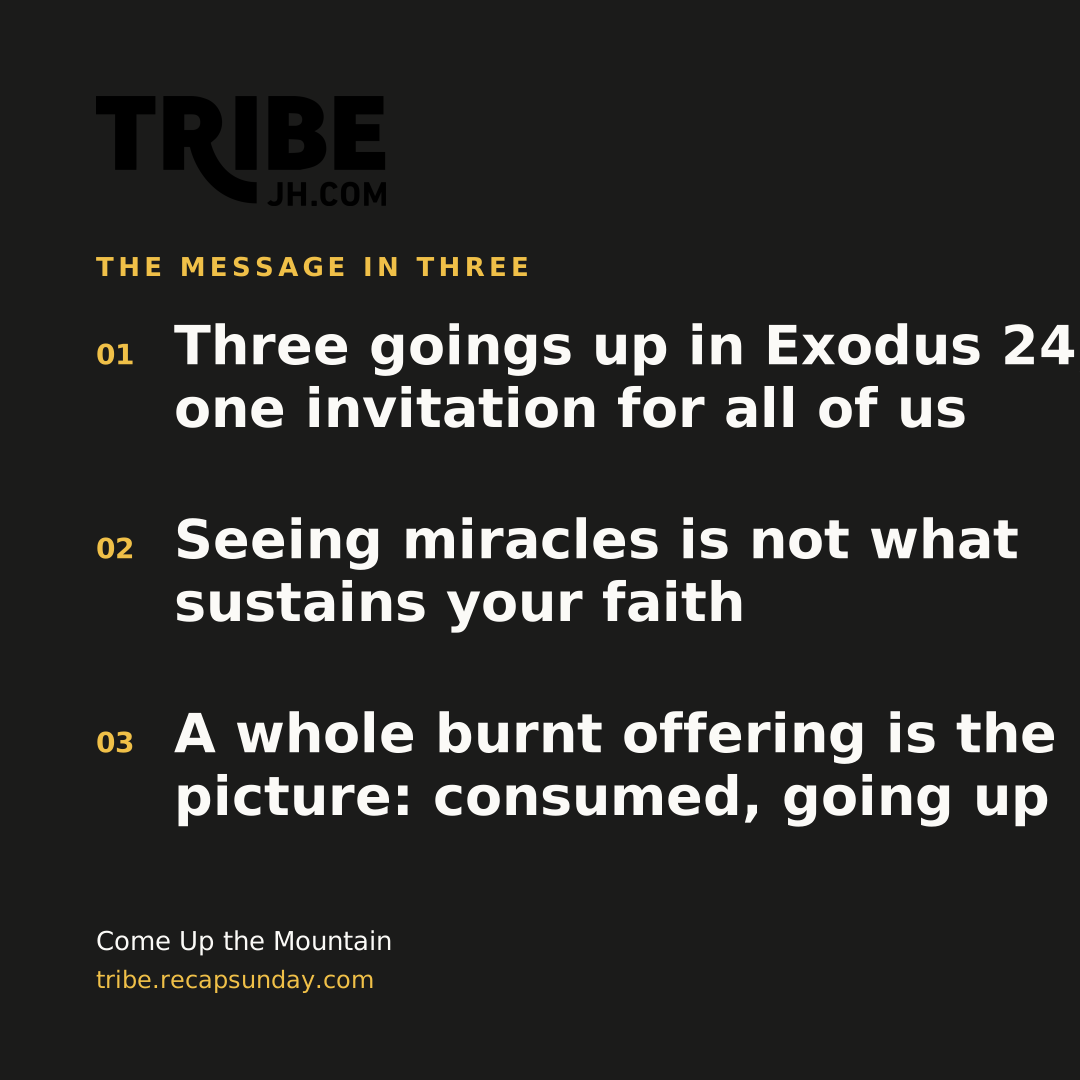
The passage this message was preached from, in full, with every other passage it reached for.
Exodus 24The primary text read and discussed throughout the entire sermon
1 He said to Moses, “Come up to Yahweh, you, and Aaron, Nadab, and Abihu, and seventy of the elders of Israel; and worship from a distance.
2 Moses alone shall come near to Yahweh, but they shall not come near. The people shall not go up with him.”
3 Moses came and told the people all Yahweh’s words, and all the ordinances; and all the people answered with one voice, and said, “All the words which Yahweh has spoken will we do.”
4 Moses wrote all Yahweh’s words, and rose up early in the morning, and built an altar under the mountain, and twelve pillars for the twelve tribes of Israel.
5 He sent young men of the children of Israel, who offered burnt offerings and sacrificed peace offerings of cattle to Yahweh.
6 Moses took half of the blood and put it in basins, and half of the blood he sprinkled on the altar.
7 He took the book of the covenant and read it in the hearing of the people, and they said, “All that Yahweh has spoken will we do, and be obedient.”
8 Moses took the blood, and sprinkled it on the people, and said, “Look, this is the blood of the covenant, which Yahweh has made with you concerning all these words.”
9 Then Moses, Aaron, Nadab, Abihu, and seventy of the elders of Israel went up.
10 They saw the God of Israel. Under his feet was like a paved work of sapphire stone, like the skies for clearness.
11 He didn’t lay his hand on the nobles of the children of Israel. They saw God, and ate and drank.
12 Yahweh said to Moses, “Come up to me on the mountain, and stay here, and I will give you the stone tablets with the law and the commands that I have written, that you may teach them.”
13 Moses rose up with Joshua, his servant, and Moses went up onto God’s Mountain.
14 He said to the elders, “Wait here for us, until we come again to you. Behold, Aaron and Hur are with you. Whoever is involved in a dispute can go to them.”
15 Moses went up on the mountain, and the cloud covered the mountain.
16 Yahweh’s glory settled on Mount Sinai, and the cloud covered it six days. The seventh day he called to Moses out of the middle of the cloud.
17 The appearance of Yahweh’s glory was like devouring fire on the top of the mountain in the eyes of the children of Israel.
18 Moses entered into the middle of the cloud, and went up on the mountain; and Moses was on the mountain forty days and forty nights.
Read during the offering segment about running with perseverance and fixing eyes on Jesus
1 Therefore let us also, seeing we are surrounded by so great a cloud of witnesses, lay aside every weight and the sin which so easily entangles us, and let us run with perseverance the race that is set before us,
2 looking to Jesus, the author and perfecter of faith, who for the joy that was set before him endured the cross, despising its shame, and has sat down at the right hand of the throne of God.
Referenced as saying we can boldly approach the throne of grace to obtain mercy in our time of need
1 Let us fear therefore, lest perhaps anyone of you should seem to have come short of a promise of entering into his rest.
2 For indeed we have had good news preached to us, even as they also did, but the word they heard didn’t profit them, because it wasn’t mixed with faith by those who heard.
3 For we who have believed do enter into that rest, even as he has said, “As I swore in my wrath, they will not enter into my rest”; although the works were finished from the foundation of the world.
4 For he has said this somewhere about the seventh day, “God rested on the seventh day from all his works”;
5 and in this place again, “They will not enter into my rest.”
6 Seeing therefore it remains that some should enter into it, and they to whom the good news was preached before failed to enter in because of disobedience,
7 he again defines a certain day, today, saying through David so long a time afterward (just as has been said), “Today if you will hear his voice, don’t harden your hearts.”
8 For if Joshua had given them rest, he would not have spoken afterward of another day.
9 There remains therefore a Sabbath rest for the people of God.
10 For he who has entered into his rest has himself also rested from his works, as God did from his.
11 Let us therefore give diligence to enter into that rest, lest anyone fall after the same example of disobedience.
12 For the word of God is living and active, and sharper than any two-edged sword, piercing even to the dividing of soul and spirit, of both joints and marrow, and is able to discern the thoughts and intentions of the heart.
13 There is no creature that is hidden from his sight, but all things are naked and laid open before the eyes of him to whom we must give an account.
14 Having then a great high priest, who has passed through the heavens, Jesus, the Son of God, let us hold tightly to our confession.
15 For we don’t have a high priest who can’t be touched with the feeling of our infirmities, but one who has been in all points tempted like we are, yet without sin.
16 Let us therefore draw near with boldness to the throne of grace, that we may receive mercy, and may find grace for help in time of need.
The message in order, in a few minutes of reading.
On the first Sunday of 2023, Tribe worked through Exodus 24 together as a congregation, reading the chapter aloud and talking through it in real time. Brian Hunter traced three distinct "goings up" in the text and closed with communion and an outdoor water baptism. The invitation he put before the Tribe fam was to begin the new year by letting their lives be consumed on the altar of God.
What was said
The congregation read Exodus 24 in sections, passing the mic and offering observations as they went. Brian set up a treasure hunt from the start: somewhere in the chapter there are two, possibly three, distinct "goings up," and one of them is harder to spot than the others. He asked people to hold that question while the reading continued.
The first going up was straightforward. Moses, Aaron, Nadab, Abihu, Joshua, and 70 elders climb to a plateau partway up the mountain, where the text says they saw God and ate and drank in his presence. Brian used a Jackson Hole reference to sketch the geography: base camp where all of Israel waited, the gondola-top plateau where the elders gathered, and the summit where Moses alone was eventually called.
The second going up was Moses entering the cloud at the summit, the cloud that the people below could see burning like a consuming fire. That image of Moses walking into fire is what Brian held onto, because the people watching from the base would have had one thought: he is gone. Consumed.
The third going up is the one that required the most brushing away of dirt, as Brian put it. Back in verse five, before any of the elders climbed anywhere, young men offered a whole burnt offering, the Hebrew word being hola. Brian explained that in this particular kind of offering nothing is spared and nothing comes back down. The smoke goes up. The author uses the same word, hola, that describes Moses disappearing into the consuming fire, and Brian said that connection is the author's intention, not his own interpretation.
Several people in the room pushed the conversation in directions Brian said he had not anticipated. One pointed to the elders eating in God's presence as something that did not ultimately sustain their faith, since Aaron, who was there on the mountain, is the same person who later builds the golden calf. Brian agreed and drew out a caution: being in an atmosphere of miracles, or even in the literal presence of God, is not a guarantee. Something else has to happen.
Renee made a connection Brian said would "preach all day" - that Moses going up into the cloud and coming back with a glowing face is a shadow and type of Christ, in the same way that Jesus was transfigured after being in the presence of the Father. The discussion also circled back to the question of why Moses had to go up rather than God coming down, which landed on the contrast between old and new covenant. The torn curtain and the removed dividing wall of hostility mean the invitation now is for anyone to approach the throne of grace directly.
Brian closed by bringing all of it into the present tense. Communion followed, framed around the same image: taking bread and cup is a picture of dying to self, of letting your life be placed on the altar. He read from the marriage-proposal language Jesus used in the upper room to explain the cup, and then the service moved outside for water baptism, with Brian describing both sacraments as ways the congregation could, that morning, begin the climb up the mountain.
Touch points
Things you could actually do this week.
Read Exodus 24 on your own this week and write down one question or observation it stirs up in you.
If there is a sin you have been carrying, take a few minutes alone to confess it and ask God to forgive you.
Sign up on the sheet by Diana White if you want to serve a Tuesday night meal.
Mark February 14 on your calendar and plan to help prepare and serve a meal for Teton County Search and Rescue.
Think about one area of your life where God may be inviting you further up the mountain, and tell him you are willing to go.
Doing a Bible study?
Here is a guide we have prepared for you: the passages
in order, questions for the group, and room to write.
Brian talked about the Israelites saying 'all that the Lord has spoken, we will do' and then turning to the golden calf just a short time later. Where have you seen that gap between intention and follow-through in your own walk with God?
The 70 elders ate and drank in God's presence and still drifted. Several people in the conversation pushed back on the idea that a powerful experience with God is enough to sustain faith long-term. What do you think has to accompany those mountaintop moments to make them last?
El primer domingo de 2023, Brian comenzó una conversación sobre Éxodo 24, un capítulo que describe tres tipos distintos de "subir al monte". El primero fue cuando Moisés, Josué y los setenta ancianos subieron a la mitad del monte y comieron y bebieron en la presencia de Dios. El segundo fue cuando Moisés subió aún más alto, entrando en la nube de fuego donde permaneció cuarenta días y cuarenta noches. El tercero, el más sutil, fue la ofrenda quemada del versículo cinco, donde el animal era consumido por completo, en hebreo llamada olah, la misma palabra que se usa para describir a Moisés entrando en el fuego. Desde abajo, los israelitas veían a Moisés desaparecer en esa llama consumidora, igual que veían subir el humo de la ofrenda. Para ellos, era como decir: ya no está.
La invitación para el año nuevo fue esta: no quedarse como los israelitas al pie del monte, ni siquiera como los setenta que llegaron a la mitad, sino responder al llamado de subir completamente y dejar que la vida sea consumida por la gloria de Dios. Brian señaló que, gracias a lo que Cristo hizo, ya no existe una barrera que nos impida acercarnos, como sí la había para Israel. La congregación tomó la comunión bajo un manto de oración como símbolo de ese pacto, y varios miembros se bautizaron al final del servicio.
---
Pasajes bíblicos mencionados
Éxodo 24 (pasaje principal, leído completo)
Hebreos 12:1-2
Isaías (referencia a los montes que destilan vino nuevo, sin versículo específico dado)
Cantar de los Cantares (referencia a "con una mirada de tus ojos", sin versículo específico dado)
Salmos (referencia a "busca mi rostro", sin versículo específico dado)
Hebreos (referencia al trono de la gracia, sin versículo específico dado)
Read the full transcript11,647 words
Thank you. Because this is, like, not
you don't you don't you don't seem to care. So I was just if you wanna add a little flair to the cajon, you can. You can eat maybe Oliver could give you he has a little single stick. Guys, you can sit right here. Here we go.
Britt, we're ready when you are. This is my power
Hi, guys.
Perfect. Let's pray together this new year as people trickle in. Oh, Lord Jesus, we thank you for today. I thank you for every heart in this room. None of us are here by accident.
We just pray that you would come and you'd meet us today. We just remind ourselves on this first day of the New Year of your amazing, amazing grace towards us, where we've been this last year and where we just surrender our heart and our lives to you of where you pray that will be in name that name, amen. Let's stand. I think we should stand. Not not us.
We're too crowded up here. Let's sing it out together. Our prayer today. You. Take knowledge his grace in your life.
This is amazing grace.
This is unfailing you.
Your eyes with me. Lord Jesus, we do. We thank you and we praise you for your amazing grace. We don't ever wanna just go through the motions and just sing songs. Sometimes really familiar songs, we just sing the words, but Lord we really wanna focus today on who you are, on your amazing grace, how we would we just couldn't even stand without you.
It's just how I feel today. Every breath that we breathe comes from you. You're worthy, worthy, worthy of our worship to you. It's all we have to give back to you for all that you've done for us. So whether we feel like it this morning or not, opening our mouths and singing to you, declaring who you are because our spirit longs to sing, longs to sing to Thank you for that truth today.
Sing about who you are, we sing your word. Let's sing this together. Death could not
powerful, of Jesus. What powerful name it is. The name of Jesus. Yes,
Lord. Your name is powerful. Yes. Lord, I was watching something and it was yesterday and it was like in the background of somewhere I wasn't watching. It was somewhere in the background of where I was.
And anyway, there was like some commentator or someone and they were using the Lord's name in vain, specifically saying Jesus Christ. And it just was stirring my just I felt like I wanted to vomit, know. And I thought, well, that would make sense, you know, if if the enemy wanted to deflate or try to make common something, it would be the name of Jesus because he's not a dummy. He knows how much power there is in that name. And Kai and I had a great conversation about it and just like there's no other name that you can call on to be saved but that name.
There's so much power in that name. Jesus, we just thank you. What a beautiful name it is. What a beautiful beautiful name it is. Let us fall at your feet in reverence to that knowledge.
Let us never take lightly your name, Jesus. We just thank you for your promises today. We thank you for who you are. Thank you for all that you're doing in all of our lives. Let's just sing this chorus.
It says, promise still stands and great is your faithfulness. And just think about this next year. But what if you already know what's on my heart, you already know what I've been praying for and longing for to see, to see how you're gonna move? Great is your faithfulness God as we start this new year. Sing this again, your promise still stands.
Your promise still stands. Great is your faithfulness, your faithfulness.
I'm still,
your and my heart will sing your praise again.
Just tell him this morning, Jesus, you're still enough.
Jesus, You've never failed me yet.
Let him remind you today of how he's always been there for you. Just open your mouth, just sing or speak just so that you can hear yourself. Just say, thank you, Jesus. Just thank you.
You never failed me yet.
We just tell you this morning you are so worthy. Lord, we just invite you to come and speak to us today through your word. We thank you for every single heart crammed in this space today, Lord. Meet us. It's like the upper room.
We are hungry to meet you today. Come and speak to us. Have your way in us. In Jesus' name. And everybody said, amen.
I'm afraid to tell you to go get more coffee because I don't know, it'd be like a stampede, but turn and greet someone if there's someone near you that you haven't met and good morning and happy new year. There's a scene next to Salem. I'll sit here. I'm fine here.
Alright. Here.
No. No.
No. You're on the bus. Okay. We just need to start the New Year off with a a little bit of harassment if he picks up. You'll hear if he answers.
If he doesn't answer
he's on speaker. That's
dangerous. No. Mhmm. Oh, here. Let me see your phone.
No. Yeah. Skiing. The the rest of us are in church. We're starting the year right.
He's he's the one who likes to ride. Yeah. He's skiing with his son. Jealous. Yeah.
Know. I know. Alright. Maybe I'm just jealous. Maybe I'm just jealous.
He's off the he's off the hook. But just always let me know anybody you want me to call while we're all at church. I'll just be that voice of conviction and trying to ski shame him. I think that's why I knew he could take it. I know.
That's why he could take it. He could take it. If you have your Bible with you this morning, would you turn with us to the book of Exodus? I'm trying to include Cory here. Corey, Lisa, and I.
Exodus chapter 24. Oh, wait. What's that, Britt? It was your birthday yesterday? Happy birthday, Brittney.
And she's like, didddle, scurries up back behind back into the production booth. Okay. So Exodus chapter 24, and we're going to read all of Exodus chapter 24 together, and then we're gonna have a brief conversation about Exodus 24. So whether you are here at the TMC and you're not in Worland, you're not down in Bondurant, but you're actually here getting to be a part of service in 3 d, we're so glad. I just gave a shout out to Bondurant and and she missed it.
But, okay, now she's picking up with us. We're so glad that you are here. And if you are watching the livestream at home or wherever you are, we're so glad that you're you're with us today. And like I say all the time, I really want today's time that we're together to be a conversation. I want us to look at, to read, to consider together what we're reading.
I want us to examine it, pick it up, look at it from different angles. I wanna hear your thoughts, your questions, your connections, your comments, and I want this to be a team effort. Okay? And we kick off the team effort by taking turns reading from Exodus 24. We're gonna read the whole chapter.
Well, whoever has the mic can start out, and what I'd like you to do is just read three or four or five verses and then hand it off to somebody else. Alright? Whoever's got it can let it rip. Yes.
That would be me. Okay. Exodus 24. Then he said to Moses, come up to the Lord, you and Aaron, Nadab and Abihu, and several of 70 of the elders of Israel and worship from afar. Moses alone shall come near to the Lord, but the others shall not come near, and the people shall not come up with him.
Moses came and told the people all the words of the Lord and all the rules. And all the people answered with one voice and said, all the words that the Lord has spoken, we will do.
Quick pause. I wanna set you up for success because there's a few things that I want to point out when we get done reading this, but I to give you a treasure hunt while we're reading Exodus 24. You see it specifically mentioned a time or two, but that's not the only reference that I'm looking for. But what I'd like you to be looking for as you're reading is this idea of going up. There two specific things.
One is directly mentioned. The other one, you're gonna have to hunt a little bit for it, but the same word is even used in the Hebrew. So that could give you a hint in your Bible. It might be the same word in English, but this is one of the things that we're going to talk about. There are two different goings ups, so be looking for them.
And
Moses wrote down all the words of the Lord. He rose early in the morning and built an altar at the foot of the mountain and 12 pillars according to the 12 tribes of Israel. And he sent young men of the people of Israel who offered burnt offerings and sacrificed peace offerings of oxen to the Lord.
Quick question. Why not the priests? The Levitical priests. Who's making the offerings? What does it say?
Not Moses. Men. Young men. Why does it say young men and not the Levitical priests? No.
Think. We don't do that kind of church here anymore. Why does it say young men and not Levitical priests or the priesthood? Come on. Yes.
Say it again. Joy, was really looking for you you said at the same time. They don't exist yet. Nadab and Aaron and his two sons are there with Moses, but they have not yet established. They haven't even they don't even have the plans for the tabernacle yet, So it's just a little trivia.
That's why it says some young men. Yes. Yes. Because we're here and not right here. Yeah.
Yeah. So everybody go, Alright. Let's continue.
And Moses took half of the blood and put it in basins, and half of the blood he threw against the altar. Then he took the book of the covenant and read and read it into and read it in the hearing of the people. And they said, all that the Lord has spoken, we will do, and we will be obedient. And Moses took the blood and threw it on the people and said, behold, the blood of the covenant that the lord has made with you in accordance with all these words.
Jeez, Moses.
I'm sorry. What verse?
Was Yes.
Reading again.
Nine. Okay. Then Moses, Aaron, Nadab, Abi, Abiha.
Abihu.
Abihu. And the 70 elders of Israel climbed up the mountain. There they saw the God of Israel. Under his feet, there seemed to be a surface of brilliant blue.
Lapis lazuli.
Mhmm. As clear as the sky itself.
God did not harm the Israelite nobles. They saw him and they ate and drank. The Lord said to Moses, come up to me on the mountain and stay there so that I may give you stone tablets with the law and commandments that I have written for their instruction.
So Moses and his assistant Joshua set out and Moses climbed up the mountain of God.
Moses told the elders, stay here and wait for us until we come back. Aaron and her are here with you. If anyone has a dispute while I am gone, consult with him.
Then Moses went up on the mountain and the cloud covered the mountain. The glory of the Lord dwelt on Mount Sinai and the cloud covered it six days. And on the seventh day, he called to Moses out of the midst of the cloud. Now the appearance of the glory of of the lord was like a devouring fire on the top of the mountain in the sight of the people of Israel. Moses entered the cloud and went up on the mountain, and Moses was on the mountain forty days and forty
nights. Okay.
How about just some initial general observations about what we just read? We don't need any kind of spiritual meaning or or deep kind of connections as we and and hopefully you do this every time you read God's word, whatever it is. Maybe if you have a bible reading plan or something, you read it once through, and you go, what what stood out? What was interesting to me? What was noteworthy?
Lots of different things that you can observe, look at, questions that you can ask. But after reading it just on this first pass, what are some things that stood out to you? If you wiggle your hand around, we'll get the mic to you so that our livestream family can be a part of your comments as well. So whoever has the mic, let's send it this way. And it'll be unmuted for you.
Sweet. What was the meaning behind, like, throwing the blood on the wall? Oh. Okay. So we got Moses throwing blood.
Interesting, isn't it? If you if you look at the text carefully, you'll see that on that day, Moses, he sets up 12 pillars. Instead of being able to have a face to face conversation with each and every Israelite gathered there at the base of Mount Sinai, these 12 pillars represented what's known in the Old Testament as the congregation, all of Israel. So some of the blood was sprinkled on the altar. That's representative or indicative of God's presence, because they couldn't go up on the mountain.
If you remember, if you look if you look at the story just preceding what we're reading, God arrives at Mount Sinai with dark clouds, and peals of thunder, and lightning, and there's fire in the clouds that descends upon Mount Sinai, but they can't go up there, so the altar represents God. That's half of this covenant that's being entered into. The other half gets sprinkled on like, you know, the first row of Israelites that were gathered. That's why it says Moses poured the blood on the Israelites, but then he sprinkles whoever was reading it at the time, it said poured blood. Mine says sprinkles.
I don't know what yours is. Sprinkled is a little more digestible to me than like, like, you know, like being Gatorade, you know, the coach after a good game.
We have a Baptist Methodist.
Baptist Methodist thing. That's that's where I feel more comfortable there. And then the other half goes on those 12 stones that are indicative. They're the other members of this covenant, and the blood gets sprinkled on them that they are partaking in, witnessing, and participants in the covenant. It's a great question.
What are some of the things that you see? Leah's got the mic.
Okay. So I have three because I have a a third one even though I'm talking to you. I have three because of what you said Okay. A second ago. So I noticed that Moses did something on the seventh day, and on the seventh day Mhmm.
God rested. And then he stayed up there for forty days and forty nights. So in my head, I'm like, what's the significance? Because Noah also had forty days and forty nights. And then I think there's another time, but I can't remember which one.
But and then you you had mentioned before, a couple months ago, about the people couldn't go into the concussion. The important place where people can't
go in except Holy of Holies?
Yes. Okay.
And so
that's why there was an altar outside because the blood was there because you couldn't go inside. So it was the same exactly what you just said as far as they couldn't go up.
Oh. It was also down there. Okay. So in a way, the altar was representative of God's presence coming down to them so that the covenant could be more accurately made. And you noticed that number of 40.
So we have to be we have to be careful with what could be called biblical numerology. Numbers are every everything in the Bible is important and has significance. Numbers typically are repeated in different times at different places. And when you see what those numbers that are repeated, what they represent or what's going on within the context of the story around those numbers being mentioned, you can like start to put it together like, this could mean this, and this number could mean this. And the number 40 is what is that?
The time of testing? My phone's gonna, like, bling up here in a minute from Don who's gonna tell me. She also was saying she texted me during the livestream. She also was helping out you guys with the answer about before the Levitical priesthood was established.
What do
you got?
The forty days and forty nights on the ark.
Forty days and forty nights on the ark. Jesus was in the wilderness forty days. Yep. Without food and no Instagram. Yes, you're exactly right.
This idea of testing. So so you can so you can you can begin to see if you look up other instances of 40 what it is. Okay. Yes. Thank you.
Real time fact checker. How about a few other observations? Like, what stands out to you? What what sort of details do you say? And then we'll get into the specifics of the question that I said to be hunting for.
Oh, you got some. Yes. Double responder today.
Was it like the going up? Yes. That was the question you were asking?
Yep. Yep. Yep. So we're gonna we're going to tackle that specifically in just a moment. Do you wanna, like, take a crack at it?
Not really.
Okay. It's a
fair answer.
Thank you for being brave enough to say what everybody else was thinking.
I have never noticed before the lapis lazuli pavement.
Lapis lazuli.
You you mentioned that, and I thought they're going up, and God made the way. I mean, he provided mine says a pavement. Something like a pavement.
Oh, man. That's gonna preach. So one of the things that we love to do at Tribe is to use our holy, sanctified imagination. The Bible says, love the Lord your God with all of your heart, with all your soul, with all of your mind, including our imagination and our creativity. And I love when when people have this, like, in their head, I wish that there was, like, a, you know, like a certain LED colored light that would just, pop on over somebody's head as they were reading God's word, and they just allowed themselves to just wonder.
What did that look like? Lapis lazuli, like brilliant brilliant blue colored, like emerald blue. Why that color? And what was this pavement doing under why did that occur? What did that look like?
And to eat the the Bible says that the elders ate a meal. They ate and drank in his presence. What must that have been like? What was Jesus's first miracle in his public ministry? The water in the wine.
He's not like he's not up there on the mountain serving like juice boxes and like ginger ale. The bible talks about in the book of Isaiah when Jesus returns, the the the language is clearly poetic, but it conjures up a beautiful image in Isaiah. It says that the mountains, the hills will drip with new wine. In a holy sanctified way, God knows how to party. And you don't think that that was the most incredible experience?
I mean, we're reading about it thousands of years later. Alright. Let's take a quick little side detour. Imagine that oh, let me give you some geography. Let me help you geographically what's going on, and then and then let your mind wonder, and then I'd love to hear what your thoughts are.
Here in the text, we see God saying, don't come up on the mountain, and then he's like calling Moses up on the mountain, and then and then like Moses is coming down off the mountain, and then he's going back up the mountain with the 70 elders, and then while they're on the mountain God tells Moses come up the mountain. He's like, I'm already on the mountain, and you're like, wait, what are we doing? So imagine we'll use a reference for the village. Imagine riding the Gandhi to the top there at the the off piste little snack bar in the piste restaurant there. If you ride the Gandhi to the top of the mountain are you if you ride the Gandhi to the top of the Gandhi, are you on the mountain?
Yeah. Yeah. Are you on the top of the mountain? No. But you're but you kind of are.
You know you're as high as the gondola can can take you. Right? Now if you were to go like behind that building and do the boot pack up the white spider to get to the head wall, that's that that's like the top of the mountain. Anybody know what I'm talking about with the White Spider? Yes.
Oh, yes. Okay. Yes.
Especially when you do this. Yeah.
Boot pack. You got a boot pack up the up the white spider. Okay? So this is what's happening. There's the base area where the congregation of Israel is.
Moses has been on the mountain. He comes down. He records all that God said. He tells the people, hey, are the terms of the covenant. The people respond.
We heard and we will do everything in there. He writes it down. God says, come back up. Bring Aaron, Nadab, and Abihu with you. They go up onto the mountain.
It would be essentially like going to the top of the Gandhi. And if you look at the the my personal opinion where the Mountain Sinai is, not in the Arabian And Arabian Peninsula, but actually in the country of Saudi Arabia. There is it's one of the spots that's believed to be Mount Sinai. The evidence to me is overwhelmingly convincing, but there is a plateau that's partway up the mountain. There's a big flat area that could easily hold 70 people, and then from there there's another push to the actual summit of it's like Jebel Al Luz or something.
I I I mispronounced it. There's a great book about it in our our bookstore that you can that you can read about from our friend Joel Richardson. But imagine having a covenant meal in the presence of Yahweh, God of the Bible? What comes into your mind thinking about that?
I wouldn't be able to eat. I was gonna say something.
You wouldn't be able to eat. Tell me tell me more about that. What do you mean?
Well, I
mean, I would be so in awe and probably afraid. I mean, that's a pretty big deal.
Starstruck. Starstruck. Okay. Okay. Okay.
Yeah. Sure. Sure. Sure. Sure.
I think that was the first dinner on
the grounds and I would have been able to eat.
Dinner on the grounds.
Yeah. Just so you know. Mhmm.
Yeah. The first that hard to
top The pavement was a parking lot. They had dinner on the grounds.
Hard to top that dinner on the grounds. He's referencing an annual event that happens in the valley. Fundraiser? Is it a fundraiser?
Could be.
Okay. Could be. I think every event in Jackson's a fundraiser. What else comes to your mind? I'd love to hear your imagination.
What do you think of?
I think that's fine.
Okay. Here comes Renee.
So I too noticed the forty days, right, and compared it to Jesus being in the desert for forty days fasting. He didn't have a pocket full of, you know, Z bars. Right? Like, he did not eat for forty days and forty nights and came into the presence of the Lord. But right before then, he tasted and saw that the Lord was good, and that's what sustained him for that forty days
and
forty nights. So coming into God's presence can sustain us. It's spiritual food. It's not physical food that sustains us.
And
that's where we meet with him is when we actually deny ourselves and take up our cross and follow him.
Come on. Okay. Let's make a connection here between Jesus, and you've you started it. Jesus in the wilderness, Moses in the wilderness. You said that Moses first encountered God on that like lower plateau where the 70 elders they ate and drank, and that's what sustained him for going up on the mountain.
Now make a make some more connections to the story of Jesus. What preceded Jesus's wilderness?
His communion with Abba.
How? Where? When? What moment?
Before he left the presence left heaven to invade earth.
Yes. Yes. But in the text, we see there's a moment, an event happens before Jesus goes into the wilderness. You're gonna be like, oh, yeah. Oh, that's right.
Yeah. Yeah. I got it. I got it. What what happened?
So he was baptized.
Yeah. His baptism. Mhmm. And as he comes up out of the water, the holy spirit comes down on him, and and the the author describes it like, I don't it was it was like a dove coming down. That's descriptive language, And then this audible voice.
This is my son and who I'm well pleased. So into it right now. Okay.
Why do you think Moses had to go up instead of God coming down? The holy spirit came down. Jesus came down but Moses was instructed to come up the mountain.
Now, let's wonder about that.
True. Renee said old covenant versus new covenant.
That's good. I love that question. That's a good one to chew on. Like, so you know, you've heard I always this is at the forefront of my mind. Every single time I say, what do you see?
What observations do you make? Like, oh, what goes in your head? I always think about raise your hand when you know that you've heard this story before. I won't I won't go long. But I would walk in the woods with my grandmother, and she always had her he's quick.
She would always have her eyes on the trail. She said she was always looking for two things. Number one, not to step on a snake. Number two, she was always looking for arrowheads. And every now and then, she'd reach down or she'd kick something in the dirt, and my heart would just thrill like, she's found an arrowhead.
Oh my gosh. She's found an arrowhead. This is happening. This is happening. And then every now and then she'd reach down and pick up something, and I like I literally thought I was gonna like wet my pants with excitement because as a little boy in the in like out in the countryside, you know, in the hills of Central Texas, like that would be the coolest thing ever to find an arrowhead.
Sometimes she'd pick it up and she'd rub around, a lot of times it was just a rock, didn't look like it, and she would pitch it aside, but I'll never ever forget a time or two, a portion of a projectile point or a full projectile point. She'd go, well, looky here, cowboy. Now she's no longer here with us. In my older age, I'm wondering if she, like, went out there and planted those things. But God plants wonderful things in his word for us to discover.
And sometimes, as we're walking along the trail of the text, a question might pop up. Why did God have Moses come up instead of him come down? Uh-oh, you might have just kicked up something there. So I love those questions. Annette, what do you got?
And then we'll come to Bea.
Well, I'm thinking, let's do a one on one. I want this very clear. I want you to hear me, Moses. I'm not going to come down and tell everyone. I want you to relay the message, but let me be very clear.
This is you and me first.
Thought you were talking
to me
at first. It's in trouble. Send Corey. I'll do everything you say. I love it.
I love it. Let's have this one on one.
I personally, I question the reverence of the children of Israel to God. And I think Moses just had like a higher respect or higher honor. And I think in that time, like, the spirit dwelled around them, but we have the privilege of it dwelling in us. And that it changes us from the inside out. And so they were saying like, all the words the Lord spoke, we will do.
We talked about how like, it doesn't work until you act on it. But the children of Israel's faithfulness was just not there. And so I think
Has the calf happened yet? The golden calf?
I think, like, we're talking numbers. It said that Moses was up there for six days, and when he came out, it was the seventh day. So I think of those six days, if we go back to the six days of creation, that is work. And I don't know if the children of Israel would have been able to stand up to that, you know? But, so I think he sent out the seventh day because it was a lot.
Like, it was a lot to carry. It was a lot to bring back, and I think Moses understood that weight. So God is like, here's rest. Like
I love how you are seeing the the Sabbath in here. And we could probably I'm pointing at different team members because we could probably, like, oh oh oh, like, riff on that for a while. Did you have something all the way in our VIP? Oh, it's Lanisha all the way back in our VIP section. So Lanisha, speak nice and loud and clear because the livestream will pick up the mic, but we want to hear your voice in here.
Okay. Can you guys hear me?
No. Come on up.
Lanisha's always got gold to say. If she can get her.
Hi, guys.
Hello. Hello.
When I was back there chewing on and thinking because I've been reading the Old Testament, New Testament, like, together and how it, like, reflects and weaves together. And back to, like, the question. So God came down to meet the 70, and, like, he didn't require them to do the extra mile, but he required that of Moses. Because a lot with Jesus says in the New Testament, however, he would, like, finish almost every parable, definitely in Matthew. Many are called, but few are chosen.
And how that can paint in the Old Testament how, like, you are chosen by God either. Like, go out and be a prophet, go be a king, go be this, this, and this. And how with Moses, we're able to see, like, those 70, like, were called up to be in the presence of God and, like, dine with them, get the taste of that glory, but Moses himself was chosen to make that extra commitment and mile for the people of Israel.
Yes. I love it. You're also you're also seeing and touching on a a a mega theme of the bible of subsets within a subset within a subset within a subset within a subset.
I also I'm not a big fan of the children of Israel because of their fickleness and how quickly they turn, but but I also think it's important to note in this miraculous, like, tangible presence of God, you see God, the seventy's see God, and feast with him. And just a few pages later, a chunk of them are a part of the golden calf and turning their back on God so quickly. And so more than focusing on the children of Israel being unfaithful, just the idea that, God, if I just get this miracle in my life, if I just see this, if you just show me your presence here, then I will da da da da. And this is a really good example. They literally saw God and it was not a guarantee to sustain them for the rest of their life and their faith in God.
And so maybe a cautionary tale to not put too much faith in the miracle or the manifestation or something that you think that's going to be it. That's gonna take you
That's
it. All the way through.
That's a good word for us charismatics. Who specifically is mentioned by name a few pages later in the Golden Calf debacle?
Aaron.
Aaron. Where is Aaron Bassost to be? Where? Says it right here. He's supposed to be up on the mountain with the elders.
But where do we see him? Oh, he comes trickling back down the mountain. Wait. What are you guys doing? Okay.
Now let's look for these two different goings up. Do you have a goings up or you got something else?
No. I didn't have a goings up. I
just Okay. Come on.
Another little the fact that the people of Israel had this relationship with God, like physically being able to see him and then kinda like what Joy was saying, kinda like what B was saying, like they had this opportunity to develop and grow this relationship with God who's been carrying them out of Egypt, sustaining them by day and by night, and they still didn't have the belief that he was gonna do what he said he was gonna do. And when it came time to put their trust in something, they put it in the golden calf. Yeah. And then that's what broke the relationship with God. That's when God had to erect the the tabernacle.
That's what kept them from being in the presence of the Lord when they had him right there. They ate with him. They saw him. They heard him, and they just like, it wasn't good enough.
In Hebrews, in the book of Hebrews, I I think, it says, they were all baptized into Moses. They were all baptized into the sea. Maybe one other. Baptized into the cloud, which is a picture of being saved, getting baptized in water, receiving the baptism of the Holy Spirit. All three baptisms are throughout the Bible, y'all.
Not just my Bible, because I went to ORU, but in your Bible as well. But it says that not all but most of them perished in the wilderness. We can't rely on on on just, like you said, being in an atmosphere of miracles as wonderful as they are and as we should crave and seek those. There's something else, something else that needs to happen that's a great segue, Brian, into digging in, trying to uncover these two, I should say, maybe three goings up. So let's look specifically at that in Matthew 24, and then we'll do something, and then we'll do our last couple things, and then we'll be done, and then we'll do another thing.
24? Settle in. Did I say Matthew 24? Sorry. Sorry.
Sorry. Sorry. Sorry. Sorry. Exodus 24.
I've just spent, like, the last three years all in Matthew 24. Sorry. Exodus 24. Let's look for those two, three goings up. What?
Yeah. Okay. Clay. Clay is quick to throw the hand up because you get, like, the low hanging fruit. You get to say, like, one of the obvious ones and then you're like, ah, you sit back.
Smart, smart.
So the first one was in verse nine when God called all of them up or the 70 and Moses and Aaron.
Absolutely. Yes. So we see Moses and the 70, there's this God saying come up onto the mountain. They go up onto the mountain.
Yeah, dude. Do you want me to do the second one too?
No. Let's let let's let's let's let them search and squirm a little bit. Okay, Sherry. So glad that you're here with us in person.
Sherry watches faithfully the livestream from Vondria every week and we never get to see her.
So the where we saw the next one was in verse 13, where he went up the Yes? Well, the Lord beckoned him in verse 12
Mhmm.
And then they actually got up in verse 13.
Yes. But
I think the thing that I've noticed just in reading I've been rereading this the whole time. But the so I wrote next to verse nine, mid mountain, because base camp was at verse
I like it.
One. And then and then, basically, God asked Moses to summit. But I think every time he got to the next place on the mountain, there was something more God wanted to show him. And so he kept beckoning him to come higher to get higher so that he could get closer, removing the distractions. Because when you're at the summit, very few people are ever at the summit.
Mhmm. Unless, of course, you have the tram to take you there. But it wasn't that easy back then. Yeah. Right?
Oh, I love that. There's always there's always an invitation to join a smaller subset.
This is Joshua Winnebago.
How cool is that? Now I could go on and on and on about leadership and mentorship and discipleship. Don't ever climb up on the summit alone if you can at all if it's possible, bring somebody with you. Moses had already been up on the mountain. This was Joshua's first time.
Mentorship, leadership. A quick comment from the livestream, and then Let's see. One person from the livestream said they were under grace before the calf. After that, they were under the law that no one could keep. That's a good spot to go, Then one more comment has come in.
To go along with what Nancy said in verse 16, the glory of the Lord came down and met Moses along with the Israelites seeing the very apparent presence of the Lord as a consuming fire. Chris Bates is onto something there. We see one coming up of Moses and the elders. There's one. There's two others.
They're kind of similar. They're kind of similar. One is very different, and it'll be tricky for you to see, but once you see it you'd be like, there it is. It's been there on the ground, lying there on my footpath this whole time. You got an idea or you want a hint?
Okay. We're looking so one of the goings up was Moses and Joshua and the 70 elders. Literally. Yep, yep, going up. Yep, they're going up.
That's one of them. There's two more.
Sherry said the second one.
Second one?
Joshua and Moses.
Okay, Joshua. All right, yes, let's go with that. Yep, let's go with that. So then from the mid mountain camp, Joshua and Moses went up to the summit. So there's this second going up.
James, hold on, the mic's coming.
Are you talking about an 18 where Moses goes into the cloud?
Okay. So so that would be part of the second. Let's go ahead and read that, but we're still looking for this third going up. And then I'll give you I'll give you a hint, and then I got two hints lined up.
Back up to 17, I guess.
Yeah.
So now the appearance of the glory of the Lord was like a devouring fire on the top of the mountain in the sight of the people of Israel. Moses entered the cloud and went up on the mountain. And Moses was on the mountain forty days and forty nights.
So the clue to the third going up is actually in the text here. If you can get a picture in your mind's eye of what the Israelites saw. What did the Israelites see? What what did they see?
Physically see?
Yeah. Yeah. It says it right here. What? A consuming or a devouring fire.
That's your clue to get the third kind of the lynchpin going up of Exodus 24. That's your clue. It's not about baptism, although you guys were gonna do baptism today, y'all. No. No.
No. No. No. God doesn't hide things from us. He hides things for us.
Has to do with fire, a consuming fire. There's a going up. There's an additional going up. Tell me more.
The smoke
or the cloud
representing the presence of God lifting to the top of the mountain From the fire? Here
we go. It's right it's right here. It's right here. It's right here. Maddie's got it.
Come on, Maddie g.
Yeah. Pardon me for being just a little daft here, but he got up early the next morning and built an altar at at the foot the foot? Sorry?
What verse? So we can see it with you. It
would be verse five.
Yeah. Come on.
Alright. He got up early the next morning and built an altar at the foot of the mountain and set up 12 stone pillars representing the 12 tribes of Israel. Then he sent young Israelite men, and they offered burnt offerings and sacrificed young bulls as fellowship offerings to the Lord.
Pause. So this is before they this is before they they go up. Three goings up. The first one, Moses, Joshua, the 70 elders, they go up to Mid Mountain Station. The second going up is that of Moses up into he goes up into the cloud, into the fire, the burning, consuming fire.
And then the third goings up is what we just read. The burnt offering. The smoke of the burnt offering is implied. That's why I said it's a little bit tricky to see. You gotta wipe away some dirt and some smudges, but it's right there.
And you can underline the word in verse five. You can underline the word burnt offering and peace offering, and then out in your little margin, write v period verse 18 because that's why I said if you depending on your translation or if you happen to be reading Hebrew, you would see that it's the exact same word. The Hebrew word is hola. Everybody say hola. Hola.
But not Spanish. That's hola. This is hola. Everybody say hola. Hola.
And hola offering, it's talked about in the book of Leviticus, is what's considered a whole burnt offering. What happens in a whole burnt offering? The whole thing consumed. In other offerings, maybe the the kidneys are spared. In some offerings, the the animal is cut up, like like dressed up, and the priest gets a cut of meat, but then you take the entire rest of the butchered animal and have a party with your friends at the fulfillment of a vow or or other occasions.
But this is a specific kind of offering called the hola, and it's a whole burnt offering. Now let's begin to connect some dots between the offering that we saw in what was that? Verse five and verse 18. And it might help to connect the dots if you think not in terms of Moses' perspective or in terms of God's perspective, but the description that we have of that moment. If they had binoculars and they were looking up from the people of Israel.
Moses going up because god was gonna reveal his glory to him and and he was the only one that would have been able to or that I guess god prepared for that And, you know, I just think about of course, I'm thinking about the the movie when he comes back out. You know, his face was aglow or what have you because of the because he had seen that. So how does that tie in? Does that does that make sense? Is that
Entering into his presence is intended to change and transform humans in every in every way. Do you do you have something, Renee? I don't want to hear. Are you are you making some?
Tinkings. So perhaps what you're looking for is the fact that the Israelites saw the sacrifice. From down low, they looked up. They saw the fire. They saw the smoke and went, oh, it's the sacrifice.
And and so being like Moses is a shadow and a type of Christ.
Come on.
And just as Christ was transfigured in the garden because he was in the presence of the Lord, that's the same thing Moses came down and he gloat so brightly. They were like, woah. We can't even look at you. And then, you know, so I feel like perhaps what you're getting at is that Moses is a shadow and a type of Christ.
It's a beautiful connection. It is a beautiful connection, and that too will preach all day long, and it's great. And I hadn't quite seen that. So that was the answer, but I had better just
tell us.
But that was so good. Does the offering, offering, after the whole burnt offering is done, does that bull get off the altar and walk back to the herd? Why not? He gone. He gone.
He totally consumed. How did the author of the books of book of Exodus describe that moment as they saw Moses going up into the presence of the lord? How did they describe it? That that it looked like he was going up into an all consuming fire. When is the last time any of you went into an all consuming fire and made it out alive?
Forty days. When Israel saw Moses go up onto the mountain into the cloud, what did they think? Two words. He gone. Oh, he gone.
Consumed. In the same way, with the whole burnt offering being on the altar, hola. That animal being consumed going up into heaven. The same way Moses goes up. It's the exact same Hebrew word.
I'm not making a connection that is not there, and I'm not making a connection that is not intended. Like, this isn't this isn't Brian's interpretation of the text or the bible. It is clearly the author's intention for us to see this in the text. We might need to kick a few leaves out of the way. We might need to stop and bend down and pick this up and rub it in our hands, it's there.
I have a word for us, for for our tribe famine, for 2023, that I'll share next week. If
there's 52 of us here next week is valuable here.
But this week, what I feel like the Lord put on my heart to to share with our tribe fam, as we start 2023, there is an invitation for us to come up the mountain and to have our lives be totally consumed by the glory of God. Not just like Israel. Praise God that that we're not just like Israel that couldn't go up on the mountain. Praise God we're not just like the 70 elders that could only come partway, but because we're Gentiles we can't go all the way, but if you're a Jew you can go all no. What does the Bible say?
We can boldly approach the throne of grace to obtain mercy in our time of need. The dividing wall of hostility has been removed. The Bible says that the curtain separating the holy of holies from the rest of the temple was torn in two. That the invitation is for us to come all the way up on the mountain and have our lives be consumed. And I thought today, we would partake in a little exercise, memento.
The churchy word is sacrament. The churchy word is sacrament that that reminds us of being totally consumed. And that's the sacrament. We actually get to perform two sacraments today. One of communion and another one of water baptism.
But with communion, it is a beautiful picture of this idea of being consumed. In the same way that Jesus laid down his life for us, we can, out of thankfulness and gratitude, lay down our lives for him. And the bible says that I don't know why it's stuck in my brain in the like King James version but we do show forth his death until his return by partaking of communion. But I thought today, we'll when it comes time for communion, we're we're gonna we're gonna add we're gonna add one extra element to to the communion. I'm not adding to communion, but we're gonna add one extra element.
Okay? Let's see. I'm gonna keep this. Hand these to you. This to you.
And if I'm out of the frame for a second, I'll be right back in the frame. It's okay. I always go slow. Number one, as a demonstration of reverence, but I just don't wanna spill it. In the New Testament, the Bible records that just before on the night that Jesus was betrayed, just before he was betrayed, he was celebrating Passover meal with his disciples in the upper room.
During that meal, the narrator records that Jesus took bread, expect, learn to embrace the breaking because that happens as well. He gave it to his disciples and he said, take and eat. This is my body which has been given for you. Then the bible records that after the meal, Jesus took another cup. And when it says another cup, it's just not like he you know, there were like a bunch of, like, half empty solo cups on the on the table.
But he took the cup of the marriage proposal. And he said, take and drink. This is my life's blood which has been poured out for you that confirms or ratifies a new covenant which I'm making today that's sealed with my life's blood. And then every every person at that table would instantly recognize that he was using the language of a of a marriage proposal. Because in that day and age, whenever whenever a young man would propose to a young woman, he would he would offer her a cup.
He would state his vows right there at the engagement. And if she received from the cup, that was in our cultural to experience today. It would be like a girl saying, yes. When the young man gets on his knee, slips an engagement ring on her finger and says, will you marry me? When she says, yes, they're engaged.
If she received the cup, that was her way of saying, yes. And then what the young man would say at that at that meal is, oh, this is happening. I mean, he might not say that part. But he would say, I'll not drink again of this fruit of the vine until I drink it anew with you on our wedding day. Jesus, we know what's recorded.
After the giving of the bread, he took the cup and as the disciples were drinking from it, he said, I'll not drink again of this fruit of the vine until I drink it anew with you in my father's kingdom. In his coming kingdom, reign here on earth. Oh, there's gonna be a wedding someday. So, god, I ask that and I love to say these words to honor my mentor of many years, but he would always say this. He would say, god, I ask that here and now that you would perform a miracle and that you would transform these simple common elements into a sacrament.
And a sacrament is simply a means of grace where we can touch you and go up on that mountain by faith. So that in the mystery of this meal, as we head into 2023, Lord, that that we would individually, uniquely, and personally receive the call from you to come up on the mountain and die. And God, I wanna pray for my brothers and sisters that they would respond like the like it says in the book of Psalms. Lord, I've heard you say, come and meet with me. And my response is, who knows it?
Lord, I am coming. That in the mystery of communion here, you would do some beautiful business with us. That there would be one more step of surrender and sacrifice that our lives may be unto you like a whole burnt offering, consumed going up. Hola. We pray these things in Jesus name and everybody said, I told you there was gonna be one more part.
We can't all go up on the mountain. But Covered. This this is a special garment that a a friend of ours gave to me, and she'll recognize this because she's participating in the livestream today. It's just a prayer shawl. There there's nothing sacred or or magical about this garment, but it's what it represents.
Perhaps Jesus had something similar as a shawl that he that he had that he had for practical purposes, but it was also, an indication that the person that that wore this was a trained scholar in the Torah, a rabbi, you could call them. But this has so this has so many different symbolic so much different symbolic significance. One of them being along keeping in in line with the marriage motif that if you've ever been to a Jewish wedding, whether it's indoors or outdoors, the the couple getting married, they always get married underneath a what? A A chuppah. And the idea is that as they come together, they're establishing a covenant of marriage with each other underneath the covering, the canopy, and the protection of the lord.
But where did they first get that idea from? We were reading about it earlier today. Where does it come from? The cloud coming over and descending on Mount Sinai as picture of his presence and glory and power and majesty. So today, I thought it would be appropriate if we celebrated the sacrament of communion as we go up onto the mountain of the Lord into his presence underneath the covering and the canopy of his power, his enabling grace, and his life transforming presence.
So Kelsey, you're here on Tuesday. You'd be one helper. That corner. Yep. In that corner.
Adrian, you come be my other helper. Gonna shock the devil. It's gonna go up and over us. And I'm going to invite Lanisha to come and help me serve communion this morning just because because I feel like it. So you come stand right here.
I'll move this out of the way in just a moment, And I'm gonna give you the cup. People will come to me. So listen. I'll place the bread in your hand, and then you step aside. And then you take the bread, and you dip it into the cup.
And when I give them the bread, I always say his body given for us. And then as they dip the bread in the cup, you say his blood shed for you. Yeah? Our communion is open to anyone who calls on the name of the Lord to be saved. And the way that we partake of communion as I just explained, just figure it out, but y'all come forward.
And I'll place the bread in your hand, and then you step aside and you dip the bread in the cup, and then you can go back to your seat. And our communion is for anybody that has invited Jesus into their heart, made him the leader of their life. Our communion is for anybody who has taken care of short accounts with the Lord. So if you have any unconfessed sin, you need to get right. Just ask him to forgive you as you go up on the mountain.
And for anybody that does not receive communion today, no shame, no judgment. You must have your own reasons for remaining in your seat, and I respect that. With that being said, you can whoever would like to come forward as the Lord leads to receive communion. My whole life. I'm gonna ask Amanda to come be up here on deck for offering an announcement.
But just keep that tucked away in your mind as we head into 2023. The Bible says as long as it's called today, today is the day of salvation. As long as it's called today, there is an invitation from heaven to come up on the mountain, to lay your life down, and yes, to the world around you and to even yourself, it's going to look like death. In the same way that Israel thought, thought, uh-oh, he gone. About Moses as he went up into this consuming cloud of burning smoke and fire.
When we lay down our lives to ourselves, our own pride, our own, gotta get it for myself, it's gonna feel like death. But when it's laid on the altar and consumed, that's when God can do something amazing and powerful and wonderful. And it's certainly going to look like death to your friends. Why aren't you out skiing today, dude? You literally chose to spend today here, like, sitting in a room with, like, other people and, like, do, like, a a thing, they they think it's death, but they don't know that your life, in a very good way, is being consumed on the altar of God, and the Olah offering is pleasing in his nostrils.
Every single seemingly small act of obedience thrills and delights the Lord's heart. Hear me. The Bible says in Song of Solomon, with one glance of your eye, you have overcome my heart, my beautiful one, my bride. Meaning, when we even just think about thinking about the Lord, He's like, alright. What do you got?
So as we bring our tithe and give of our offering today, I am just thinking how beautifully it ties into what we've been talking about. When you give a portion of your hard earned finances regardless of what's in your account, it feels like you're dying to something. It feels like death of that. And I know that most of us, you know, we're not scroogey and string stingy and scroogey. And we were like, sure, we'll give to we'll give to things, we'll give to charities, we'll give a little here, give a give a little there.
But do not lump bringing your tithe and giving of your offering at your local church, whether it's tribe or somewhere else. Do not lump that into the same thing as just being generous somewhere because there's something supernatural that happens when you're obedient to the Lord and you let that portion die, so to speak, like we've been talking about today, and you give it to the Lord with open hands and say, whether I see the fruit of this or not, it doesn't matter because I fully trust you. And if there's anything we know about the character of the Lord, it's that he is so, so faithful to us when we're obedient. He's faithful no matter what. But man, he honors our obedience, and I so love that about his character.
So may I borrow your Bible? I just had a scripture on my mind.
Right straight there on the His lap too. Oh.
God. Guys, everyone, I will read all the translations. If you don't have to turn here. It's just so on my heart. Maybe it's just for me and so you get to be in it, or maybe it's for you, but I cannot get Hebrews 12 off of my mind.
So I just wanna read it and tie it in. And it says in Hebrews 12, therefore, since we are surrounded by such a great cloud of witnesses, let us not throw off everything that hinders us and the sin that so easily entangles us, and let us run with perseverance. You can think of it as a race, a linear race, or up the mountain like we talked about today. Let us run with perseverance the race marked out for us, fixing our eyes on Jesus, the pioneer and perfecter of our faith. And there's more to that, so much more, but I just think about that.
Why what better day than January 1 of a new year, right, whether you do resolutions or not, not only to start the new habit of bringing a tithe to your local church because you're obeying the Lord and he's gonna honor that, and I promise you, you're gonna see a difference when you start doing that. But to just say, Lord, as we start this new year, whatever sin is making me heavy. If you were here when Joel Richardson was here, he calls it milk jugs. Why would you attach lots of gallons of milk to you while you're running? That's ridiculous.
So as you obey the Lord, whether it's through your tithe and offering, bringing that or just other things that he's speaking to you, it's like like scissors clipping off those milk jugs. You just are lighter and lighter in a spiritual sense, running this race, going up the mountain, just unhindered. Doesn't that sound lovely? Just unhindered. We can't reach perfection because we're humans, but man, we can be obedient.
And the Lord honors that. So let's pray together. Thank you for letting me use that. Let's pray together as a tribe family and just release our finances to him. It's his anyway.
Right? So close your eyes, bow your head. Heavenly father, we just come to you with such grateful hearts. Thank you for who you are and that your character and nature are unchanging. Thank you that you are an anchor for us.
No matter what's happening in the world, no matter what's happening in our personal lives, in our finances, in our relationships, anything, God, you remain the same yesterday, today, and forever. Thank you for always being faithful and for honoring our obedience. So as we bring our tithe to you today, we give our offering above and beyond the tithe to you. Whatever you put on our heart, Lord, thank you for seeing us and honoring our obedience. And Lord, practically speaking, I pray that every penny that comes in today or whatever rhythm you're on will just go to bring more and more people into your kingdom.
That you'll help us to be good stewards of the money that you put in tribe's hands. Lord, let us do your work. Be your hands and feet and mouthpiece to the people around us and the people far away that need you, Lord. Thank you for the honor and the privilege it is. So, thank you for your character.
We give you praise and glory for what's to come in Jesus' name. Amen. So
I'm gonna let pastor Brian come back up
and tell you all about our baptism today, and you can do that. The only other thing is right behind me, if you'll you don't probably don't miss Diana White is. If you'll just do this, if you wanna sign up for a Tuesday meal, we just have a couple spots left, we'll soon get the get another one on there. But this is such a way that you can honor the Lord. You know, we like to give to him with our time, our talent, and our treasure.
And, like, if you have a talent for cooking, please sign up for Tuesday night. If you wanna serve at Tribe in any other way, please come see me right after service. There are lots of ways that you can serve. We're just like a family here anyway, but come and see me right after. Pastor Brian, will you come back up, please?
I was explaining to my daughter, Selah, that I have a gift, not for cooking, but for that of eating. So if you have a a gift guys were talking about? Yes. Yeah. Very very holy things.
We're gonna discuss this more at our staff meeting tomorrow, but you can mark your calendars for February 14. If you are celebrating Valentine's and you're like thinking about what kind of Valentine's plans you're gonna make, if you have that special someone bump it back to a little later in the evening because, tribe is gonna say thank you to Teton County Search and Rescue for the great work that they do in general out there every year and for a specific and special thank you for what they've done for us. February 14, this summer, we said thank you to our men and women in law enforcement. By during fair week, we made a meal for them. And so February 14, we're gonna prepare a meal for the SAR team that they have their night they have their monthly or weekly training.
So we'll feed them, and then they go into training. You'll get more information about that, but, like, come on, y'all. Let's go all out to, like, serve them, like, a deluxe meal. And I I know I know that our tribe fam will represent. So keep that in mind.
Alright? As Amanda mentioned, soon as we dismiss here, those of you who are planning on getting baptized, I know we have at least two folks that are getting baptized. When we dismiss here, there's gonna be all the old people with their bladders holding coffee. They gotta go run to the bathroom real quick. Soon as they clear out, somebody's gonna be like, oh, so if I go to the bathroom right now, does that mean I'm one of those old people?
People whose bladders are full. They gotta go to the bathroom real quick, but then as soon as you can, get changed into shorts and a t shirt. Please, if you're if your schedule allows it, stay with us to witness this baptism. We're gonna meet downstairs. We'll huddle up inside.
We'll talk about baptism just just briefly, and then we will go So, guys get to dress warm. The candidates for baptism, they'll be in shorts and a t shirt. Tyler Dunn, who's a member of our local fire department, he set up the the tank and water for us, so let's give him a hand. And he was very nice because I think I saw a little hot water tank, a a trough heater in there for you. So so you asked him to think, like, my preference would be to add some ice in it.
But then again, I'm not getting in the waters for the baptism. So so thank, TD. Thank you so much for for setting this up. If you would stand to your feet, I would like to pray a prayer of blessing over you. Okay?
And I have to stay seated so that I'm in frame for the livestream. Could you take that away, please? Thank you.
So
the idea is that whenever a young man would get married, he'd stand at the altar and he would have a garment similar to this. And if Clay was the rabbi, the officiant, then the bride if I were the groom, the bride would come stand here and the young man wraps the bride around in his prayer shawl and it's a beautiful picture of not only like coming into and under the opinions of pinions, not opinions, but the the outstretched arms or wings of her husband's covering and protection and blessing. But it's also a beautiful picture of going up into the cloud, being consumed and because, like, when you when you get married, right, you kinda like, you're supposed to stop being selfish and die to yourself. Don't look at her. Don't look her.
Don't look at her because she says I'm still working on it, which I am every day. But you die to yourself, and the Bible says that the two become one. And so my prayer for you today, I wanna symbolically wrap you underneath the pinions, the outstretched arms of God's healing's wing. The Bible says that there'll be salvation that rises with healing in his wings. And so, Lord Jesus, I wanna pray that as a prayer of blessing over each and every member here at Tribe, whether you're watching the livestream or you get to actually be with us here at the TMC today.
I command a blessing over each and every one of you. Today, this week, and throughout 2023, We pray these things in Jesus name, the strong son of god and everybody said, amen. Amen. I love you guys so very much. I want you to have a great week and remember, you got this.