the feast of harvest instruction to bring a voluntary offering in proportion to how God has blessed you
9 You shall count for yourselves seven weeks. From the time you begin to put the sickle to the standing grain you shall begin to count seven weeks.
10 You shall keep the feast of weeks to Yahweh your God with a tribute of a freewill offering of your hand, which you shall give, according as Yahweh your God blesses you.
11 You shall rejoice before Yahweh your God: you, your son, your daughter, your male servant, your female servant, the Levite who is within your gates, the foreigner, the fatherless, and the widow, who are among you, in the place which Yahweh your God shall choose to cause his name to dwell there.
12 You shall remember that you were a slave in Egypt. You shall observe and do these statutes.
God has planted eternity in the human heart, giving every person an inner compass toward him
11 He has made everything beautiful in its time. He has also set eternity in their hearts, yet so that man can’t find out the work that God has done from the beginning even to the end.
Peter quoted Joel on the day of Pentecost to explain the outpouring of the Spirit
1 Blow the trumpet in Zion, and sound an alarm in my holy mountain! Let all the inhabitants of the land tremble, for the day of Yahweh comes, for it is close at hand:
2 A day of darkness and gloominess, a day of clouds and thick darkness. As the dawn spreading on the mountains, a great and strong people; there has never been the like, neither will there be any more after them, even to the years of many generations.
3 A fire devours before them, and behind them, a flame burns. The land is as the garden of Eden before them, and behind them, a desolate wilderness. Yes, and no one has escaped them.
4 Their appearance is as the appearance of horses, and as horsemen, so do they run.
5 Like the noise of chariots on the tops of the mountains do they leap, like the noise of a flame of fire that devours the stubble, as a strong people set in battle array.
6 At their presence the peoples are in anguish. All faces have grown pale.
7 They run like mighty men. They climb the wall like warriors. They each march in his line, and they don’t swerve off course.
8 Neither does one jostle another; they march everyone in his path, and they burst through the defenses, and don’t break ranks.
9 They rush on the city. They run on the wall. They climb up into the houses. They enter in at the windows like thieves.
10 The earth quakes before them. The heavens tremble. The sun and the moon are darkened, and the stars withdraw their shining.
11 Yahweh thunders his voice before his army; for his forces are very great; for he is strong who obeys his command; for the day of Yahweh is great and very awesome, and who can endure it?
12 “Yet even now,” says Yahweh, “turn to me with all your heart, and with fasting, and with weeping, and with mourning.”
13 Tear your heart, and not your garments, and turn to Yahweh, your God; for he is gracious and merciful, slow to anger, and abundant in loving kindness, and relents from sending calamity.
14 Who knows? He may turn and relent, and leave a blessing behind him, even a meal offering and a drink offering to Yahweh, your God.
15 Blow the trumpet in Zion! Sanctify a fast. Call a solemn assembly.
16 Gather the people. Sanctify the assembly. Assemble the elders. Gather the children, and those who nurse from breasts. Let the bridegroom go out of his room, and the bride out of her room.
17 Let the priests, the ministers of Yahweh, weep between the porch and the altar, and let them say, “Spare your people, Yahweh, and don’t give your heritage to reproach, that the nations should rule over them. Why should they say among the peoples, ‘Where is their God?’”
18 Then Yahweh was jealous for his land, And had pity on his people.
19 Yahweh answered his people, “Behold, I will send you grain, new wine, and oil, and you will be satisfied with them; and I will no more make you a reproach among the nations.
20 But I will remove the northern army far away from you, and will drive it into a barren and desolate land, its front into the eastern sea, and its back into the western sea; and its stench will come up, and its bad smell will rise.” Surely he has done great things.
21 Land, don’t be afraid. Be glad and rejoice, for Yahweh has done great things.
22 Don’t be afraid, you animals of the field; for the pastures of the wilderness spring up, for the tree bears its fruit. The fig tree and the vine yield their strength.
23 “Be glad then, you children of Zion, and rejoice in Yahweh, your God; for he gives you the former rain in just measure, and he causes the rain to come down for you, the former rain and the latter rain, as before.
24 The threshing floors will be full of wheat, and the vats will overflow with new wine and oil.
25 I will restore to you the years that the swarming locust has eaten, the great locust, the grasshopper, and the caterpillar, my great army, which I sent among you.
26 You will have plenty to eat, and be satisfied, and will praise the name of Yahweh, your God, who has dealt wondrously with you; and my people will never again be disappointed.
27 You will know that I am among Israel, and that I am Yahweh, your God, and there is no one else; and my people will never again be disappointed.
28 “It will happen afterward, that I will pour out my Spirit on all flesh; and your sons and your daughters will prophesy. Your old men will dream dreams. Your young men will see visions.
29 And also on the servants and on the handmaids in those days, I will pour out my Spirit.
30 I will show wonders in the heavens and in the earth: blood, fire, and pillars of smoke.
31 The sun will be turned into darkness, and the moon into blood, before the great and terrible day of Yahweh comes.
32 It will happen that whoever will call on Yahweh’s name shall be saved; for in Mount Zion and in Jerusalem there will be those who escape, as Yahweh has said, and among the remnant, those whom Yahweh calls.
our conscience bears witness, either condemning or affirming our actions
1 Therefore you are without excuse, O man, whoever you are who judge. For in that which you judge another, you condemn yourself. For you who judge practice the same things.
2 We know that the judgment of God is according to truth against those who practice such things.
3 Do you think this, O man who judges those who practice such things, and do the same, that you will escape the judgment of God?
4 Or do you despise the riches of his goodness, forbearance, and patience, not knowing that the goodness of God leads you to repentance?
5 But according to your hardness and unrepentant heart you are treasuring up for yourself wrath in the day of wrath, revelation, and of the righteous judgment of God;
6 who “will pay back to everyone according to their works:”
7 to those who by perseverance in well-doing seek for glory, honor, and incorruptibility, eternal life;
8 but to those who are self-seeking, and don’t obey the truth, but obey unrighteousness, will be wrath and indignation,
9 oppression and anguish, on every soul of man who does evil, to the Jew first, and also to the Greek.
10 But glory, honor, and peace go to every man who does good, to the Jew first, and also to the Greek.
11 For there is no partiality with God.
12 For as many as have sinned without the law will also perish without the law. As many as have sinned under the law will be judged by the law.
13 For it isn’t the hearers of the law who are righteous before God, but the doers of the law will be justified
14 (for when Gentiles who don’t have the law do by nature the things of the law, these, not having the law, are a law to themselves,
15 in that they show the work of the law written in their hearts, their conscience testifying with them, and their thoughts among themselves accusing or else excusing them)
16 in the day when God will judge the secrets of men, according to my Good News, by Jesus Christ.
17 Indeed you bear the name of a Jew, and rest on the law, and glory in God,
18 and know his will, and approve the things that are excellent, being instructed out of the law,
19 and are confident that you yourself are a guide of the blind, a light to those who are in darkness,
20 a corrector of the foolish, a teacher of babies, having in the law the form of knowledge and of the truth.
21 You therefore who teach another, don’t you teach yourself? You who preach that a man shouldn’t steal, do you steal?
22 You who say a man shouldn’t commit adultery. Do you commit adultery? You who abhor idols, do you rob temples?
23 You who glory in the law, do you dishonor God by disobeying the law?
24 For “the name of God is blasphemed among the Gentiles because of you,” just as it is written.
25 For circumcision indeed profits, if you are a doer of the law, but if you are a transgressor of the law, your circumcision has become uncircumcision.
26 If therefore the uncircumcised keep the ordinances of the law, won’t his uncircumcision be accounted as circumcision?
27 Won’t the uncircumcision which is by nature, if it fulfills the law, judge you, who with the letter and circumcision are a transgressor of the law?
28 For he is not a Jew who is one outwardly, neither is that circumcision which is outward in the flesh;
29 but he is a Jew who is one inwardly, and circumcision is that of the heart, in the spirit not in the letter; whose praise is not from men, but from God.
The message in order, in a few minutes of reading.
This message closed out Tribe's "Walking in the Spirit" series by connecting the biblical feast of Shavuot to the question of what it actually looks like to follow the Holy Spirit. Brian worked through the book of Ruth alongside passages from Deuteronomy and Luke to show that following is a theme running through scripture and through Jesus' own life. The setting was the TMC rather than the Virginian, and the smaller room made for an unusually conversational morning.
What was said
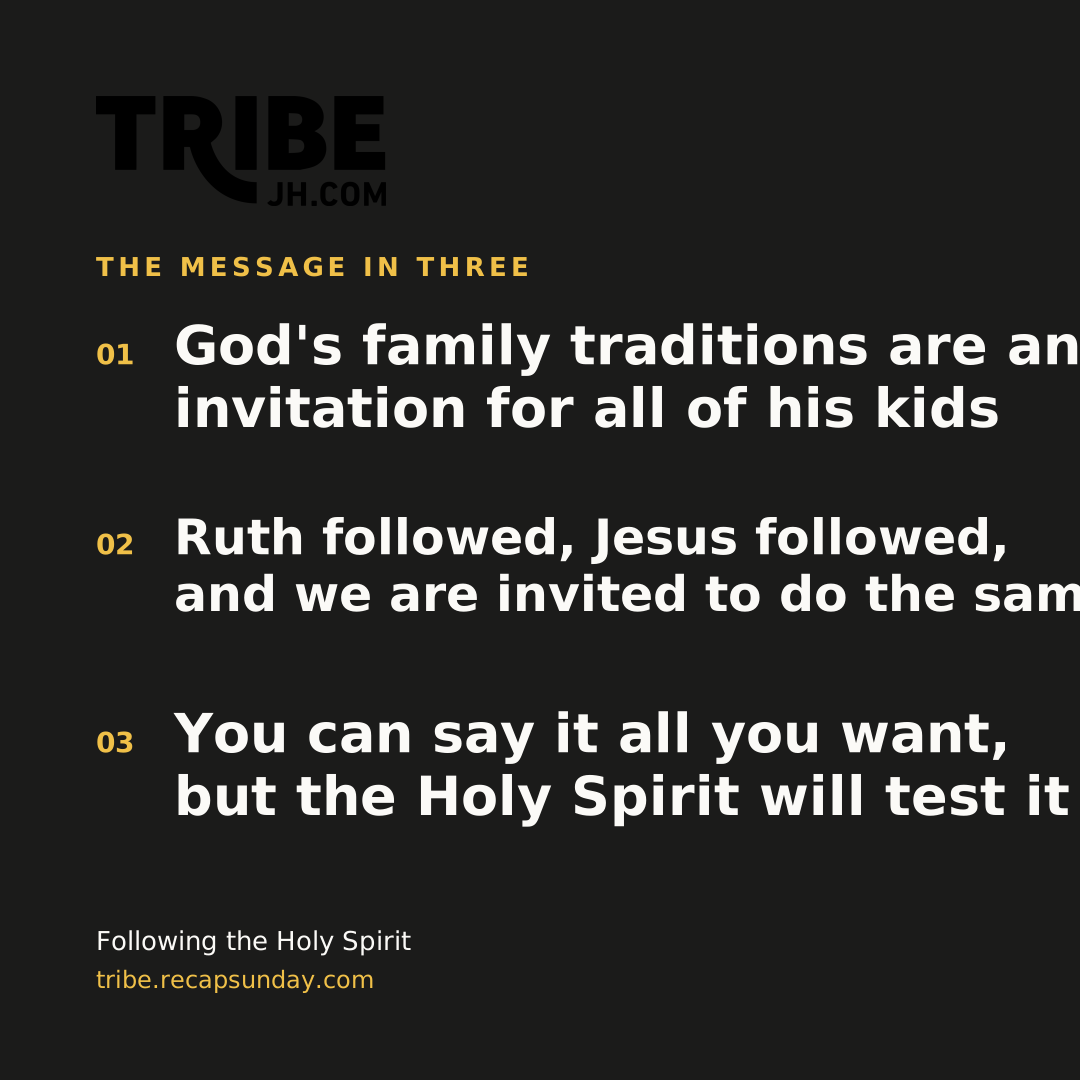
Brian opened by framing Shavuot not as a Jewish feast that doesn't concern Gentiles, but as one of seven family traditions God established for all of his kids. Every one of those traditions carries three purposes: to help us remember what God has done, to recalibrate when we have drifted, and to rehearse events that haven't happened yet. Four of the seven have already played out in history; three, including the final gathering, are still ahead. The point of rehearsal, Brian said, is so that when those events unfold, we can do what Peter did on the day of Pentecost and say "this is that" rather than losing our bearings like everyone else.
The Deuteronomy 16 passage introduced the idea of a voluntary, proportional offering. Brian pointed out that God doesn't set a fixed amount here. He just says bring whatever you want, in proportion to how I've blessed you. That structure forces you to actually think through your blessings before you give, and Brian connected it to the childhood dilemma of which cookie you hand to your mom when she asks for one. The big one is the right answer and every child knows it. The point is that a good parent uses that moment to train generosity, and God is doing exactly the same thing.
Ruth came in as the text traditionally read during Shavuot, and Brian drew out three moments where following is the explicit action: Ruth committing to go wherever Naomi goes, Boaz telling Ruth to follow his workers through the field, and Ruth telling Naomi she will do everything she says. The pattern, Brian argued, is an invitation for us to follow the Holy Spirit in the same way. He also paused on Naomi's attempt to rename herself Mara, and noted that the narrator of Ruth keeps calling her Naomi anyway. The Holy Spirit, Brian said, is only ever going to call you by the name he has for you, not the one you've assigned yourself out of grief or failure.
The Luke 4 passage showed that Jesus himself was led by the Spirit into the wilderness, not into Rome or Jerusalem, not into an obvious next step. Brian used that to make the point that the Holy Spirit's direction is often a hard right turn or a U-turn from what you expected. He brought a kid up to the front to illustrate it simply: if Huxley says "I'll follow you anywhere" but Brian walks the opposite direction from where Huxley already wanted to go, whether Huxley actually follows reveals what was already in his heart. The Holy Spirit isn't trying to fake anyone out, Brian said, but he does take divergent paths to show us what's really there.
Moses came up as the Old Testament example of someone called to the right thing but doing it in his own strength. He killed an Egyptian, ran, spent forty years in the desert being deprogrammed, and then at eighty was finally ready to try again, this time partnered with God rather than operating independently. Brian's point was that the calling didn't change, only the source of the effort. The same work that failed under Moses' own initiative succeeded under the Spirit's leadership, and that pattern, he said, repeats throughout scripture and in ordinary life.
Brian closed by returning to the idea of a well-trained working dog, one that stays close without needing a leash, that goes exactly where its handler goes the moment the handler moves. That, he said, is the picture of what walking in the Spirit is supposed to look like. Not straining against a leash, not running off toward the bison in the field, but moving in freedom that is so well-practiced it looks effortless.
Touch points
Things you could actually do this week.
Go back through your week and write down specific ways God has blessed you, then let that list shape how generously you respond to him.
Catch up on the Walking in the Spirit series on Spotify, iTunes, or YouTube if you missed any of the earlier conversations.
When you feel the Holy Spirit nudging you in a direction that surprises you or costs you something, resist the urge to read hard circumstances as a sign you are off track.
Stop using a name for yourself that God would not use, and replace it with what he actually says about you in scripture.
If you are a man, show up to the men's Bible study Monday at 6PM at the TMC, where the group is working through a book on walking with the Spirit.
Doing a Bible study?
Here is a guide we have prepared for you: the passages
in order, questions for the group, and room to write.
Brian talked about God's family feasts being an invitation to remember, recalibrate, and rehearse. Which of those three feels most alive or most lacking in your own life right now, and why?
The free will offering in Deuteronomy 16 is voluntary but guided by the principle of giving in proportion to how God has blessed you. What would it actually look like for you to sit down and take stock of what God has done for you before deciding what to give back?
El pastor Brian cerró la serie "Caminando en el Espíritu" durante la semana del Shavuot, una de las siete tradiciones familiares que Dios estableció para todos sus hijos. Explicó que estas fiestas no son solo "tradiciones judías" sino invitaciones del Padre a recordar lo que ha hecho, recalibrar el rumbo y ensayar lo que aún está por venir. La ofrenda voluntaria de Shavuot, que se da en proporción a las bendiciones recibidas, nos entrena en generosidad, igual que una mamá que le pide a su hijo que le traiga una galleta cuando sabe perfectamente que el niño quiere quedarse con la más grande.
La historia de Rut sirvió como hilo conductor. Rut siguió a Noemí, siguió las instrucciones de Boaz y siguió el consejo de su suegra, y en eso vemos una imagen de cómo se supone que nosotros sigamos al Espíritu Santo. Brian señaló también que Jesús mismo fue guiado por el Espíritu al desierto, y que esa guía no siempre lleva a donde uno espera o quiere ir. A veces el Espíritu da un giro brusco o incluso da vuelta en U, no para engañarnos, sino para revelar lo que realmente hay en nuestro corazón y para mostrarnos que él tiene un plan mejor. Así como Moisés intentó ser libertador por su propio esfuerzo y tuvo que pasar cuarenta años en el desierto antes de intentarlo de nuevo bajo la dirección de Dios, nosotros también aprendemos a no operar en nuestra propia fuerza.
La paz del Espíritu, la Palabra de Dios y la comunidad local de la iglesia fueron señalados como guías confiables para saber si estamos siguiendo al Espíritu o siguiendo nuestro propio camino. Las circunstancias difíciles no son señal de que Dios nos ha abandonado, como pensaba Noemí cuando quiso llamarse Mara. La escritura, señaló Brian, siempre la llama Noemí, porque Dios solo nos llama por el nombre que él tiene para nosotros.
---
Pasajes bíblicos usados
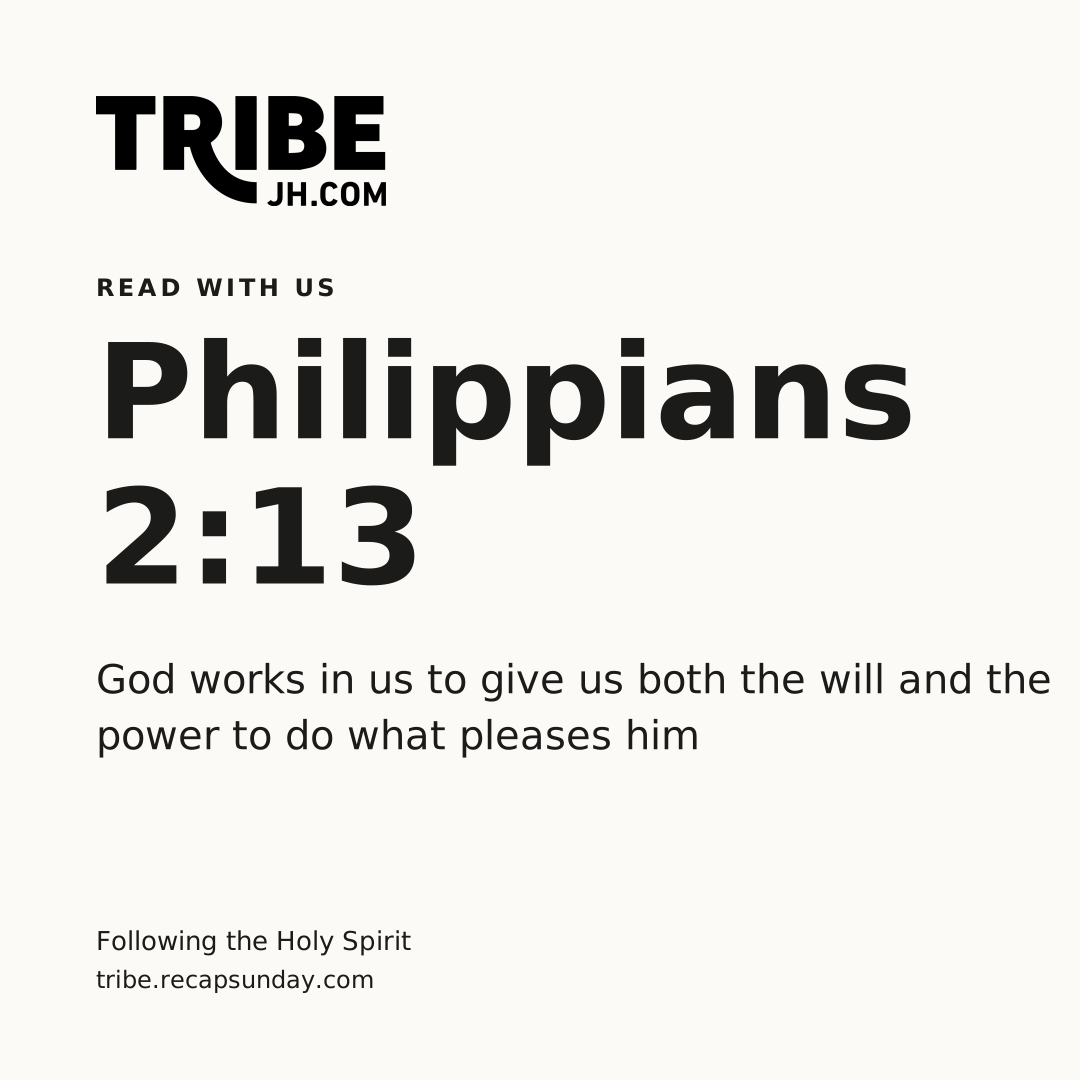
Filipenses 2:13
Deuteronomio 16:9-12
Rut 1:1-22
Rut 1:16
Rut 2:8-9
Rut 3:5
Lucas 4 (Jesús lleno del Espíritu llevado al desierto)
Eclesiastés 3:11
Joel 2 (citado por Pedro en Hechos 2)
Read the full transcript8,440 words
Are you ready?
God, thank you for this day. God, thank you for another beautiful day that we get to be in your creation of God. Thank you for those that are here and those that are not God. Thank you for this tribe, and the work that you're doing here in Jackson, God.
Thank you. It's been a lot this morning. Good morning.
To help us bridge from from the first type of worship into the next type of worship, Lee shared a bible verse with me that he goes like the Lord put in his heart,
and I thought it would
be great. Would you just stand up and share that with us? This is actually in the Bible. Yes. Is.
Everything you say is good. It's not like, well, for once, you're sharing the Bible. You're always sharing the Bible, but it's amazing that this verse is in the Bible.
Jesus, through the Holy Spirit, the scripture, the truth, says, he gives us desire to be obedient, and he gives us the power to do what pleases him. So I'm gonna pray for myself and for all of us and ask, holy spirit, that's that you help us to step into the truth Amen.
The address for that verse is Philippians two thirteen, and it says, for God is working in you to give you the power to obey him and the will to do what pleases him. Amen.
Thank you.
Imagine if he didn't give us that. So, like, pleasing the Lord was entirely up to us in our own
strength. Yeah. Yeah. I'm doing that.
And anything done in our own strength, he's like, it doesn't impress him at all, no matter how impressive it is. Yeah. But when we come to him, Lord, help me. Yes. He's like, oh, I'm all over that.
Yeah. And please remember you and the rest of us, please remember what what Lee said because you were not at first service this morning. No. No. You're still you're you're still on So your well, the rest of us were at church.
So those of you who are about my age and grew up watching the Dukes of Hazard and happen to live in Idaho, it's all about to pay off for you. Those who watch the Dukes of Hazard know exactly what I'm talking about. For the rest of you, you really missed a great joke. Right? Dukes of Hazzard come on, Lee.
Dukes of Hazzard I don't know the name, but I The general Lee? I was watching Dudes of Hazard and Airwolf and okay. Alright. So, guys, there are some connect cards in your seats. If you're newer visiting, you can we'd love to have a record of your visit.
Yep. He's got one right there. Just fill that out. You can either leave it in your seat and put it in a drop box. Why is it that between first service and here we are at second service, like, we got so many, like like, new faces and visitors, and if you're new, you have no idea.
Trying to figure it out. But it's great to see you. I'm I'm so impressed that you found us. Normally, every week, we meet in a bar. This week, we happen to be meeting in somebody's upstairs living room.
This is the TMC Triad Ministry Center. This is where we have our offices. We bought this building during the in the middle of COVID, and we thought, what in the world are we gonna do with it? And this space has proved so useful and helpful and valuable and just a great blessing from the Lord for two years during COVID and and since then as offices. We do bible studies out of here, meetings, prayer gatherings, young adults meet here.
We have meals here. And so this week at the Virginian, they're having an event and the space was unavailable to us. So we just pivot and we meet here. This is a great stretching so that we don't get what do you call the word? Calcified.
I'll use the word religiously calcified into, like, wait a minute. I can't check the box of church unless we're meeting where we normally meet Because the church is not a space. The church is what? It's a people. It's a people.
It's a gathering of people. Wherever two or more gathered in my name, I'm right there in the midst. So whether we're doing church in a bar or upstairs here or as a gathering in a community of whether you're passing through or you call the tribe home, I'm so glad that you found us here in this upper room. We'd love to have a record of your visit with that connect card, and we're going to get into today's conversation. Today's conversation is going to tie a bow on a series of conversations that we've been having about what we're calling walking in the spirit.
Now I understand that that can be, like sound like a churchy phrase, walking in the spirit. Hey. Are you walking in the spirit? I'm walking in the spirit. Brother, are you walking in the spirit?
I've just been walking in the spirit all week. What in the world does that even mean? Well, we've spent five weeks talking all about it. And I do use that word conversation intentionally. Here in this venue, it feels a little easier to have a conversation because all I need to do is just like lean forward and here we are.
Right? You lean forward, you're on the worship team this morning. But I want this to be a conversations to to help you engage with the material and what we're talking about. And I don't want this to just be a monologue, but a dialogue. I wanna hear from you.
So if
you have
questions, comments, connection, it's it's really conducive to be able to to do that right here in this venue. But even when we're meeting at the Virginia, I want to hear from you. And so periodically throughout this morning's conversation, I'll check-in with you and I'd love to hear your contribution. It just makes the everyone's time much more rich. And it's gonna be hard for me to not kinda think of like, who is who is David Letterman's like sidekick on the keyboard?
Or, like, you know, like, all, like, the evening talk shows, like, have, like, somebody. I'm gonna need you to be quick on the keys if I have a joke. Yeah. Let's just try Oh, okay. Try that.
If I have a bad joke? Okay. There'll be no bad jokes. Alright. So we're gonna tie a bow on the conversation that we've been having, and we're we're gonna we're going to break together several different threads here and then tie them in a bow because not only we're going to wind down this series of conversations that we've been having on walking in the spirit.
And if you're just jumping in with us, you can go to Spotify, iTunes, or YouTube to catch up on all the conversations that we've been having. But we're gonna tie that thread together with a family tradition of the Lord that we're going to honor and recognize today. And the third thing that we're going to to tie together is I completely lost my train of thought, but the third thing will come to me. If you had your bible with you this morning, turn to Deuteronomy chapter 16. I remember the passage that we're going through today ties into a trip a passage that is traditionally read as Jewish people honor this feast.
I got it. Deuteronomy chapter 16, and in a moment, we're gonna we're gonna read a few verses together. But this is the week of God's family tradition of Shavuot. Now I I also use that phrase intentionally. What you might be familiar with or you've heard of, like like out there, is Jewish feasts.
And and the word Shavuot, like that word means nothing to us as Gentiles, but it means a lot to Jewish people and religious Jewish people, the feast of Shavuot. But I used the word family tradition intentionally because that's really what this and seven other major feasts are of the year. They're God's family traditions. Now I don't know about you, but in our family, we have a lot of, like, little sayings that we've picked up from, like, movies throughout the year and, like, we throw these we throw these sayings out that really only our family understands. And if you spend a lot of time with some other family, like, we pick up your phrases and you pick up our phrases.
And so we have this, like, mingling of family phrases and also traditions. One of our family traditions is whenever somebody's coming to visit us, we walk out on the edge up a hill and we wait for them to, like, come, like, driving down the highway and then turn up. We wait and wait and wait, enjoy the company while they're here. And then when they're done with their stay, we say goodbye, hugs and kisses and all that. They get in their car.
Nana and papa were just here, and they drive down the driveway. And when they turn out on
the highway, where did we do? Say love? Staying on highway.
Yep. Yep. She's in the Hunter family. We stand on the edge and we wave and honk because that's what Nana and Papa did whenever their daughter, Lissa, who's now my wife, like, that's what they did in their family. We've just adopted that into our family.
And so in a similar way, God reveals himself to mankind as a father and a good father. You don't you aren't a father without a family. And if you're in a family, every family has family traditions. God established seven major family traditions that he invites all of his kids to participate in every year. And you might have been thinking of them as Jewish feasts for your whole life and your church might not have ever had anything to do with them, and that's fine.
But God invites all of his kids into these seven family traditions. And this the one that we're going to recognize and honor today is found and founded in Deuteronomy chapter 16. Would somebody please read out loud verses nine through 12. There's the address right there on your screen. Deuteronomy 16.
Would somebody read out loud verses nine through 12?
You. Remember that you were slaves in Egypt and follow carefully these decrees.
So this family tradition, in your bible, it might say feast, it might say festival. Think of it as God's family tradition. If you think of it as a Jewish feast, that's only because the Jews happen to be the first ones to be invited in to celebrate that feast. But numerous places in the bible, it says, this is my feast. This is my family tradition that I'm sharing with you, says the Lord.
And so when you read this passage right here, this is the feast of the family tradition of the harvest, otherwise known as Shavuot. So as we read that little passage right there, what are what's maybe a detail that jumps out at you? What do you notice about that? What strikes you as interesting for networking? Everyone's invited.
Everyone's invited. Now, let's take it a little bit deeper. What what do you think God is getting at? Are all of the feasts or God's family traditions for everyone? Not all of them, but this one is.
What is he what do you think he could be up to?
Just take a guess. Yeah. Yeah. Yeah. Yeah.
Yeah. Just like,
come on, guys. Lava granny shot him.
Showing that he's welcoming to all and furthering that fellowship among the people and also just proving that a Yeah.
Yeah. Remember when Ebony's or Scrooge, like, has that, like, turning and, like, he's running up and down the street, Merry Christmas, everyone. And he's, like, getting the goose, and he's, like, everybody come. And then Tiny Tim says That was absolutely perfect. Right?
Like like, God, he God hasn't had a change of heart. He's been like the redeemed Scrooge all along, magnanimous, generous, and in this particular family feast, he's like, bring everybody. That's a great observation from that passage. What else do you notice? I am trying to steer you towards one thing.
Person at the first service pointed this out and and it's worth coming back around to it again. I give you hints in verse 10.
It's not in every translation either. Oh. Help us.
What is what somebody read your verse 10 out loud. I have the NLT. Does everyone have a verse 10? Good. Okay.
Take
a crack at reading aloud. Feast of the weeks to the Lord your God with a tribute of freewill offering from your hand, which you shall give as the Lord
your God bless you. Excellent. Verse 10, then celebrate the feast of the harvest to honor the Lord your God. Bring him a voluntary offering in proportion to the blessing you have received for him. Now what can somebody unpack that for me?
What is interesting or significant about that? I'm not looking for you to be a bible scholar, but how does that strike you? What is interesting about that to you? Voluntary. Voluntary.
It's not the 10%. It's not yep. It's something more. It's more or who else? He says it's oh, to you.
Were you gonna say something? Yeah. Just yesterday,
we were having a conversation about, like, grace and how there's common grace amongst us. That, like, god gives us blessings to the evil to wicked and the good. Mhmm. The the rain falls on everyone. And this is just kind of a recognition to recognize that god has blessed us with so much and given us so much.
That it's not just us saying, okay. I'm fine. I'll give my stuff to you. But it's going, alright. Give it in proportion to the blessings that the Lord your God has already given you.
And so now it's just a moment to just present that back. Yeah.
What does that do for you when you hear that? Like, hey, give back to the Lord whatever you want. And then there's just a little caveat. Here's here's a here's here's a little guiding principle. In proportion to however the Lord has blessed you.
But give what you want.
You know what that I think that that does for me or would do is because I have to discern my blessings. I have to think, you know, I'm not asking god how have you blessed me. It's like, okay, Lee. What's up? Where where are these blessings?
What are they? I have to think about them. I have to write them down or put them in my mind. And then I think what would happen is I would give proportionately or, you know because now I've discerned, he's blessed me so much. I I hope that
I would want to give them more. Sure. More than proportionally. Do you think the Lord is not for the sake of of anything mean, but do you think that the Lord has or keeps a record of all that he has done for you? A 100%.
He knows all that. He knows it. Yeah. He knows. Yeah.
It's been his gift. It's been his gift. It really puts the responsibility on our shoulders. Yes. It's not like you said, bring a tenth.
Okay. Or other times, bring the very best. Okay. Well, here's my 10% very best. Okay.
I bring that done. This is a different offering that the Lord invites Israel and us to to bring to him. Whatever you want in proportion to how I've blessed you. Oh. You know that our parents were training on the training us on this since we were little kids.
Right? Whether you grew up in a Christian home or not. Your parents trained you in this very principle. Okay. Let let me let me take you back to your childhood.
Mom's in the kitchen and she bakes a fresh batch of chocolate chip cookies and the whole house is filled with the smell of chocolate chip cookies. And as a kid, you're just like, oh, I can't wait. You finished watching Dudes of Hazard. You're about to go outside, play all day, drink from the hose, but first, you need a chocolate chip cookie. Right?
So chocolate chip cookie cookies come off the plate off the off the cookie sheet and onto a big pile. You ask mom, can I have a chocolate chip cookie? And she goes, sure. Would you bring me one? And so you go, you get two cookies, and you come back to mom with two cookies.
What's the dilemma? You gotta give one. You gotta give one of them to mom. But what's the dilemma?
The big one or the small one?
Right. Which cookie do you
give to mom? Does every child intuitively know the correct answer to that question? Do you intuitively know? What is the correct answer to the question? Big one to mom.
The big one goes to mom. You know that deep down in your heart. But what's the dilemma?
You want the big one. You want the big
Oh, can I always do that?
You want the big one. Why do you want the big one? Because you're selfish. Parents, did you have to teach your child to be selfish? No.
No. Did you have to teach your child to lie? No. No. Did you have to teach your child to be brave?
No. That's just already in there. Mom is training you. Would you bring me one too? She's up to something.
So you come back to mom with two cookies and mom hasn't said, bring me one too, but I'll take the bigger one. She doesn't say that. She just says, bring me one too. She's giving you an opportunity, number one, to test to see what's in your heart. Number two, to give you an opportunity to to train you in being what?
Generous. Generous. How many of you remember that dilemma? Maybe it was like last week, you know, when it's like I'm like, man, maybe I'll go for a bowl of ice cream unless he's like, I'll take one too. I was an only child.
You know how hard that is for me even at my age? I come back with one bowl of ice cream and she's like, you didn't offer me one.
I was like, oh, I forgot. We go, okay. Do what?
You got two cookies there. Which cookie are you gonna give mom? This is a principle of good parenting. The lord says, bring me an offering of volunteer. What whatever words your translation was.
A voluntary offering. Whatever you want. But he's training us to be generous. And this is just one of of many principles that that a good parent and our great parent, our heavenly father, is always training us in. And in fact, seven times a year, there are seven different family traditions that he invites us to be a part of.
And each one of these family traditions all has three components to it. I'll I'll put them right up here on the screen all at once. He invites us oh, yeah. The chart. Let's go to that chart real quick.
No. No. No. Go to the three things. Okay.
Sorry. And then we'll go to the chart. We honor the feast. There are three three purposes every time. To remember.
Remember all that he's done for us. Remember the journey that we've been on. He invites us to utilize the feast to help us recalibrate. Man, I kind of like have like been drifting over here towards the guardrail, then I'll be in a ditch. But but when we celebrate the feast of Shavuot, God invites us to bring a free will offering to him.
However, the Lord has blessed you. It causes us to remember and then to recalibrate. Man, I've been living like a selfish little brat. I need to recalibrate. And then finally, the last one is to rehearse.
Why why that last word? To rehearse. Why is part of each one of God's family tradition why is the purpose to invite us in to rehearse? First of all, what does rehearse mean? To something that Is to come.
Is to
come or will happen in
the future. Why do we why does God have a family tradition for something that hasn't happened yet?
Because one day we offer him feast for him. Mhmm. We got the life we can afford. Mhmm. We're have a heart right.
You're so right. One of the things that has been told to us in this book but hasn't happened yet is the wedding supper of the lamb where Jesus sits down with the bride of Christ, which is us, and we have the most incredible wedding celebration and party and dinner the universe has ever known. And he wants us to prepare for that with a rehearsal. Was somebody gonna say something else? What does it profit a man to gain the entire world and forfeit his soul?
And he's like, practice now denying yourself, laying down your life. But if he gives his life away, he'll get that and so much more in return. He's he's inviting us to practice these things. Okay. Now go to my chart.
I don't know why this resolution is so bad. Just squint your eyes and it clears up. Sorry. But these are the seven different feasts that the Lord invites us to, seven different family traditions that the Lord invites us to on a yearly basis. Now tell me, what's that big red line across the chart four?
Future. What is it? Future. Future. Four of these feasts have already played out in human history.
Three, we're still running a rehearsal on. Mhmm. So that when we see these events play out in human history, and I believe that they very well could be all three within our lifetime in in quick succinct order. Just like Peter said on the day of Pentecost when he stood up and he addressed the crowd in Jerusalem, he said, this that you're seeing is that that the prophet Joel spoke about. Peter remembered.
His heart was correctly calibrated. He had been rehearsing Jews have been rehearsing these events for thousands of years so that he could connect the dots when he saw it play out. The rest of the world, when these future prophetic events unfold on planet Earth, literally, the stuffing is gonna come out of the brains of so many people around the world. They're gonna lose their marbles. Not us.
We'll be like Peter. We'll be able to say this that you're seeing in these world events is that. And that's exactly what he said as he was quoting Joel chapter two. These men are about drunk as you suppose. It's only ten in the morning.
But the prophet Joel said that that I'm going to pour out my spirit upon all flesh, and that's what you're seeing. So this feast, the feast of Shavuot, has a a gentile Christian counterpart. What do we know this feast as? What do what do Christians in the church know this feast as? You can go either forward or backward one slide.
Maybe backwards. There we go. What do Christians celebrate? It's a churchy word. Christmas.
Did you say Christmas? Christmas. Okay. So so that's a great idea. You're onto it.
Not Easter. What is it? Pentecost? Yeah. Yeah.
Especially those happy clappy churches. Oh, yeah. Yeah. That's funny. You're at a happy clappy church, the way.
We just didn't have room for the banners and the runners. The flags. The flags. I love them. Hey.
Bring those. Lanisha. So so Gentile the Gentile church, that's that's us, celebrates an equivalent. It's a bummer that the Christian church has tried to really separate itself from God's family feasts and many wonderful, amazing of God's traditions that that carry right through the filter right through the cross. But but we think of Shavuot, like, we've never even talked about it, probably at the church that you've come from.
But what we talk about is Pentecost. The the when Jesus gives the Holy Spirit to the church in Acts chapter two to the disciples who were gathered in the upper room. But what we're going to look at today we started in Deuteronomy chapter 16. What we're going to look at, and if you wanna write the title of today's conversation at the top of your notes, is following the holy spirit. With this coming week of Shavuot, we're going to read a passage from a story that's told in the Old Testament that a lot of Jews read during this feast.
So the next place that we're going to turn in our Bibles is the book of Ruth. Baby Ruth.
Ruth.
I'll give you a little bit of background. So Ruth is this woman from the region of Moab, not Utah, but Region 10. Okay. Every week now. Ruth is a Moabite.
She's from this region in in in Moab out in like like Mesopotamia. And she married a guy who, end of the story, like a unfortunate sad country western song, he dies. But his dad has already passed away and his brother's passed away. Poor Ruth. She's having a hard time.
So the the matriarch of the family, the mom of this family is this woman named Naomi. Her husband dies and then her daughter-in-law is widowed because Ruth's husband dies. Are you with me? Yeah. That that's not too complicated, teenyologically.
Right? So we're gonna pick up this story where not only Ruth, but there's another woman who married one of these brothers, and the sad part is that brother died too. Poor Naomi. She's had it she's had it rough. So let's pick up the story in chapter one, and we're gonna read verses one through 22.
Read just a few verses, and then and then hand it off and somebody else can keep reading, and we'll get all the way from verse one to 22.
The man's name was Ellen. His wife's name was Naomi, and the names of his two sons were Malin and Killion. They were
Ephesians. You're
Then Eleonelac died, and Naomi was left with her two sons. The two sons married a Moabite married Moabite women. One married a woman named Orfa, and the other a woman named Ruth.
The Lord grant you that you may find rest, each of you in the house of her husband. Then she kissed them, and they lifted
up their voice and left. And they
said unto her, surely, we will return with thee unto thy people. And I always said, turn again, my daughters. Why will you go with me? Are there yet any more sons in my womb that they may be your husband? Turn again, my daughters.
Go away. For I am too old to have husband. And if I should say, I have hope. And if I should have a husband also tonight, to also bear sons, would you tarry for them so they were grown? Would you stay for them from having husband?
No, my daughter. The
reason why God established this and Jews celebrate it is because it coincides with the agrarian calendar. There's all kinds of calendars that we interface with on our normal life. And if we talk about Jews for just a second, they have a religious calendar, they have an agrarian calendar, and they all, like, interface work. And their calendar is essentially based off of lunar cycles. We follow the Gregorian calendar, which is based off of solar cycles like years, and we have to have leap years.
But but similarly, we also interface with a lot of other calendars. Like, what's an example of another calendar we interact and interface with? JDR? Yeah. Yeah.
Yeah. There you go. Yeah. Ski season, off season, on season. Yes.
Yes. You're exactly right. I was looking at you. I don't know. Mom?
School calendar. School calendar. Like, they all are kind of, like, intermeshing and and and fitting in together with one another. And so so it's not it may sound like a difficult or foreign concept to understand, but but we're always interacting with multiple calendars that we have spun up in our in our life rhythm. And so this feast is celebrated because the text and Ruth is often read because it says, this happens.
They arrived in Bethlehem in late spring at the beginning of the barley harvest. Two other quick broad observations is is that that I saw at first service I wanna share with you at this service is, number one, look at the intimacy between Naomi and her two daughter in laws. Man, she loved those girls. Not family by blood, but she must have done something really wonderful and nurturing that that look at the language that's used. Like, I'm gonna go with you.
They were weeping. They're hugging. They're kissing. Naomi is caring. She's like, if I could just bear you children, right now I would, but that's just not feasible.
So look at that relationship and and see the tender care of the Lord for you in how Naomi cares for her two widowed daughter in laws. There's just so much girly affection in there. Right? When guys when girls see each other like, oh
my gosh, your hair. Look at that dress. Have you lost weight? Oh.
Guys see each other and they're like, hey. You packed all those LBs, That's just how guys talk to each other affectionately. Okay. Maybe that's only how I talk to guys I love. Second thing that I want to show you here is is this, is verse 20.
She's like Debbie Downer. Don't call me Naomi. Call me Mara. And yes, she has gone through a lot of grief. But I love what verse 22 says.
So what does the author of the book of Ruth call Mara? What does what is what do they call her? Naomi. The scriptures are inspired by the Holy Spirit. The Lord is like, I'm only ever going to call you by the name that I have for you.
What name have you tried to put on yourself that is silliness? Damaged goods, failure, whatever. Don't call me by the name that the Lord has for me. Just call me messed up, bloated, dropped the ball again, failed. God's like, uh-uh.
My name for you is Naomi. He sees you, and he sees the potential in you. Yes, he sees your shortcomings and your failures because nothing escapes his sight, but that is not the way he chooses to relate to you on the basis of your merit. He chooses to relate to you based upon his nature and character. And so why would you call yourself anything less than what God has to say about you?
Well, I don't know what
God has to say about me. Well, you gotta you gotta pick this up. I love what you cooked up to make me look up. You said I could pick your brain if I just pick your book up. And ever since the day you and I hooked up, life has been super fly like Jimmy Snooker.
Now in the same way that Ruth followed Naomi, we are invited to follow the holy spirit. Three different occasions in the book of Ruth. This is a big theme that comes up out of the book of Ruth. How Ruth follows. She follows Naomi.
She follows Boaz. Let's look at these places.
I'll put them up on
the screen here. In chapter one verse 16, but Ruth replied, don't ask me to leave you and turn back. You hear this sometimes quoted at weddings. Wherever you go, I will go. Wherever you live, I will live.
Your people will be my people, and your God will be my God. Jewish scholars say that this is often say that this is the first Gentile convert to Judaism. Ruth follows Naomi. Look at this. You can write this address down.
Chapter two verse eight and nine. So Boaz, he is he ends up, spoiler alert, marrying Ruth and being a great husband to her. Boaz went over to Ruth. Ruth is super poor. She is she is destitute and homeless.
And she is going behind people that are harvesting the spring harvest. And there is a law in in Jewish law that says don't pick your crop to the very edge. Don't be so greedy, but leave some of your crops on the fringe of your fields as as a system of welfare. Notice this, if you're in need of welfare, you still gotta go out and work and harvest it yourself. Mhmm.
But we're gonna help you. And so that's what you see playing out here what Boaz does. In chapter two verse eight and nine, Boaz went over and said to Ruth, listen, my daughter. Stay right here with us when you gather grain. Don't go to any other field.
Stay right behind the young women working in my field. See which part of the field they are harvesting and then what? Follow them. Follow I have warned the young men not to treat you roughly, and when you are thirsty, help yourself to the water they have drawn from the well. Follow.
So in chapter one, we see Ruth committing to Naomi, I will follow you. In chapter two, we see Boaz saying, follow my servants that are harvesting the field. And then additionally in chapter three, look at verse five. Naomi is giving Ruth some instructions, and Ruth says this, I will do everything you say, Ruth replied. So she went down to the Freshman Floor that night and what?
Followed the instructions of her mother-in-law. So when we read the story of Ruth during the season of this family tradition of Shavuot, we can see that Ruth followed Naomi, Ruth followed Boaz, and we, in a similar fashion, are invited to follow the Holy Spirit. But watch this. In the same way that Ruth followed Naomi and Boaz, Jesus followed the holy spirit too. Look at this.
Luke chapter four. Let's take a look. Wait. Almost like you saw that coming. Luke chapter four.
I'll put it up on the screen here. Then Jesus, full of the Holy Spirit, returned from the Jordan River, and he was led by the spirit into the wilderness. Quick side note on following the Holy Spirit. There's a big difference between following your own, even best intentions, but coming originating from yourself, your own passions, pursuits, even if you're good at it, even if you happen to make a lot of money at it, whatever it is. There's a difference between following your path and following the leadership of the Holy Spirit.
And oftentimes, I have seen in the Bible, in my own life, and in lives of people that I shepherd and pastor, the holy the the person will say, I'm following you, Holy Spirit. I'm following you, Holy Spirit. And the Holy Spirit's like, okay. Let's try this. Brink.
And it's a right turn. Sometimes a hard right turn. Sometimes it's a u-turn. Why does he why does he why does he when we say, I'll follow you anywhere, Holy Spirit, why does he sometimes take a u-turn and go the opposite direction? To see if we're committed.
To see if we're committed, but does he already know? Yes. Why? Because he's omniscient. He knows everything.
So yes, he does it for that reason, but why else does he do it?
We learn
from it. We learn from it. But it really what does it show us?
He has a better plan.
It shows us that he has a better plan, but it really reveals what's in our own heart already. Yeah.
I'll
Okay. Show Hux, you come up here. Stand right here. Okay. Now you say, Brian, I will follow you anywhere.
Brian will
follow follow you you anywhere. Anywhere. Okay. But the desire of your heart is to go in that direction. Right?
That that's what that's what you're gonna do. Say it again. There you go. Now, sit while you're active. Ryan, I shall follow you anyways.
Oh, great choice of vocabulary. Okay, Huxley. Follow me. Okay. Follow me.
And then I go this way. And then he goes off that Is he following me? No. No. Because that's the direction alright.
Come back. That's the direction that he wanted to go. Now what if Hugs and we're standing here, stay there. And Hugs said, I shall follow you anywhere. And I go, that is so awesome.
That is great. Fantastic. I believe you. And then I never go anywhere. I never see what's going on with him and he is never tested to really know what's in his heart.
This is a huge, huge, huge principle in following the leadership of the Holy Spirit. You can say, I'll follow you, Holy Spirit, all you want. You can get bumper sticker. You can even get it permanently marked on your body, and then you can even show people with your little thin script of your, like, shrimpy millennial tattoo? Peter.
I'll follow you anywhere. Peter. Holy Spirit. Yep. Said Peter.
But the proof is in the pudding, and the holy spirit will often take a a a course contrary to what you think, anticipate, or even want to test you. He doesn't he doesn't like Like he's not trying to fake you out. That would be cruel. Like what if I said, Hugs follow me and then I just like I just took off and we're gone. That's cruel.
That's not fair. That's not what he does. But he oftentimes takes a divergent path of what he thought, anticipated, or even want to show you what's in your heart. How how really how really really are you to follow him?
So I'm still still struggling here. Okay. So how am I going to at what point do I know that I've missed the holy spirit? I'm following. Something's got holy spirit's gotta come back and say, hey.
You screwed up me or something. Otherwise, I wouldn't know. That's great.
Does that make sense? The bible in the book of Romans says that our own conscience bears witness with us. It either condemns us or it it congratulates us. Yeah. And so what that verse meaning is every single human, whether you follow Jesus or not, the bible says in Ecclesiastes three eleven, God has planted eternity in the human heart.
What that means is every single human throughout all of history has a compass in their heart that if you had a real compass, it points towards magnetic north, but there's a compass in your heart that the red needle is always pointing towards the throne room of God by way of the cross of Jesus. And whenever you do think or say anything, it will either line up with that bearing and your conscience will say, great job. You're taking a step towards God. You're following or walking in the spirit or following the leadership of the Lord. Or a divergent path, the Holy Spirit does not keep condemnation, but he says, hey, you're off course.
So
something
about my peace has been disturbed or there is no peace or something.
So so circumstances can be a poor indication of whether or not you are following the leadership of the holy Spirit. And most beginner Christians get hung up on that. They run into hard times, they run into trouble, and they're like, well, guess it's not the will of the Lord because this is hard. Hudson Taylor, the founder of the Inland China Mission, the first missionary to China, described the work of the Lord in three phases. Anybody remember that quote?
The work of the Lord comes in three phases. Impossible, difficult, and done. Right? And so so circumstances can be a can be a very poor indicator of walking in the spirit. But you just said it, the peace of the holy spirit that surpasses all understanding is a great guide.
His word is a great guide. When you're in the context and and community and fellowship of a local church, the prophetic gifting, speaking words of direction and encouragement and exhortation can be a great guide. His word, I love what you cooked up to make me make them.
So I can make you bring them if I just make you look them. His word. Thanks, dad. Naomi Naomi thought God had come against her with the loss of her husband and her sons. She called herself she wanted to rename herself.
Mhmm. But in fact, she was in God's plan with Ruth. Yeah. That ended up blessing her at the end of her life. Yeah.
So she walked a lot of years saying, God, have you left me? Mhmm. So the death of of a close member of the family can be thought of as being God has forsaken me.
There's so many things in our life that we that happen as a result of living in a fallen world that we attribute or blame or accuse God for. He's like, I didn't do that.
Recognizing that we've split from the Holy Spirit's path for us and following are following our own path, I think also provokes us to humility,
which I think is so fucked up. Here's what's you're just showing. Here's what's really interesting. So so we've gone on this path, but we haven't followed the leadership of the holy spirit. When we come to that point, even if we have success, even if it looks like it's all working out to us, that we pick our head up from the pig's lot.
We come to our senses. We come back by the conviction of the holy spirit. We come back under his leadership and guidance, and he's like, now, let's try it again under my leadership. The exact same thing. Now is there a biblical precedent for that?
You tried it in your own strength and you just messed it all up. It is what God's called you to do, but you were doing it in your own strength. You you you come back to the Lord and he's like, let's try it again, but under my leadership. That's not the one that I was thinking of, but that's so good. He was zealously pursuing the Lord, but legalistically.
Yeah. Oh, it's a good one. I'm thinking of an old testament example. Paul. Sorry.
Paul is a great example. I'm thinking of an Old Testament example. Moses. Well, who said that? Moses.
And how did he what was he called to do? What was he called to do by God? That's my view. To be a deliverer of the people. But he did it wrong the first time.
How? Killing an Egyptian. Committing murder. You'd have to kill a lot of Egyptians to liberate a million Jews from pharaoh. So he was doing what God called him called him to do, but not under submission being partnered up with the holy spirit.
God's like, hey, let's go take a time out. It happened to be a forty year time out in the desert. He messed up. And then after forty years so he was 40 years old, committed murder, ran away, spent another forty years getting deprogrammed from the Egyptian. At 80 years old, remember, it's never too late to get synced up with the plan of the Holy Spirit.
God's God's like, alright. Let's try it again. This time, one, two, five. Moses like, okay. God's like, I'm gonna equip you.
Here's a stick. You got all you need? Jesus, full of the holy spirit at about 30 years old, knowing that he was the messiah, savior of the world. Where you want me to go to Rome, kick down the door of Caesar's palace? You want me to go right into Jerusalem, kick out the Roman garrison?
What are we gonna do? Should I start a band? Like, here we go. And the holy spirit was like, come on. Let's go.
Alright. And takes him right where? Into wilderness. Into the wilderness. The book of Hebrews says that Jesus learned obedience through the things that he Suffered.
Suffered. Some suffering that you experience is a result of your own sin, Like when you step on a rake and it snaps you in the face. You did that, bro. Other suffering is that that that fight, that conflict, because your compass, your conscious is saying follow the holy
A police officer being trained by the policeman or military service member. And I I just felt like I heard the Lord say, like, that's, like, what I want my relationship to be like for you. He's like, I'm training you for a very specific purpose. And I don't wanna have to have you on a leash to yank you every time you're trying to run right away. He's like, we need to
be
there. You're walking in complete freedom. But wherever I go, I love those videos. Seem like moves. Yeah.
Or like with Hudson, like, as soon as they flip around, the dog is just right on their head. Right? What an awesome way to live. I was talking with this guy, Ryan, right after first service, and I followed this Instagram page called Tourist of Yellowstone and I saw this video of like, there's a bison out there and like somebody like opened their car door and their dog just paves off towards the bison. And what do you what do you think happened?
They're like, oh, look.
I'm jet here. What's price?
But like, I think that's also what we're tempted to do. It's just to operate in independence and on our own strength and go out and do something. But what a better way to live with the Lord equally yoked in him. And he's trained us up to where he can eventually say, go get a police dog or whatever or military service dog does exactly what they're afraid to do. So I just wanna keep that picture in mind as I pray over our tithe and offering here today.
If you don't mind bowing your heads with me. Father, we wanna stay close to you. Forgive us for the ways that we are tempted to go astray and and run off and give our attention, time, talent, treasure, things that you're not asking us to do. Us to stay in tune with you, to hear your voice, to be obedient, to be your hands and feet, Lord, in this valley here everyone said. Amen.
If you do try, a couple ways you can give are online. There's a gift tab on our website, drivegh.com, or if you go downstairs outside on the side of our building next to, like, the coffee table, there's little black box. You can drop cash or check-in there. Or if you filled out your connect card today, that's another great spot for
you to go ahead and put
that on the back of those connect cards. If you've been coming to try for a while, there's prayer requests. Like, that's where you write those in. We love writing over those in staff meetings, things like that. And then the last one to give is my personal favorite, which is opening a text to 84321.
It's easy as texting us friend in the McDonald's house. A couple quick announcements are we're back in Virginia next week. Just 10AM service like what you guys just did today. Good job. You found us.
We'll be back in Virginia. Gotta keep it keep it fresh. Gotta cover this up on you guys. Full u-turn. See if you guys can follow us there.
Yeah. We got TMA sign ups if you look over on the fridge. Couple different events going on this summer here in June. It's a great way if you're new or if you're not new to just connect and have shared experiences with people. I didn't know how to climb, like, nine to two weeks ago.
Brian took me and I out.
Nina did better. Yeah.
Nina did do way better and taught us how to touch wild rocks. I've only ever done our official ones, so it's a very different experience. Really cool way to learn and just let me yoke together. PB, did I miss anything? Men's bible study.
Men's bible study. Tomorrow, 6PM here, we meet. We're going through a book called Journeying Towards the Spiritual by Watchman Ephesians. And it's teaching us how to walk with the spirit just like with this series is going over. So we really encourage you guys to jump in.
Feel free to talk to me or Brian. We'd love to get you guys connected with that. Okay. Raise up. Yep.
Thanks, Jay. Stand up. Let me pray for you. Hey. If you don't take away anything else from this morning while you're here in Jackson, Literally and spiritually, don't get horned by a buffalo.
Let me pray for you. Lord Jesus, thank you so much for inviting us into your family tradition. Help us to walk in the spirit and be submissive to your great and wonderful leadership. I command a blessing over each and every person here today. Help us to have a great week.
We love you so very much. We pray these things in Jesus' name, the strong son of God. And everybody said Amen. Amen. Thanks for joining us here at the PNC.
We'll see you at the Virginia next week. Have a great week. And remember,