The passage this message was preached from, in full, with every other passage it reached for.
Matthew 9:14-17read aloud as the primary text on new wine and wineskins
14 Then John’s disciples came to him, saying, “Why do we and the Pharisees fast often, but your disciples don’t fast?”
15 Jesus said to them, “Can the friends of the bridegroom mourn, as long as the bridegroom is with them? But the days will come when the bridegroom will be taken away from them, and then they will fast.
16 No one puts a piece of unshrunk cloth on an old garment; for the patch would tear away from the garment, and a worse hole is made.
17 Neither do people put new wine into old wine skins, or else the skins would burst, and the wine be spilled, and the skins ruined. No, they put new wine into fresh wine skins, and both are preserved.”
read aloud as a parallel account with additional details
33 They said to him, “Why do John’s disciples often fast and pray, likewise also the disciples of the Pharisees, but yours eat and drink?”
34 He said to them, “Can you make the friends of the bridegroom fast, while the bridegroom is with them?
35 But the days will come when the bridegroom will be taken away from them. Then they will fast in those days.”
36 He also told a parable to them. “No one puts a piece from a new garment on an old garment, or else he will tear the new, and also the piece from the new will not match the old.
37 No one puts new wine into old wine skins, or else the new wine will burst the skins, and it will be spilled, and the skins will be destroyed.
38 But new wine must be put into fresh wine skins, and both are preserved.
39 No man having drunk old wine immediately desires new, for he says, ‘The old is better.’”
The message in order, in a few minutes of reading.
This message was the first week of a short series called New Wine and New Wineskins, prompted by a question from a congregation member the week before. Brian walked the room through what Jesus actually meant when he used those images, and the congregation worked through it together in conversation. Communion closed the service as a direct encounter with the new wine Jesus described.
What was said
The passage comes from a moment when followers of John the Baptist challenge Jesus: why don't your disciples fast the way we do, the way the Pharisees do? Jesus answers them not with a direct defense of his disciples but with a series of images, a wedding party, a patch of new cloth on an old garment, and new wine poured into old wineskins. Brian pointed out that Jesus was not being scattered or random. He was drawing his audience into something deeper than the surface images, the way a parable does, even without the explicit signal of the word "like."
The congregation noticed several things in the two readings side by side. Luke's version adds a closing line that Matthew does not have: no one who has been drinking old wine wants the new, because they say the old is better. That line raised a real question in the room. If the new wine is so good, why does Jesus say "no one" wants it? Part of the answer that emerged was that without the Holy Spirit, a person simply cannot see clearly enough to recognize or want what God is doing. The NLT softens it slightly to "seems to want," which Brian noted as worth sitting with.
Brian drew a distinction between the specific and the general meaning of new wine. Specifically, the new wine is the new covenant Jesus came to establish, a way of being made right with God through faith rather than law-keeping. He pointed to Matthew 5:17, where Jesus says he did not come to abolish the law but to fulfill it, and to Romans 3, where Paul states plainly that God has shown a new way of being made right with him, apart from keeping the law's requirements, through faith in Jesus Christ. For anyone who has been in church a long time, Brian said, those words can slide past without landing. He asked the room to try reading them as someone stuck in a rut of trying to earn God's approval, and noted that saying these things out loud is what got both Paul and Jesus killed.
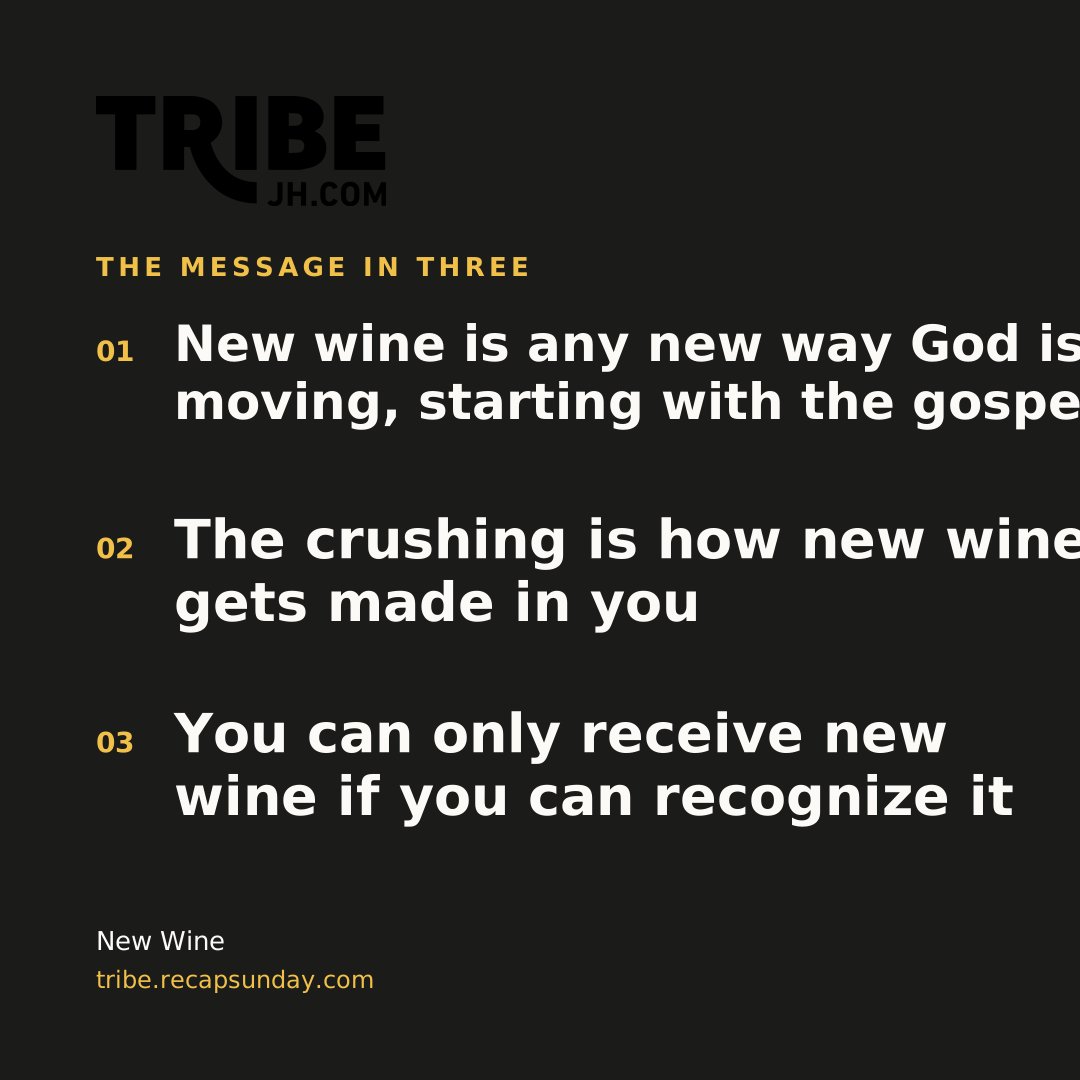
Generally, the new wine represents any new way God is moving, with the firm boundary that he will never act inconsistently with his character as laid out in scripture. The congregation supplied examples: the Pentecostal and charismatic movements, the spread of church into unexpected spaces, the resurgence of smaller discipleship-focused communities over anonymous megachurch attendance, and a visible new unity among churches and parachurch ministries in Jackson Hole. Brian affirmed all of these as legitimate examples of new wine being released, and noted that recognizing it in the past helps a person spot it when it appears in the present.
The homework Brian left the room with was a single question to bring to God during the week: where and how are you releasing new wine over my life? He was clear the answer is not whether God is doing it, but whether a person can recognize and receive it. The wineskin, meaning the container, he said, is the subject for next week.
Touch points
Things you could actually do this week.
Ask God this week to show you specifically where and how he is releasing new wine in your life.
If you have a prayer request, fill out a connect card and leave it in the box by the doors so the staff can lift you up at their next meeting.
Read Matthew 5:1-17 on your own and sit with the question of what the new wine Jesus describes means for your daily life.
If you need prayer, find John and Kate Micas and let them pray with you.
Take one verse from this week's study and try to restate it in your own words, the way Brian asked the congregation to do in the service, so it moves from something you know in your head to something you actually believe.
Doing a Bible study?
Here is a guide we have prepared for you: the passages
in order, questions for the group, and room to write.
Brian pointed out that Jesus jumps from a question about fasting straight into talking about wineskins and fabric patches, suggesting he is getting at something deeper than the surface topic. What do you think Jesus was really trying to communicate by doing that, and why do you think he chose those particular images to say it?
Several people in the room observed that Luke ends the passage with 'no one after drinking old wine wants the new, for they say the old is better.' Where have you seen that resistance to new wine play out, either in your own life or in church culture generally?
El domingo pasado, Brian exploró la pregunta que hizo Nancy la semana anterior: ¿qué quiso decir Jesús cuando habló del vino nuevo y los odres nuevos? La conversación partió de dos relatos del mismo evento, uno en Mateo y otro en Lucas, donde los discípulos de Juan le preguntan a Jesús por qué sus seguidores no ayunan. En lugar de responder directamente, Jesús habla de remiendos en ropa vieja y de vino nuevo en odres viejos. Brian señaló que Jesús no estaba hablando literalmente de vino ni de cuero, sino de algo mucho más grande: una nueva manera de estar en relación con Dios, no a través del cumplimiento de la ley ni de la religión de rutina, sino a través de la fe en él.
La congregación participó activamente en la discusión. Juntos llegaron a esto: el vino nuevo, de manera específica, es el evangelio, el nuevo pacto que Jesús vino a establecer. De manera general, el vino nuevo es cualquier forma nueva en que Dios está obrando. Se mencionaron ejemplos concretos: el movimiento del Espíritu Santo en el avivamiento de la Calle Azusa, la unidad entre iglesias y ministerios en Jackson, el regreso a comunidades pequeñas de discipulado, y hasta la propia Tribe como expresión de una iglesia que no sigue los moldes tradicionales. Brian dejó una tarea para la semana: preguntarle al Señor dónde y cómo está derramando vino nuevo en tu vida ahora mismo.
El servicio terminó con la comunión, donde Brian recordó que Jesús tomó una tradición antigua, la Pascua, y la convirtió en el vehículo del vino nuevo, su cuerpo y su sangre como señal del nuevo pacto. La próxima semana la conversación continuará con la segunda pregunta: ¿qué representa el odre nuevo?
---
Pasajes bíblicos usados
Mateo 9:14-17
Lucas 5:33-39
Mateo 5:1-12 (mencionado, no leído)
Mateo 5:17
Romanos 3:21-23
Romanos 8:1-2
Colosenses 3 (mencionado por un miembro de la congregación)
Read the full transcript11,283 words
Check. One, two, three, four. Oh, no audio for the livestream?
Well, we're going. Good job getting here on time. Yes. Good job honoring everybody who is able to get here on time. Here's a funny vortex.
You start worship and there's all these faithful people in the seats. We end worship and we have to bring in chairs. So just watch as this, like, little situation happens. Let's see. If you're on an end, perfect as long as people can get in between you, like scooch in or you know what I mean?
Like scooch in or scooch out, whichever you think is more appropriate. You decide. Why don't we stand together this morning? Let me pray for us as we get started today. Lord Jesus, we thank you for today.
We acknowledge that you are the reason that we're here, not even just in this room today, but you're the reason that we're here. Here on this earth, we thank you that you are our creator and that all you long for from us is our surrender and our worship. So that's what we're doing this morning. We're just giving back to you. The only thing that we have, we can't earn your love.
We could never deserve your love, but Lord, we can surely thank you for it. So we tell you that we raise a hallelujah, a praise to you today in Jesus name. And everybody said, amen. Let's worship together. The presence of my enemies.
Just fix your eyes on him. I'll raise a hallelujah. Louder than the unbelief. I raise a hallelujah. I raise a hallelujah.
Yeah. My weapon, yeah. My weapon is a melody. Yes, it is. Yes, it is.
I raise a hallelujah. Heaven comes to fight for me. Come on, I'm gonna sing. And I'm gonna sing in the middle of the storm louder and louder. You're gonna hear my praises roar up from the ashes.
Hope will arise. The death is defeated. The king is alive. You believe that this morning? I'll raise a hallelujah.
Yeah. With everything, with everything inside of me. Yes, I do. Yeah. I'll raise a hallelujah.
Yeah. And I will watch the darkness flee. I'll Louder and louder, you're gonna hear my praises roar up from the ashes, hope will arise. Death is defeated, the king is and sing that again. I'm gonna, oh, I'm gonna sing in the middle of the storm, louder and louder.
Louder than the unbelief. Sing a little louder. Weapon is a melody. Sing a little louder. Heaven comes to fight for me.
Sing a little louder. Heal the presence of my enemies. Sing a little louder. Oh, louder than the unbelief. Sing a little louder.
I'm gonna Yeah. Oh, to you. I'll raise a hallelujah. Yeah. I'll raise a hallelujah.
Yeah. Oh, yeah. I'll do, lord. Just give the lord praise this morning. Just say thank you from your heart this morning.
Lord, we thank you that we are free this morning. Oh, we're free this morning because who the sun sets free is free indeed. Amen? Just close your eyes with me before we continue on worship. I feel like sometimes the first song is just like a frontlines battle.
I like my voice will be great, rehearsal goes great, and then all of a sudden I I start to sing and I just I don't know. I just I I think it's sometimes underestimate that you're worrying worrying in the spirit when we come to worship. So let's just with our eyes closed for just a minute, let's just ask the Lord. Maybe it's been a long time since you've talked to him. Just ask him, Lord, would there be anything today that would keep me this morning from experiencing your presence, from hearing your voice this morning.
Let him just search your heart today. Maybe it's been a long time since you've prayed or talked to God and maybe today you're just like, Lord, here I am. I know it's been a while. And let him just wrap you up. His word says that one glance of your eye towards him ravishes his heart.
He doesn't scold you. He just wraps you up and he says, okay. I've been waiting. Lord, thank you that we are free today to enter into your presence because whom the son set free is free indeed not because of our works but because of what you did on the cross. So we praise you for that and we declare that this morning that we're free.
Whatever lies we're believing is not because it's truth, it's because we're just believing it. We're free from the bondage of sin and death today. Yes. Whom the sun sets free is free indeed and the rain all chains can hinder me. Hallelujah.
Yeah. Yeah. Hallelujah. Just praise him for that truth. Whom the sun sets free is free indeed and there ain't no chains can hinder me.
Hallelujah. Yeah. Yeah. Yeah. Yeah.
Hallelujah. Who's free this morning? Whom the sun sets free is free indeed and the rain on chains can hinder me. Hallelujah. Hey, yeah, yeah, yeah, hallelujah.
Come on, sing. Whom the sun sets free Oh, we praise your name. Hallelujah. Oh, we praise your name. When the sun sets free is free indeed and there ain't no chains.
Hallelujah. Oh, yeah. Yeah. Yeah. Hallelujah.
You got it. Let me hear you singing. When the sun sets free is sun sets free is free indeed and there ain't no change can hinder me. Hallelujah. Yeah.
Yeah. Yeah. Hallelujah. Whom the sun sets free is free indeed and there ain't no chains can hinder me. Hallelujah.
We're so thankful God. Hallelujah. One more time. Whom the sun sets free is free indeed and there ain't no chains that can hinder me. Hallelujah.
Oh, we're free today. Hallelujah. Just say hallelujah. Hallelujah. We praise you, Lord.
Hallelujah. Hallelujah. Hallelujah. Come on. Lift your voice and praise.
Hallelujah. Oh, we praise you, lord. Yeah. Hallelujah. We thank you, Jesus.
Hallelujah. We thank you, Jesus. Hallelujah. We praise you, Lord. Yeah.
Hallelujah. We praise you, Lord. Hallelujah. You're worthy, Lord. Hallelujah.
We thank you, Jesus. Our god sing how great is our god how great is our god sing with me how great is our god oh we'll see how great is our god. Yes, you are lord. How great how great is our god. Sing with me how great is our God.
Oh, we'll see how great how great is I got. Oh, you sound so good. Let's sing. You're the name above. Fill this room.
You're the name above all day. You're worthy. Is our God. Just in your own words, right there, you just thank him. Just thank him.
Thank him for all that he's done and as he recalls things to your mind, just thank him. Lord, thank you. Thank you, Jesus. Lord, we thank you that even in the storms, even in the crushing, that you are pouring out, pouring out your spirit on us. Your word said that when, when hard times come, not if, that when hard times come, Lord, you will not forsake us, you will not leave us, that you're closer than our very breath.
So we thank you that even in the pressing and even in the crushing that you are there. We just yield today and we just say, Lord, in that those hard times and in those doubts that we would press into you so that we could be a vessel to be used by you. That's how oil is made. That's how wine is made. The grapes have to be crushed.
The olives have to be crushed in order to produce something new and that God doesn't cause the crushing in our life. But this fallen world does and he'll use it. He'll use it to bring beauty out of ashes. Amen? So just thank him.
I know it's sometimes hard. Thank him for the hard times. Thank him for those seasons. Thank him that he shows himself faithful in those. Lord, make new wine in us today.
In the crushing and in the pressing, you are making new wine. So I yield to you and to your careful hands. Because when I trust you, I don't need to understand. Here's our prayer. Make me a vessel.
Make me an offering. Make me whatever you want me to be because god I came here with nothing but all you have given me Jesus bring new wine out of me Just mean that this morning. Cry out to him in the crushing. In the crushing. And in the pressing.
You are making new wine. And in the soul, you lie. And now surrender. You are breaking new ground. You're breaking air.
You are breaking new ground. So I yield. So I yield to you and chew your careful hands. Yes, Lord. Because when I trust you, I don't need to understand.
Because make me a vessel. Make me an offering. Make me whatever you want me to be. God, I came here with nothing. All you have given me, Jesus bring new wine out of me Jesus Jesus bring new wine out of me because where there is new wine I'm gonna And all we can ask is, Lord, you'd make us a vessel.
So make me a vessel. Make me an offering. Make me whatever want me to be. God, I came here with nothing. And all you have given me, Jesus, bring new wine out of me.
Jesus, Jesus, bring new wine out of me. Yes, Lord. The only one you You're the only one who care. You're the only one who care. Oh, there's nothing.
Oh, there's nothing. Nothing is better than you. I just declare there's nothing better. Lord, there's nothing better than you. Lord, there's nothing always faithful.
Better than you, Lord, Lord. There's nothing. Nothing is better than you. Oh, We declare that as truth today. There's no amount of money, no relationship, no job, nothing that can provide us with more peace, more comfort, more hope, a deeper love, a deeper connection than you, God.
Nothing this world has to offer as good as it is and as good as the gifts that you give us here on this side of heaven, Lord. There is nothing of this world that can compare to you. When we dig in, when we press into you, when we seek what you think first, Thank you that you are a good, good father to us, one that is trustworthy, worth putting all of our trust. You are the only one that we do not have to guard our heart from. We lay it out freely.
Thank you for who you are. We give you all the praise in here for all these amazing worshipers in here today. I ask that you would meet every single of us right where we are today in our walk with you. If we're far from you, that we would take a step and we would run into your arms today. And then if we've been walking with you for a long time that you would reveal new fresh wine, and that we would have a new fresh vessel to hold what you're teaching us today.
We tell you we love you, Jesus. And everybody said, amen. Turn around and say good morning. Say good morning. It's a good day to worship the Lord.
Thank you.
Thank you. Good morning. How are you? Good, man. Great to see you all this morning.
Great to hear your voices being lifted to the king. He is worthy. He is worthy. He is worthy. He's worthy.
In your seat, there's a connect card. And if you're new or visiting, we would love to have a record of your visit. There's also a couple special things on that connect card. We do a lot of our communication through text blast. And so we communicate with you through a text blast.
And if you'd like to be added to that list, just fill out your phone number there. But there's also a way for you to communicate with us if there's a prayer request that you have. We take these very seriously at staff meeting, and we would love to lift you up in prayer. You can fill out that connect card. Either leave it in your seat or put it in the little offering box there by the doors, and we'll make sure to, like, take notice of that.
If you have your bible with you this morning, we're going to look at two different places, but the first place that we're going to go is in Matthew. Matthew chapter nine, And we're going to camp out on a specific topic for just a couple of weeks. And this sermon series actually came from a question last week, a series of conversations that we're going to have. And last week, I believe it was Nancy that asked like, alright, so we're talking about new wine, wineskin, like, could you just break that down and and help me to understand exactly what you're talking about and, like, what does Jesus because they're the words of Jesus. What did Jesus mean when he was talking about this?
And that question was was really simple and really profound. And so, we're gonna take just a couple of weeks and have a discussion about this idea of new wine and new wineskins, so that we're all on the same page, because I feel that it's very important for us to be on the same page as we talk about this subject to help give you a baseline, all of us, to give you a baseline knowledge and understanding of perhaps some deeper things that we'll talk about coming up. And so, well, with that in mind, the first place that we're going to turn to is Matthew chapter nine And, who is running the mic around today? Oh, Kat is. That's great.
So, one of the things that we like to do here at Tribe is not only have a conversation, which means I look forward to hearing from you, even if you haven't been here in a while because you've been traveling and you've been out and about, but now you're back. I love I love for us to be able to talk together and engage with the text together. And so, you have questions, comments, or there's a little hyperlink in your brain, something that you're thinking of, another bible passage or something, then I want to hear it. And all you have to do is just raise your hand. Kat will get the mic to you, and then the reason why we have the mic in the room is we could probably hear you without the mic in the room, but all of our families that are watching the livestream, they get to engage and participate, So, that's why we have the mic in the room.
We're going to start in Matthew chapter nine and would somebody please read verse 14 through 17.
If I do Matthew, someone else gets Luke.
Okay. Deal.
One day, the disciples of John the Baptist came to Jesus and asked him, why don't your disciples fast like we do, the Pharisees do, and the Pharisees do? Jesus replied, do wedding guests mourn while celebrating the groom? Of course not, but someday the groom will be taken away from them and then they will fast. Besides, who would patch old clothing with new cloth for the new patch would shrink and rip away from the old cloth, leaving even bigger tear than before. And no one puts new wine into old wineskins, for the old wineskins would burst from the pressure, spilling the wine and ruining the skins.
New wine is stored in new wineskins so that both are preserved.
Great. And then let's take a look at Luke chapter five. Ryan, you loved that. I know you did. Luke chapter five verse 33 through 39.
So, Mark tells the exact same story but the details are are very similar between Matthew and Mark And so, we could read Mark, but it's very similar. So, Luke gives a few more details, says it a little bit differently. This particular if you wanna touch the corner of your glasses and say pericope, which is just an isolated, either a parable or a story or an incident, something that happens that's kind of self contained, you can call that a pericope. But, Matthew and Mark are very similar. Luke is a little bit different, so we'll go right to Luke.
Chapter five verse 33 through 39.
Okay. They said to him, John's disciples often fast and pray and so did the disciples of the Pharisees, but yours go on drink eating and drinking. Jesus answered, can you make the friends of the bridegroom fast while he is with them? But the time will come when the bridegroom will be taken from them in those days, they will fast. He told them this parable.
No one tears a piece out of new garment to patch an old one. Otherwise, they will have torn the new garment, and the patch from the new will not patch the old. And no one pours new wine into old wineskins. Otherwise, the new wine will burst the skins. The wine will run out, and the wineskins will be ruined.
No new wine must be poured into new wineskins. And no one, after drinking old wine, wants new for they say the old is better.
I'm curious why do you ask that? Did something stand out to you that was
Different than mine, so I'm just curious.
Okay. Anything from your version that you wanna, like, highlight or read or contrast? Okay. So, this is a a great first opportunity to check-in with you. Either between the two stories that we just read, the it's the same event as told by two different biographers.
What did you notice? Either difference between the two or similarities between the two. And if you need to use your fast Bible fingers and flip back and forth to reference those, what did you notice about these two different stories? And again, at this point, we don't need you to go deep into deep spiritual meaning or anything, just observations about what we just read. What do you see?
If you just raise your hand, Cat will get the mic to you.
Similarities is they both start off with fasting, and then they go into the new wines and new wineskins. And I have always kept those two subjects kind of in separate categories. Like, there's fasting and feasting, which is what Luke doubles down on. And then there's wine and the old wineskins. And I am just thinking, what is the connection?
Why did Jesus use that as his answer? That's my deep thought for the day.
That's great. I love to pose questions that aren't necessarily answered. It activates your sense of wonder. It weans you from being spoon fed all of the answers. It forces you if you're willing to engage with the question in the conversation, it forces you to instead of just hearing my answer, it forces you to consider what your conclusion would be about the matter.
I like that. Great question. All the way up here, Kat, thank you.
I'm far from a conclusion,
but I do have
something that I've noticed, that is back in that time, when it says at the end of the Luke passage, it talks about that the old wine or that the new wine is better. Well, our culture thinks the opposite. Our culture thinks the longer a wine ages, the better it gets, and that is true. But we have, modern bottling and ways to store it. Back then, I think it was very different in that they used wine even in cases, as they do in some parts of Europe even, where that is more safe or more readily available, easier to preserve.
Their water might have been bad, but they certainly didn't have bottling like we have now. So I think there is a little bit of info there on that last part of Luke that says the new is better. Well, back then it probably was.
Yep. Certainly. Because of of storage and the alternative to drink, brackish water or perhaps unclean water, fermented wine was sterile. And I like how you're noticing a detail. In this story, Jesus makes a point that would be commonly understood that new wine was more fresh and better than old wine in old wineskins, because the wineskins were organic.
They were made of the bladder of an animal or the stomach of an animal. And so the longer that that wine sloshed around, the more So I like how you're noticing. In our day and age, older wine is better. It's aged better, vintage. I am so wine illiterate, I couldn't tell the difference between a bottle of $19 wine and $900 I wouldn't know.
You're going to waste it on me. But in those days, the point is that new wine was more fresh. I like that. That's not what the NIV says. Well, let's hear what the NIV says.
Right. Right. So the new wine was better, but the people preferred the old wine.
And no one, after drinking old wine, wants the new, for they say the old is better.
Yeah. I'm used to that slight goat flavor.
They say it's
They say it's better. Better.
Okay. I want my old I
just want my old ways. So you are we got all kinds of discussions happening. I think I like this. Two of you, like Do we need two mics? And you just Ah.
Okay. So we're going to tackle two very important questions that I will pose in just a moment. Hold on to that.
Okay. I think the best example I can think of in what Holy Spirit brought to me is, it's just like you have a pair of shoes that you love or a pair of boots that you love. One day, the side rips or the sole comes loose. But those are my favorite shoes. You go to the store and you buy a brand new pair just like those, and you think, I had forgotten how comfortable the insole was in this because I have worn the old out.
Sometimes it's hard to let go of the old. Well, I had this experience with God or I had that experience with God. No matter how long you've been walking with him, that experience is awesome. Sometimes it's hard to let go and say, I want the more. Sure.
I want the new.
That's great. So let's let's pose two two big questions that we're going to tackle. What does the new wine represent? What is Jesus talking about? And then what is the what does the wineskin represent?
Sometimes we've heard these stories so frequently and so often that we take them for granted, new wine, new wine, skin, da da da. But if you were to sit down at Pearl Street Bagel with somebody that has never darkened the door of a church, and they're like, hey. I've got some Bible questions for you. And you're like, okay. Great.
Shoot. And they say, my first question is, what is Jesus talking about when he says a new wine? New wine. What does he mean? What does he mean?
What is he talking about? So those are the two questions that we're going to tackle. What does new wine represent, and what does a new wineskin represent? So with that in mind, considering, Nancy, the great question that you've asked and the discussion that is happening, let's tackle this first question. What does new wine represent?
Let's get into this. What does new wine represent? There is well, this is like I'm just you know, I'm letting I'm allowing you to marinate in the question, if you will. What does new wine represent? So consider think about how how you would answer that question.
How would Jesus answer that question? What does new wine represent?
Can I add
Oh, yeah? Yes. Sorry. Sorry.
So the I kinda geeked out on this a while ago, just watching YouTube videos. Because Mark just asked, do we actually use wineskins anymore? And so I've seen video where this guy made a wineskin and then was actually fermenting the wine within the wineskin. And when the fermenting process happens, it expands. And so I feel like the new wine in this situation is the spirit, the holy spirit being alive and moving and doing new things in the midst of the body.
If you're set in a certain practice and your wineskin is like, okay. I go to the same place every Sunday, and I sit in the same place. And then we stand, and then we sit, and then we see this prayer. And it's a routine. It dries and cracks so that the holy spirit has nowhere to go.
And we break in the expansion and the movement of the holy spirit, and we don't we don't get more like you were talking about. We don't press into the new thing that the Holy Spirit's doing
in the church.
You're onto it. Is Joy has her hand in the back. We'll just race you all over the place today, Kat. Hopefully, you're tracking your steps for your splat points. So one question that needs to be asked preliminarily as you're studying the word when Jesus says, it's what does he say?
Do wedding guests fasten more besides and no one puts new wine into a wine skid. So they're so they're talking about fasting. He starts talking about wine. So we have a clue, just looking at the text, we have a clue that perhaps even though Jesus is talking about wine and fabric and garments, that that's not really what he's getting at. It is safe for you to assume that Jesus means something more than.
And any English teachers or English majors in here would be able to look at the text. Well, all of us could. We can look at the text. But there would be a tip-off that's not it's not in the NLT. It could be in another version.
But there's a couple of clues, words, grammar that can be used to give you a hint that Jesus perhaps is talking about more than what he's talking about. What would those words be? Like or as. So as soon as you see those words, it is like a man who owed a great debt. Like, oh, uh-oh.
This could be a parable. Jesus is talking about more than an actual, so we don't see that here. But the fact that they asked about fasting, and then he goes off talking about fabric and patches and wineskin, he's not crazy. It's not like he's ADHD, like some of us, like, in his brain, it's scattered. He's trying to draw us into something a little more.
So you're on the you're on the right track. Joy, what were you gonna contribute?
I've always heard this teaching about the wine and the wineskins as the overall concept is that when you're either presenting the gospel or when you are, you know, I guess, doing life really in ministry, the methods of how you do that ministry or how you teach or whatever speaking to what Renee was saying about, like, this the where you go to church and, like, what seat you sit in and all these things. Like, the methods change, but the message never changes. And so the idea that, like, we never get away from the bare bones of the gospel with Jesus, the only way to heaven is through Jesus and accepting his sacrifice for our sins, That message never changes. But the method, the way that we present it, the way that we, you know, the way that we do church in a bar, as opposed to in a building or as opposed to around a table, those things may change. But the but if we get so stuck on our quote, unquote old wineskins, which would be the old methods, then then it actually is detrimental to the to the message.
Like, we need to change some of those things as we're going along. I was thinking about the connection with fasting too, and we can put probably, Jesus was trying to put spiritual disciplines into this into this category as well. Like, the the early church was very regimented maybe in the way that they practice spiritual disciplines like fasting. And so they're questioning because they found that the fasting you know, like, what why aren't they doing that? Like, that is the thing that we are supposed to do every time.
Like, we always similar to we always have church on Sunday mornings, and we have to go and sit in the same seat and sing two to three songs, and then we're out by a certain time. It's the same idea. Like, they just had gotten so hung up on the fasting part that when the disciples weren't fasting and Jesus is claiming to be the son of God, they were like, well, no. That can't work out. And he's like, no.
No. No. Listen. The methods are changing, but the message has never changed. And I don't think that it means that we throw out fasting or we throw out spiritual disciplines.
That wasn't his point because he said there's gonna be a time for that too. But the idea here is that while some things change around it, we keep our message always the same.
I love it.
Yeah. Joy, thank you for, saying in the beginning that you never you don't know how it's related to fasting. Because I've read this so many times and was always like, what does this story have to do with fasting? How is this answering the question? But as I've been sitting here listening and also I've been reading the chronological bible this year and like seeing a lot of the ways that people expected Jesus to show up.
And, like, you know, he's all the different ways that he was supposed to be from different places. You know, like, he would be called a Nazarene, but he would be called out of Egypt and all of these different things. They're like, well, it can't be this because he was supposed to be called this. And then but god answered all of those things. And similarly, they were constantly just looking for ways that he was not the messiah.
And so, like, Joy just said, like, you're supposed to be fasting if you're and, like, that's our tradition. And so I think it's a way for him to say, like,
bup bup bup bup.
I might not show up how you want me to show up or be exactly how you thought I would show up. And you better be willing to, like, open up your paradigm so that you can hold more and get the fullness of me when I'm here. Not to steal your sermon.
And with every head bowed and every eye closed, we will now receive our tithes and offerings, hear some announcements, and go home because the word of the Lord has been preached. Well said, well said, well said. I love how we can weave together. That's I I love the conversational format of Tribe because you've said more and in different ways in a few moments than I could have in a number of weeks. And so I love these contributions.
What does the new wine represent? I'm going to we're going to answer that question generally and specifically. So I don't have this in the notes, but you can write down in your notes Matthew chapter five verse one through 12. Right now, we are looking at defining, digging into what does Jesus mean by new wine. What is he talking about?
This new wine. What is this new wine you speak of? Matthew chapter five verse one through 12. We're not going to read it, but what is the title of that section? The Beatitudes.
That is that's that's the new wine right there. Let's look in another place. Stay in Matthew chapter five, but jump ahead to verse 17. And I believe this one is on the screen. Don't misunderstand why I have come.
Oh, my gosh. There's so much to unpack right there, meaning there's a really good chance that you're going to misunderstand why I've come. So at the front end, I'm going to get out ahead of this and pre warn you. Don't hear what I'm not saying. Don't misunderstand what I'm about to tell you.
If you have eyes to see and ears to hear, you're gonna be able to pick up what I'm putting down. I did not come to abolish the law of Moses or the writings of the prophets. No. I came to accomplish and to fulfill their purpose. Romans chapter three.
You can write this address down and or click on Romans chapter three. Verses 21 through 23. But now God has shown us, some translations add the word, a new way of being made right with him without keeping the requirements of the law. As was promised in the writings of Moses and the prophets long ago. Oh, look at this.
But now God has shown us a way to be made right with him. Alright? I'm with you. Without keeping the requirements of the law? Wait a minute.
What are you talking about? And then he says, it's been in your Torah all along. You might not have seen it, but it's been there all along, you guys. He says that. And the prophets long ago, verse 22, we are made right with God by placing our faith in Jesus Christ.
And this is true for who? Everyone. Everyone who believes no matter who we are. This Paul saying these words in the book of Romans was saying in a different way what Jesus was saying with his life and ministry and with his teaching. We just have it distilled and and said stated very plainly and clearly.
For us, two thousand years later and if you've been going to church, if you have invited Jesus to be the leader of your life, you read that, and you're like, yeah, Okay, sure, got it. Yep, it's how I got saved. I'm one of those. But try to read those words as somebody stuck in a formulaic, rote, ritualistic, law keeping rut of trying to earn right relationship with God. This was I mean, it literally got Paul killed for saying this.
It got Jesus killed for saying this. It was so disruptive. It was so countercultural to what had been the tradition for 3,500, two thousand five hundred years. They couldn't stand it. What is the new wine?
This right here. In fact, in the margin of your bible, you can write new wine. Another verse. Romans chapter eight. So now, there is no condemnation for those who belong to Christ Jesus.
And because you belong to him, the power of the life giving spirit has freed you from the power of sin that leads to death. Now I wanna let me ask somebody to be brave and to take a crack at restating this verse in terms of new wine and new wineskin language. You might not even understand my question. But, like, look at the verse and then take a crack at resaying that verse in your own words, but use the language of new wine and new wineskin. Let's see if anybody can do it.
Oh, Sarah. Very good.
Okay. So when you,
like, ask Jesus into your life and into your heart and the Holy Spirit enters into you, I think of this as, like, you're not being condemned, and you shouldn't feel, like, guilty for the things that you've done because Jesus has already forgiven you for it. Now you just have conviction instead of, like, guilt and shame, so there's no condemnation. And then through Jesus, like, we're free because he died, so he took everything upon the cross for our sins so that we may live again. So when you as, like, a new wineskin of, like, you, like, Jesus died for your sins and rose again. So that's, like, almost, like, another, like, new wineskin for your life of, like, I am dying to my old self and taking on
his new the new life.
I love it. I love it. So just as Okay, let me ask you a different question, and you you don't need the mic. Why did I ask somebody that question to rephrase it? All the teachers in the room are really qualified to answer this question.
Why did I ask that question? To simplify it, number one. Number two, here's what it does, is it forces the person and all of you were thinking of answering this question in your mind, so you all get credit. Good job. But it forces you when I asked that question, who would be willing to take a crack?
Every one of you thought, well, how would I answer that question? And so it forces you to consider the material, the content, the discussion that we've had already. It forces you to put it, well, how would I say it? And when you do that, there are neurons firing in your brain, and there are connections being formed that increases the likelihood of not only you engaging with this, but you considering it and having it take root in your life. And that's where change and transformation happens.
We could take three weeks and just memorize each of these. And maybe some of you do have it memorized. Great. But as long as it stays up here, it really does you no good. It is not until God's word makes that 18 inches drop from your thinker into your knower that it has any ability to change your life.
And when you do things like this, well, how would I re say that verse? It helps you to engage, and it takes that little seed and goes, it deeper in the soil.
I know this is in Romans, but I think if Jesus was there with them, he would say, look. You belong to me. And because you belong to me, your old wineskin, your old person is gone. It's gone. And my new wineskin is all you need to live in because there's nothing holding you back.
I love it. You've been freed from that old wineskin. Why would you go back and continue to take swigs from that old wineskin? That's what I'm talking about, allowing I thought you were going to bring the mic to me. I have a connection.
The preaching is so good. I have a connection.
I'm going off what Sarah just said a little bit ago. You just substitute the four letter word of new wine for new life.
I love it. I love it.
Do you want us to keep interrupting? Are you ready?
No. No. No. Please.
The older I get and the more I read the bible, I I can put this is maybe good, maybe bad. I can put myself in the shoes of, like, the characters maybe we don't want to put our our feet in, you know? So, like, the pharisees, I'm really thinking about where they were at. And, course, they were keepers of the law, and they had the Torah memorized. And so when this guy comes along, this guy comes along and he's, like, against the grain of all that they know, I really can see lacking information, lacking the spiritual eyes to see that this was the coming messiah they've been waiting for, how that would frustrate them and madden them.
And I was thinking about the the old wineskins did their job because you just know what you know. Mhmm. Right? And until Jesus came and until the cross, the old wineskins did what they were supposed to do. They were just lacking what was supposed to be.
So they did their jobs up to a point, and change is hard for people, for all of humanity, and all of time. I've always thought of the new wineskin as being the new life that we put on. So the old wineskin, you know, like, why it talks about in Galatians before the fruits of the spirit, like, sexual pleasure, lust of the flesh, gluttony, like, all the all the bad list. Right? That's you just know what you know.
That's your flesh. And so that's the old wineskin. But when you accept the new wineskin, you have a responsibility. When you have when you have knowledge, it comes with responsibility. And so I'm thinking, let's see, in Colossians, this is this would be the new wineskin is our new life.
It's what you put on. It's what you clothe yourself with. And in chapter three, it says, since god chose you to be the holy people he loves, you must clothe yourself. This is new wineskin, with tender hearted mercy, kindness, humility, gentleness, and patience. Make allowance for each other's faults and forgive anyone who offends you.
Remember, the lord forgave you, so you must forgive others. Well, that's new wineskin. They didn't have that teaching yet. So the old wineskin, I I'm trying to, like, show a little grace. Like, they only knew what they knew.
Right. But that pivot point, that fulcrum, I guess, we talked about that many years ago, that tipping point was your sermon, is once you have the knowledge of the new wineskin, then you have the responsibility to carry it out. So if you know and are familiar with the new wine and you still choose the old, that's on you. Mhmm.
You're good. That's my job. Cat's very fit. She's very capable of this.
So in oh, this is a lot. In Luke, then whenever it ends with, and no one after drinking old wine wants the new for they say the old is better, is that our sin craving the old? But for it to say no one, that's pretty broad. Like, some
of us like the new. Right?
So that's my question. Alright.
Send the mic back. Interesting question. What are your thoughts? And I want to turn there. Where Lynn, I I wanna I wanna go there specifically so that I can see where that question is coming from.
You're in Luke chapter five verse 39. Verse 39. And I'm with you. What are your thoughts?
It just it just makes me think of sin and craving our old ways and our habits. But I do think once we have a taste of the new, it, like, awakens us to more. So I think that part confuses me.
So you're seeing a discrepancy between Jesus's words. In the grammar, it says, but no one, which by definition would eliminate everyone, wants the new wine. And you're saying, but experientially, there are some people that want the new wine. And hopefully, the expression of your heart without being stated is, like me. So so you're pointing out, why is Jesus saying no one when, in reality and experientially, there are some?
Or even just our whole conversation, like this morning, like, the benefits of the new and, like, all the good it means.
So perhaps your question is and I don't and if you want me to, like, really give an answer, I can consider it. But I love the fact that you're noticing that question just noticing it. It's a great place to wonder. Jesus, what are you talking about when you say no one? Gretchen, right behind you.
That is a beautiful question. We should never, ever, ever, ever, ever be afraid to ask hard questions about the text and to Jesus. Jesus, why did you say no one? Bring him that question. Okay.
Think
that that's a really good question, too. And I think that's what Nancy was asking earlier as well. My only thought would be that he's saying this before he died for our sins and we got the holy spirit. And so this is specifically talking to people who don't have the holy spirit yet.
I think it is easier.
My guess my guess, this is just my thought, is that it would be it's a little bit easier when we get the Holy Spirit after he's died for after he died for us, when we get the Holy Spirit to then want the new wine more than we want the old.
Imagine being in a dark room, and the god of the universe is in that dark room where there's no light. And there are 10 people in the room. Two of them so there's 11 total. 10 people and God, 11 beings total. Of the humans, two of them are Christian.
They've invited Jesus into their heart, made him the leader of their life, like some of you raised your hand last week and did, which was beautiful and amazing. When the Holy Spirit takes up residence within your heart as described in scripture, he illuminates and loves to reveal and talk about Jesus. It's as if you get night vision goggles to see God clearly in the room, to see Jesus clearly in the room. Woah. There he is.
You can tell those other eight people all about him. And we do have a script. We have a mandate in scripture to testify and to evangelize and to bear witness to our faith. He's amazing. He's incredible in attributes, in his actions, in his ways.
But as long and people can go up and kind of touch him, put their hands on him, and like, woah, Like, trying to get some idea of what this guy is like. But it's not until you see him that you're like, oh, wow. There he is. And in a similar way, it wasn't until Jesus went to the cross, paid for our sins, and released the Holy Spirit to convict the world of sin and unrighteousness and about his goodness that a person then becomes illuminated to be able to see, and then they want the new wine. But there's also, to answer your question a little bit more, what translation do you or are you reading out of?
NIV. Okay. Let's look at verse 39 really quick, and then we're gonna we're gonna land the plane with some very clear, concise definitions that you can write down. Okay? For those of you that are like, ugh.
I need something more concrete. Verse 39. Would you hand the mic back? Verse 39. How does your NIV translation read verse 39?
And no one after drinking old wine wants the new. I know. Say the old is better.
Okay. So perhaps a little bit from a little bit different facet, little bit different angle, like you're looking at a brilliant diamond, the NLT says, but no one who drinks the old wine seems to want the new wine. The old wine is just fine, they say. So that's a good point for everybody to go, All right, let's some definitions get and draw some conclusions here, because we're going to then experientially together, corporately encounter new wine together through communion. Okay?
So, specifically, what is Jesus talking about with the new wine? New wine specifically. Jesus came to fulfill the law and establish a new covenant, a new way of having right relationship with him. When Jesus talks about the new wine, specifically, this is what he's talking about. And if you are a Jesus follower, if you're a disciple of Jesus, you have been as long as you've been a Christian, you've been guzzling away at that new wine, praise the lord.
In some ways, asking you for a definition of what does the new wine represent, you kind of bounced back and forth between new wine and a new wineskin. And Amanda talked a lot about new wineskin and new wine. We're of like back and forth. I'm trying to be clear and concise by talking about, specifically, limiting, for this week, our conversation to just new wine. It's almost like asking a fish to describe water.
They'd be like, what are you talking about? Would you I don't know. What does the new wine represent? Specifically, Jesus came to fulfill the law and establish a new covenant, a new way of having right relationship with God. The rest of the world is drinking old wine.
The old wine of what? Tradition, legalism, the law, work based things, recycling, driving a Prius. If you do it, if you do it, if you do that for the wrong motive, it's old wine.
Anything.
Steve, don't encourage me. You can build hospitals. You can hold orphan babies in Bosnia. It's great. They need to be helped.
But if you're doing that as a way or a method of trying to earn right relationship with God. It's old wineskin, and it is ineffective at earning. But look at me, Lord. God's like, bleh. Religion.
In fact, the nation of Israel had drifted so far from the spirit of God's family traditions, the feasts that he had commanded them to celebrate. And they had become so legalistic and ritualistic, devoid of any kind of heart connection, that he literally said, your feasts and all of your religious stuff that you're doing in my name disgusts me. What is the new wine? You can take a picture of that. You've had enough time to write it down specifically.
Now, generally. Generally, what does the new wine represent? It's so simple. The gospel. Well, the gospel is specifically.
That's the gospel. Blink. Right there. But generally, what does the new wine represent? Any new way that God is moving.
Now, he will never move or do or act or say anything that is inconsistent with his character as laid out in scripture. So he chooses to constrain himself to a precedent established in scripture. You know what I'm saying? But the new wine, and you touched on this, generally is any new way that God is moving. That's the new wine.
Let me ask you, and then we're gonna go into communion. Can you think of an example of new wine? You can keep that definition back up, Trent. Can you think of an example of new wine, either in the big broad body of Christ or or more, you know, local in some way. What would an example of a new way that God is moving?
What would that look like or be? Because if you can connect some dots of like, oh, yeah. That's new wine. And, oh, yeah. That's new wine.
That's new wine. It will help you to see it proactively. If you can recognize it retroactively, oh, he did that and that was new wine. Oh, okay. Alright.
I'm I'm sniffing what you're stepping in. Then as new wine is released today in your heart specifically or over an area or region or denomination or something, you're like, oh, oh, this is new wine. What would be an example? Brian.
I don't know if I'm making this connection the right way, but
Give it a shot.
Okay. I'll try. So when Jesus walked the earth, he performed miracles and healed the sick and cast out demons. And then when Jesus left, he sent the spirit. And that almost seems like a new way that God is moving in now instead of moving his Jesus in one one flesh, one temple, he's moving through all of us, and we are commanded to cast out demons and heal the sick.
So to me, the different portions are parts of the persons of the trinity, which is still very hard for me to grasp, kind of demonstrates God's different ways of moving in the spirit in this age is his new way of moving through us.
Oh, I like that. So, if you are familiar historically with the Pentecostal movement or the charismatic movement, the Azusa Street revival where we have a sudden reemergence in an explosion of the person, and work, and ministry of the Holy Spirit being released through the body of Christ. That is a fantastic example. Holy Spirit's been in there. He's been doing his thing all along, but God's like, I'm releasing the new wine of intimacy and expression of the Holy Spirit in and through the life of a believer.
That is a great example of new wine. What might be one or two others maybe that's coming to your mind? Nancy, I almost called on Chris Baxter, but he was scratching his beard. Careful.
I think just seeing how God is pouring his spirit out among his people and giving us a boldness to speak up for him is pouring new wine into our country, into our communities. Yeah. Because it's definitely changed.
Yes. And
I think the only the bone the way the boldness comes is through allowing the Holy Spirit to work in us.
Yeah. That's great. That's great. Kate and Joy, I love all your contributions even though you're down there in one of those
I know. I'm, like,
super cold
back here.
You're at the kids table.
I feel yeah. I can't see you at all. Yeah. Sorry. So many different contributions.
I think, like, one of the obvious ones, our joke every week, church in a bar, a new way that God is moving.
It's There you go. Come on.
Where we're expecting it. But I also think nationwide or maybe around the around the globe, this this return or we we kinda went into this new wine of big mega churches. Not that that's a bad thing, but and at the time, that was reaching massive amounts of people at the same time. But there seems to be this new wine, this resurgence of this idea of discipling and smaller groups and more one on one working together and doing life together as opposed to going to a large church, checking a box, and then coming home. I think that that had its place and had its time, and maybe it still does in a lot of, I'm not trying to dog that, but I think there's a new wine that seems to be creeping up where we're like, oh, you know what?
I need to like, I need that face to face connection and doing life together and talking with people as opposed to kinda getting lost in a crowd.
Oh, that is a that is a bull's eye example of the of what I'm talking about for this new wine. And there is some type of nutritional, spiritual, or perhaps relational nutritional need that you have or that God has given you that is drawing you to tribe. Some of you are like, well, I kinda, like, got invited here. I didn't really pick it. That's alright.
That's alright. It's alright. You're here. Others of you choose tribe Despite the fact that we meet in a bar and that sometimes we can't even meet in the bar, we meet outside, we meet hither and thither. We're we're we're we're we're all over the place.
The preacher wears a baseball hat, like, you can't wear a baseball hat. Remember when Joy might know this. Remember when ministers, evangelists, first started using artificial amplification like mics and speakers? Before that, it was you could only talk to a crowd as loud as your voice was. But as soon as you could have, like, mics and speakers, you could speak to more people, draw more crowds, and there was a huge uproar about, like, well, you're gonna manipulate people.
You can't use a microphone. That's that's and it was old. It was it was new wine of technology that God was releasing that so many people were like, that's just blasphemous. And now look at us.
My example is more coming even in the microcosm here of Jackson. Looking at just over the last couple of years that god that a new wine in unity of the body. I feel like like the community worship nights, the youth groups, and all the different kind of parachurch and youth groups coming together for the youth and the unity that's happening there. It's just like like, that's just God's heart for unity. And I just feel like that's a new wine that that we're seeing, you know, filled here in Jackson, and I'm
sure it's happening in other places too. The new wine of unity among the churches and ministries, local church and parachurch. That's a beautiful example of new wine that the Lord is releasing. And those with new wineskins, which we will talk about next week, are the only people that will be able to receive that new wine. Oh, there's so much more to talk about.
That's why we are gonna split this. Could I have that mic, please? New wine. New wine. New wine.
So in the bible, it's recorded that on the night that Jesus was betrayed, they met with his disciples in an upper room. They were celebrating the Passover feast. And Jesus took a tradition that Jews had been celebrating for several thousand years, and he said, I'm going to use this ancient meal and tradition as a vehicle or a vessel to release new wine to anyone with eyes to see and ears to hear. Because the bible records that during the meal, he took bread, he blessed it, and then he broke it. He gave it to his disciples and said, take and eat.
This is my body which is given for you. New wine. New wine. New wine. Then the bible records that after the meal he took another cup and he said, take and drink because this wine represents a new covenant that I am making with my father, and it represents my blood which will be poured out for you.
Then he said, I'll not drink again of this fruit of the vine until I drink it anew with you when I return. The kingdom of the Lord, the kingdom of God is manifest here on earth with the return of Jesus. Behold the cup of redemption, the cup of salvation, the cup of eternal life. Lord, I ask that you would perform a miracle right here and that you would transform these simple common elements into a sacrament, which is simply a means of grace where we can touch you by faith. So that so that as we partake of this meal, a mystery would be revealed to our hearts that we would actually encounter the new wine of what you are doing in our life and around the world today.
In Jesus name. So here's how here's how communion has been set up in in the bible. The communion is for some people and not for others. Communion is for anyone who follows Jesus, has invited Jesus into their heart, made him the leader of their life, is a Christian, is born again. Communion is not for anyone who has not done that yet, who's not born again.
This is a special meal between the lover of your soul and the beloved. The bible also says that if you take communion either as a non believer or with judgment or unforgiveness in your heart. The bible says that you would be taking you would be taking judgment upon yourself. So I say that not to exclude you and to say nanny nanny boo boo, but to protect you from the wrath and the judgment of God that would fall on you if you choose not to take communion. Now there may be other reasons that you choose not to take communion, but here's the great thing.
There's no judgment from me. No judgment from anybody else in this room for anyone that doesn't receive communion today. But for those of you who are going to receive communion, it's gonna be a little tricky, but let's do this. We will that can stay there. We'll start from the back and then you come down forward here and then you can receive the bread and then you can receive the cup and then you can like file back around into your you're adults, you'll figure it out.
Here's here's how we do communion here at Tribe. If you come forward, it's my honor to serve you communion. So I'll place the bread in your hand, and then you can shift to the let's shift to the right. Clay's gonna help me. I'm calling an audible.
And and then you take the bread, and you dip it into the cup, and then you can go back around. Okey dokey. So we'll start from the back and as you feel that you can come forward.
And if you're asking yourself, Lord, should I exclude myself? The good news is is just take care
of
business. Yeah. Just get right before the Lord. Ask him to forgive you of your sin. New ground you are breaking new ground so I yield So make me, so make me a vessel and make me an offering.
Make me whatever out of me. Jesus, Jesus, bring new wine out of me.
We are gonna stay in this attitude of worship just a few minutes longer. And before we leave and go about our day, while we're here together corporately as a tribe family, as a local church, we wanna worship the Lord in one more way, and that is bringing our tithe and our offering to him. We worship him through giving like we're about to do. We worship him through honoring of his word and reading the Bible and the discussions we have. There's just so many ways to honor the Lord, but we see that it's good to do corporately together and honor him in this way.
You can give any time, but it's something that we do as part of our service. But not to be legalistic, you don't have to give on Sunday morning. This can be a Tuesday night. Get crazy. So we're gonna pray over the offering, but this is just an expression of worship, and it's between you and the Lord what you bring.
If you have a conviction on your heart, you listen to the voice of the Holy Spirit and practice obeying what he's telling you to do. So practically speaking here at Tribe, we don't pass buckets and do that, but we do have a box. If you have cash or check, something physical, you can put it in the little drop box on your way out. On the screen, you see the easiest way to give. That's texting a new number 84321, and you just type in the amount you'd like to give.
You can do that anytime. If it's your first time, it'll give you very easy, about 60 seconds of instructions, and then you never have to do that again. And then of course online, tribejh.com, there's a giving tab. But let's let's just close our eyes for just a moment. Father, we come to you as a tribe family while we're here today corporately, we say we love you.
We honor you. We bring this tithe and this offering to you today. You know our heart, every one of us sitting here between us and you. You know if this feels easy, you know if it feels hard, but Lord, I just ask for not only for us to hear and listen to the voice of your Holy Spirit, but to have the courage to obey in tithing, but in every area of our life. Help us to recognize more and more as we spend time with you.
Recognize that still small voice called the Holy Spirit and what he's nudging us and leading us to do in both small and big things. And, Lord, we thank you as a local church here in the valley that we have the honor and the privilege to be your hands and your feet. And so, father, I just ask that you take all that's being given today or another day in your name, and that it go and do exactly what you want it to go and do. Help us to continue to be good stewards of the things that you put into our lap. We thank you so much in Jesus' name.
Amen. Really, we just have one quick announcement. If you have a few extra minutes, we would love for you to walk out the saloon doors as soon as church is over and go to the left. If you have big, strong mussels, and we need just a little bit of help getting some tribe kids stuff packed away and and put up. Some of our crew had to leave a little early, so we'll just be a family and go do that together.
Brian, will you pray us out today?
Here's your homework this week. Consider, ask the Lord, where and how are you releasing new wine over my life? We're gonna talk about the container and the vessel next week, but how is the Lord releasing new wine in your life? The answer is he is. The question is, are you able to recognize it and are you able to receive it?
What is the new wine that the Lord is wanting to release over your life this week? Stand up. Let me pray for you. Jesus, I'm so thankful for this community, for this family. Lord, you are releasing new wine.
Help us to be able to recognize it and to receive it. Far be it from us that we would be stuck in old stuffy religious ruts. But wake us up and disrupt us. And just before I say amen, I want to let you know that, members of our prayer team, John and Kate Micas, are over here underneath the big bold moose. If there's anything that you need prayer for, they would love to pray for you.
Just find them. And if there's a line, just be patient. Wait. They will they would love to pray with you and for you. So, Lord Jesus, I command a blessing over each and every member of our tribe fam here that not one drop of new wine would fall to the ground, but it we would receive all that you have for us this week.
We pray these things in Jesus' name, the strong son of God. And everybody said, amen. I want you to have a great week. May the Lord fill your freezer full of meat. And remember, Adam, you got this.