The passage this message was preached from, in full, with every other passage it reached for.
John 9:1-41primary text read aloud and discussed throughout the entire sermon
1 As he passed by, he saw a man blind from birth.
2 His disciples asked him, “Rabbi, who sinned, this man or his parents, that he was born blind?”
3 Jesus answered, “Neither did this man sin, nor his parents; but, that the works of God might be revealed in him.
4 I must work the works of him who sent me, while it is day. The night is coming, when no one can work.
5 While I am in the world, I am the light of the world.”
6 When he had said this, he spat on the ground, made mud with the saliva, anointed the blind man’s eyes with the mud,
7 and said to him, “Go, wash in the pool of Siloam” (which means “Sent”). So he went away, washed, and came back seeing.
8 The neighbors therefore, and those who saw that he was blind before, said, “Isn’t this he who sat and begged?”
9 Others were saying, “It is he.” Still others were saying, “He looks like him.” He said, “I am he.”
10 They therefore were asking him, “How were your eyes opened?”
11 He answered, “A man called Jesus made mud, anointed my eyes, and said to me, ‘Go to the pool of Siloam, and wash.’ So I went away and washed, and I received sight.”
12 Then they asked him, “Where is he?” He said, “I don’t know.”
13 They brought him who had been blind to the Pharisees.
14 It was a Sabbath when Jesus made the mud and opened his eyes.
15 Again therefore the Pharisees also asked him how he received his sight. He said to them, “He put mud on my eyes, I washed, and I see.”
16 Some therefore of the Pharisees said, “This man is not from God, because he doesn’t keep the Sabbath.” Others said, “How can a man who is a sinner do such signs?” There was division among them.
17 Therefore they asked the blind man again, “What do you say about him, because he opened your eyes?” He said, “He is a prophet.”
18 The Jews therefore did not believe concerning him, that he had been blind, and had received his sight, until they called the parents of him who had received his sight,
19 and asked them, “Is this your son, whom you say was born blind? How then does he now see?”
20 His parents answered them, “We know that this is our son, and that he was born blind;
21 but how he now sees, we don’t know; or who opened his eyes, we don’t know. He is of age. Ask him. He will speak for himself.”
22 His parents said these things because they feared the Jews; for the Jews had already agreed that if any man would confess him as Christ, he would be put out of the synagogue.
23 Therefore his parents said, “He is of age. Ask him.”
24 So they called the man who was blind a second time, and said to him, “Give glory to God. We know that this man is a sinner.”
25 He therefore answered, “I don’t know if he is a sinner. One thing I do know: that though I was blind, now I see.”
26 They said to him again, “What did he do to you? How did he open your eyes?”
27 He answered them, “I told you already, and you didn’t listen. Why do you want to hear it again? You don’t also want to become his disciples, do you?”
28 They insulted him and said, “You are his disciple, but we are disciples of Moses.
29 We know that God has spoken to Moses. But as for this man, we don’t know where he comes from.”
30 The man answered them, “How amazing! You don’t know where he comes from, yet he opened my eyes.
31 We know that God doesn’t listen to sinners, but if anyone is a worshiper of God, and does his will, he listens to him.
32 Since the world began it has never been heard of that anyone opened the eyes of someone born blind.
33 If this man were not from God, he could do nothing.”
34 They answered him, “You were altogether born in sins, and do you teach us?” They threw him out.
35 Jesus heard that they had thrown him out, and finding him, he said, “Do you believe in the Son of God?”
36 He answered, “Who is he, Lord, that I may believe in him?”
37 Jesus said to him, “You have both seen him, and it is he who speaks with you.”
38 He said, “Lord, I believe!” and he worshiped him.
39 Jesus said, “I came into this world for judgment, that those who don’t see may see; and that those who see may become blind.”
40 Those of the Pharisees who were with him heard these things, and said to him, “Are we also blind?”
41 Jesus said to them, “If you were blind, you would have no sin; but now you say, ‘We see.’ Therefore your sin remains.
quoted as a prophecy of Jesus opening blind eyes, connected to the water imagery in the healing story
5 Then the eyes of the blind will be opened, and the ears of the deaf will be unstopped.
6 Then the lame man will leap like a deer, and the tongue of the mute will sing; for waters will break out in the wilderness, and streams in the desert.
7 The burning sand will become a pool, and the thirsty ground springs of water. Grass with reeds and rushes will be in the habitation of jackals, where they lay.
quoted by a congregation member to connect physical blindness in the story to spiritual blindness caused by Satan
3 Even if our Good News is veiled, it is veiled in those who are dying;
4 in whom the god of this world has blinded the minds of the unbelieving, that the light of the Good News of the glory of Christ, who is the image of God, should not dawn on them.
paraphrased as 'in this life there will be trials and tribulations, but take heart, I have overcome the world' to address whether God caused the man's blindness
33 I have told you these things, that in me you may have peace. In the world you have oppression; but cheer up! I have overcome the world.”
The message in order, in a few minutes of reading.
Brian walked the congregation through John 9, the account of a man born blind who is healed by Jesus, expelled by the Pharisees, and then found again by Jesus. Rather than preaching straight through, Brian invited the room to read aloud together, ask questions, and make connections, turning the whole chapter into a shared conversation. The thread running through it was one the congregation recognised from recent weeks: where are you hanging your hat, and what happens when Jesus knocks it off that hook.
What was said
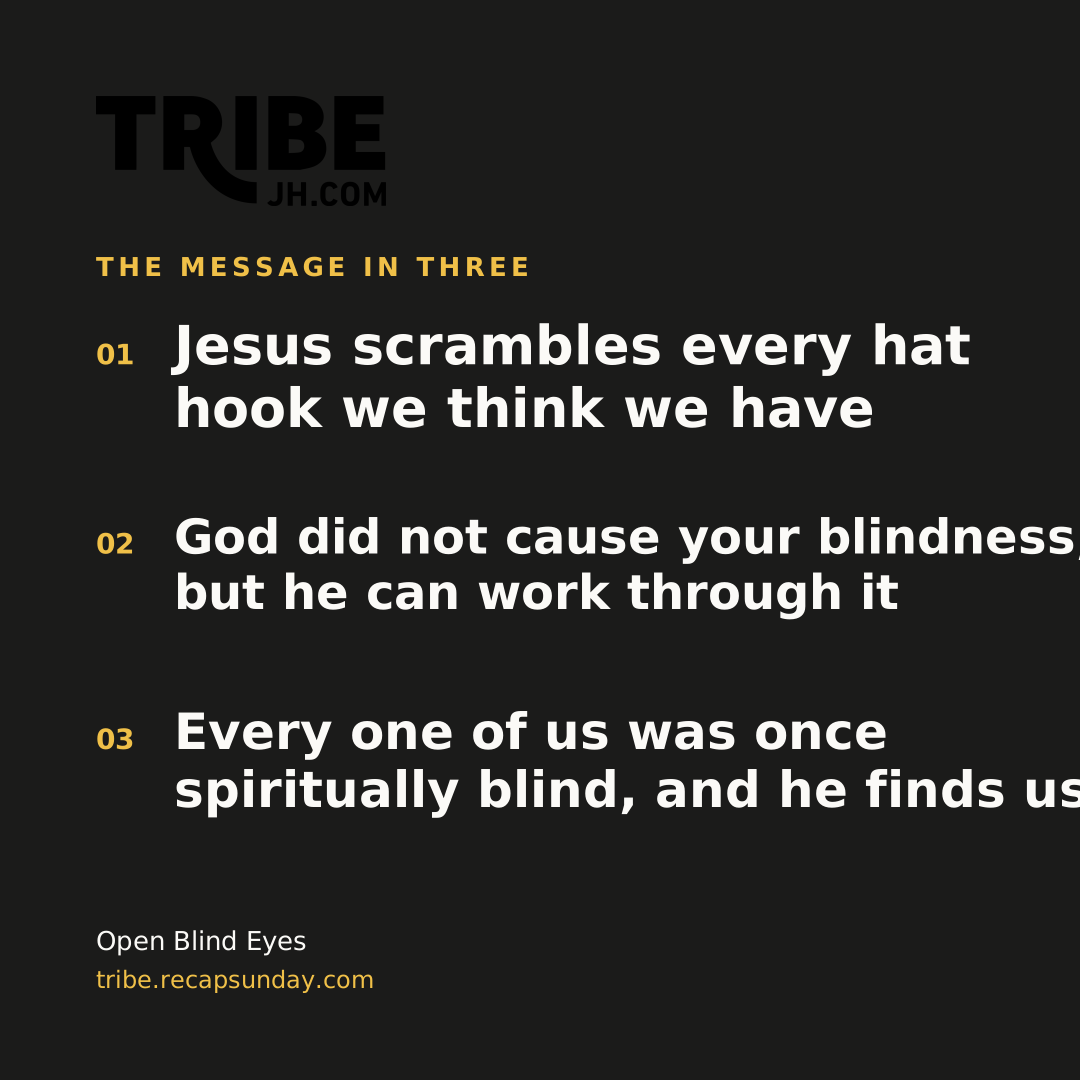
The disciples opened the story by asking Jesus whether the man's blindness came from his own sin or his parents' sin. Brian pointed out that the question itself shows the hook they were hanging their hat on, a tidy system where suffering has a guilty party attached. Jesus refuses it. He says it is neither, and then points toward something else entirely.
That "something else" took the room a while to work through together. On the surface Jesus' answer can sound as though God caused the blindness on purpose, and Brian did not brush that tension aside. He held it, let the congregation push back, and kept widening the frame. A fallen world produces hard things. God is not surprised by them. And the preponderance of what scripture says about the character of God, a good Father, makes it clear he did not reach in and blind a child. What Jesus was saying, Brian argued, is that this just happened, and now it is going to become the ground on which the power of God is displayed.
The healing itself drew just as much attention as the theology behind it. Brian noted that anyone in Second Temple Judaism would have known that restoring sight to someone born blind was a specific sign associated with the Messiah. That is why the Pharisees convene what amounts to a formal inquiry, tracking down the parents, summoning the man a second time, recording everything. Brian slowed the room down there, because the text moves from one sentence to the next as though it all happened in five minutes, and it did not. This was an investigation, complete with subpoenas and scribes and cleared calendars.
What the congregation kept returning to was the man himself. He does not get to celebrate. Nobody around him is glad. The neighbours are skeptical, the parents are too afraid to stand by him, and the Pharisees throw him out of the synagogue entirely. One person in the room said that hit close to home: sometimes God does something in your life, you try to tell people, nobody gets it, and you end up feeling cast out. Brian sat with that for a moment before reading the line that follows. Jesus hears the man has been expelled. Then Jesus goes and finds him.
The conversation moved from physical blindness into spiritual blindness, drawn forward by a connection someone in the room made to 2 Corinthians 4, where Paul says the god of this age has blinded the minds of unbelievers. Brian took that and ran with it. Every person who has invited Jesus into their life, he said, knows what that prior condition felt like, because all of us were born spiritually blind. The healing in John 9 is a picture of what Jesus does for anyone who becomes aware of their blindness and calls out to him.
Brian closed by describing the moment when Jesus re-encounters the healed man. The man does not argue theology or file a complaint about the Pharisees. He simply worships. Brian's prayer at the end asked Jesus to do three things: make people aware of their blindness, give them the courage to call out, and then heal them. He mentioned briefly, without naming her, a woman in the congregation whose story followed exactly that pattern, someone who thought life was fine, picked up a Bible almost by accident, and came to see what she had not been able to see before.
Touch points
Things you could actually do this week.
Read all of John chapter nine on your own this week and write down every time the words see, seen, sight, or blind appear.
If you have been carrying something from your past that you feel still owns you, take a few minutes this week to tell God specifically what it is and ask him to help you lay it down.
If you have never invited Jesus into your life, find a quiet moment this week and ask him to open your eyes to your own condition the way he did for the man in John nine.
If you feel rejected or cast out by people around you right now, read the end of John chapter nine again and sit with the fact that Jesus went looking for the man after he was thrown out.
Fill out a connect card at the back of the room on your way out, or reach out to the prayer team this week if there is something specific you need people to agree with you in prayer over.
Doing a Bible study?
Here is a guide we have prepared for you: the passages
in order, questions for the group, and room to write.
Brian pointed out that the disciples' question about who sinned seemed like an attempt to impress Jesus with their knowledge. When have you caught yourself approaching God or faith more as a performance than as genuine seeking?
Jesus answered that the man's blindness was not caused by his sin or his parents' sin, but that the works of God would be displayed through it. How do you personally wrestle with the tension between God not causing suffering and God working through it?
El pastor Brian guio a la congregacion a leer juntos todo el capitulo 9 del Evangelio de Juan, la historia del hombre que nacio ciego y fue sanado por Jesus. En lugar de predicar solo, Brian invito a todos a participar en voz alta, haciendo conexiones y compartiendo observaciones. La conversacion giro alrededor de una pregunta central: cuando los discipulos le preguntaron a Jesus si el hombre era ciego por causa de su propio pecado o el de sus padres, Jesus respondio que ninguna de las dos cosas era cierta, sino que aquella situacion seria una oportunidad para que el poder de Dios se viera en el. Brian explico que eso no significa que Dios causo la ceguera, sino que Dios, en su conocimiento de todo, puede tomar lo que simplemente ocurre en un mundo caido y convertirlo en algo extraordinario.
Otro punto que surgio con fuerza fue el contraste entre la ceguera fisica y la ceguera espiritual. Brian dijo que todos, antes de conocer a Jesus, estamos espiritualmente ciegos sin saberlo. La congregacion conecto esto con un pasaje de Segunda Corintios sobre como Satanas ciega la mente de quienes no creen. Brian tambien señalo algo conmovedor en el relato: nadie celebro la sanacion del hombre, todos lo cuestionaron y finalmente lo expulsaron de la sinagoga. Fue Jesus quien lo busco despues de que todos lo rechazaron, y el hombre simplemente lo adoro.
Al final, Brian invito a quienes sufren de alguna condicion fisica de la vista a creer que Jesus puede sanar, y tambien a quienes todavia no conocen a Jesus a reconocer su condicion de ceguera espiritual y llamar a aquel que sana.
---
Pasajes biblicos mencionados:
Juan 9 (capitulo completo)
Isaias 35:5-7
Segunda Corintios 4:3-4
Santiago (referencia general sobre la ley)
Primera Corintios (referencia general sobre la sabiduria griega y hebrea)
Read the full transcript9,908 words
Good morning. Let's stand together and worship. If anybody would like to move forward, feel free. It will fill up in the bag for those who are coming in late. Just pray with me this morning.
Lord Jesus, we invite your presence in this place. We lay everything at the foot of the cross this morning that we would come in with today. We tell you we love you and that you are worthy this morning in Jesus name. Everybody said Amen. Amen.
That made me laugh. There's just a single donut sitting on the couch over there. No napkin or anything. I love it. I'll think about these words this morning of who God declares that we are.
We're heavens from creation, pride in adoration, treasures that you weren't by my side. There wasn't a day that you let me fall in all of my life. Your love will be that you weren't by my side. And there wasn't a day that you left me for in all of my You are faithful. Just take a minute, close your eyes, and just in your own words this morning, tell me he's worthy of this time.
Tell him he's worthy of your worship today. Worship you. Oh, you, I'm faithful God. I worship you. You, I'm faithful Lord.
Then he sings to us, I couldn't love you anymore than I do right now. There's no way I wouldn't go to get to you my child. So take a look at the cross, and you'll know it for sure. I couldn't love you. I couldn't love you anymore, anymore, anymore than I do right now.
Just think about these words in this bridge that the past doesn't own you anymore. Just lay it down at the cross today. He paid it all. The past doesn't own you anymore. You believe that this morning?
The grave doesn't haunt you anymore. Oh, yeah. Say your life worth dying for. Yes, it is. I look at the cross and know if for sure I couldn't love you.
I couldn't love you anymore anymore receive it this morning. He do right now anymore. Says your life's worth dying for. He says the past doesn't hold you anymore. Oh, yeah.
Right where you are today, he couldn't love you anymore. He couldn't love you anymore. He couldn't love you anymore than he does right now. There's nowhere Oh, you couldn't earn it anymore. Oh, yeah.
He gives it freely. He gives it freely today. Because he paid the price for you and me. Hey. Anymore, anymore than not you right now.
Oh, Oh, to even grasp this kind of love. Oh, your great love for us, God. Even in our weakness and our failures. Sing this with me. Amazing how can it be?
You, my king, would die for me. Let's declare this that he's our king, the leader of our lives. We surrender to him. You're my king, Jesus. Oh, you are my king.
Oh, you I always feel like a hypocrite singing that last line. I always say, in all I do, I'll honor you because that's the desire of my heart, God. I know I don't always honor you with my words, with my actions because that is the desire of my heart. Would you help me with my surrender to you, surrender of all that I allow in and all that I allow out? Because my desire is to honor you with everything that I am.
And even when I fall short, Lord, help me. Thank you that your grace is there. You're so worthy. So worthy. Sing this together.
You're worthy of it all. You're worthy of it all. Worthy of it all. You deserve the glory. Let's really sing that and beat it, that he deserves the glory for it all.
Deserve the glory. Can we just do something? Can we just lift our voices and fill this room? Just fill this room with praise, fill this place, the Virginian, this valley because something supernatural happens when we worship. You know that, right?
It's not just singing words to a song, we can do that anytime. But we deal with not flesh and blood, but with principalities and powers. And when we worship the Lord, we send out a really strong signal of praise and worship. We give the enemy warning that our God reigns in this place and in our hearts and in our lives. It's like we're marching forward with a flag with our worship, declaring whose we are and what we stand for.
So let's sing this, and let's lift our voices and sing you're worthy of it all. Let's just declare it. Lift your voice. Worthy of it all. Come on.
Sing it out. You all things. You deserve the glory. Yes. You do, Lord.
Lord, we just say right now, we praise you. You are Lord of all. You're the Lord of my life. Just tell you we love you. Just tell him he's worthy this morning.
Let's just say for just a few more seconds, just telling me he's worthy. One last time you're worthy. You're worthy of it all.
Because
You deserve the glory. Oh, Lord, we just declare your goodness, your glory, your worthiness in this place today as we continue to worship you by getting into your word. I just ask that every heart would be open today. They would forget everything in the past and that we would just move forward today. Build on everything that you've done like we said in that first song, I will sing of all you've done.
And we'd use that as a foundation, but we would come in with an open heart today to receive from you. We tell you we love you in Jesus name. And everybody said, amen. Turn around, greet somebody, say good morning, say he's worthy. Jacob, would you take that iPad off and put the stand here for Brian?
Right there. Thank you, sir. I'm gonna put it over here.
Yeah. Yeah. Good morning. This is this is great. Yeah.
Alright. If you if you're over thirty this morning, let me hear you say good morning.
Good morning. If
you're under thirty this morning, let me hear you say good morning.
Good morning.
Yeah. That's that's what I was picking up. Oh, thirty just on the barrel head. You go either you yes. You go either way.
That's great. And the rest of us are on ibuprofen. It's fantastic. There's a little card in your seat. If you are visiting or you are passing through this morning, we would love to have a record of your visit.
Or if you call Tribe home, but you want to stay connected with what we are doing and what's going on, if you fill that little card out and then drop it in the box right by the swinging saloon doors on your way out, we take those cards, and we'll add those too. We'll make sure we get you on the text blast that we send out. Also, there's room on there if you would like to leave a prayer request. It really is a highlight of our staff meeting on Mondays. We consider it an honor.
Every time we get a connect card, and on the back, there's a prayer request, whether it's, like, significant or superficial, it doesn't matter. It's important enough for you to write it down. We really feel honored that you would allow us a little glimpse into your life to be able to agree with you in prayer. And so we take them very seriously. If you, like, wanna put your name or, like, whatever you wanna do, we we will make sure that we get those lifted up to you.
Also, at the end of service, if there's anything that you need prayer for, Lanisha and the Micas family, they, like, find their way to the back there with a booth, and I'll have them wave to you at the end of service. So if there's anything that you need prayer for, like, right now in this moment, like, express mail, not regular mail, but, like, express, let's get it there. They would love to pray for you at the end of service. Sound good?
Sounds good.
Sounds good. If you have your bible with you this morning, would you turn to the book of John? And if you're taking notes, you can write at the top of your notes this morning, open blind eyes. That's gonna be our topic of conversation this morning, open blind eyes. And we're gonna be in the book of John chapter nine.
Last week, if you remember, we we tied a bow on a series of conversations that we were having about hanging your hat on God's truth. And, yes, the bow has been tied and snugged up. That series has been wrapped in lace and set on the shelves of our heart so that we can pull it out and unpack it whenever we need it. I'm going to try not to quickly untie the bow and take the package off the shelf. As we read together today, I think that you'll see a lot of connections with what we've been talking about in the dialogue and in the text that conversations that's recorded here in the text.
And so I'm going to try not to go back there, but it's going to be hard. And if you make those connections, fantastic. I would love to hear from you. Why don't we do this together today? Instead of just me preaching, Aaron's like, don't make eye contact.
Why don't we do this together collectively like like friends, instead of just me sitting up here being the the only voice with the mic that supposedly knows everything. If you know me, you you know that's certainly not true. But I would like us to do this together. I would love us to engage with this content and what we're gonna read. I'd like us to engage with it together.
So if you have questions, comments, or connections, all you have to do is raise your hand. Yes. You get to talk out loud during the sermon. I want to hear from you. We want to hear from you.
And there's a mic that's in the room. If you just raise your hand, the mic will be passed to you. And the reason why we have the mic in the room is so that and we could probably hear your voice without the mic, but we use the mic so that all of our families that are joining in the service on the livestream, they get to be participating. They get to hear what's going on. The mic, if you're not mic'd in the room, the video mic won't pick up your voice, and people in the livestream are like, what'd they say?
And so this allows them to stay connected with us in the service, okay? With that in mind, did I tell you what chapter in John? I didn't tell you. I was checking, but it looks like there's help. So John chapter nine.
We're going to read verses one through 12. And I have a feeling that, like, we might get on a roll, and we may just like like, brace yourself for the whole chapter. Sorry. We'll just read an entire chapter of God's word together on Sunday at church. Raise your hand if this will be the only time you've gotten into your Bible this week.
Don't. Don't just don't. Or, I don't know, maybe do this. It'll be great for you. John chapter nine, we're going to read verses one through 12, and then we'll reach a decision point, see if we want to continue on with reading.
And the mic is in the back of the room, and the way that we do it here at Tribe is we just pass the mic around, read a few verses, and then you can hand it off to somebody else that would read. Most of us read from the New Living Translation. So if you have your electronic bible, you can queue up the NLT. If you have an acoustic bible and it's not the NLT, just do the best you can. Yeah.
Electronic. Oh. Acoustic.
Alright. Verse one. As he went along, he saw a man blind from birth. His disciples asked him, rabbi, who sinned? This man or his parents that he was born blind?
Jesus said, neither this man nor his parents sinned, but this happened so that the works of God might be displayed in him. As long as it is day, we must do the works of him who sent me. Night is coming when no one can work. While I'm in the world, I am the light of the world. After saying this, he spit on the ground, made some mud with saliva, and put it on the man's eyes.
He told him, go wash yourself in the pool of salaam. Salaam means scent. So the man went and washed and came back seeing.
Wow.
We just read that. Like, I'm not saying you read it casually, but we just read those verses so casually. The cry of my heart today is that somehow, someway, by a miracle of the living God, not only if he wants to open blind eyes that he would do that, but that we would encounter the man born in Bethlehem, raised in Nazareth, cruising around Galilee, who lived and breathed and is alive forevermore, that we would encounter the reality of him instead of being inoculated by stories that we read about him. Jesus just spit in the dirt, made a mud pie, rubbed it on the guy's eyes, and told him to go wash, and the and and and we just read that. He washed and came back seeing.
Incredible.
Let's keep going. His neighbors and others who knew him as a blind beggar asked each other, Isn't this the man who used to sit and beg? Some said he was, and others said, No. He just looks like him. But the beggar kept saying, Yes.
I am the same one. They asked, who healed you? Happened? He told them, the man they called Jesus made mud and spread it over my eyes and told me, go to the Pool Of Siloam and wash yourself. So I went and washed and now I can see.
Where is he go where is he now? They asked. I don't know, he replied.
We want we like like, the story's just getting good. Right? Okay. Great. Let's keep going.
Verse 13.
How far am I going?
The people, they want the whole chapter. Okay. It's so good.
13. Then they took the man who had been blind to the pharisees because he was but because it was on the Sabbath that Jesus had made the mud and healed him. The Pharisees asked the man all about it. So he told them, he put the mud over my eyes, and when I washed away, I could see. Some of the Pharisees said, this man Jesus is not from God, for he is working on the Sabbath.
Others said, but but how could an ordinary sinner do such miraculous signs? So there was a deep division of opinion among them. Then the pharisees again questioned the man who had been blind and demanded, what's your opinion about this man who healed you? The man replied, I think he must be a prophet. The Jewish leaders still refused to believe the man had been been blind and could now see, so they called his parents.
They asked them, is this your son? Was he born blind? If so, how can he now see? His parents replied, we know this is our son and that he was born blind.
Quick pause. As we read these verses, we tend to think that the events happen and unfold as quickly and succinctly as we read them. The Jewish, verse 18, the Jewish leaders still refused to believe the man had been blind and could now see, so they called his parents. And then in verse 19, then they're asking them. It is it is we're not reading into the text.
We're not stretching the text, but it is very reasonable to conclude that the parents weren't just standing right there like all like a bunch of actors on a stage. And then the pharisees turned to the parents and said, who happened to be right there. Right? That's one of the things that I I enjoy about the chosen is there's some some really cool granted admittedly artistic shading and coloring filled into the story, and so I see that as I read this. They they launched a formal inquiry and an investigation and had a hearing.
You had to track down the parents. You had to identify the parents. You had to get the pharisees back together. You had to have the scribes there to record it. They were put essentially on trial.
That doesn't happen between, like, one the the period of one sentence and the capitalization of the letter of the next sentence. And so allow your holy sanctified imagination to consider what a a huge stir this is causing in the community. And imagine a pharisee, like like, getting into work one morning, and he, like, logs into his email, and it's, like, important meeting, like, on Wednesday at 6PM. Like, ugh, I gotta clear my calendar and, like, you reply all. Okay.
Fine. I'll be there. But it took a lot just for this moment to happen. Are you with me? Alright.
Let's continue reading. Start from Twenty. Eighteen. So start from eighteen so you can, like, see it, read it, and then here we go.
Okay. The Jewish leaders still refused to believe the man had been blind and could now see, so they called his parents. They asked them, is this your son? Was he born blind? If so, how can he now see?
His parents replied, we know this is our son and that he was born blind, but we don't know how he can see or who healed him. Ask him. He is old enough to speak for himself. His his parents said this because they were afraid of the Jewish leaders who had announced that anyone saying Jesus was the Messiah would be expelled from the synagogue. That's why they that's why they said, he is old enough.
Ask him.
So for the second time, they called the man who had been blind and said to him, give glory to god. We know that this man is a sinner. He answered, whether he is a sinner, I do not know. One thing I do know is that though I was blind, now I see. They said to him, what did he do to you?
How did he open your eyes? And he answered them, I have told you already, and you would not listen. Why do you want to hear it again? Do you also wanna become his disciples? Oh.
So I imagine I don't know if any of you have seen, like like, super boring C SPAN where they have, like, the entirety of, like, you know, congressional hearings and things like that. And there's been stories in the news, and, really, I just check-in on the sound bites of, like, various committee meetings, congressional hearings. You know, like, they're talking to the director of the Secret Service after the Trump thing. They're talking to these other people. They come in.
They sit down. They're asked these questions. That's in in my imagination, that's kind of what is unfolding here. It's a congressional inquiry where people of position and influence are grilling these witnesses to come in under subpoena and testify and hear the blind man. He's like, there's a whole new world that I need to be looking at, and I'm just looking at you guys.
And I don't know if you see it, but I see emotion of, like, like, exasperation. Maybe he's getting a little bit sassy. Look. I told you once. Didn't you listen?
Do you wanna hear it again? Do you wanna become his disciples too? Those in the gallery gasped. Verse 28.
And they reviled him saying, you are his disciple, but we are disciples of Moses. We know that God has spoken to Moses, but as for this man, we do not know where he is where he comes from. And the man answered, why? This is an amazing thing. You do not know where he comes from, and yet he opened my eyes.
We know that God does not listen to sinners. But if anyone is a worshiper of God and does his will, God listens to him. Never since the world began has it been heard that anyone opened the eyes of a man born blind.
That's important. That is that is clearly a sign that Old Testament Second Temple period Jews were acutely aware of as a sure fire indicator, take it to the bank sign of the messiah. It's one thing if, you know, you got, like, a piece of dirt in your eye and it gets washed out. Now I can see. Woo hoo.
It's one thing you were you could see, and then maybe you had hemorrhagic fever, and then you lost your sight. But Pharisees knew that anyone who was born blind. And recovered their sight or gained their sight, that was extremely significant, which is part of the cause for this huge inquiry. And and that that's why that detail is in there. It's a big deal.
If this man were not from God, he could do nothing. They answered him, you were born in utter sin, and would you teach us? And they cast him out. Jesus heard that they had cast him out, and having found him, he said
Oh, quick pause. Sorry. Anybody ever felt like you didn't get picked for kickball? Anybody ever felt like you've been rejected, that you have been betrayed, abandoned, passed over, overlooked in a community, whether it was your family or friends or anything. If you ever felt rejected and alone, you can relate to this man.
And it is this man, after he was expelled from the synagogue, it says that Jesus found him. If you feel alone, abandoned, rejected, outcast, like you don't fit in, you, my friend, are welcome here, and you, my friend, are a prime target for Jesus to find you right where you are. That'll preach.
And having found him, he said, do you believe in the son of man? And he answered, and who is he, sir, that I may believe in him? Jesus said to him, you have seen him and it is he who is speaking to you. And he said, Lord, I believe. And he worshiped him.
Jesus said, for judge for judgement, I came into this world that those who do not see may see and those who see may become blind. Some of the pharisees near him heard these things and said to him, are we also blind? Jesus said to them, if you were blind, you would have no guilt. But now that you say, we see, your guilt remains.
All of John chapter nine, may the lord bless the reading of his word this morning. This is a good opportunity to check-in with you. If you've been tracking with the series of conversations that we've been having about hanging your hat on god's truth, in this story, I see a number of examples of of characters in this story, people in this story who had their hat hung in one place, and then Jesus comes along and then scrambles the whole thing up. And so if you're like, I am not tracking at all with this, like, hanging your hat thing, that probably means you haven't been here in a while or you're just visiting. It's okay.
Just, like, hang in there with us. So first of all, let's do this. Let's identify the various characters that are in this story. So you don't need to like, you don't need the mic, but just, like, tell me, and I'll repeat it in the mic. Who is one of the characters in this story?
Jesus. There you go. Go for that low hanging fruit first, and then right there next is the blind man. So we've got Jesus, the blind man. Who is another character in the story?
The Pharisees. The Pharisees. Yep. Exactly. And then His parents.
His parents. The rents. Any any other characters? The disciples, minor, yep, minor character, but important because they triggered this whole sequence of events. Okay.
Whenever you read a a story from the bible, like in the in the gospels, as you're trying to mine out the goodness of what god intended, not what you wanna see, but what god intended in his word, a great step as you're studying the bible is you read something and then you can just go back and ask yourself, who are the main characters? And if you want to write them down, great. Then you can write down the actions, the sequence of events that happened, and then you go back through and you look for any interesting details that stand out to you. And then from those details that stand out from you, then you can, like, really go on a fine tooth search. You can use various bible study tools.
You can pray, ask like, holy spirit, are you showing me something in here? That's that's one of the many ways that you can pull out the richness from the text of what god intended. The question that I have for you as we get into this text is, in light of the series of conversations that we have recently had about hanging your hat on God's truth, what examples do you see of people who either didn't have a hook on which to hang their hat of the events that they witnessed, or perhaps they were hanging their hat on the wrong hook, and then Jesus, like, messes everything up. What do you see? Raise your hand, and we'll get the mic to you.
What do you see in this? Okay. Yeah. That he healed on the Sabbath. So the mic's still coming up.
Tell us a little bit more.
That Jesus healed on the Sabbath, so a good Jewish person would not be doing any sort of work on the Sabbath. And so it just ruffled the I almost said the Philistines. The Pharisees' feathers.
Absolutely. Jesus hope would
be he didn't do what he was supposed to be doing. That that is the first, like, ah, for
the Jesus is never doing what he's supposed to be doing. He's never doing it. He's always doing his own thing according to his own good purpose and plan. And if we come across a a situation where, like, Jesus, you're not doing what you're supposed to be doing. Who's wrong?
It's us. So Jesus was known as a rabbi, a teacher of the Tanakh, which is the entire Old Testament. The Torah is the first five books, but when you look at the entire Old Testament, as Christians, we call it the Old Testament. A Jew today would call it the Tanakh. And if Jesus was a rabbi, a teacher, then he should there was an expectation of the pharisees that he would obey all the laws, which included honoring the Sabbath, which he did, but there was a man made tradition that you don't heal on the Sabbath.
Jesus is like, I feel no obligation whatsoever at all to to acquiesce, to conform to your man made traditions. And so the pharisees had a hook that said, you don't heal on the Sabbath, and that's where they hung the hat. And Jesus was like, oops, bump. That's a great example. What else?
I would say the parents were hanging their hat, and you just spoke to it on that hook of tradition because they were unwilling to claim Jesus as the Messiah, even though it could be inferred that they believed he was, because they feared being thrown out of the synagogue like their son was.
Perhaps their position, their status was at stake. That's a rough one. Oh, how about the disciples way at the beginning of the story? Look at this. What what hook were they trying to hang a hat on at the very beginning?
Yeah, yeah, yeah. Come on. And then tell us a little more. Yeah.
They were trying to make it fit that all illness comes from sin. So they were asking, is it like, why was he born blind? Was it because of his sin or his parents' sin?
I'm making a yeah. We're gonna speak to that, but I'm making a connection. We see twice mentioned his parents. I've never I haven't made that connection before. The disciples I I wonder if it's possible that the the blind person was known, and more importantly, the parents of the blind person was known.
And that maybe the disciples knew of or knew of the reputation or the standing in the synagogue of the parents. I wonder. Okay. So the disciples were trying to hang a hat on his blindness being caused by, number one, sin, and number two, the possibility that it was his sin or the sin of his parents. I almost feel like the disciples were attempting to touch the corner of their glasses when they asked that question.
Jesus, look at this blind man. I wanna impress you with my knowledge by asking you a question. Do you think that it was his sin or the sin of his parents? Trying to, like, maybe earn some spiritual brownie points with Jesus. I'm totally reading into the text that.
And what does Jesus do? Knocks the hat right off that hook. Now, this next sentence, his answer is really important. It's really easy to get wrong. And it's very, very important to get right.
Wherever the mic is, this side of the room is really carrying the service today and Lissa. But what is Jesus's answer? Would somebody read the text? What is Jesus's answer to the disciples' query?
Jesus says, it was not because of his sins or his parents' sins. This happened so the power of God could be seen in him.
Perfect. So he says, let me tell you what it's not. It's not his sin. It is not the sin of his parents. But then he gives an answer.
Is his answer an explanation for why? Good response. The teacher is not trying to trick you, but here's what many people do. Many people read this story, and they get they get hung up, and they spin out in the mud on Jesus' answer. And I will admit to you that from looking at the basic grammar of the text, it could appear as though the man was born blind.
Why? For this moment. For this moment in time, and so it's almost as if what? God did it. Did God cause this man's blindness?
Consider it. Consider it. Consider it. Take a moment. Look at the text.
Did god cause this man's blindness? Now to answer that very important question, You have to you have to widen the aperture of scripture that you're looking at and consider all of Jesus' works and all of what we know about the nature and character of god. And when you do that, you will clearly discover that god did not cause this man's blindness. Well, how do we know that? How much time do you have?
Because it kind of sounds
like it. Because it kind of sounds like it. It kind of sounds like it. Admit how many of you would think, like, it kind of sounds like it? Let's be honest.
It kind it kind of does sound like it. It was not because of his sins or his parents' sins. Jesus answered, this happened so that the power of God could be seen, oh, I love that, seen in him. Oh, this would be a great word study. Go through John chapter nine and just highlight or write down every occurrence of see, seen, sight, and see how many times it's mentioned right here in in John chapter nine.
Here's what's actually happening. We know from a preponderance of scriptural evidence that the god of the bible is a good god, and he describes himself even further as a good and loving father. What good father would intentionally blind their child? No good dad would do that. Now, if you're still spinning your wheels in the mud, you might be thinking, yes, yes, yes, but god did that to that child, infant in the womb, and have him go through how how we don't know the age of this man, but we do get a clue what it he's gotta be older than, like, the age of accountability because when his parents come in, they say, question him.
He's able to answer on his own. So a minimum of what? When do you have your bar mitzvah? Thirteen. Thirteen.
Thirteen years of blindness, being an outcast from society because the culture thought, oh, either he sinned or his parents sinned. Ew. Icky. God did not cause him to be blind. But here's what Jesus is saying.
I'm not rewriting the text. I'm trying to help you understand what the text is saying. This happened. Things in this world just happened. It's a part of living in a fallen, cursed world.
Things just happen. It's not a surprise to god. It's not outside of his knowing about it, but it's also not outside of his scope of being able to do something wonderful and amazing with it. So look what Jesus said. This happened.
It it just happened. It's not his sin. It's not his parents' sin. It just happened. But this is going to be an opportunity
God allowed it.
For the power of God to be seen and through him. And even that is tough to say, I agree with you. God allowed it. That's that's a tough one to swallow. I would say I would say to try to make it a little less jagged edged to go down to make it easier to digest and swallow.
In his foreknowledge, he knew of this. Nothing surprises him. Right? Yes. Nothing surprises him.
It makes me think of Jesus' words when he says, in this life, there will be trials and tribulations, but take heart. I've overcome the world. And so it's kind of like that baseline of there are in this fallen world. There are trials. There are tribulations.
There is hardship. But then there's the overriding, but take heart. And I feel like this is one of those scenes of take heart. Yes. I've overcome the world.
Overriding, overarching, I would say what we see is one one law at work. We live in a fallen world where where bad stuff just happens all the time. But in the same way that the law of aerodynamics transcends the law of gravity, we see a higher law at work. And Jesus always fully realizing moments realized this is an opportunity for the glory of god to be displayed. And here we are two thousand years still talking about it, two thousand years later.
So something that I am chewing on, this is not a fully formed thought, but the phrasing of saying God caused it, I think, assumes a perspective of blindness being an illness versus a characteristic of a human. Like, a characteristic that, as we said, could draw strength from or learn from or grow from or overcome. So it wouldn't be so bad to view blindness as a creation of God when you view blindness from the perspective of what he's overcome now? Like, he's developed other characteristics through his blindness that gives him strength in ways that he couldn't if he were not blind.
Let me see if I can re say back to you what I think you're saying by way of a story from the Old Testament in the book of Genesis when Joseph was the youngest but the most beloved, and he aroused the envy and jealousy of his older brothers who did a terrible thing to Joseph, Beat him up, threw him in a pit, slavery, jail, finally to the palace. And when he is finally, after years and years, reunited with his brothers, he's weeping, they're weeping, they're crying, they're like, we're so sorry. And he says, what what you meant for evil, the Lord intended and turned it all out for good. Is that essentially what you're saying?
Yeah. And so to say he didn't cause it and to try to justify this by saying he didn't cause it, I feel a little bit of tension around that perspective because I would be comfortable saying that God created this and caused it Because I feel, I don't know, from this guy's perspective, as being a blind man for thirteen years, obviously, but if he had that perspective as well, then I would be comfortable with sharing the notion that God caused it.
I will allow you to have that. Not that you needed my permission at all, but, Parker, I love you.
I think this gets into the age old theological debate over good versus
Oh, here we go.
We're blurring into that line. But I do agree. I think allowing something to happen, which God does, is different than causing it. But also, we have to look at the outcome of this. God also can change every one of these outcomes and every one of these moments
in
an instant. And just because he allowed it, that doesn't mean he can't change it. Just because this guy was born blind and allowed to be blind, that doesn't mean God right now couldn't change that. Yeah. So I think that's the truth we need to look from this verse is that he can change it.
He can change it in your life. That doesn't mean that it's for the rest of your life you have to deal with this ailment or whatever it is. It can change in an instant if you go to him, if you cry out to him, if you live your life for him. And that's what he wants. So these things are allowed to happen to bring us to him in whatever manner that may look like.
I appreciate the fragrance of redemption in your words. Kate and then while Kate is sharing, let's go to a verse in Isaiah. I think I have it on the screen. Do I have that one? Yeah.
Yeah. Yeah. So share, and then let's look at this verse.
Okay. So I've just been thinking this the the whole time, and it's kind of off on what we've been talking about. But what amaze one of the things that's amazing me most about this story is this young man, if he's a young man, has been blind his entire life. He has been healed. Nobody is exalting in his healing.
Everybody is just like, is this the guy? This can't be the guy. Why did you heal on the what no. It's like this huge nobody is excited about except so then he gets cast out. Yeah.
And then Jesus finds him. And it's just making me think about our lives.
And
how sometimes the Lord does something in our lives, and we try to share it with people or we try to explain. Like, I was this, and now I'm this, and nobody gets it. And you feel cast out. But Jesus finds
us.
Yes. In that. He has found me in that. Yeah. And I mean, that's the part of
the story that's really standing out to me. It's like, you know. He doesn't get off in the theological weeds or the metaphysical weeds. He just says, I don't know. I was blind, but now I see.
You go sort it out. Isaiah 35 verse five through seven. This is a a prophecy of Jesus that was partially, literally fulfilled at the first advent. But when you look at Isaiah chapter 35 in in, like, as a whole, you zoom out, you see that there is a future coming elaboration of literal fulfillment of this passage. So it's yes and.
Yes. He did this during his earthly ministry in Galilee two thousand years ago, but he gonna do this on a supersized level again someday. Verse five. And when he comes, he will open the eyes of the blind and unplug the ears of the deaf. The lame will leap like a deer, and those who cannot speak will sing for joy.
Springs will gush forth in the wilderness, and streams will water the wasteland. The parched dry ground will become a pool, and springs of water will satisfy the thirsty land. And marsh grasses and reeds and rushes will flourish where desert jackals once lived. Now, somebody make the connection between Isaiah 35, and I'll give you a hint, verse six, and what we see Jesus doing and what we just read. What is the connection?
Well, I mean, the besides the obvious connection of, like, blind eyes being opened. Yeah. Come on. But there's a cool little connection there. Just say it.
What do you see? Okay. I'll give you a hint. The chemical formula for what I'm looking for is two parts hydrogen and one part oxygen. Now now make the connect yes.
Wow. But what's the con yes. Yes. Yes. But what's the connection?
Yes. Even go go ahead, Lanisha. You you need full credit in the mic. I'll say saliva this time. His saliva.
Even the moisture in his mouth has such healing, redemptive properties. It is like what is prophesied in Isaiah 35. Springs will gush forth in the wilderness, and streams will water the wasteland. We have water in Isaiah. We have water in the moisture of his mouth being combined in order to create streams of water in the wasteland.
Think of his eyes. Unusable, unproductive, invaluable until Jesus comes along.
I I think what's interesting too is Jesus could have healed him just by saying you're healed. But he did he did an action that required the man to go have faith and go do something. And so it took it took both for him to be healed. You know?
I love the observation of this particular instance of healing where partnership is required and faith on the man's part. He could have been offended, probably not the first time this guy was spit on. He could have been offended. It required faith on his part. I like I like that you're seeing a partnership in this instance.
Something that I like, about the whole holy spirit imagination is I will read a story like this and think when he said the actions and brought me back to it of how many times the pharisees may have tried to do it themselves. So they we always see
the pharisees go, Jesus, don't
do that. Jesus can't do this. And they don't leave that town. How many of the pharisees went
out and were like, let's see
if we can do it now and fall short? It always just helps me realize whenever you wanna live like Jesus and be like him, you can't do it without him. You can't just do the action and expect the same result if you don't have him in your heart and in the center.
Two two mud pies. One can change a person's life. The other one just dries out and is a mud pie.
Okay. I'm making so many connections right now.
I love this.
Okay. So usually when we think about blindness, like we think about the physical blindness but there's also like that spiritual blindness as well. And so at the last verse of John nine it's the pharisees are asking you mean to tell us that we are blind and Jesus told them if you would acknowledge your blindness then your sin would be removed but now that you claim to see your sin remains with you And then in Isaiah 35, and when he comes, he will open the eyes of the blind and unplug the ears of the deaf. And that just makes me think of Corinthian of second Corinthians four when it's talking
about Second Corinthians four three through Yeah.
Four four, something like that. Me look
at that. Do
I not have that one? Oh, I don't have that one, but I got it here.
Their mind yeah. For their minds have been blinded by the God of this age, aka Satan, leaving them in unbelief. Their blindness keeps them from seeing the day spring light of the gospel of the glory of Christ who is the divine image of God.
Second Corinthians chapter four verses three and four. Yes. What translation are you reading out of to get that word dayspring? Woah.
That was the passion translation.
Okay.
Yeah. So, you know, Fancy translation.
I If the if the good news we preach is hidden behind a veil, it is only hidden from people who are perishing. Satan, is the god of this world, has blinded the minds of those who don't believe. So here's something that's that's amazing, and I love that you're making this connection. We've been talking about physical blindness, physical blindness, but there's also a spiritual blindness that every single person who has invited Jesus into their heart made him the leader of their life knows what that prior previous condition was like of being blind. All of us, in a sense, were born spiritually blind.
The bible says there's no one perfect, no, not one. For all have sinned and fallen short of the glory of God. The Bible says in the book of James, if you keep all of the law and stumble at but just one point, you're guilty of having broken all of the law. Blinder than blind. Super blind.
And then in first Corinthians, it talks about how that there are there are two mindsets, a Greek mindset and a Hebrew mindset. And then and then he goes on to talk about, but the power of the gospel to save those who are perishing, and he's and then he pulls from those same two groups. Meaning, all of us were spiritually blind at one time before, by the grace of God, we were allowed to see the condition of our blindness that caused us to cry out to him as I walk the razor's edge between I can't the two guy whatever. Free will and predetermination. We chose him, and now if you've invited Jesus into your heart, you can see.
If you have not invited Jesus into your heart, it don't matter how smart you are. It doesn't matter how much you read this book as an intellectual. It doesn't matter how learned you are, how open minded you are, you're blind. And it is not until Jesus helps you to become aware of your condition of blindness that you then cry out to him and he's like, I thought you'd never ask. Come here.
What you may think as debasing, not cool, very humbling. Have any of you don't raise your hand. Have any of you ever been spit on before? I'm not talking like a llama at the zoo, I'm not talking by like a child, you know, that doesn't know any better, but somebody that was like being nasty spit on you? That's horrible.
Or spit in the mud and then rubbed it on your eyes? That's very humbling to say the least. Realizing your condition of blindness is very humbling and it puts you in a very vulnerable position. But when we go by faith and wash in the pool of Siloam and partner with him, we're open. Our eyes are open.
Oh my gosh. I was blind, but now I see. I thought I had it all figured out. I thought I was a good person. I thought like like like, Jesus was a cool dude.
I didn't know that he was savior. And remember when Jesus re encounters that guy? What does the guy do? He just worships Jesus. You're the savior.
You're my savior. You healed my blindness. Jesus, today, will you draw close to all of our hearts? Maybe there's people in here that that, like, actually have a physical condition of some sort of sight impairment. Jesus stands ready to release physical healing in your life, and how awesome would that be?
Maybe there would be more people in here today who suffer from a far worse condition in that of spiritual blindness. Would you draw close to that human heart and by a miracle do two things? Number one, cause them to become acutely aware of their blindness. Okay. Do three things.
Would you please? Two, by your grace impart to them the courage to call out for you, the healer. And then number three, by your incredible amazing love, would you heal their condition of blindness? Just with your eyes closed, me just tell you a quick story. She can tell it much better.
And I won't say her name to put her on the spot, but there's a young woman that goes to to tribe here, and she was bopping along, like twirling her little ribbon, thinking life's great and that she's a good person. And she came to a a women's event and was like at the end, there was an invitation, like, hey, if you want a bible. She's like, I'll take a bible. Started reading this book and became more increasingly aware of her, like, spiritual blindness. Invited Jesus into her heart, and today her testimony is I was totally, spiritually blind and didn't even know it.
But now, I see. Just speak to us, Lord. Minister to us for just a moment.
Let's just receive his grace this morning.
I was blind. Now, oh, I can see. Expose the scales of pride that blind us, Lord. Expose the scales covering our eyes of arrogance. Expose the blindness that is caused by rejection or abuse.
Jesus, we need you, and this world desperately needs you. I know that you're alive and real, and I know that I was once blind, but now I see. Reveal yourself as the great miracle worker to the hearts of your people. This is a a city of blind people. Help us, Lord.
Help us, Lord. And you take just a a few more moments, and perhaps there's a little bit of business that you need to take care of with the Lord. Whatever. I don't even know what that might be. You just take just a moment and talk to him from your heart, and then we'll worship the Lord in one other way.
Thank you, Jesus. So I tried. Our goal is to live a life lifestyle of worship, not just singing songs on Sunday, but from the bottom of our heart out of thankfulness and gratitude for who he is and what he's done for us. We live a lifestyle of worship, which includes on Sunday morning, at the beginning of service, we worship the Lord with with song, with praise, and I love that little spontaneous moment in the middle of worship this morning where I could hear you just lifting your song of adoration and thanksgiving to the Lord. That's good stuff.
We worship the Lord by considering and pondering like you're doing, like I'm chewing on this right now even as we talk. We worship the Lord by honoring the word that is preached, and then we also worship the Lord by surrendering and sacrificing a portion of our finances, which we call tithe and offering. And so every week, we give you an opportunity to worship the Lord in that way by taking a portion of your finances and tangibly and practically saying, Lord, I love you and I trust you even with a hard earned money that comes into my hand. I open my hand to tell you I love you and I trust you by surrendering a portion of my finances back to you. And we do that through through giving here at Tribe.
A lot of people are generous with their smartphone. When you open up a new text, you can follow the instructions there on the screen. Through our website, tribejh.com, you can click on the giving tab there, and you can also put cash or checks in that little box. Are we set up in that box to receive bitcoins also? Yes.
Okay. So if you have bitcoins, those go back in there too. Braden is just shaking his head. It's not how it works, b.
The bitcoins are still at the TMC in
that box. Yeah. We have some, but don't tell them. Okay. Those are the Lord's bitcoins.
Let me pray over the offering, share some announcements with you, and then we will get out of here. Lord, you're so good to us. You open blind eyes. You provide finances for us. And by way of telling you that we love you and that we trust you, as a practical demonstration, we surrender a portion of our finances, and we give freely and with a cheerful heart.
Father, I pray for everyone that's giving today or that regularly gives or that will give. Lord, would you bless their finances as a result of their giving today? Would you receive these tithes and offerings to make your name famous here at Tribe, in Jackson Hole, the surrounding region, and to the uttermost bounds of the earth. We pray these things in Jesus' name. And everybody said, amen.
Two announcements really quickly, both related to Israel. Number one, if you know, since shortly after October 7 of this past fall, the the ethnic and religious Jews of this community have been gathering together on the first Sunday at every of every month on the town square to show their solidarity and support for Jews around the world and those that are going through heavy intense conflict in Israel. And as Christians and as a tribe family, we have taken it upon ourselves to follow God's scriptural mandate that says, those who bless Israel, I will bless. And he has uniquely and distinctively touched many of our hearts at Tribe and on our leadership to stand with the Jews of this community as they support Israel. And so, you've heard me mention this for several many months now, but this Sunday at 5PM on the town square, yep, we're there's gonna be another gathering.
It's not a rally. It's not a it's just a gathering. Okay? And so I would like to personally invite you to join us. If you're like, I don't I don't quite know.
I'm a little bit curious, but I'm not quite sure. It's okay. It's a great opportunity to come and meet some folks from our ethnic and Jewish. I wanna make that distinction because not everybody that's there that's Jewish is religiously Jewish. But everybody that's there is Jewish.
Right? Except us. We're not. Except us. Us gentiles.
Support the Jews. So if you're curious if you're curious, I'd like to invite you to to to come and and be a part and support. Usually, there's a speaker or two. It's only about an hour, and and then we disperse. Here's the next thing.
This is this one is really important and really cool. The best you can do would be to take a picture of it so that you have these details.
My glasses.
How many of you recognize, if you can see it, the face of the guy in the in the circle? Interesting. So he's all over all of the major media news outlets. He is the primary spokesman speaking on behalf of the IDF, Israeli Defense Force. He gives updates to to people here in The United States, CNN, MSNBC, ABC, NBC, Fox, like like, he doesn't lean right or left.
He leans, like, all white and blue towards Israel. But he's going to be speaking and sharing his very unique perspective at an event here in Jackson, Monday, 06:30PM, August 5, which is when? Tomorrow. That's right. Tomorrow at the library.
Now one one more, and then there's some other events. Just take a picture of this, look at it. We'll also send it out as a text blast. Here's the last thing that I'm going to say about this. The event tomorrow that's happening at the public library, we are we are we are we're not promoting this overtly on, like, social media and newspaper ads and things like that.
This this man and the topic is very controversial, and the Jewish community has gotten word that there intends to be counter protests and and not a dust up, but to cause a stir outside of the library. And so if, like, you have enough, like, controversy in your life, I don't know. I don't know. Maybe maybe don't come. I I will will try to clear my schedule so that I can be there for this event.
It's gonna be powerful. It's going to be eye opening, and it I'm not saying it's gonna get rowdy, but I think there would be an attempt to, like, cause a kerfuffle. What an old guy thing to say. Brian, shut up. So that is Monday.
That's happening tomorrow at the public library. Alright? If you're up for it, I'd like to invite you to come. If you stand, I'll pray for you. And then if you need prayer specifically, members of our prayer team right there at the back booth, they would love to agree with you in prayer.
Alright? Lord Jesus, thank you so much that you are alive, that you are so real, and that for two thousand years you have been healing us frail humans of the condition of our blindness, physical and spiritual. Thank you for opening our eyes today. And would you help us to walk in the light and in the freedom of who you are and what you've called us to be. We love you.
We love you. We love you, Jesus. I command a blessing over each and every member of our tribe fam here today. Give us a great week. We pray these things in Jesus' name, the strong son of God.
And everybody said, amen. I love you so very much. And remember, you got this.