The passage this message was preached from, in full, with every other passage it reached for.
Exodus 3:1-12read aloud in full as the first of two Bible stories anchoring the sermon
1 Now Moses was keeping the flock of Jethro, his father-in-law, the priest of Midian, and he led the flock to the back of the wilderness, and came to God’s mountain, to Horeb.
2 Yahweh’s angel appeared to him in a flame of fire out of the middle of a bush. He looked, and behold, the bush burned with fire, and the bush was not consumed.
3 Moses said, “I will go now, and see this great sight, why the bush is not burned.”
4 When Yahweh saw that he came over to see, God called to him out of the middle of the bush, and said, “Moses! Moses!” He said, “Here I am.”
5 He said, “Don’t come close. Take off your sandals, for the place you are standing on is holy ground.”
6 Moreover he said, “I am the God of your father, the God of Abraham, the God of Isaac, and the God of Jacob.” Moses hid his face; for he was afraid to look at God.
7 Yahweh said, “I have surely seen the affliction of my people who are in Egypt, and have heard their cry because of their taskmasters, for I know their sorrows.
8 I have come down to deliver them out of the hand of the Egyptians, and to bring them up out of that land to a good and large land, to a land flowing with milk and honey; to the place of the Canaanite, the Hittite, the Amorite, the Perizzite, the Hivite, and the Jebusite.
9 Now, behold, the cry of the children of Israel has come to me. Moreover I have seen the oppression with which the Egyptians oppress them.
10 Come now therefore, and I will send you to Pharaoh, that you may bring my people, the children of Israel, out of Egypt.”
11 Moses said to God, “Who am I, that I should go to Pharaoh, and that I should bring the children of Israel out of Egypt?”
12 He said, “Certainly I will be with you. This will be the token to you, that I have sent you: when you have brought the people out of Egypt, you shall serve God on this mountain.”
read aloud as the second Bible story, the disciples encountering Jesus walking on water
45 Immediately he made his disciples get into the boat, and to go ahead to the other side, to Bethsaida, while he himself sent the multitude away.
46 After he had taken leave of them, he went up the mountain to pray.
47 When evening had come, the boat was in the middle of the sea, and he was alone on the land.
48 Seeing them distressed in rowing, for the wind was contrary to them, about the fourth watch of the night he came to them, walking on the sea, and he would have passed by them,
49 but they, when they saw him walking on the sea, supposed that it was a ghost, and cried out;
50 for they all saw him, and were troubled. But he immediately spoke with them, and said to them, “Cheer up! It is I! Don’t be afraid.”
51 He got into the boat with them; and the wind ceased, and they were very amazed among themselves, and marveled;
52 for they hadn’t understood about the loaves, but their hearts were hardened.
The message in order, in a few minutes of reading.
On August 26, Tribe met outside in Miller Park for their Sunday gathering. Brian Hunter preached a message called "Resisting the Rut," built around two Bible stories read back to back and opened up through conversation with the congregation.
What was said
Brian started by pointing out that meeting outside in the park, like meeting in a bar, is the kind of thing that throws people off their normal expectations. He called this a "Holy Spirit judo move," the idea that when something disrupts your routine and knocks you off balance, it creates an opening for God to do something in you that a comfortable, predictable setting might not.
The congregation read Exodus 3:1-12, the story of Moses and the burning bush, and then Mark 6:45-52, the story of Jesus walking on the water. Brian asked people to look for connections between the two stories before he explained them, and the conversation that followed surfaced several: disbelief in the face of something impossible, fear as an obstacle to receiving what God has for you, and the way curiosity or the absence of it determines whether you encounter God at all.
Two details from the text became the center of the message. In Exodus 3:3, Moses says something along the lines of "I must go and see" or "I will turn aside." He moves toward the disruption rather than away from it. In Mark 6:48, a detail Jay pointed out, Jesus was walking on the water and intended to pass the disciples by. He was not forcing an encounter. The disciples had to turn aside from their fear and respond.
Brian pressed on what those two details have in common. In both cases, the person who encounters God is the one who moves toward the unusual thing rather than away from it. He named the default human instinct, which is to back away from disruption, and asked why God would wire us that way and then regularly place encounters with himself right inside what we would instinctually avoid. He did not answer the question, but held it up as worth sitting with.
From there he talked about what it means to be stuck in a rut. Moses had been a shepherd for forty years, the same work, the same pastures, the same routine. The burning bush appeared in the middle of that rut. Brian said we all want a burning bush moment, a clear word or direction from God, but very few of us are willing to see the burning bush in what we dismiss as an inconvenience. He used the image of a mountain bike trail: if you stare at the rut, your front tire goes straight into it.
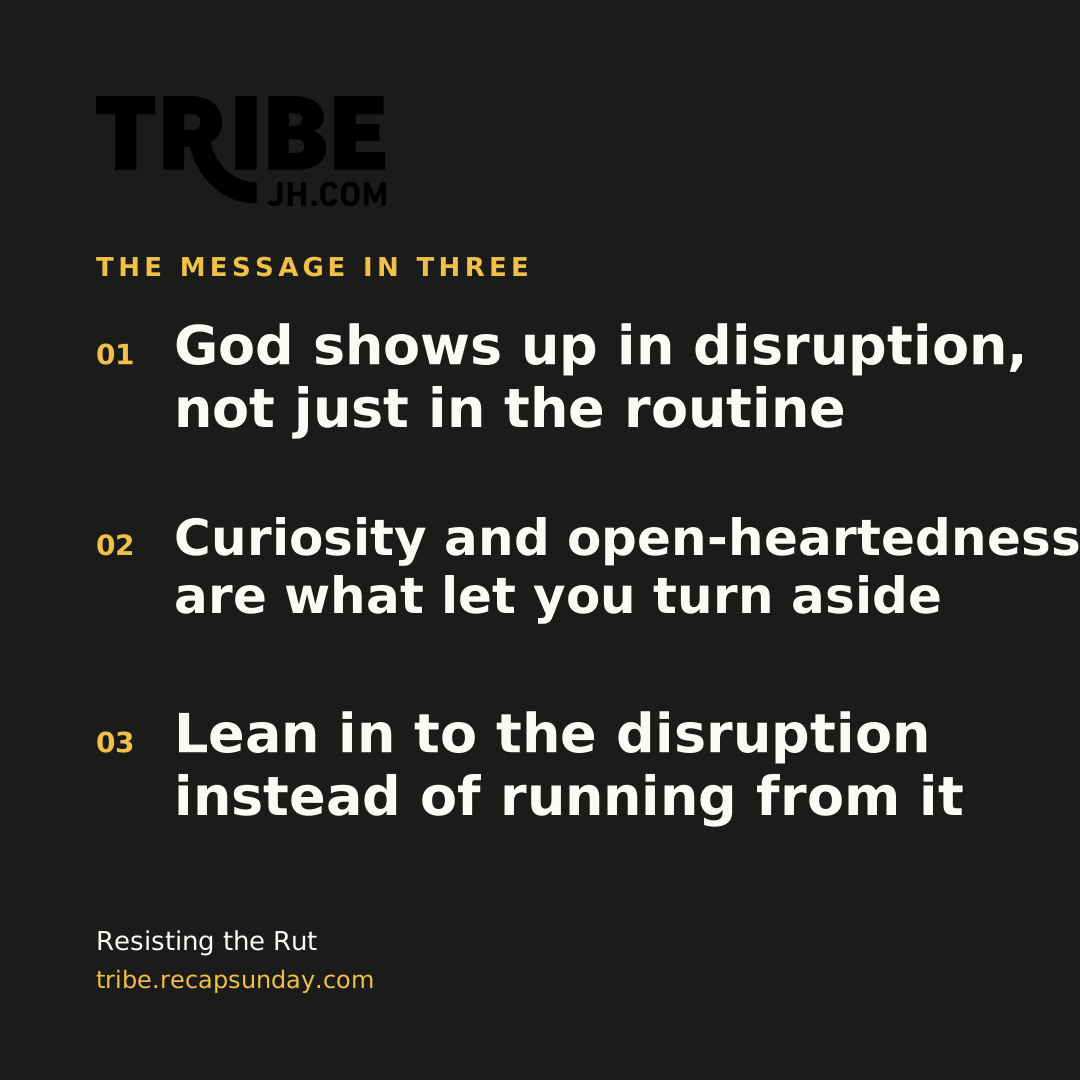
Brian closed with three practical responses for when disruption comes: pick your head up rather than getting grumpy and closed off, open your heart and mind to what the Holy Spirit may want to do in the moment, and lean into the growth opportunity rather than running from it. He quoted a cowboy poem about slicker-breaking a bronco and used it to land the idea that God is trying to train us for difficulty, not to keep us comfortable in the harbor. The point was that calm waters don't make skilled sailors, and the faith God wants to build in people is the kind that holds up on the open ocean, not just in safe conditions.
Touch points
Things you could actually do this week.
When something disrupts your plans this week, pause before reacting and ask Jesus out loud, 'Where are you in the middle of this?'
Pick one disruption you have been grumpy about and deliberately move toward it instead of away from it, the way Moses turned aside toward the burning bush.
Keep your heart open to a new or unexpected side of who Jesus is rather than assuming he can only show up in the ways you already expect.
If a disruption makes you want to shut down, do the one physical thing that Brian described as step one: pick your head up.
Spend a few minutes this week talking to God about whatever rut you have been stuck in, and then stay quiet long enough to let him talk back.
Doing a Bible study?
Here is a guide we have prepared for you: the passages
in order, questions for the group, and room to write.
Brian talked about how Moses could have looked at the burning bush and thought 'what a pain' instead of 'this is amazing.' Think of a disruption in your own life right now. What word would honestly describe your attitude toward it?
Several people in the group noticed that Jesus intended to walk right past the disciples, and Moses had to turn aside toward the bush. Neither encounter was forced on them. What does it look like in practical terms to turn aside toward something instead of away from it?
Brian predicó sobre cómo es fácil caer en una rutina que nos impide ver lo que Dios quiere hacer en nuestra vida. Usando dos historias bíblicas, mostró que Dios frecuentemente se encuentra con nosotros precisamente en los momentos que nos resultan incómodos o inesperados. La clave está en nuestra actitud frente a esas interrupciones: podemos alejarnos de ellas, o podemos acercarnos con curiosidad y el corazón abierto, como hizo Moisés ante la zarza ardiente.
En la historia de Jesús caminando sobre el agua, Brian señaló un detalle importante: Jesús iba a pasar de largo, pero los discípulos lo notaron. Aun así, sus corazones estaban tan endurecidos que les costó creer lo que veían con sus propios ojos. La pregunta que dejó en el aire fue esta: ¿cuántas veces perdemos un encuentro con Dios porque ya decidimos de antemano cómo se supone que él debe actuar?
Brian dio tres cosas concretas para resistir la rutina: levantar la cabeza en medio de las dificultades en lugar de amargarse, mantener el corazón y la mente abiertos a lo que el Espíritu Santo quiera decir, y acercarse a esos momentos difíciles como oportunidades de crecimiento. Como dijo alguien en la congregación, a veces simplemente hay que quitarse del camino de uno mismo.
---
Pasajes bíblicos usados
Éxodo 3:1-12
Marcos 6:45-52
Read the full transcript9,748 words
Let's just make this our prayer. This morning that the Holy Spirit would come and speak to us today. That these just wouldn't be words to a song but really our hearts cry today. The Holy Spirit, you're all we want. Sing it to him this morning.
You. Pour it out to him give the lord praise this morning. He is worthy. Let's sing this together. Lord we give you all the praise this morning in this park, in this valley, and with our lives.
We tell you we love you this morning. Speak to us today. Through your words, speak to us. Where would we be without you? You are worthy of this time and worthy of our praise.
In Jesus name, amen. Amen. Well, turn around and greet somebody this morning. Say, good morning. It's a good day to be in the park.
It's a good day. Worshiping the lord together. I really didn't. I would tell you. Yes.
And then we're gonna use this handheld. Where is Robert? Robert, two quick things. This is the Mike B's using. I forgot we pass around and people talk.
Yeah. When we go. So we use this one. Yeah.
And Brian would like to be off in the monitors when he talks because he doesn't he doesn't like his voice so loud. Okay. I don't know why,
but Yeah.
No. That's fine.
Okay. You can take those over there.
That would be great. And then in my voice will slowly, like a siren song, resistibly draw them back to attention.
Get it before we go back up because Brian wants us all to go back up to the.
Question for the students. Is this no. This is not your last weekend of freedom. Correct? You get one more weekend of freedom.
Alright. Enjoy it. And then you have to dial back your feralness. You're gonna have to clip your toenails, your fingernails. You have to brush your hair first time in the summer.
You have to go to bed before 3AM. Yep. Yep. Parents, you're looking forward to that. Right?
Mixed reaction. That's fair. That's fair. Here we are in the park once again. Maybe you're passing through Jackson Hole and you've found us.
Welcome to Tribe. We are a community of people and not a place that we meet because, obviously, we're meeting in a new and unique place today. We've met here at the park several times this summer. We have a few more dates to meet here at the park. But, as we gather together as a community, I think that this really emphasizes because we're at different locations.
Normally, we meet in the bar, but tribe has been kicked out of the bar. I like that. Again You're right at home. Yep. Welcome.
Welcome, friend. So we we're we're a community of people. We are not a destination or a location. We normally have been meeting in a bar, but there are events at the Virginian bar last couple of Sundays. Last week, we got to meet back in the bar.
They let us in for just one Sunday. Amanda got us kicked out. She preached last week. I guess she got us kicked out again. So here we are in the park.
Next Sunday, I don't even know where we'll be next Sunday. Oh, right here. Alright. And then the next Sunday, right here. Okay.
Alright. So you can leave your chairs set up.
Just leave them here.
Yeah. Just leave your chairs right here, and it'll it'll be good to go. There I don't know how many more Sundays we'll meet in the shade, but we may it's almost that time of year where we, like, meet out here in the sun, but then we'll be back in the bar. And so I think one of the unique distinctives of Tribe, we've been a church here for going on eight years. We'll we will celebrate our eighth birthday this fall.
My wife, Lisa, and I and our family have been in the valley since '98. Tribe is is relatively young and new, but Lisa and I and our family and many of our our church family are not new to the valley. But one of the things that we encounter is that it's, as sure as many of you know, it's hard to find, like, a permanent home here in Teton County. And I'll never forget when is Chris Bates here today? Did he waddle in today?
Or maybe somebody's dragging him. Oh, little buddy. Please just feel free to go ahead and text him. Yeah. Yeah.
Just call him out right now. He had a little run yesterday. A lot of people take three or four or five days and do this really amazing scenic backpacking trip called the Teton Crest Trail. Well, he and several other comrades from tribe here decided to run it all in one day. And so if you see people with taped toes and they're limping around a little bit, it's because they ran the Teton Crest Trail all in one shot yesterday, and I'm super proud of those guys for their stupidity, for their bravery and courage for for doing it.
Like we say here in Wyoming, if you're gonna be dumb, you better be Fast. Fast. That's right. Get her done. Thank you, Justin.
So here we are here we are in the park once again, and what I love about meeting here at the park is it gets different. Right? Like, when's the last time you went to an outdoor church service in the park? When's the last time here in Teton County through amplification you heard the name of Jesus being made made famous. And so it's a unique opportunity every time we gather here in the park to do something, for for the person of the spirit of Jesus to do something unique in your heart.
Right? We're not sitting in pews. We're not indoors. Even a bar meeting in a bar would be unusual and different, but I like to think of these opportunities as we gather at an outdoor service as a unique opportunity similar in a in a really good way, a holy spirit judo move. So if you're familiar with judo, it's all about throwing your opponent off balance, using your opponent's weight and momentum to throw them off balance and gain the upper hand.
Does does that make sense in judo? In a similar way, whenever we meet in a bar or whenever we meet out under the blue sky here, in a similar way, in a really gentle way, it's an opportunity for the Holy Spirit to do a judo move to you, to throw you off balance. And why does it throw you off balance? Because it's not normal. It's not routine.
It's not what you're expecting. And as soon as you're thrown off balance, it creates an opportunity if you are ready and willing for the Holy Spirit to do something special in your heart, which is we're not gonna talk about Judo, but it kinda goes along with what we are going to talk about today. We're going to jump into two bible stories. We're gonna read two bible stories back to back, one from the Old Testament, one from the New Testament, and then we're gonna try to weave it together for what the Lord wants to speak into our hearts today. So if you have your Bible with you this morning, the first place I'd like you to turn is the book of Exodus.
Click on Exodus chapter three. And one of the other unique distinctives that we like to do here at Tribe is we love to take turns reading from God's word, and we love to have a conversation. And so as we are digging into today's content and material, if you have questions, connections, or comments regarding what we're talking about, we would love to hear from you. We have a wireless mic that we pass around so that we can hear your voice right here, and also so that all of our livestream families that are watching from home or on the road can tune in. And a quick shout out to Peppers who is watching the livestream this morning.
Glad that you are with us watching the livestream. Peppers, can't wait to see you at the end of this week, maybe even sooner. Right? We got a big wedding coming up here this weekend. Jackson will never be the same.
Exodus chapter three, and we're going to read verses one through 12. So whoever would like to start us off, looks like Liz is running the mic around today. And oh, it looks like I think I saw Chris Baxter raise his hand.
No. He doesn't. Hannah's grabbing for my mom.
Oh, okay. Alright. Alright. So we'll let you read the second story. Mhmm.
With his freshly cut okay. Hair. Exodus chapter three verses one through 12. You can rip through the whole thing or read a few verses and pass it off. Okay.
Now Moses was keeping the flock of his father-in-law Jethro, the priest of Midian. And he led his flock to the west side of the wilderness and came to Horeb, the mountain of God. And the angel of the Lord appeared to him in the flame of fire out of the midst of the bush. He looked and behold, the bush was burning, yet it was not consumed. And Moses said, I will turn aside to see this great sight, why the bush is not burned.
When the Lord saw that he turned aside to see, God called to him out of the bush, Moses, Moses. And he said, here I am. Then he said, do not come near. Take your sandals off your feet, for the place on which you are standing is holy ground. And he said, I am the God of your father, the God of Abraham, the God of Isaac, and the God of Jacob.
And Moses hid his face, for he was afraid to look at God. Then the Lord said, I have surely seen the affliction of my people who are in Egypt and have heard their cry because of their taskmasters. I know their sufferings, and I have come down to deliver them out of the hand of the Egyptians, and to bring them up out of that land to a good and broad land, a land flowing with milk and honey, to the place of the Canaanites, the Hittites, the Amorites, the Perizzites, the Hivites, and the Jebusites. And now behold, the cry of the people of Israel has come to me, and I have also seen the oppression with which the Egyptians oppressed them. Come, I will send you to Pharaoh that you may bring my people, the children of Israel, out of Egypt.
But Moses said to God, who am I that I should go to Pharaoh and bring the children of Israel out of Egypt? He said, but I will be with you, and this shall be a sign for you that I have sent you. When you've brought the people out of Egypt, you shall serve God on this mountain.
Awesome. Great. Thank you. So here's what I want you to do between this passage that we just read, Exodus chapter three verses one through 12. Keep that spun up in your mind as we read the next story, and I want you to be thinking about and looking for connections.
What are some similarities, either thematically or with the grammar or what what transpires? So listen and be reading along looking for connections. I want you to engage your brain, not just come to church and open your mouth so that the preacher can baby bird feed you and drop it into your mouth. Ugh. I can't stand that kind of Christianity.
And I'm off my soapbox. Mark chapter six is the next place that we'll go. We're gonna read just a few verses, and we're gonna start in verse 45. We're gonna read a story that is that is equally probably very familiar to you all. Mark chapter six verse 45.
Read all the way to verse 52.
Immediately after this, Jesus insisted his disciples get back into the boat and head across the lake to Bethesda. While he sent the people home no. After telling everyone goodbye, he went up into the hills by himself to pray.
Can we pause right for one moment really quick? He tell he told the people goodbye or maybe your translation, it says he dismissed them. But I love that small little detail contained within that sentence of Jesus telling people goodbye. How often do you tell your friends goodbye? Alright.
See you later. Goodbye. Like, that is so normal for us, and it's easy for us to read about Jesus in the pages of the Bible and think that he is some mythical or distant or detached or far away character, not even really a person. But Jesus said goodbye to people. Did he give high fives?
Did he wave? Was it a lot of, like, did he literally hug everybody? I'm a big hugger. I like to hug you when you get here. I like to hug you when you leave.
Was he giving him some shakka? I don't know. But just we allow our sanctified imagination to fill in the gaps and make him the real person that he is. Jesus told them goodbye. Alright.
Let's keep going.
Late that night, the disciples were in their boat in the middle of the lake, and Jesus was alone on land. He saw that they were in serious trouble, rowing hard and struggling against the wind and waves. About 03:00 in the morning, Jesus came toward them, walking on the water. He intended to go past them, But when he saw him walking on water, they cried out in terror, thinking he was a ghost. They were all terrified when they saw him.
But Jesus spoke to them at once. Don't be afraid, he said. Take courage. I am here. Then he climbed into the boat, and the wind stopped.
They were totally amazed, for they still didn't understand the significance of this miracle of the loaves. Their hearts were too hard to take it in.
Man.
I'm sure that there's a when we read that story thank you, Chris. When we read that story, I imagine there is the full spectrum of belief about the factual details of that story, like, here gathered in the park. Everyone from from, yep, he said it, it happened, to, well, I mean, nobody can really actually walk on water, but the purpose is to show us something. I would suggest to you that the correct interpretation of this passage, because we have no other details that would give us from the text, no other details given that would suggest that what happened in this story was just allegorical. We're looking at historical narrative in this passage.
If the Bible says in this passage that he walked on the water, the reader is should interpret these words as historical facts. He walked on the water. How he did that? I don't know. We'll find out someday.
And here's the here's what I caution you about if you read this and think, like, well, we shouldn't take that little. Nobody can walk on water. Nobody's walked on water besides Jesus that we know of yet just because it hasn't happened to you. And I know that you tried it as a kid when you're at the public swimming pool. You're like, mom, mom, mom, watch me.
Watch me. Mom, mom, mom. And you're like, okay. If I run fast enough raise your hand if you ever did that. Cat was like, last week.
If you run fast enough, you get and you get, like, half a step, down you go. If Jesus if it says that Jesus did it, it just it it happened. He walked on water. Even the disciples who saw him, the Bible says here at the end of this little passage that their hearts were so hard, it was difficult for them to even believe it even though they saw it. So here's the title of this morning's conversation.
If you're taking notes, at least, like, pick up your phone and pretend to, Aaron. If you're taking notes this morning, you can write the title of the conversation that we're going to have. The title of this morning's conversation is resisting the rut. Resisting the rut. All of us, especially me, tend to be creatures of habit, and it's easy for all of us to fall into a rut.
I love going on adventures with my family. The challenge for my family is I like to repeat the same adventure. We have some friends that live down in The Bahamas. They've been to tribe a time or two. You hear me mention them from time to time.
They are outfitters, so they do commercial outfitting, like they'll take you fishing, snorkeling, whatever, but they also have a fleet of sea kayaks and they'll, like, send you out into the wild of these Bahama Islands and Keys where you can paddle and camp and and it's really fun. But I like to do the, like, same route every time. We've been three times, maybe four, four times. And if it were up to me, we would we would leave, at the exact same point, at the exact same time that we did last time. We would paddle to the exact same key.
We'd set our tent up in the exact same spot. Like, I'm just a creature of hat. I like to have it all dialed in and know and my family is like, oh my gosh, we've been there. Can we do something different? I'm like, yes.
But there's something I I just love to anybody else like me? Do you like to camp in the exact same spot? Do you kinda like to do the same, like, rhythm and routine? So by nature, all of us are creatures of habit, but there is a dark side to being creatures of habit that can cause us to fall into a rut. And what I feel like the lord put on my heart to share with you this morning is that we are to resist falling into a rut.
With that in mind, remember I told you we just read we read two stories, and we were gonna look at the similarities between those two stories. I'd love to hear from you. What observations do you have that could connect these two different stories? The first story of Moses encountering the burning bush, and then the second story of Jesus walking on the water and encountering the disciples. Lyssa has the mic, and so I'd love to hear from you.
What observations do you see similarities?
And church can continue now because Chris Bates is here every Finally,
everybody, there he is. Disbelief. Somebody just grab his quads and his hammies. I'm sure he'll appreciate that. Stay away.
Disbelief. Oh, disbelief. Okay. Tell me more. What do you what do you see?
Like, how do you see disbelief?
How do you see a bush burning but nothing's being burned up?
Right.
How do you see a man walking on water Oh. And believe it?
Okay. Okay. So you see disbelief in two different impossible things. Yeah. Bushes that are on fire are consumed.
People don't walk on water. They sink. Okay. I like that. That's great.
That's great. Sarah, right here. Let me I'll do it. Sarah with the mic right here. I
see them both as miracles.
Oh, okay.
Like, I mean, same thing. Like, you don't see people walking on water and you don't see a burning bush without it actually burning up. But I see that more as a miracle then.
But, yeah, disbelief
too. What if there is a a literal miracle? And I'm going to attempt to define miracle for the sake of our conversation here today as something that transcends or supersedes the bounds of normal reasonable experience in physics. A miracle. What if there is a miracle that could unfold for your life but happens to just be obscured by your disbelief?
Well, that'll preach. What if Moses was like, I don't believe that? What if the disciples I mean, they did think it was a ghost. And when you read the other story, we see that that that Peter cries out to Jesus. If that's really you, Lord, bid me to come to you on the water.
And in the Texas vernacular, Jesus said, y'all come on. What if there is a miracle waiting for you from the Lord for you to encounter lurking just behind the veil of your disbelief, that if you would just resist the rut well, bushes aren't supposed to do that. People aren't supposed to do that. If you would just resist the rut that you can encounter an amazing facet and feature of God. Okay.
Okay.
You just kinda said what I was gonna say, but the different levels of curiosity. Because if Moses wasn't curious, he would have missed out. And same with the disciples, but in Mark, we see that they were curious, but they didn't respond. The way Moses did, they responded in fear versus in the other gospels when they responded in fear, but one was like, I may be curious. I may be fearful, but still call me out to meet you, Lord.
So a measure of curiosity, and I might suggest open mindedness. Imagine Moses if he were like, what is a bush that's burning but not being consumed? Oh, that's it. I'm out of here. He picks up his little Moses skirt and runs off.
What what other observations do you see?
I see fear as well. I guess, partially in awe, and then partially as an obstacle to receiving something that God has for you.
An obstacle.
Something you may be called to that looks scary, but you're afraid so you don't receive. And then, the last piece was I see God taking care of his people, leading them out of bondage, and then also literally feeding them in the New Testament.
Yeah. We tend to move away from things that we fear, which is why we've been able to survive as a species. Like, mean, that's there's an element of it that's, like, good. But yet at the same time, that instinct can work against us. Why would God give us a survival instinct of moving away from things that we fear, but yet also at the same time, placing opportunities for us to encounter him in new and remarkable ways in the midst of that fear.
Are you are you tracking with me on that question?
Say it again.
Why would god he made us. Right? He wired us as humans that that when we experience fear or we experience alarm, the instinct that has been programmed into us is to back away and and and be fearful. Oh, there's a snake right there. And by the way, any snake on the ground that I ever see, it's always like a cobra, like and to be extremely avoided.
But why is it that when we encounter fear, our instinct is to back away, but yet god oftentimes places an opportunity for encounter with him right in the midst of what we would instinctually tend to shy away from. Why does he do that? We're not gonna answer that question, but he's tricky like that.
I see just how easily it is for us to kinda miss what the Lord is doing. Like, he's not always just gonna completely interrupt us. Like, just how Jesus was walking by on the water, he didn't, like, intend for them to He didn't intend to stop. He was just walking on the water doing his thing. And same thing with the bush.
It looks like Moses had to turn aside to see the bush and pay attention to it. So it wasn't necessarily in his path. He had to go out of his way, kinda like what Lanisha was touching on, like the curiosity. Like, we need to keep our eyes open to see what he's actually doing.
Way to telegraph where I was going with both of these those two stories. This is worthy of writing down. God loves to encounter us in the disruption. We think of disruptions as a nuisance to be avoided, but it is in the midst of those disruptions that God loves to encounter us. And Jay just beautifully connected two dots that I want to bring our attention to.
The first one is in the book of Exodus chapter three, what the story that we just read. Hone in on verse 12. Exodus chapter three verse 12. Hone in on that verse. Moses says, this is amazing.
He uses the word amazing, but I would suggest to you that you could substitute several other words in that moment for the for it to help you put yourself in the shoes of Moses. Moses says that's amazing. Something unusual, something different out of the normal, out of the routine, This is amazing. But you could substitute the word annoying, hassle, pain. What a what a pain that like, oh my gosh.
Something different, something out of the ordinary. Oh my gosh. Like, I I did not need this today. Moses says, this is amazing. And then just like you pointed out, Jay, very good, Moses said to himself, why isn't that bush burning up?
I must go see it. Or what does you don't need the mic, but what does perhaps your translation say in verse 12 there? What does your translation say? Moses says to himself, why isn't this bush burning up? Mine says, verse three, what did I say?
Sorry. Sorry. Sorry. Sorry. Verse three.
Sorry. Sorry. Sorry. Sorry. Sorry.
Verse three. Thank you for the coaching. This is amazing, Moses said to himself. Why isn't that bush burning up? I must go see it.
But what does your translation say in verse three? Strange sight. Strange sight. Must. Does he say turn aside, or what does he say?
It says, so
Moses thought, I will go over and see this strange sight. Why the bush why the bush does not burn up.
I will what is it? I will go and see? I will go over and see. What about another translation? What does yours say in Exodus three verse three?
Sorry. Whose translation says, I will turn aside? Okay. Alright. So we have a couple of turn asides.
I will go see. I must go see it. What about something else? When we hear it from a couple of different angles, it helps us to, like Like, this wing. Like, have it dialed in.
What does yours say? Does it all say basically the same thing? Okay. Alright. Alright.
I'll let you off the hook. Oh, what did Zoe say? Oh, would you would you, like, take a little bit more of a run? Tell us a little bit more of, like like, say that say that, like, what's around that. Here you go.
Why is this bush not burning up? I need to move a little closer to get a better look at this amazing sight.
Oh, that's pretty cool. God loves to encounter us in the midst of disruption. When when we encounter disruption, it is inconvenience. It's a hassle. It's a pain.
It throws us off of our rhythm. I had a good routine going here, or were you stuck in a rut? And then in the midst of that, there's a burning bush. Wouldn't it be great? I mean, how many of you've ever wanted to hear the voice or get the direction of the Lord in the midst of a burning bush?
Like, how could I miss that? We all want the burning bush, but very few of us are willing to see the burning bush in the midst of what we think of as a disruption. It's a pain and it's a hassle, and we stand the the potential to completely miss out. But what does it say again one more time?
I need
to move a little closer. What is our tendency with disruption? To move closer towards it or to move away from it? To move away from it. Now hold that in in Clay's got something over here.
Hold that intention. Hey, Liz. Sorry. Can we have the mic? And if you wanna switch off duties, go for it.
Where was it?
Oh, yeah. Ollie's got the mic. Alright.
Ollie, you're on.
You're on mic duty, Ollie. Thank you, sir. Clay, what do you got?
I think the thing that stands out the most to me is why. You think about a child, why? Why? Why? Always asking why?
We never accept God at face value. We always wanna ask why like we don't. We're not willing to step out on faith and trust. You know, we're we're we always wanna question. It's like, you know, you can't you can't learn from your mistake.
Hey, maybe you take the wrong step. Maybe you don't get what he's trying to get across to you. But I think the I think where we miss the boat so many times is that we don't step out on faith. I mean, we're we're constantly asking why when we have an opportunity to learn.
That's such a great point is we want to know why. Why? Why is the bush burning? Why should I turn aside? Why should I disrupt my life, my schedule to go and see this burning bush?
Why? Why is that bush burning? Instead of leaning into this inconvenience.
We always want somebody else to interpret for us. We're not willing to step out. And, you know, we as a a body of believers, we depend on so many other people instead of getting in the word ourselves Oh. And praying and being specific and getting on our knees and praying through Sure. Versus just throwing out a prayer Fix it.
Hope it gets better.
Yeah. Fix it, Lord. Think about Moses. He had been deep in a rut Forty years at the same job. Don't raise your hand, but how many of you have that are under 30 been in the same job for more than four years?
Don't raise your hand. But, like, four years is like a lifetime for you. Imagine, here's Moses as a shepherd for forty years. Same routine, day in and day out. Maybe you spend nights out in the field with the sheep, but the seasons, you shear them, you you breed them, you separate them, you do the same thing with the flock.
You have the pasture in the summer. You have the pasture in the winter. You take them here. You bring them back. Talk about monotony in the routine.
After forty years of being a shepherd, he sees a burning bush. He could have been like, oh, great. But yet he turns aside. Where was that mic? Oh, right here.
I was just thinking about how in this situation with Moses, it kinda seemed like God was presenting himself as, like, this is my character. Like, use this as a sign that I will be with you. But the disciples were with Jesus, like, all the time. And if you think of someone you're with all the time, you think you'd know their character. And it it's I think it's amazing to me how, like, it even said their hearts were still, like, were hardened, so they didn't realize what fully happened earlier.
But I think the it should have been like a a understanding in their heart, like, oh, this is Jesus. This is what he does, you know, versus, like, still just puzzled, you know, all of this all of these miracles happening, and it's just like, you know, they're next to Jesus, like, communing with him and in fellowship. But whereas Moses, I just love how, you know, God showed up. He turned his side. Yeah.
And he's like, hey. Use this as a sign as, like, this is my character. This is what I do. And, like, through this miracle, you'll see that I'll never leave you. But, like, the other side is that Jesus was physically with him doing all these things consistently, and they were still, like
What if there is something that something amazing that Jesus has for you even today at this gathering that unless your heart is open to encountering a new facet of his personality, you would completely miss it because you're stuck in a rut of this is how I think Jesus is besoused to be. He's only supposed to say this or do this or act this way. And when he wants to, in the midst of disruption, reveal something new about him or or or share something new with you or do something new in your heart and in your life, but you're closed off to it because you're like, I don't think Jesus is supposed to walk on water. I don't think Jesus is supposed to do this. He's just supposed to I'm just supposed to throw up a prayer and have him, like, some sort of, like, heavenly vending machine.
I threw up the prayer, pulled the lever, and then out comes the answer. Jesus is a person, and he don't roll like that.
Yeah. I don't know where the connection is necessarily with this yet, but when I think of Moses going to the bush, I envision like the girl in the cheesy scary movie who hears a sound outside of her safe house and she goes outside and you're you're like, girl, what are you doing? Girl, if you're gonna be this stupid, you better be fast kind of thing. Know? So I don't know where that connection is, but that's the thought that comes in my head.
And like, everyone else might be like, dude, what are you doing? Like, are you going to this burning place?
You got a nice little lake house that you're on a girls weekend with. You hear some strange noise down in the boathouse on the lake. What are you thinking going down to the boathouse? And you don't have a flashlight? Yeah.
Yeah. No. I'm I'm I'm with you. I like it. I like it.
Okay. So, yes. Oh. And then right back there. And then we're gonna look at Matthew.
I mean, the story of Mark. Sorry.
I swear I'm not saying this to be funny, but what Parker just said and what I've been sitting on is I always find myself, like, yeah, I'm curious, but I never go check it out or look at it. And I always find myself still getting interrupted because stereotypically, in most horror films, the black person stays inside the house, but they always end up dying first. And I somehow always find myself not being curious, but the Lord still being like, hey, listen. Look. I need you.
I want you here. And I'm like, oh, no. I'm scared.
Thank you, Lanisha. Like, oh, she said it first. Thank goodness.
Yeah.
So what I was thinking is the in Proverbs, it talks about, the process of discovery. We we need to discover what God means. So it's it's kinda like Vinitia was talking about curiosity and desire to discover. It's huge. If you don't wanna discover something, you ain't gonna do it.
You ain't gonna do it. So so there is oh, oh, and pass it right over, she said. I
ask God often, is this you? Jesus, is this you? Are you showing me something? And I love I have much confidence in his answer.
Okay. How do we resist the rut? How do we resist the rut? We're gonna we're gonna get to some really specific things in, like, just a moment here, but how do we resist the rut? Listen to what she just said.
You can ask, Jesus, is this you? Sometimes it's just a flat tire. We live in a fallen world. And with the fallen world come flat tires sometimes. I think we have to hold we have to hold things in in intention so that so that we don't get into a ditch on either side.
One ditch is everything is spiritual, and the people in that ditch tend to think that it's a demon. Well, flat tire demon got me. And you sit in your car, and you're, like, splashing holy water around and you're, like, rebuking the devil, but then you still gotta get out and change the tire. Right? The other side of the the other side of the road is a ditch where you just bumble along and you never encounter the lord in the midst of disruption because you're you refuse to turn aside like Moses in that burning bush.
There is a healthy place of maturity where we hold these things in tension. Okay. What were you going to say?
So the first word that I thought of when you mentioned that all of this were all saying the same thing, just in a different way. Okay. For me, it was get out of your own way. Just get out of
my way. Put that back at the top of your notes as an alternative title to today's conversation. Get out of your own way. Don't get stuck in a rut or get out of your own way. That's so good.
Oh, yeah. Thank you. Okay. Mark chapter six, and and Jay touched on this a moment ago. I think it's verse 46.
Look at verse 46 of Mark chapter six. 48 verse 48. Now we see this same story in more than one gospel account. And in one gospel account, like we mentioned, it says that Peter sees him. They they freak out because they think it's a ghost, which I probably would too.
And then Jesus says, peace. Like, it's alright, guys. It's okay. It's me. And then Peter is like, Lord, if that's really you, bid me to come out to you on the water.
In this gospel account in Mark chapter six, there's a unique detail that Jay picked up, and I'm sure others of you have as well, that says, Jesus intended to what? Where was he going? Where? Yeah. He was gonna pass right on by.
Jesus intended to pass by. And the disciples could have been like, well, that's a ghost. Like, don't look over there. Whatever you do, don't make eye contact with it or it'll steal your soul or something. I don't know.
Was that funny? That was for you, Hugs. But Peter turns aside, He embraces that disruption, has an interaction with he's not even for sure that it's Jesus that's out there in the wind, in the waves, and at night. But he I like what you just said. He got out of his own way.
He got he resisted the rut, had this interaction with Jesus, and something amazing and incredible happened. In the same way that Moses turned aside, we see that that Jesus was walking on the water, and he intended to walk right past, but the disciples turned aside from there in the midst of the disruption and ended up having this incredible encounter with Jesus. So here's what I'm getting at. We have to resist the rut of routine. Because when we encounter disruptions, because it's a part of our everyday life, the tendency is to have the wrong attitude and approach towards disruptions.
Well, the job that I wanted to the job that I applied for isn't the job that I got. The the the health that I wanted in my body isn't what I got. The the day that I had planned out and scheduled isn't what I got. All of us, to some degree or another, are creatures of habit. The danger is that we tend to fall into a rut.
And when we fall into a rut, it's really hard to get out. Have you ever been, like like, on your way back on a, like, a Jeep road two track that's kind of washed out? And if you stay on the high side, you're fine. But if that if that trail is muddy or greasy at all, you fall down into that rut, and then hopefully, you have enough clearance to keep going. Otherwise, you're stuck.
Or how about when you're mountain biking and you're bombing down that single track trail and the trail is a little bit washed out? Don't look at the rut because your front tire will always go where you're looking. You wanna look ahead at the trail. Don't look at the rut. But if you are looking and staring at the rut, then that's where your front tire will go.
You get down into that little washed out spot on the trail, and the next thing you know, you're like a real Wyoming cowboy going right over the saddle horn. You have to resist the rut. Okay. Three really practical things that you can do to help you resist the rut so that when you encounter disruption, you have your head on a swivel. And and like you just said, Colleen, like, not are is this you?
But Jesus, where are you in the midst of this? Because sometimes Jesus may say, hey. Don't go down to the boathouse on the lake. There's an axe murderer in there. Right?
But Jesus, where are you in the midst of this disruption? Couple of really, really practical things. In the midst of disruption, pick your head up. The tendency is for us to immediately be disgruntled, discouraged, downcast, grumpy. And when you're grumpy, it's really hard for you to see what God is doing and how he's at work.
So number one, in the midst of disruption, pick your head up. Number two, don't close your heart and mind, but instead open them up to what the Holy Spirit may want to speak to you in those moments. That's that spirit of curiosity. Moses resisted the rut, and he stepped aside. What did he say?
I have to draw closer? I have to come near? What what They made up. I have to move closer to this. Can you imagine your friends seeing you in the walking through in a season of disruption?
Maybe your job is in chaos or some some other aspect of your life that your friends notice and see is just in absolute turmoil, but you have an attitude of expectation and eagerness and excitement. Your friends are gonna be like, what is wrong with you? And you're like, oh, this disruption, it's an opportunity for encounter. And the next question is that they're gonna ask is encounter what? And there you go.
There's your wide open door. So number one, in the midst of disruption, pick your head up. Number two, don't close your heart and mind. Open them up to the Holy Spirit, who he is and what he may want to do. And then number three, lean into that growth opportunity.
You have heard the saying that calm waters don't make for skilled sailors. Now there there is a time and a season when the boat is being built that is not for the open ocean. All boats are built where? In the safety of the and all you landlocked people said harbor. That's right.
Right? Boats are built in the harbor where it's safe, but boats are never intended to stay in the harbor. The faith that that god wants to equip you with is not a harbor kind of faith. And if your faith, your relationship with Jesus is only good in the harbor, God god the desire of god's heart is to equip you to equip you with the kind of faith that can move out beyond the harbor and into the open seas. Many times, he will even, in a really good God way, lure you out onto the open ocean.
So that when you encounter difficulties, so that when you encounter rough seas, there's an opportunity for you to meet with him and encounter him that he that will equip you for those for that for those wind for that wind and those waves. I'm gonna jump in the force really quick and talk about horses. So I'm not much of a horse person. I know that many of you are, but to me, horses are like they're unpredictable and skittish. And all the horse people are like, well, yeah, that's a horse.
You can walk it past the same wiggly stop sign on that country road a thousand times, and then you're going by one day and the horse is like, what is that? And then they freak out and run away. Or you can be you can be in all different kinds of weather with your horse, but then just one day, you know, one crack of lightning far off and that horse is like, that's it. I'm out of here. And to to me, horses are really unpredictable.
Is that is that fair to say? Okay. Yes. But that that horse, in a way, is is really good for training for for us. That horse wants to to run at the at the first sign of something that it that's inconvenient or doesn't understand.
And then as the rider, what do you do as the rider? With this analogy, you can be the horse and you, at the same time, you can flip back and forth. You can also be the rider. Like, are you prepared to handle your horse when your horse encounters something that's unusual and unexpected. Oh, and this analogy goes even deeper because we can think of the lord as the rider and we as the horse?
As a as a good rider, have we as a good rider, which the lord is, he's trying to train us for opposition and difficulty to get us out of a rut. But do we tuck tail and run at the first sign of something that disrupts our life? It makes me think of a old cowboy poem that that probably some of you have heard, but I'll read it to you really quick. When you're breaking out a bronco, you better get him slicker broke for you'll have to try it sometime when it isn't any joke. When the wind begins to blow until it snaps his mane and tail, and a big black clouds are coming full of lightning, rain, and hail.
You know that if you get off of him, he'll probably run away. So you try it in the saddle, hoping that you'll stay. But the horse starts a bucking when you get it halfway on, while your arms and sleeves are tangled, then he throws you and he's gone. Now your slicker's torn and busted and the wind has took your hat, and you see the horse and saddle go adrift in down the flat. About that time, you get an idea and you don't forget it, pal.
If you're gonna slicker break a bronco, you better do it in a darn good corral. Close your eyes. Lord, the desire of your heart is to get us slicker broke So that in the midst of difficulties, something that disrupts our normal pattern and routine, we don't tuck tail and run, but we lean in to trust you. Now you take just a moment, and here we are in this park in the middle of the city of Jackson where life is continuing all around, and let's make this place in time, not this place geographically, but this place in time, a holy moment where we ask the Holy Spirit in the midst of whatever disruption you may be going through, Lord, what do you have for me? Just ask him.
Just take a moment and talk to him. Let him talk to you. Thank you, lord. Just speak to us, lord. And we love you, Jesus.
While you're having this moment, a tender moment with you and the Lord, nobody's looking around. I'd love to pray for you. If you would say today, like, man, I I really have been stuck in some kind of a rut, and I've had a poo poo attitude towards that rut that I've been stuck in. And maybe just maybe I've missed encountering the Lord because I've had the wrong attitude about the rut that I've been stuck in. But today, I wanna resist that rut, and I wanna encounter you, Lord.
I wanna meet with you. I I'd like to pray for you, but I wanna know who I'm praying for. Will you just slip your hand up? Like, man, I feel like today was for me. Okay.
Cool. Cool. Super cool. Okay. Let me just pray for you.
Jesus, you see the hands that are up. And maybe people that are watching this livestream, they you're walking on the wind and the waves. There's literally a burning bush in front of them, but they're so stuck in a rut that their attitude has polluted their ability to encounter you in the midst of this disruption. But that changes today. They're they're in the best way they they know how, these people are trying to resist the rut.
Would you meet them in the tenderness of this moment right here in this park? Just whisper to their heart. Let them talk to you. We'll go just a moment longer with this part. Just let him talk to you.
Let's stand up together and sing this little part together. Teach us those complicated words, would you?
Sing that out. There's nothing. One single There's nothing better than you. Just
There's no disappointment. There's no curveball that ever comes into our life that is new information to the lord. And there's nothing that we would ever walk into that he does not have a wonderful, miraculous provision for if we will just resist the rut and turn aside. I know that your dad was not supposed to pass away yet. I know that that health report that you got was not supposed to be delivered to you.
I know that, and so does he. But there's nothing that's better than him. And when we resist the rut, we position ourselves to encounter him like Jesus walking on the water or Moses in the burning bush. So thank you, Lord, for your goodness that nothing is better than you. As we are in this place of worship, why don't we worship the Lord one other way?
Stay standing because we're we're in the homestretch here. We're almost back to the barn. Hang in there. We can see it from here. Let's worship the lord one other way.
We've worshiped him with singing with our voice. We've worshiped him by honoring and chewing on and considering and discussing the word, which I think is so valuable. Let's worship the Lord one other way with our tithes and offerings this morning. We're not really we we're not that kind of church that passes a bucket. So and it'd be weird out here in the park.
So so what we do, you can give a couple of ways. You can give online through our website, tribetribejh.com. It's literally in our name. You can give through your smartphone by sending a text to 84321. Just type a number in the message field.
If it's the first time you're giving, you'll get a reply with instructions on how to give, and that's how most people are generous with their tithes and offerings. But if you've got check, cash, or bitcoins, you can put them in there's a little box by the donuts and coffee. You can put check and cash in a little brown box right there. Let me pray over the offering, share a couple of announcements with you, and then you can continue to enjoy each other's fellowship in this incredible end of summer weather. Lord Jesus, thank you for the jobs that we have.
Every good and perfect gift comes from you. And your word says in Romans thirteen one that there's no authority but that which you have established. Even if we don't have a great manager or boss right now, that's not a surprise to you, and we still get to learn and grow from that. So we thank you for the jobs that we have. We thank you for providing for all of our financial needs according to your riches and glory.
So, we tell you that we love you and that we trust you not just with our mouth but with a portion of our hard earned finances as a really practical way of saying that we love you and we trust you. God, I ask that you would receive these tithes and offerings to make your name famous here at Tribe, in Jackson Hole, the surrounding region, and to the uttermost bounds of the earth. We pray these things in Jesus' name, and everybody said, the Lord bless your giving this morning. Couple of announcements. Number one, next Sunday, we will be right here.
So, save your spot. In the sun probably in the sunshine next week. Okay. Well, let let's
The other side of the hill.
Let's see what happens. We may move locations from here to just this way. So We could find. Let's see let's see what happens with the temperature and the weather. It's finally nice that it's nice and cool instead of blazing hot.
And if you're visiting and you're from some place hot, you're like, guys, this ain't hot. It's been hot here this summer for us. So next week, we will meet right here, number one. Number two, next week, we're gonna have a special guest with us. Like I mentioned earlier, Caleb is getting married to Susan.
Whoo. You're not all invited to the wedding. But but it's gonna be it's gonna be a great weekend for many of our tribe fam here. And one of the guests that are coming for the wedding is a former IDF Israeli Defense Force, officer who lives in Israel. And despite what you've read in the news or what you've been fed in your curated feed on social media, why don't you hear from an Israeli citizen who's on the ground living towards the Northern part of Israel about his perspective of what's going on in Israel.
And he's gonna be here. His family will be here next week as a part of the wedding. He's going to join us for service, and we'll do, like, an interview style where I'll ask him questions. And then if you have an a question, we'll have a time for question and answer. So be thoughtful about your questions, but you'll be able to ask Marco a question about his perspective of what's going on in Israel.
That'll be next week. And then also next week, there are two other things that are going on after service. The first one is at 5PM, there's been a monthly gathering of of, religious some of them are religious. All of them are ethical Jewish people that live here in this community that gather to show their solidarity and support for Israeli citizens that are really facing a seven front war at this moment. You only hear of one or two, but there's really seven different fronts that Israel is defending itself at this time.
And so since October seventh of last year, they have been gathering on the town square. And as Christians and as a tribe fam, you've been invited to join them, so that's also happening. But then tell us the last thing that's happening.
There's also the hootenanny down in Bondurant, the worship hootenanny. So we're gonna load the tribe bus. So we already let all the friends know that we won't be at the town square that Sunday and they they're going to handle it. So, you want to go to Bondurant with us, we're going to load the tribe bus at 3PM at the TMC and head down to Bondurant for the worship hootenai. There's food trucks and tribes going to play.
Couple other bands are going to play.
And it's a gathering of other churches.
Then tribe are gonna play.
Hardly.
Yeah. So, if you wanna come, just show up at the TMC. We'll announce it again next week. TMC at 3PM to be there ready to play at five.
And it's a gathering of several of the other churches. Right?
Yep. Going on.
Yeah. Busy weekend. Let me pray for you really quickly, and then there's still opportunity to to grab some donuts, enjoy the sunshine, and then we'll tear down and get out of here. Alright? So, Lord Jesus, thank you so much for disruptions.
Alright. Let's just say this prayer really quick together. So repeat after me. Lord Jesus Lord Jesus. Thank you Thank you.
For disruptions. For disruptions. I will use these I will use these. As an opportunity. Opportunity.
To resist the rut. Hey, they said it, Lord. Would you bless the words and the confession of their mouth? I pray a blessing over each and every person that's here today. Thank you so much for being so good to us.
We pray these things in Jesus name, the strong son of god and everybody said, amen. Amen. I love you guys so much. Enjoy your last week of freedom before the imprisonment of school next week. You got this.