God's instruction to proclaim appointed festivals as holy convocations, with convocation meaning rehearsal
2 “Speak to the children of Israel, and tell them, ‘The set feasts of Yahweh, which you shall proclaim to be holy convocations, even these are my set feasts.
read aloud describing the Pentecost offering of seven lambs and two loaves of fine flour
15 “‘You shall count from the next day after the Sabbath, from the day that you brought the sheaf of the wave offering; seven Sabbaths shall be completed:
16 even to the next day after the seventh Sabbath you shall count fifty days; and you shall offer a new meal offering to Yahweh.
17 You shall bring out of your habitations two loaves of bread for a wave offering made of two tenths of an ephah of fine flour. They shall be baked with yeast, for first fruits to Yahweh.
18 You shall present with the bread seven lambs without defect a year old, one young bull, and two rams. They shall be a burnt offering to Yahweh, with their meal offering, and their drink offerings, even an offering made by fire, of a sweet aroma to Yahweh.
19 You shall offer one male goat for a sin offering, and two male lambs a year old for a sacrifice of peace offerings.
20 The priest shall wave them with the bread of the first fruits for a wave offering before Yahweh, with the two lambs. They shall be holy to Yahweh for the priest.
21 You shall make proclamation on the same day: there shall be a holy convocation to you; you shall do no regular work. This is a statute forever in all your dwellings throughout your generations.
Christ united Jews and Gentiles into one body, reconciling both groups to God
14 For he is our peace, who made both one, and broke down the middle wall of partition,
15 having abolished in his flesh the hostility, the law of commandments contained in ordinances, that he might create in himself one new man of the two, making peace;
16 and might reconcile them both in one body to God through the cross, having killed the hostility thereby.
17 He came and preached peace to you who were far off and to those who were near.
18 For through him we both have our access in one Spirit to the Father.
The message in order, in a few minutes of reading.
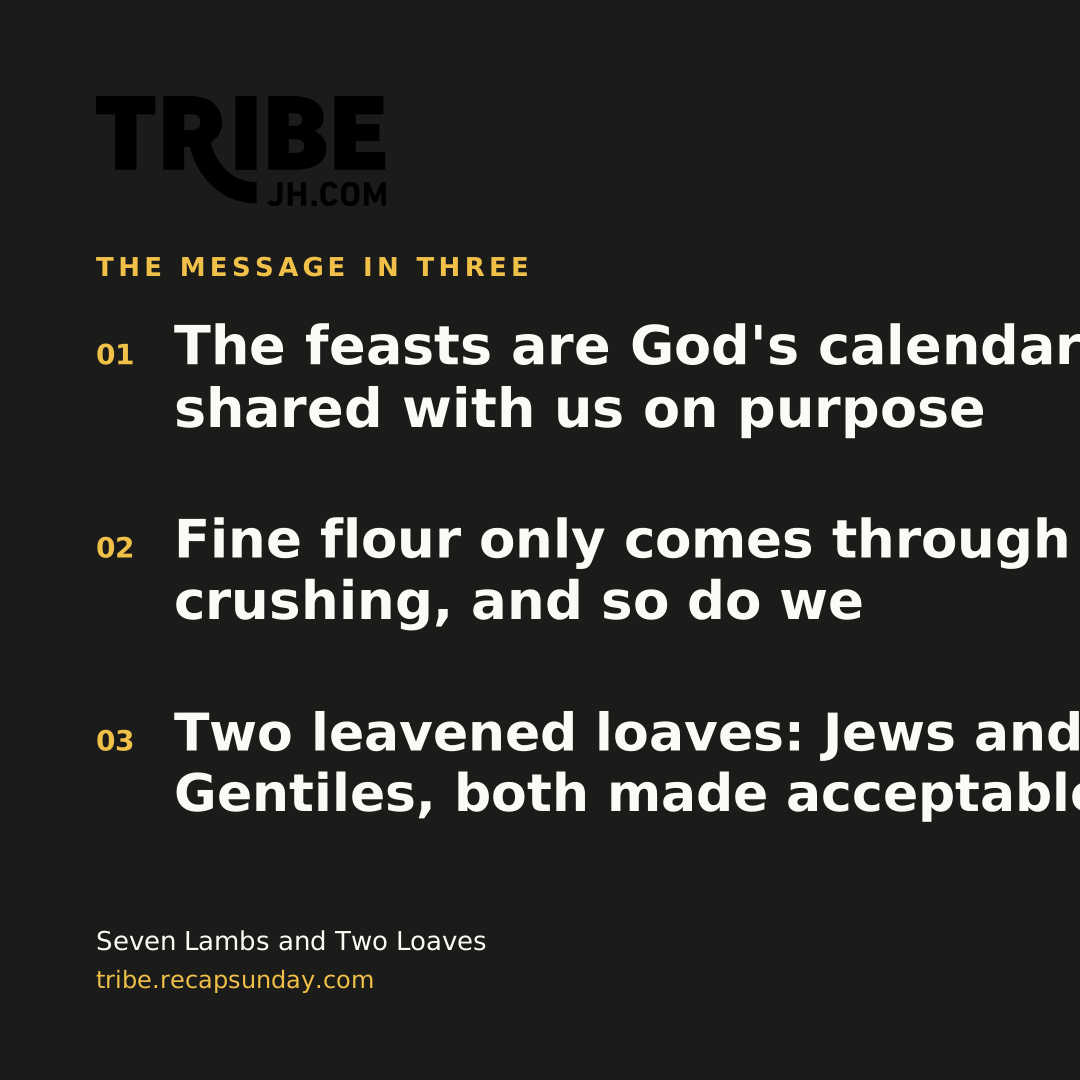
This was Pentecost Sunday, and Brian walked Tribe through the biblical feast of Shavuot, its roots in Leviticus 23, and the way it points to what happened in Acts 2. The central images were the seven lambs and two loaves described in the feast ordinance, and what each one reveals about Jesus. The goal was not to over-celebrate the feast but to let it do what Brian says God designed all seven feasts to do: help us remember, recalibrate, and rehearse.
What was said
Brian opened by explaining that in 2020 the Holy Spirit prompted him to get Tribe synced up with God's calendar. The seven major feasts in the Bible, he said, are not just Jewish feasts but God's feasts, and the Lord shared that calendar because he wants to be known. God told him there were three reasons to recognize the feasts at Tribe: to remember, to recalibrate, and to rehearse.
The remembering piece came from Psalm 77, where the psalmist is overwhelmed and distressed but then pivots with the word "recall." Brian's point was that the feasts give us a lens made of God's past faithfulness through which to look at present circumstances, however hard they are.
Recalibrating came from Psalm 119, the idea of turning our eyes from worthless things. Brian connected it to the mule's ear wildflowers blooming on the hillsides outside, saying that even common beauty in creation is God's way of inviting us to get our minds right and see his hand.
Rehearsal was the third reason, and it carried the most weight in the sermon. The Hebrew word behind "holy assembly" in Leviticus 23, Brian explained, carries the meaning of gathering for the purpose of rehearsal. Several of the spring feasts have already seen prophetic fulfillment in history. Three fall feasts have not. Getting familiar with the feasts now, he said, is what puts believers in a position to say, like Peter did in Acts 2, "this is that" instead of running around in confusion when those events unfold.
Brian then worked through the two specific details from the Leviticus 23 passage: seven lambs and two loaves. The seven lambs, offered without blemish, point to Jesus as the perfect sacrifice, and the number seven to completeness. Every day, he said, believers are invited to remember that sacrifice. The two loaves were made with fine flour, and the congregation talked through what fine flour actually requires: the grain goes through the tribulum, crushed and sifted repeatedly, the finest flour being the product of the most refinement. Brian connected this directly to Isaiah's description of Jesus being crushed for our iniquity, and then to the invitation for believers to walk the same path of dying to self.
The two loaves also carry a second meaning. Brian read from Ephesians 2, where Paul writes that Christ broke down the wall of hostility between Jews and Gentiles, making one new people from the two. Unusually for biblical offerings, these loaves were baked with leaven, which normally represented sin and was excluded from sacrifices. Brian said the point is that neither Jews nor Gentiles come to God in perfection, but the perfect sacrifice of Jesus makes both acceptable and able to be presented before the Lord together.
Brian closed with Acts 2, the moment Pentecost reached what he called its kairos fullness, when the Holy Spirit fell on the gathered believers. He read a short poem by Lucy Shaw about that event, then drew the distinction between the law, which reveals sin and condemns, and the Spirit, who reveals the Messiah who saves. The practical invitation he left the congregation with was the same raw question the crowd asked Peter after his Pentecost sermon: "Now what should we do?" Hands open, hearts surrendered, ready to hear the answer.
Touch points
Things you could actually do this week.
Read Acts chapter 2 today, since it is Pentecost Sunday and the whole chapter ties directly to what was discussed this morning.
When you see the yellow mule's ear flowers blooming on the hillsides this week, let them remind you of the Holy Spirit's goodness and what Pentecost means.
Take a quiet moment this week to ask the Holy Spirit what is filling up your cup and keeping you from being filled by him, then surrender it.
If you want to serve beyond Sunday, sign up for the Wind River Reservation VBS trip to Riverton on June 25 through 28 to work with kids.
Check the fridge at Tribe for what Tribe Mountain Adventures has going on this summer and find one outing to join with the community.
Doing a Bible study?
Here is a guide we have prepared for you: the passages
in order, questions for the group, and room to write.
Brian read Romans 8:28 at the start and talked about giving up control and being present in the now. Where in your own life right now is it hardest to stop trying to manage the outcome, and what would it actually look like to rest in that?
Brian laid out three reasons God wants Tribe to recognize the feasts: to remember, to recalibrate, and to rehearse. Which of those three do you personally need most right now, and why?
El sermón de Pastor Brian se centró en Pentecostés y su conexión con la fiesta bíblica conocida en hebreo como Shavuot. Explicó que Dios tiene un calendario de siete fiestas principales, y que él quiere que la congregación las reconozca por tres razones: para recordar lo que Dios ha hecho, para recalibrar el corazón y la mente, y para ensayar eventos proféticos que aún no se han cumplido en la historia. Así como en un ensayo de boda uno practica para el día real, estas fiestas nos preparan para reconocer lo que Dios está haciendo cuando ocurra.
La fiesta de Pentecostés en Levítico 23 incluye la ofrenda de siete corderos y dos panes de harina fina con levadura. Pastor Brian explicó que los siete corderos apuntan a Jesús, el Cordero perfecto, y que la harina fina representa el proceso de ser triturado y refinado, tal como Jesús fue aplastado por nuestros pecados. Los dos panes hechos con levadura representan a judíos y gentiles, ninguno perfecto, pero ambos aceptables ante Dios gracias al sacrificio de Jesús. En Hechos 2, cuando llegó el momento más pleno de Pentecostés, el Espíritu Santo cayó sobre los creyentes y comenzó a ser derramado sobre toda carne.
La invitación final fue personal: así como un recipiente lleno no puede recibir más, necesitamos vaciarnos de preocupaciones, orgullo y distracciones para poder ser llenados por el Espíritu. Pastor Brian animó a la congregación a leer Hechos 2 durante la semana y a vivir con el corazón abierto preguntándole a Dios, como los que estaban en Jerusalén aquel día: "¿Qué quieres que haga ahora?"
---
Pasajes bíblicos usados:
Romanos 8:28
Salmos 77:4-12
Salmos 119:37-40
Levítico 23:2, 15-21
Colosenses 2:17
Efesios 2:14-18
Hechos 2 (especialmente versículos 1-4 y 37)
Read the full transcript11,155 words
That's the
way to start a service.
That's now live. Alright. Hello, everyone.
Welcome, everyone. Thank you guys for joining us today and being here on a Sunday, beautiful Sunday outside. If you're watching on the livestream, thank you for joining us, for taking time out of your day to be with us and just to put off the world and worship our savior and our king. I don't know about you guys, but it seems like the past couple days have been a little wild in events and just the things going on. I don't know if they may be in your personal life, which just feel something's moving, like not necessarily good things, sometimes there's just bad things moving in the air.
I guess the main thing I just this first came to mind when I was thinking about that. Let me just read it to you. It's Romans eight twenty eight. It says, and we know that in all things God works for the good of those who love him, who have been called according to his purpose. So that's just an encouragement that we can remember that God works in all things.
And so everything has a purpose, everything has a plan, everything is there for one way or another for you to see him. He created all this. He knows you. He knew you before the beginning of the world. Before he created it all, he had you in mind.
And that's a beautiful thing that we can sit back and rest and have comfort in that knowing that we don't have to be in control. Okay? And I think that's the message God wants to give us in this time is to just stop. Stop trying. Give up control.
Give up what you wanna do and listen to him. Just rest in that and sit back and just hear what he has to say. You don't have to think of the words. You don't have to think of the plan. God, where do you want me to go in life?
He wants you here right now. He puts you where you're at right now for a reason. Okay? Everybody's in this room for a reason. In one way, or form.
You all have a purpose. And when we leave this room, you have a purpose in where you're gonna go. So let's not miss the moments we have in the now just because we're thinking about the future or where we wanna go or what we wanna be. Don't don't miss those moments because that's where God uses us the most is in the the now. As the spirit.
You're moving. I'm here and I know you'll feel me come down. Spirit, when you move, you make my heart pound. When you feel the room, you're here and I Let that be your
prayer today Ask the spirit. Holy Spirit.
You're moving. I'm here and I know you'll feel me come down. Spirit, when you move, you make my heart pound. When you fill the room, you're here and I know you're moving. I'm here and I here and I know you'll fill me in.
I don't know about you guys, but the spirit's here. Oh, Lord, we thank you. We thank you for all that you've done, Father. We thank you for this day that you've given us, this chance to come before you and give you worship and praise, Father. To give you our sacrifice, Father.
To give you our time and our effort, Father. You are the king of kings and the lord of lords. You are the creator of all. Father, you are worthy of our praise. Let us give up of ourselves, father, to worship you.
Give up of our pride right now, father. We give up of our pride and the things that we think others are thinking. We don't have to worry about that. This is a safe space, Father, that you've given us because you're protecting us in this space. Each one of our hearts, Father.
Your spirit is in this room right now and it's full, and we're full, Father. And we listen to that prompting and that movement. And maybe you're speaking to one of us right now, Father God. Let us be obedient and faithful and speak up so that it benefits the group, Father and everyone listening. If you have something on your heart, let's just say it.
Speak up. Talk to us. Tell us what God is saying.
I just wanna remind us that the level at which we experience the presence of the Lord is the level that we give him permission. That he is just longing to pour out living water, living water, living water. Just give him permission today to just fill you up, fill you up.
We may not feel like we have faith enough, but the truth is I declare for myself, my brothers and sisters that we do have faith to see impossible situations, bow their knee to the name of Jesus. That's the truth. That's the way it is.
Every
inferior situation will come under the dominion of God. In the name of Jesus, we declare this in unity. Mhmm. Yes. Amen.
One of the things you were talking about was letting go of everything, trying to be in control of everything. And believe it or not, I used to be the keeper of the world. Believe. Don't say anything. And it was exhausting.
And when I finally let go, and it went on for years. I'm not looking at my husband right now because he'll say it's still going on, but it's not. But when you finally let go of it and let God be in control of things you have absolutely no control of anyway, it's so uplifting. And it it truly takes the weight off of you. And another thing is we waste so much time, Clay.
So much time with what if we had done this or what if we had done that. It doesn't matter. That's gone. And there's a reason the rearview mirror is so small and the windshield's big. Oh, okay.
Because what's ahead is what's important, and what's behind us is not that important. That's good. Good. And we've got to remember that that we can't go back, and we've gotta let go of the future because we know who holds it. Yes.
So live life one day at a time.
I love the idea of resting, from the the verse you read in Romans. There's a danger in resting, and the danger is you may start to feel like, well, I don't have to worry about getting that job. I can rest and God will get that job for me, take care of me. I gotta tell you folks, it doesn't work that way. Resting means in the spirit and comfort and knowledge of the role of God and your role, but your role is active.
You need to get out and try to get that job or whatever it is that you're dealing with.
Liz, I loved what you said about filling me up, and I'm just feeling the spirits telling me that, like, we all come in here with stuff. You said it in the beginning. We all come in with things from the week, hard things, good things, whatever it is. But, like, sometimes in order to be filled up, we need to pour out first. Right?
So, like, the song that we're going into, some of you may have heard, some of you may not have, I'll teach it
to you. But it says over and
over again, fill me up, God. And I'm just really feeling like there's anything that you're bringing with you that needs to be let go and poured out first, like, do that. Put all of all of your thoughts, all of your heartache, all of your expectations, anything that you brought in here, pour it into this worship and let it all out so that you can be filled up. This is the space.
Thank you, Lord, for your word. Thank you for what you've just spoke to us, Father. Let us each take that in. Starts out, you provide the fire, and we'll provide the sacrifice.
And you provide the fire,
up, God. Fill me God. Fill me up, God. God. Fill Fill me up,
and you provide the fire,
I wanna I'd like to share something real quick, and it's great what you said. Hey, Trent. Am I can you get me on one of these cameras? Like, can you get me? Or should I move?
Move. Alright. I'll go right here. Uh-huh. I'd like to read a a verse to you from Proverbs.
Proverbs 27. And just let the moment build. Ah, here we go. Proverbs twenty seven seven. It's beautifully dovetail dovetails with what you just said in this song.
Proverbs twenty seven seven says, a person who is full refuses honey, but even bitter food tastes sweet to the hungry. And the idea is, well, Thanksgiving, you know, when you overeat and the turkey is so good and all the fixings are so good and you just eat, eat, eat, eat, eat, it's great, wonderful, and fine. And then out comes the pumpkin pie and the pecan pie. And no matter how much you like pumpkin pie or pecan pie, when you're stuffed, you're stuffed and you go, oh, I can't even. And it's like almost like repulsive to you because you're just so full.
It's the same way with God according to his word. Stay right there. I got a little object lesson. And you didn't know I was gonna do this. We got got props.
But let's say, like, this is your this is this is your heart. Alright? And and this is what the Lord has for you. Fill me up, God. Fill me up, God.
But if he's pouring out, but your heart is already full of other stuff, it just spills out and runs over. And God is not he's not a foolish investor. He's not a foolish investor. Jesus says, don't cast your pearls before swine because he is a wise investor. If your heart is full and it could be good stuff, but just full, it could also be stuff that is harmful to you, but your heart is already just full.
And you sing these words, fill me up, God. Fill me up, God. In his wisdom and in his business acumen, like in his is his business smarts? He's like, it's a foolish investment. And because I love you, and because what I have to offer you is so precious and so valuable, he will withhold answering that prayer because he already knows that your heart is so full of other stuff.
And and and the point of this is not to make a judgment value on the stuff that your heart is already full with. That's the Holy Spirit's job in this moment. He's literally speaking to you in this moment. But the point is, just as Gretchen said, and I don't think I could have said it as better than you said it in a fraction of the time, and you didn't even need an object lesson. But that's the way us preachers are.
We say it more complicated and with visual aids. Let's take a moment and take a quick inventory of what is in the cup of your heart. We could all raise our hands and say, fill me up, God. We want what he has for us. But the Lord could be saying, oh my dear one, how I long to pour out my spirit and fill the cup of your heart, but your cup is already so full of many, so many other things.
It would pour out and spill on the ground and be wasted, and that's not how I roll. Empty your cup, and I will fill it. Empty the cup of your heart of the cares, troubles, worries, and I will fill it. Spirit of the living God, speak to us right now. And I know that you're so good, you're not gonna be like this thing, this thing, this thing, this thing, this thing, two of those, and it all has one thing.
One thing that in the surrender of this moment, because you're right, Jacob. The the Holy Spirit is here and moving in this atmosphere. One thing, and you just surrender it, let it go, or you repent from it. And then he's like, I'll I'll fill it. Holy Spirit, fill the cup of our hearts to the extent that we make room for you.
Fill me up, God. Fill me up, God. Fill me up. Would you make that a personal invitation before we start singing some more?
You provide the spirit. And I will open up inside. And you provide the fire. Let's not lose this moment you're in right now. Let's just keep our hearts in a posture of worship.
Oh, Lord, you're in this room. You're with us right now. Let's not take for granted this opportunity to be able to stand here in your presence amongst other believers in front of the whole world. We can let your light shine on the lampstand where we're called to be. So, father, we thank you for that blessing of this country letting us be here.
We pray, father, that continues. Father, thank you for this day. Thank you for letting us come here and worship you and stand before you. Lord, we ask that you just teach us through Brian. Give us wisdom through your word, father.
And let us leave here changed and different than we came in. We love you. We give you our praise. In Jesus' name, amen. Alright.
Let's transition into a word. But first off, fill up your coffee. Move to seats if you need to, and we'll go from there.
Who would do that? For you. Okay, guys. Didn't they do great, y'all? So good.
So good. What I was telling Jacob was, I mean, musicality, like, has a part, but it's really more about the environment and the atmosphere that you set, and it and and they did a great job. Did a great job. And oh, thank you. I really see worship less about song leading and more about ministering unto the Lord.
My take my take on worship leading is that the the the person, you know, in the mic or up here, they are ministering unto the Lord. And they're leading by bringing a sacrifice of praise and worship that is that is prepared in their hearts and laying it before the Lord, and they invite us to do the same. That's how they lead us. They're not song leaders. They're leaders in ministering unto the Lord.
And what I love, one of the many things I love about Tribe is that as we grow in maturity, we learn more and more and more and more and more and more that it is less about us. Oh, we've already sang that song like twice in the last six months. Or like, why are they camped out on this? Like, let's move it along. Like, you know that that worship is not about us.
Right? But it's about the sacrifice that we bring to the Lord to find so that he would find it pleasing and honoring in his sight. And I love that we're growing in maturity as a family to come to greater and greater understanding and depths of that truth. Cool? I debated I debated between saying, amen or cool, like, are you with me?
I went with cool. I don't want to be churchy. Amen? Although it's a Oh, man. How many of y'all saw what's the name of those yellow yellow flowers that are growing mule's ear?
Wild flowers.
Just the the yellow flowers that are growing on the hillside right now. What are they called? I'm getting a lot of conflicting information here. Mule's ear? Yeah.
Jacob and Gretchen, come back up. Mule's ear, those yellow flowers.
They look like daisies.
Yeah. Yeah. And when they're done blooming, they're, you know, green all summer. But then as they dry out, like, at the end of summer, they, like, they kind of, like, curl up, and they, like, get really rattly, and it makes it almost impossible to sneak up on that elk. If you've ever been tromping through the hillsides in the mountains, like, they're so loud and crunchy.
It's like, shh. So I love them right now, and it's so great to see.
Mules here.
Because they get crunchy?
They make noise, and animals can hear more.
Oh. I always thought because they were, like, big and shaped like a mule deer's ear.
They're a daisy.
We can continue this conversation to help, like let's go with both and. Don't fret. Don't fret. The the preacher's not just wandering off. And if I do, I'll I'll quickly come back.
Oh, in fact, today, y'all, I'm gonna just give myself a little timer here. If you have your bible with you, the first place that we're going to turn, but this won't be our primary text, but it's the first place we're gonna turn this morning, is Psalm 77. Today, how many of y'all know that today is Pentecost Sunday? Raise your hand if you knew that. Okay.
Alright. Cool. So we're gonna we're gonna have a conversation this morning here at Tribe about Pentecost. And really, what I I chose my words specifically when I said conversation because the the venue that we're in for right now that we've been in for the last two years is so much more conducive to a conversation and a dialogue that we can have instead of just a monologue that I would deliver. It give this this environment is conducive to conversation even when that conversation can get spicy at times, as it has done from time to time and did last week.
But don't worry, I'm the one with the mic and, the Holy Spirit's the one with the mute button. And so, when we open it up for conversation from time to time, we might get some some colorful commentary, but but I love it because it doesn't bother the Lord or the Holy Spirit. It doesn't throw me off at all. We'll just rein it back on track. I'm not giving you permission to, like, say weird things, but just know that, like, if you do, we'll just rein it right back in, and you're you're in good hands under this leadership.
Probably what Paul experienced constantly.
Paul probably experienced that constantly, whether he's having to do, spontaneous exorcism for little girls, like, in the crowd or, like, whatever he was doing. And so so I it comes with the territory. As this is Pentecost Sunday, we're gonna we're gonna talk a little bit about Pentecost, but we're gonna look at the connection and the tie to one of the Lord's feast. And if you've been with us at Tribe for any length of time, you'll remember that back in 2020, the Lord whispered to my heart and he said, I want you, as we move closer and closer to the fulfillment of all things in nearing the return of the Lord, I want the the Holy Spirit whispered to my heart. He said, I want you to get more synced up with my calendar.
How many of you have a family calendar because all of you have, like, like, robotics tournaments and, like, climbing trips to go on and meetings to have until you have like a big like like family calendar so that like well, did you put it in the calendar or did you write like some place somewhere so that you can get all of your family's transportation and logistic needs like figured out. No. We're we can't go camping this weekend. We have a volleyball tournament in Boise this weekend. Oh, yeah.
What about next weekend? Well, next weekend is a graduate you know, you know what I mean. So the God of the Bible, creator of heaven and earth, he has a rhythm and he has a calendar. And he does things according to his calendar because even though he may be unpredictable, he's always reliable, and he always operates according to predetermined objectives and values that are in his heart. He's not winging it, and he does not shroud himself in unknowable mystery.
The bible says that he never does anything without first revealing it to his servants, the prophets. We serve a god who many of his attribute some of his attributes can be known, and we serve a god who desires to be known in the same way that he knows us deeply and intimately and authentically. With that in mind, he has shared his calendar with us.
That was really good.
Should we write that down? No.
But just for a moment. Let that sink in. He has shared his calendar with us. I want you to know what I'm up to, where I'm going, what I'm doing. So there are seven major feasts in the bible that we typically think of them as being associated with the Jewish faith.
They're very Jewish, and they sound Jewish. But if you look closely at in the bible, especially at Leviticus 23 where we're going to turn in just a moment, you'll see that the Lord says very clearly, whose feasts are they? God's feasts. He says, these are my feasts. These are dates on my calendar.
We think of them as Jewish feasts because they sound Jewish and Hebrew. And it was the Jews that he shared the calendar with first, but the calendar invite has gone out to the rest of the world. And so it's it might help you to think of the feasts as God's feast and not just Jewish feasts. But in 2020, God said, I want I want you to get synced up on my calendar. Seven times a year, there's things that I'm up to that I want to call your attention to so that I can speak to you and reveal things to you in a wonderful, unique, special, cyclatory, repetitive, memorable way.
And this Sunday is one of those times. And then the Lord gave me three reasons why he wants tribe to recognize. Not go overboard, not go crazy, but also not dismiss, but let's maintain a balanced tension of what the Lord is up to. And he says there are three reasons, PB. He doesn't call me PB.
He calls me son or boy or sometimes he has to say hey in all capital letters. But a lot of times he refers to me as son. He said there are three reasons, son, why I want you to recognize the seven major feasts in the bible. And we've talked about this. Can any of you remember one of those reasons why God wants us to, at Tribe, recognize the seven major feasts throughout the year?
What's one reason? Can you bemember? I actually just gave you a hint. Remember. That's right.
To remember. I turned you I told you to turn to Psalm 77. Let's look at verse 37 through 40. Excuse me. Excuse me.
Psalm 77 verse four. Would somebody with the mic read verse four through 12? Here's the first reason why God wants us to celebrate to recognize the seven major feasts in the Bible. The first reason is to remember. Psalm 77 verse four through 12.
Looks like you got the mic list.
I'm only because I'm holding it. I'm looking. I'll start. You don't let me sleep. I am too distressed even to pray.
I think of the good old days long since ended when my nights were filled with joyful songs. I search my soul and ponder the difference now. Has the Lord rejected me forever? Will he never again be kind to me? Is his unfailing love gone forever?
Has his promises permanently failed? Has God forgotten to be gracious? Has he slammed the door on his compassion? And I said, this is my fate. The most high has turned his hand against me.
But then, and I have circled recall
Mhmm.
All you have done. Remember. Oh Lord, I remember your wonderful deeds of long ago. They are constantly in my thoughts. I cannot stop thinking about your mighty works.
Wow.
So when the fit hits the shan and it seems like the wheels are falling off and everything is going to hell in a handbasket around you, and it very well could be. The psalmist says, but then I remember. Part of the the reason that God wants us to recognize this recognize the feast so that we can remember all that he's done. And it helps create a context for us, a lens for us to see our present circumstances. He's trying to get us to form a lens of his goodness, his sovereignty, his grace, his miracles, his comfort, his encouragement, to form that lens through which we look at our present circumstances.
He's so good. I want you to remember. That's just one reason. The second reason, perhaps you said it, Amanda, one of your favorite words. Not that one, the other favorite word.
That's right. Recalibrate. I thought I heard you say recalibrate. To remember, the second one is to recalibrate. Recalibrate.
Psalms one nineteen. Now we'll look at verse 37 through 40. And person on the front row, I'm intrigued by your big bible. Know it's Tell can you tell me about that? Does it have multiple does it have multiple versions right next to each other?
It has to do with these.
Ah. Amen. Uh-huh. Companion It's bible. Okay.
That gives me scripture in the sidebar from Bollinger. It goes into the.
Oh, I like it.
An study
bible. Man, that thing looks really cool.
It's heavy. But I can see it.
Yeah. I know. I know. I had to get the large print version too. And, like, like, every, like, few years, have to, like, increase my font size on my notes here.
To remember and then to recalibrate. Psalms one nineteen verse 37 through 40. You can just jot it down. Why don't I read it to you from the passion translation? Help me to turn my eyes away from illusions so that I only so that I pursue only that which is true.
Drench my soul with life as I walk in your paths. Reassure me of your promises for I am your beloved, your servant who bows before you. Defend me from criticism I face for keeping your beautiful words. Help turn my eyes away from illusions so that I only pursue that which is true. The second reason that the Lord invites us to recognize the Feeset is to not only remember his good deeds, but also to recalibrate.
Get our minds right. Like, my kids hear that all the time. Like, hey. You better get your mind right. Or sometimes I need to say that to myself.
I just gotta get my mind right.
My ESP in verse 37 says, turn my eyes from looking at worthless things
Worthless things.
And give me life in your ways. That's that recalibrate.
I don't think that it is any waste of any of our time and it is not worthless to gaze upon the beauty of those mule ear flowers that are blooming on the hillsides right now and to consider the hand of the Lord, his his what's known as common grace that that he gives all of us air to breathe in our lungs, and and some of us use that air to curse and mock his name, but his his common grace is is prevalent throughout the earth. And that if we look, we can see beauty in his nature and character and how he deals with us. And mules ear flowers and this verse help us to recalibrate. So not only to remember, not only to recalibrate, but there is a third reason why the Lord whispered to my heart and said, I want you to recognize the feast. Can anybody remember what that word is?
Rehearse. You thought I was but it went this way. To re see, I tricked you. You gotta stay on your toes. To remember, to recalibrate, and then also to rehearse.
You can write this verse down, Leviticus 23 verse two. God is speaking. He says, give the following instructions to the people of Israel. These are the Lord's appointed festivals which you are to proclaim as official days for holy assembly. Now it's probably already in your study bible that that you're that you would look at right there, but the the Hebrew word for holy assembly in your translation, it might read convocation.
And convocation sounds like a a churchy word. You use that in church, but you don't use that in your every everyday vernacular. But that word convocation in Hebrew means assembly or convocation to gather, to call together also for the purpose of rehearsal. What are we rehearsing? Why does God have tribe and his feast a a portion of his feast?
Why is it devoted towards rehearsal? What are your thoughts on that? Why rehearsal?
We
pass the mic around. Your voice is not amplified in the room through the wireless mic, but it's for all of our families that watch the livestream. Maybe they're traveling or they're stuck at a hotel in where Dallas or something before their flight to London or wherever they may be. Because I'm sure David's tuning in. Right?
Okay. Glad that you are.
Are we gonna be rehearsing for the greatest feast ever?
There you go. What?
Boom. Boom.
There you go.
Stop the mic. There
you go. So what's the point of a rehearsal? Well, I do lot of weddings here in Jackson in the summer as a minister. Some of them are tribe fam. Some of them are, you know, from folks out of town.
And when my schedule allows, I like to go to the rehearsal on Friday so I meet them and, you know, do the thing and the stuff, and then I'm there for Saturday, the big day. But the purpose of a wedding rehearsal is so that especially those groomsmen, it's like herding cats. So you look like like Anybody have groomsmen in their wedding that you were like, oh my gosh, just k I t. Keep it together, fellas. Yeah.
Yeah. So mine were. My all my groomsmen had like those fake Billy Bob teeth. For every picture. And this was like And so the point of a rehearsal is to practice walking through so that when the real thing comes, you're like, oh, yeah.
You look less like an idiot. You're like, oh, yeah. We've done this before. I know what to expect. I know what's happening.
In the same way, there are events on God's calendar which have not played out in the course of human history. But every year, he wants us to rehearse these things and draw our attention and our mind to them, so that when they play out on the world stage at the end of the age, we don't run around like chickens with our head cut off, but we have a spirit of sobriety, level headedness, and that because we have practiced. Oh, oh, oh, just like just like, Peter said in the book of acts of chapter two, this is that. They had been reading about it in the book of the from the prophet Joel, the scroll of Joel for hundreds of years. I will pour my spirit out on all flesh.
And when that happened at Pentecost, we're going to get to, Peter being of a sober mind and and being able to connect the feast with future prophetic fulfillment was able to say, this that you're seeing, these men are not drunk as you suppose, but this that you're seeing is that what the prophet Joel spoke of a long time ago. We, when we get on God's calendar, when we accept his calendar invite and we recognize and get what the Lord has for us out of these feasts, it puts us in a position of leadership and influence so that in the days ahead, we won't be running around like chickens with our heads cut off saying the sky is falling, the sky is falling, but we will be able to see guys, guys, guys, this that you see is that which the Lord spoke of. Come, come on, come on. Let's go to church. Let's get you educated.
Let's get you let's get you up to speed on what God is doing in the earth.
I think the rehearsal not only gets us ready and prepared, but it's like it tickles our heart almost so we have it to look forward to. If you're doing rehearsals right, it should just create or foster joy and excitement. So, when the real thing finally comes, you're not just like, oh, this is this is cool. You're like, oh, I've been waiting for this and it's finally here.
Beautiful. Well said. You can write this first down. Colossians two seventeen. Paul is speaking and he says, so don't let anyone condemn you for what you eat or drink or for not celebrating certain holy days or new moon ceremonies or Sabbaths.
For these rules are only shadows of the reality yet to come, and Christ himself is that reality. So in that verse, there's some beautiful tension and balance that Paul is providing. That's why we don't go like totally overboard and get well, we don't go overboard with the feasts. But I try to keep us in some tension so that we recognize and honor the feast and get out of them what the Lord intends because these are only shadows of the beautiful, wonderful, greatly anticipated reality yet to come.
Be well. Amanda was saying that I just had this memory of being little and my sister would I was the younger sibling. So, my sister would dress up in this white dress that my mom had and was all frilly and everything. And then, she'd put a doily over her head, and then she'd say, Okay, you start the music, and then, you're the groom, and you walk me down the aisle. Like, from the time we were as little as I
could At her wedding, the groom was gonna walk her down the aisle?
Yeah. Yeah. Yeah. Makes sense.
In the because they stand on the cake together. So, in your mind, they walk together at a
time. Yeah. Yeah.
But, she would rehearse that like over and over and over just like that day when she would, like, walk down the aisle. And I just that popped into my mind and I thought, gosh, you know, just like the Bible says God has planted eternity in every human heart, like, he's also planted the wedding feast of the lamb in our hearts for those who are saved, like rehearsing the seeing the bridegroom.
Yeah. And, he gonna make one heck of an entrance. Right? The bible says according to Matthew 24 that before his return, just before his return, the lights will go out on this stage. And at the darkest moment, the Bible literally says that the sun will give no light because Jesus won't share that moment of resplendent glory with any being heavenly or in the solar system or on earth.
And then, the heavens will split, and we will see the snake crusher, the resurrected one, the fairest among 10,000, the lily or the rose of Sharon, The one who's wearing robes that are so crimson red it looks as if they've been dipped in blood, riding on a white horse on the clouds of heaven, coming for his bride. Now, that's an entrance. If you're taking notes, you can write the title of this morning's conversation, seven lambs and two loaves. And we're going to look at the biblical roots of this feast. We're gonna look at how Jesus fulfills it, and then we're going to talk about future prophetic significance.
And we're gonna do all of oh, right on time. So first, let's read, and and notice you won't see the word Pentecost in this passage, but let's read Leviticus chapter 23. You know it's gonna be a good Sunday when the preacher says, turn in your bibles to Leviticus 23, especially if he says it like that. Leviticus 23. And would somebody please read verse 15 through 21?
And we'll pass the mic to you. How about our new friends? Yeah. Yeah. Just throw
them in there.
Leviticus chapter 23 verse 15 through 21.
You shall count seven full weeks from the day after the Sabbath and from the day that you brought the sheaf of the wave offering. You shall count fifty days the day after the seventh Sabbath. Then you shall present a grain offering of new grain to the Lord. You shall bring from your dwelling places two loaves of bread to be waved, made of two tenths of an epiph. They shall be a fine fat flour, and they shall be baked with leaven as first fruits to the Lord.
Would you read that word again? They shall be made from what kind of flour?
Leaven.
Rewind it a little more. What kind of
Oh, fine flour.
Fine flour. That is a great word to underline, and we'll come back and make a note about it. Just that one simple word. Oh, fine flour. I mean, it's fine, but there's a lot more to that word.
Continue reading.
And you shall present it with the bread seven lambs a year old without blemish, and one bull from the herd, and two rams. They shall be a burnt offering to the Lord with their grain offering and their drink offerings, a food offering with a pleasing aroma to the Lord. And you shall offer one male goat for a sin offering and two male lambs a year old as a sacrifice of peace offerings. And the priest shall wave them with the bread of the first fruits as a wave offering before the Lord with the two lambs. They shall be holy to the Lord for the priest.
And you shall make a proclamation on the same day. You shall hold a holy convocation.
There's that word, a holy convocation, a holy assembly gathering with the intended point of what was our word? Rehearsal. You can underline that word and put rehearsal out next to
it. You shall not do any ordinary work. It is a statute forever in all your dwelling places throughout your generations.
May the Lord bless the reading of his word this morning. Great stuff in Leviticus, Leviticus 23. So let me give you the the big picture with a a chart. You've probably seen this chart before if you've been here a part of tribe. We may refer to it again if you wanna just take a picture of it, you can.
But we are in the season of the spring feasts as you can see. Fifty days after Passover is Pentecost. Penta means fifty. So the Greek intentionally, there's some history behind what some of the early church fathers wanted to do. They they got this notion to really if we wanted to get, like like, theological, the the idea is replacement theology.
Israel had their chance. They blew it. They've been cut off from the nurturing sap of the vine of God's divine destiny for a people group, and Christians have been grafted in. And I could see in some places in the bible where you might get, begin to get that notion, but it doesn't take root when you look at the whole council of scripture at all.
We are.
We have been grafted in, but we have not replaced Israel at all in any way, shape, or form. Because he's like he's like, think of how much you're getting blessed, you Gentile. And he means it in a nice way. How much more will the entire world be blessed when Israel finally goes, bing. And so so what what we as Christians, as Protestants, we are we're products of this this lineage that there has been a movement in early church history to to divorce the doctrines and even terminology of the church from Jewish roots, which is why we, as Protestant Christians, celebrate Pentecost counting fifty days.
But in the Jewish culture, in in according to God's feast in the word, he says, want you to count seven weeks. We're like, we're doing it different. We're counting fifty days. But the word Shavuot or Shavuot means seven weeks. So I want you to count seven weeks or fifty days, Shavuot, Pentecost, from Passover.
And then you get to the spring feast of Pentecost, and you can see that it's talked about in Leviticus 23 verse 15 through 22. We read a portion of that. It's the Lord bless you. Demons out. The giving of the Holy Spirit, which we're gonna get to Acts chapter two.
Then there's this interesting pause right there. It says church age. And here's here's the beautiful part of this idea of rehearsal. Several of these feasts have already literally prophetically been fulfilled, like the feast of Passover. How has that been fulfilled in real human history?
You can just tell me. You don't need the mic. There you go. Am I asking too easy of a question? Is that why you're slow to answer?
Alright. Alright. So Passover has literally been fulfilled. What did John the Baptist say when he saw Jesus walking on the shore? Behold, the lamb of God who takes away, not just covers or atones, but propitiates, satisfies the righteous requirement of the law with his precious blood.
Passover has been fulfilled. Unleavened bread has been fulfilled. First fruit has been fulfilled. And there's actually two areas of first fruits, but we won't get into, like, we won't get that deep. And there is yet to see these feasts to be fulfilled.
Four have prophetically been fulfilled. Three have yet to see their emergence on the world stage of human history. The feast of trumpets, the day of atonement, and tabernacles. Last year, we made a big deal about the feast of tabernacles or booths, and it's in the fall, Sukkot. And it was really fun.
So I think we'll do something fun for Sukkot again this year. Y'all wanna? Alright. Good answer. So seeing Jesus in the feast.
If you recall from what you read from Leviticus, there are two two two elements or aspect of this feast that kinda stand out in my mind. There are seven lambs and there are two loaves. And what I wanna do is take just a moment, talk about those. Let's let's draw our attention to those aspects, and then we'll see how Jesus how he fulfills those feasts, and then we're gonna look just really quickly at the prophetic foreshadowing in that feast. Seven lambs and two loaves, which is also the title of our conversation this morning.
The sacrifice calls for or or the ordinances call for the sacrifice of seven lambs. Now let's use our holy sanctified imagination, and I'd love to hear from you your thoughts on what is the significance of that specific instruction from the Lord, the sacrifice of seven lambs? What are your thoughts? And the mic will come around to you. And this is not a trick question, it is it is it's what you're thinking.
But I wanna hear from you. Janet's brave. Seven
being the number of perfection?
Bam. You're you're going part way. You're gonna let somebody else finish it off.
Oh. Intercepted. I don't think this is where you're going. But I am wondering, why do we need seven lambs when Passover was just one? Was a thought.
How many times have you reminded any of your beautiful, perfect children? How many times have you needed to remind them about the basics about, like, let's say, brushing their teeth before bed? Many. Oh, many. So the idea is repetition, repetition, repetition.
And not for the sake of getting into this rote mentally and emotionally detached mechanical response, but repetition because he's trying really hard to make a point.
I see it as the seven days, and then the lamb is the sacrifice. It's the you sacrifice every day.
Jesus
is the lamb. Seven is the number of perfection. And then I thought you were gonna finish it off. And Jesus is the lamb. And you just did.
And Jesus is the lamb of God. And there's this idea of every day, we are invited to remember Jesus's sacrifice on the cross. He paid for the sins of the world so that I don't have to punish and beat myself up. Now, I better learn and turn my cat around, but I don't have to every day like, oh, well. But every day I get to remember his sacrifice.
And and we could probably go on and on and on about that, but you're you're so right. So seven lambs, and then what was the other part?
Two loaves.
Two loaves. Seven lambs and two loaves made with what kind of flour? I don't know. Choice. So some translations say choice.
Some, no, not gluten free. The good stuff. The yeah. Yeah. We want the good.
Yeah. Yeah. That was so what tell me about this idea of fine flour. Let's let's consider that together. This is a little bit more tricky question, but you have to consider a little bit more.
You need to think about, well, how is flour made? How do you imagine flour being made? You wanna share? Too late. Mike's coming to you.
Oh, he says no. Oh.
I'm going out on a limb now. I don't care if
I'm wrong.
Yeah. Come on. Well,
the fine flour represents the best, which is what Jesus is. The bread, when we take communion, the bread represents him, his body. And he died for me, which is two, he and me.
He and me. Well, that's pretty good. Once again, you don't drop the mic. Just keep it. So, yes, that is beautiful.
That is beautiful. But let's talk about where where I'm going is the process for arriving at fine or choice flour.
This may be wrong too, but the first thing that came to my mind was that tribulum right behind you.
Come
on. And so, from wheat to go from just tall itchy grass to flour that you make bread with, it has to go through a process of rough handling. So to me going through that more than once the more you would go through tribulations, the grain goes through tribulation and gets all roughed up, the finer it becomes. So, more pain for the finer product I guess.
Beautiful.
Are we talking about fine or are we talking about fine?
Fine choice, the finest. Premium.
Are we talking about fine meaning the best, or are we talking about fine like thinly sifted? Well, which is the best? The flour that has been So it's
the same thing. It is the same thing. So so this has set on our mantle for some time now. Maybe some of you know exactly what this is. Others of you have never seen it or your attention has never been drawn to it.
Maybe some of you who've seen this for a few weeks and be like, that is the silliest piece of I don't even know what it is. But this is a like a a little model. It's a little model. The scale model of a ancient Middle Eastern farming implement called the tribulum. And a tribulum a real tribulum would be closer to the size of this rug, and it would be pulled by donkeys or by a horse on a threshing floor.
So the seeds would be planted, the wheat crop or the the grain crop, whether it's wheat or barley, would grow. When it was time for harvest, they would come with the sickle. They would harvest the wheat or the barley, and then they would let it dry out and they would put it they would spread it out on what's called a threshing floor, big wide open area. Then the tribulum would come and do its work, and the tribulum being pulled by a horse or a donkey and sometimes the the driver of the farming implement would stand on top of the threshing sledge that had stones embedded in the bottom of the sled, would go over and over and over and over the wheat, reducing it into its smaller part with the goal of separating the wheat or the barley, the good stuff from the chaff. And the process of going over the wheat would would separate the wheat from the chaff.
This is what Amanda's talking about. Then the farmer would come along with what's known as a winnowing fork, like a big pitchfork. And on a nice sunny windy day, he would throw it up in the air, up in the air, up in the air. And what would blow away and what would fall to the ground? Chaff would blow away.
The grain falls to the ground. The grain would then be harvested off of the threshing floor, and then we start the refinement process. And the grain would be ground and ground and sifted. So any chaff that maybe fell down, you can have core I don't know if this is a real bake. Can you have coarse ground flour?
Is that a that's a thing? Alright. Most of the baking that we do I we that is done.
That we're still waiting to see from you.
I mean, you can do cookies sometime. It's fine flour. Right? And we just take it for granted. Fine flour.
But but never take it for granted considering the process that it's gone through. The finest flower is the flower that has been through the most crushing, the most refining, the most sifting, only the best. And yes, it is a picture of Jesus because the bible tells us in Isaiah that he was crushed and bruised for our iniquity. He was put through that refiner's fire, if you will. I know I'm mixing my metaphors, but you get it.
And Jesus says in in the gospel of John, I'm going to prepare prepare a place for you, and I'm going to take you to be with me. And the way that I'm going to take you to be with me is through the same methods and path and journey. I don't know if the preacher told you this when you signed up for Christianity, but there's a significant element of dying and laying down your life and being crushed for the purpose of bringing out the finest in you, of separating the pure gold from all of the additives and pollutants and and when flux is added pulling out the dross and the slag from our lives because Jesus is coming back for an equally yoked bride. Christians, we lay down our lives because our boss and our leader and our forerunner laid down his life for us. Why the finest flower?
Because Jesus was crushed, and the invitation is for us to do the same in the picture of those two loaves. Jesus is the perfect sacrifice that makes both oh, this is so good. Oh, I jumped ahead in my notes. Let me read this verse to you. Two loaves.
You can write this address down because I have it right here. Two loaves. Ephesians chapter two verse 14 through 18. For Christ himself has brought us peace to us. He united Jews and Gentiles into one.
When in his own body on the cross, he broke down the wall of hostility that separates us. His He did this by ending the system of law with its commandments and regulations. He made peace between Jews and Gentiles by creating in himself one new people from the two groups together as one body. One loaf, two loaves. Christ reconciled both groups to God by means of his death on the cross and our hostility toward each other was put to death.
He brought this good news of peace to you Gentiles who were far away from him and peace to the Jews who were near. Now all of us can come together. Now all of us can come to the father through the same Holy Spirit because of what Christ has done for us. Oh, and I just gotta say this. Most sacrifices of bread that were to be presented to the Lord, there was a very strict instruction that what ingredient was to be left out.
Not gluten, not gluten. Leaven. Leaven or yeast. I guess leaven would be the verb. Yeast is the noun.
No yeast because in the bible, yeast was a picture of sin. So the sacrifices that had to come forward had to be sinless. But in this particular feast, two loaves of bread were to be made with fine flour and what was in there? Yeast. And the idea is that Gentiles ain't perfect.
Jews ain't perfect. We're all sinners who have fallen short of the glory of God. But because of his perfect seven sacrifice lambs, we can come together and be presented, waved in front of the Lord. That would be acceptable to him. Come on.
That'll preach. Jesus. Jesus, the perfect sacrifice makes both Jews and Gentiles Gentiles who who aren't aren't perfect acceptable to God. So there's a prophetic fulfillment as well. We'll we'll just touch on that.
Today, when Jews celebrate Pentecost, they think of the law giving on Mount Sinai where fire and thick smoke come and rest on the mountain of the Lord. Fire and smoke and the blast of a trumpet. But I love what Jesus does with the with this feast. This is so good. I'll read it twice.
The law reveals sin that condemns us, but the spirit reveals the Messiah who saves us. Us. The law reveals sin that condemns us, but the spirit reveals the Messiah who saves us. Let's land with this last verse, Acts chapter two, and I'll put it on the screen there. On the day of Pentecost or when Pentecost reached its fullest moment.
Not Kronos time of like, well, it's when we it's when we celebrate it, but kairos moment time, this God appointed time when it was the most pregnant with richness and meaning and would have the most impact for the entire world. When that moment arrived on the day of Pentecost, all the believers were meeting together in one place. Suddenly, was the sound from heaven like the roaring of a mighty windstorm, and it filled the house where they were sitting. Then what looked like flames or tongues of fire appeared and settled on each of them. And everyone present was filled with the Holy Spirit and began speaking in other languages as the Holy Spirit gave them this ability.
Perhaps that passage is familiar to you. Can I read you a poem really quick that I I didn't write? But a lady by the name of Lucy Shaw wrote this poem. And it's a poem, it's, you know, some poetic language. God's acts in acts.
Why don't you close your eyes real quick? A blast of wind grates its weight across our church's slate roof, tugs at the stained glass windows, and just at this moment, a wild morning sun blazes through the nave like a signal, blessing the altar, lighting the preacher's face. And I remember the ancient story about a sacred wind that carried your breath. A wildfire, it licked the heads of the locals, formed words, spread in a conflagration of gospel speech. And it grew until the whole language and grew until whole languages roared beyond all borders.
Strike our dull matches. Let us today, even if our dark wicks only flicker in the corner, light us today. If even our dark wicks only flicker in a corner, translate our lives into your words. When we get saved, we get a brand new life. When we get baptized in water, it's a picture of dying to our old life.
And when we receive the baptism of the Holy Spirit, it is a picture of receiving the power to walk out the new life that we've been given. He fills us at the moment of salvation. But there comes a moment where we surrender to him and that Holy Spirit that takes up residence on the inside of us is released out of our lives to a lost and dying world around us.
Let's just keep our eyes closed for just another minute and just let the Holy Spirit speak to us as we come to a close today in this time. Lord, don't let us miss anything that you're speaking. You just set aside these next just couple last moments. Come, Holy Spirit.
Fill us. Fill us. Let a mighty wind rush through the caverns of our heart. Fill us with your spirit.
Just tell him you don't wanna do anything apart from him. Holy Spirit, crucify our flesh, our selfish desires, our instinct to get offended. Let us look for you in everything. Us.
In this tender moment, these last couple minutes that we're together, whenever we come together as a tribe family, we like to worship the Lord in several ways, but please don't let Sunday morning be the biggest slice of your week, of your Jesus pie. Let Sunday morning just be a small time when you see your friends, but put the Lord in every aspect of your day. And I encourage you to read Acts two, especially today with it being Pentecost, but, I wanted to read Acts two and just verse 37. So after what Brian just described, when the tongues of fire, let's just imagine what that looked like, came down in the upper room and everyone was filled with the Holy Spirit and speaking in other languages. Well, the people in Jerusalem, it was a diverse city with lots of languages being spoken, and it drew their attention.
They're like, they're speaking our language. And it's so cool because what they were speaking, it says back in verse 11, was about the wonderful things God had done. I love that when someone, you know, if you hear someone speaking in tongues and if it's not familiar, you're like, what are they saying? Probably something about the wonderfulness of God. I mean, there's a lot to say there, but in verse so that had happened and everyone was awestruck.
And in verse 37, Peter saw a ministry opportunity. He learned from his rabbi when to speak. And Peter's words, it says in verse 37, pierced their hearts. And they said to him, well, now what should we do? Like, what a raw and tender and awesome moment.
Their hearts were open and ready. So I just want to encourage you as we bring our tithe and offering, you don't we don't have to have an extravagant external experience. We can and we love it when it happens. But like it was on Pentecost, we don't have to have that to say to the Lord with a surrendered, truly surrendered heart, well, what do you want me to do? Hands up, hearts open, what now?
We can practice that by reading his word, by, you know, fellowshipping with other Christians who, like, sharpens iron. We also can do that by practicing surrender. You can do that in a lot of ways. You can fast. That's hard.
You can do something that takes self discipline. That's hard. And you can bring your tithe and your offering to him not only because it's biblical, but it's an act of surrender to him and it's an act of worship. You're saying, Lord, I love and trust you so much. I'm giving a portion of my hard earned finances to you, to your kingdom's work.
And I trust you to do what only you can do with it. And so that's what we do that's why we do it every week. We bring a portion of our tithe and above and beyond that is our offering to your local church. If tribe don't give today if tribe's not your church. We don't that doesn't matter.
You're giving to the Lord. It's your heart posture to him in obedience, practicing surrender so you can be at this point where the people in Jerusalem Jerusalem were at Pentecost where they just said, now what? What do we do now? So let's pray together as we bring our tithe and offering. And just speaking here, we don't pass buckets, but if you have cash or check, you can give it to one of us at the end or there's a little black box downstairs.
You can give cash or check or on our website, tribejh.com. And the easiest way is on your smartphone. You send a number to like you're texting a friend, you send a number to 84321. Just type the amount you wanna give. But let's pray together and just, like we said today, recalibrate your heart in the area of giving.
Father, we just say thank you for who you are and for how you love. Thank you for the examples we see in your word, father, of how we're supposed to be. Let our hearts be open and truly authentically. You know the difference anyway. We can't fake it in front of you.
But let our hearts just be surrendered and open to you and say, what now? What do you want me to do? I'm ready. I'm ready. So Lord, as we bring our tithe and our offering, I just pray that you will bless everybody in here today.
Just show them in specific and individual way to them how much you love them and how much our surrender and our sacrifice and our obedience means to you. Just like a good dad who's so proud of their baby when they do something right. You've been teaching them, teaching them, teaching them, they get it wrong, and then finally they get it right. And as a parent, you just beam with pride. So father, that's how I see your character.
I see you as the best dad in the whole world just being so proud of us when we do something even seemingly as small as just giving a little bit of our money to you. It's huge to you. Not the amount, but our heart posture. And so we love you, and we thank you for the opportunity that we get to do with each other every week. It's in Jesus' name we pray.
Amen. Amen. Few quick announcements. We'll get you guys out of here. On the fridge, just check out the fridge when you go.
Tribe Mountain Adventures is so full. What is? The fridge. Oh, the fridge. I know.
Got a lot going. It's better than sad and empty with nothing. This represents that that Sunday isn't our only, you know, slice of the pie. But Tribe Mountain Adventures is something that we have launched, and Jackson Hole, in case you didn't know, is a beautiful place full of adventure just waiting to be explored. And so this is an opportunity that we can go out and explore this beautiful place together.
Some things are early, like, if you're not very good at something and you just want to get better, some things are advanced, but check out the summer happenings for that. If you ever want to bring a Tuesday meal, we also meet, on Tuesdays, do the same service, and we eat together at six and then kick off service at 06:30. You don't even have to stay. You could just drop off food. I promise you.
Nobody will care. We promise you it'll get eaten. We promise you it'll get eaten. And then, one more opportunity to serve, not here, but through tribe. We're gonna go to Riverton, Wyoming and the Wind River Reservation.
We're gonna work with the kids for their VBS on June twenty fifth through twenty eighth. So I know that's a sacrifice for some, but it's important to when you roll up your sleeves and work with kids, it's a big deal to the Lord, especially when it's hard and you don't want to. It's like extra. So is there anything else we should talk about today? Got it.
Then I'll ask you, pastor Brian, to come back up and pray with us.
Let's stand up. I'll say it before I pray it. But what I'm about to pray for you is that there would be beautiful wildflowers that bloom in your heart of encounter with the Lord this week. So that as you're driving around town or go up into the hills and you see those amazing yellow flowers that are blooming right now, you would think about the giving of the Holy Spirit at Pentecost and his goodness and beauty bursting forth in your life. Jesus, I pray that as our tribe fam goes throughout their week and they look up on the hillside or as they go hiking in the mountains, maybe hunting for mushrooms or whatever it is that they're up to and they would see those yellow flowers that they would be reminded of your goodness and the beauty.
And God, I command a blessing over each and every member of our tribe fam. May beautiful wildflowers of your goodness burst forth on the scene of the soil of our hearts this week. I pray these things in Jesus' name, the strong son of God. And everybody said, amen. I love you guys so very much.
Have one more cup of coffee. Make some new friends. Have a great week. And remember, you got this.