The passage this message was preached from, in full, with every other passage it reached for.
Leviticus 23:39-44primary text read aloud by a congregation member, instructions for the feast of Sukkot
39 “‘So on the fifteenth day of the seventh month, when you have gathered in the fruits of the land, you shall keep the feast of Yahweh seven days: on the first day shall be a solemn rest, and on the eighth day shall be a solemn rest.
40 You shall take on the first day the fruit of goodly trees, branches of palm trees, and boughs of thick trees, and willows of the brook; and you shall rejoice before Yahweh your God seven days.
41 You shall keep it as a feast to Yahweh seven days in the year. It is a statute forever throughout your generations. You shall keep it in the seventh month.
42 You shall dwell in temporary shelters for seven days. All who are native-born in Israel shall dwell in temporary shelters,
43 that your generations may know that I made the children of Israel to dwell in temporary shelters, when I brought them out of the land of Egypt. I am Yahweh your God.’”
44 Moses declared to the children of Israel the appointed feasts of Yahweh.
congregation member connected the willows of the brook to trees planted by the riverbank bearing fruit
2 but his delight is in Yahweh’s law. On his law he meditates day and night.
3 He will be like a tree planted by the streams of water, that produces its fruit in its season, whose leaf also does not wither. Whatever he does shall prosper.
congregation member connected God's covering to the blessed one who trusts in the Lord like a tree planted by water
7 “Blessed is the man who trusts in Yahweh, and whose confidence is in Yahweh.
8 For he will be as a tree planted by the waters, who spreads out its roots by the river, and will not fear when heat comes, but its leaf will be green; and will not be concerned in the year of drought. It won’t cease from yielding fruit.
referenced as the passage where nations celebrate the feast of tabernacles during the millennial reign
16 It will happen that everyone who is left of all the nations that came against Jerusalem will go up from year to year to worship the King, Yahweh of Armies, and to keep the feast of tents.
17 It will be, that whoever of all the families of the earth doesn’t go up to Jerusalem to worship the King, Yahweh of Armies, on them there will be no rain.
18 If the family of Egypt doesn’t go up, and doesn’t come, neither will it rain on them. This will be the plague with which Yahweh will strike the nations that don’t go up to keep the feast of tents.
19 This will be the punishment of Egypt, and the punishment of all the nations that don’t go up to keep the feast of tents.
read in part to illustrate resting from striving for salvation, God's promise of entering his rest still stands
1 Let us fear therefore, lest perhaps anyone of you should seem to have come short of a promise of entering into his rest.
2 For indeed we have had good news preached to us, even as they also did, but the word they heard didn’t profit them, because it wasn’t mixed with faith by those who heard.
3 For we who have believed do enter into that rest, even as he has said, “As I swore in my wrath, they will not enter into my rest”; although the works were finished from the foundation of the world.
4 For he has said this somewhere about the seventh day, “God rested on the seventh day from all his works”;
5 and in this place again, “They will not enter into my rest.”
6 Seeing therefore it remains that some should enter into it, and they to whom the good news was preached before failed to enter in because of disobedience,
7 he again defines a certain day, today, saying through David so long a time afterward (just as has been said), “Today if you will hear his voice, don’t harden your hearts.”
8 For if Joshua had given them rest, he would not have spoken afterward of another day.
9 There remains therefore a Sabbath rest for the people of God.
10 For he who has entered into his rest has himself also rested from his works, as God did from his.
11 Let us therefore give diligence to enter into that rest, lest anyone fall after the same example of disobedience.
12 For the word of God is living and active, and sharper than any two-edged sword, piercing even to the dividing of soul and spirit, of both joints and marrow, and is able to discern the thoughts and intentions of the heart.
13 There is no creature that is hidden from his sight, but all things are naked and laid open before the eyes of him to whom we must give an account.
14 Having then a great high priest, who has passed through the heavens, Jesus, the Son of God, let us hold tightly to our confession.
15 For we don’t have a high priest who can’t be touched with the feeling of our infirmities, but one who has been in all points tempted like we are, yet without sin.
16 Let us therefore draw near with boldness to the throne of grace, that we may receive mercy, and may find grace for help in time of need.
quoted as an allegory of Jesus speaking over us, inviting us to rest from trying to earn his love
14 My dove in the clefts of the rock, In the hiding places of the mountainside, Let me see your face. Let me hear your voice; for your voice is sweet, and your face is lovely.
The message in order, in a few minutes of reading.
Tribe gathered at the Virginian Saloon on October 14 to kick off two weeks on Sukkot, the feast of shelters. Brian walked through Leviticus 23 and made the case that God's feasts belong to the whole family of God, not just to Israel, and that this particular feast is an invitation to stop running and rest. The conversation wove together congregation members' own observations and Scripture connections throughout.
What was said
Brian opened by acknowledging that after COVID, many churches scrambled to jump back onto a treadmill cranked to speed ten, trying to recover lost ground as fast as possible. He said that as a leadership team, Tribe asked a different question: instead of matching the world's pace, what does God want? The answer they landed on was to honor the feasts of the Lord, which had been in the Bible the whole time.
He laid out three reasons Tribe returns to these feasts each year. The first is to remember what God has done, for Israel, for the early church, and in their own lives. The second is to recalibrate, to let the crusty outer layer of the heart soften so God's voice can come through in ways it normally can't. The third is to rehearse, the way a wedding party rehearses the night before, so that when prophetic events unfold on the world stage, those paying attention will recognize them.
Walking the congregation through a chart of all seven feasts, Brian pointed out that four have already seen their literal prophetic fulfillment through Jesus, Passover through the crucifixion, First Fruits through the resurrection, and so on. The remaining three fall feasts, he said, will be fulfilled in rapid succession at the return of Jesus, not spread across generations. He noted a passage from Zechariah, confirmed by someone in the room, that the feast of Sukkot will even continue into the millennial reign.
Brian described the sukkah itself as a simple, intentionally flimsy shelter built from leafy branches, something that takes creative effort but is far from a permanent structure. God's instruction, he said, was not to cobble something together but to put real care into it. The point of leaving a comfortable home for that simple shelter is to be reminded of the forty years Israel spent in the wilderness, during which, Brian noted, their clothes never wore out, their shoes never gave out, and not one among them was sick.
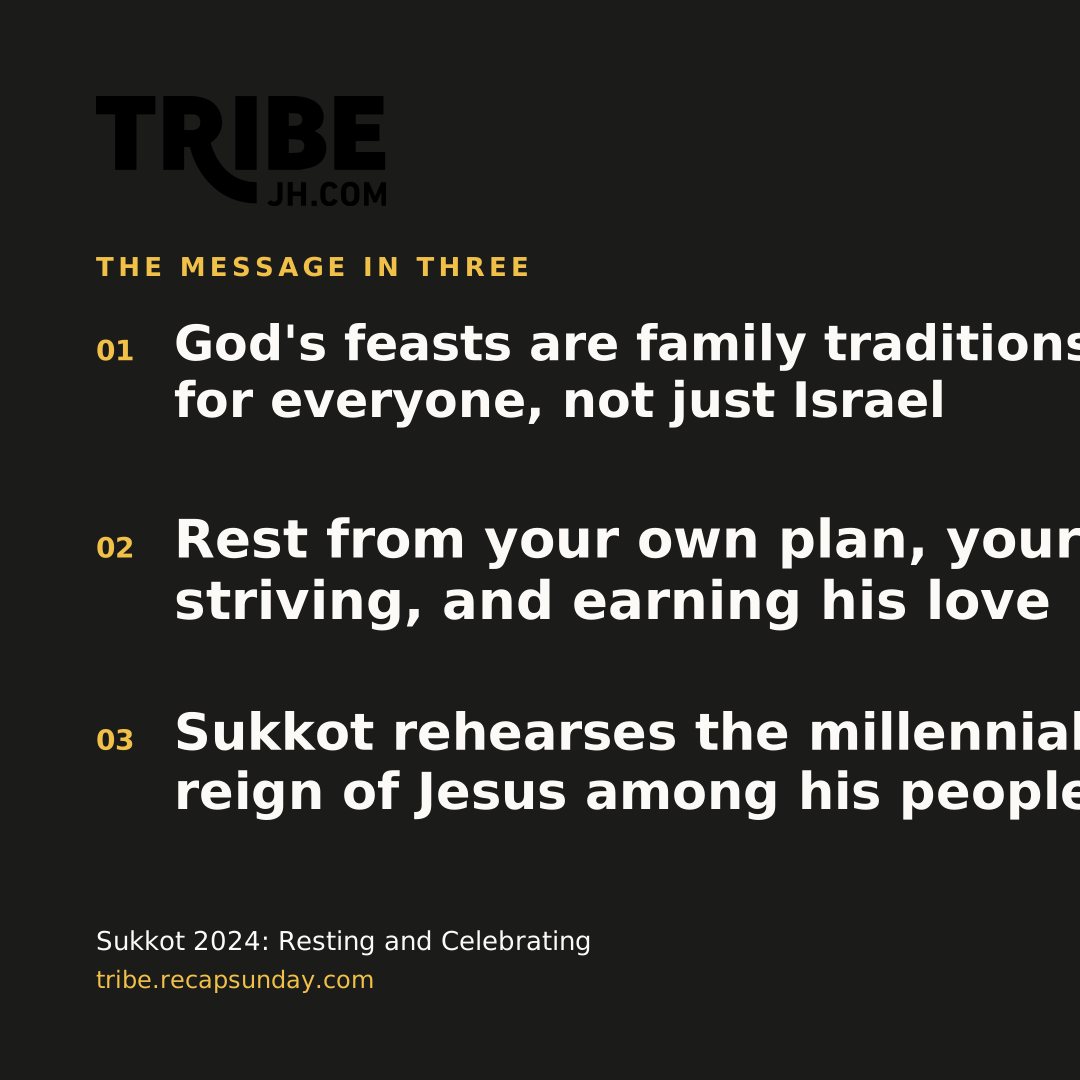
He named three specific things God invites his people to rest from during Sukkot. The first is their own plan, leaning on Proverbs 3 and the image of someone following a GPS so rigidly they drive into a lake. The second is striving for their own salvation, drawing from Hebrews 4, which says that those who believe can enter God's rest while those who insist on earning their standing by works find God resisting them. The third, and the one Brian called perhaps the most important, is trying to earn God's love, which he said is not based on performance at all but on who God is.
He closed with Song of Solomon 2:14, reading it as an allegory of Jesus calling to someone hiding behind the rocks, asking to see their face and hear their voice. The invitation was to step out of a carefully constructed life and sit in the simple shelter of the truth that God's love cannot be earned, only received. Tribe fam was then pointed toward a week of living that out, with a sukkah in the backyard, a camping trip down Little Granite Creek starting Wednesday, and a long trail run planned for Saturday morning.
Touch points
Things you could actually do this week.
Build a simple sukkah on your back deck or in your backyard this week using branches, lights, or whatever you have, and spend time in it each day.
Join the Tribe family camping trip up Little Granite Creek in Granite Creek Canyon on Wednesday, Thursday, or Friday night, even if you can only come down for the evening.
If you have not been water baptized and you have a saving relationship with Jesus, reach out to Pastor Brian this week to talk about getting baptized.
Sign up for the Tribe text blast by filling out a connect card so you receive the dropped pin for the camping location and other updates during Sukkot.
Each morning or evening this week, step outside away from your phone and your normal routine, and spend a few quiet minutes letting go of your own striving and simply receiving what Brian described as God's love that is not based on your performance.
Doing a Bible study?
Here is a guide we have prepared for you: the passages
in order, questions for the group, and room to write.
Brian talked about the church scrambling after COVID to jump back onto the treadmill at speed level 10 rather than pausing to recalibrate. Where in your own life do you feel that pressure to keep running at the world's pace, and what has it cost you?
Brian described the three reasons Tribe honors the feasts of the Lord as remembering, recalibrating, and rehearsing. Which of those three feels most personally meaningful or most foreign to you right now, and why?
Este domingo en Tribe, Pastor Brian comenzó una serie de dos semanas sobre Sukkot, la fiesta de los tabernáculos que Dios ordenó en Levítico 23. Explicó que Dios tiene tradiciones de familia que invitan a su pueblo a recordar lo que él ha hecho, a recalibrar el ritmo de vida según su paso, y a ensayar eventos proféticos que todavía están por cumplirse. Así como cuatro de las fiestas de Dios ya encontraron su cumplimiento literal en la vida, muerte y resurrección de Jesús y en la llegada del Espíritu Santo, las tres fiestas de otoño apuntan al regreso del Mesías, la liberación de Jerusalén y el reinado milenial.
La invitación práctica fue construir una "sukkah", una pequeña enramada sencilla y decorada, y pasar tiempo en ella durante la semana. Pastor Brian explicó que Dios pide a su pueblo salir de la comodidad de la casa moderna para recordar los cuarenta años que Israel pasó en el desierto bajo la protección divina, sin que su ropa se gastara ni hubiera enfermedad entre ellos. Dios invita a descansar de tres cosas: los propios planes, el esfuerzo por ganarse la salvación, y el intento de merecer su amor. Jesús es el cumplimiento de esta fiesta porque en él encontramos ese descanso completo.
La congregación participó activamente con observaciones y conexiones bíblicas durante el mensaje. Al terminar el servicio, la familia de Tribe se reunió en el South Park Boat Ramp sobre el río Snake para un bautismo en agua, y se anunció un campamento familiar de Sukkot para miércoles, jueves y viernes de esa semana en Little Granite Creek.
---
Pasajes bíblicos usados:
Levítico 23:39-44
Salmos 1:2-3
Jeremías 17:7-8
Zacarías 14:16-19
Proverbios 3:3-5
Hebreos 4 (varios versículos)
Cantares 2:14
Read the full transcript11,153 words
Good morning, tribe. I'm just gonna pray over us as we head into worship.
Good morning, everybody. Come have a seat.
Dear heavenly father, I thank you for bringing everyone into the house today, God. I just invite you into this room. Yes, Jesus. And I just pray that you saturate our atmosphere, God. I pray that you come and love on us and a tangible kind of love as we worship today.
Thank you for chasing us down, guys. Thank you for choosing us. You, father. God, I just pray that you'd be in this worship and that you encounter every heart that is open to receive you, Lord. In Jesus' name.
And if you always stand with us while we worship. Sing that chorus again. Thank you, Jesus, for being in this place. I thank you for chasing us down, God. Thank you for reminding us that we have to die every single day to ourselves.
Thank you for bearing our cross, Lord. Yes, Jesus. God, I pray that we just see you as our living hope, God. No matter the darkness we're surrounded by, we can see your light through all of it, God. I pray that we stand firm on you and your word.
The rock that will not wash away, God, our strong foundation.
You deserve the glory.
This song, it sounds like we're reminding him, but it feels like I'm reminding myself that he deserves the glory, that everything comes from him, and to him is all things. So how about we sing it in a declaration, but we're reminding ourselves that he's worthy of it all no matter what we're going through because the ultimate price was paid. And what we're going through down here is nothing, and he's still worthy. Alright. Let's lift our voices.
Oh, wait. Let's do the let's do the verse. We're gonna invite the angels to join us, but we're the saints. Right? Alright.
Alright.
Of God and say, you're worthy of it all. You're worthy of it all. Here are you. Just voices, you're worthy of it all. You're worthy of it all.
It all. For from you are all things, and to you are all things. You deserve the glory. One more time, that was beautiful. You're worthy of it all.
You're worthy of it all. You You deserve deserve the the glory. Glory.
Most precious father, I thank you for meeting us in here today and for the spirit that is permeated in this atmosphere, god. God, I just pray that the spirit continues as we go throughout our other forms of worship, god. I just thank you for this time. I'm so grateful for all of the hearts you've touched, god. I just pray that pastor Brian is your mouthpiece and that we hear directly from heaven today, god.
On your heart, God. We wanna hear what your heart has to say, God. So I just thank you so much for being here and in our next forms of worship. Bless the service. Bless the people in Jesus' name.
Amen. Grab yourself a coffee and a couple donuts and greet someone you haven't seen in a while.
Good morning. Good morning. So great to see you all here this morning. Thanks for joining us. They have church in a bar.
I was I was given some news at the beginning of service before service started. We, as you know, this week, we're going to begin celebrating one of god's family traditions of Sukkot and we'll talk more about it in a moment but I had I had somebody come in to me and say, hey, have you checked the forecast for Sukkot? And, you know, we've had some amazing weather this fall. Like, you get to you can you can do so much. You can, like, get in all those last minute, like, chores and projects outside and around the house.
You can tick off hikes, climbs, bike rides, like, all of those things that you didn't get to do in the summer, just squeeze them in right now and you better get them in because Sukkot rose around this week and bye bye goes the good weather. But you know what? It'll be good sleeping weather at night. Yeah. It already is a little bit chilly.
So my name is Brian. I'm so glad that you are here, that you found us at the Virginian Saloon. If you notice underneath your biscuits there, there's a connect card and a pin. And if you're brand new, if you're visiting, or if you haven't been in a while, we would love to have a record of your visit. And so just fill out that connect card.
If you're a young adult looking to get plugged in to young adult stuff and things, there's a box on the back that you can check. There's also opportunity for you to write out a prayer request. If there's anything that you need prayer for, you can fill that card out. You can drop it in the back. There's a little box there.
You can drop it in the back. Also, at the end of service, there'll be members of our leadership team that would love to pray with you and agree with you. So, take advantage of that connect card. As we get into today's conversation, if you have your Bible with you, would you turn to the book of Leviticus? You know it's gonna be a good sermon when the preacher says turn to Leviticus.
Okay. Thank you, b. Hey. Speaking of b, didn't she do a great job this morning? Oh, come on.
Our ministry team has such a deep bench. I just love that. Lyssa is at home watching the livestream this morning. Good morning, Lyssey. So, Leviticus chapter 23 and we're going to read verses 33 through 44.
And one of the things that we like to do here at Tribe is really have this be a a team effort. Instead of just me doing all the stuff and the things or just whoever's on the stage doing the stuff and the things, I really like this to be a a a team effort. And so what that looks like is, in just a moment, you're gonna have an opportunity to read. We have a mic in the room. Who's on mic today?
Oh, hey. Sarah's on the mic. Great. And you've got your super floofy cushy shoes running on. I noticed those earlier.
So you're ready to run all around the room with the mic. So we have the mic in the room. And if you're going to read, well, we'll hand you the mic, and that's for all of our families watching the livestream. They'll be able to hear and participate. And also, if you have questions, comments, or connections, something that you think is valuable to the conversation that you would like to contribute, guess what?
We wanna hear from you. And so if you just raise your hand, we'll get the mic to you and you can ask your question or or make your comment pertaining to what we're talking about. Or what I really love, this excites me the most, is when you have a connection. Oh, oh, oh, PB, something that you just said reminds me of a verse in first Peter, you know, something like that, or something that I just read recently. I love to hear those connections because that just gets more of your neurons firing and more of your brain engaged.
And when your brain is engaged, then you are engaged. And there's nothing more valuable that you can do with your Sunday and with your life than to engage with this book because this is the only book that you will ever ever read that is alive. This book is alive. Now from your biology class, when you think about a living organism, there's no respiration, so to speak. There's no growth.
It's not like you have your Bible beside your bed and then you come back a year or two later and it's like bigger. I almost said it doesn't reproduce, but in a way it does. It's like a seed. Is a seed alive? If you put it in the ground, Right?
The seed itself dies, but then life comes up out of it. In the same way, this is like a a seed that is alive. Number one, it's the only book that you will ever read that actually reads you. Have you ever been reading the Bible and you're like, wait, how'd that get in there? That's literally speaking right to me right now.
It's been in your Bible all along, but it's alive and it reads you. And number two, it has the power to transform the human heart, to transform a family, a city, a nation, and the entire world. The truth contained within this book and the man that is the hero of the story, Jesus. Changes is in the business actively right now of changing lives all over the planet, even in the place that we might think as, like, the the hardest to penetrate with the love of god, the the darkest place or the most anti God place that you can think of on earth. Did you know that the fastest growing church in the world is not Seoul, South Korea?
It's not Biloxi, Mississippi. It's not somewhere in Indonesia. The fastest growing church in the world right now is in the country of Iran. The people are about to experience freedom like they haven't known since the sixties and the seventies. And guess who's leading the church in Iran today?
Women. You're both right. Jesus as the head of the church. Thank you, Justin. Give him a pinch.
Uh-huh. And, yes, you are right, Amanda. Women stepping up. And it's women and it's women not like this woman, mom, woman, but it's like this woman, a teenager, like Trinity. What year are you, Trinity?
A in high school. Women in Iran who have been visited by Jesus in a dream to to tell them to tell them like, hey, what is in the culture is not the truth. And in Arabic, they call him Isa. Isa comes and visits them in dreams and stands at the foot of their bed and gives them hope and freedom and offers salvation. They put their faith and trust in him.
And when an Iranian or any Arab gives their life to Jesus, it's such a bigger deal than it is here in America. Because when they say yes to Jesus, even though the commitment is the same throughout the ages and around the globe, even though the commitment is the same, it costs so much more in Arabic cultures. It will cost you, all of your friends if they find out that you follow ESA. It will cost you relationship with all of your immediate and extended family. It could cost you most likely your job.
It will probably cost you the town in which you live. You'll be outcast. And many times, it will cost you your life. At the worst and at the very least, disfigurement where men in the community, demonically inspired, will antagonize you in many incidences, whether it's a young woman or even a young man, to come and to try to set you on fire or to throw acid in your face to disfigure you, to mark you as an outcast. That's the cost that people pay for following Jesus.
So with that in mind, today, we're going to have a water baptism. We are going to have a water baptism. So far, we have two candidates for baptism. I'll tell you a little bit more about that at the end of service, but it is going to cost him something because we'll be outside and in the Snake River and just be glad that you get to witness the baptism. Amen?
Amen. Alright. Alright. Where did I tell you to turn this morning? That's right.
Leviticus. The exhilarating, the thrilling book of laws and what to do if you've got mold on your house or all kinds of crazy things. Leviticus chapter thirty three twenty three and would somebody please read verses 39 through 34.
Wait. You say
23.
33. 23. 20 You said
thirty nine and thirty four. Yeah.
Leviticus twenty three thirty nine through 44. Isn't that what I said?
You said 34, but that's okay.
It's my list, Dexia. Sorry. For those of you who call tribe home, you just know, alright, Brian, we're I have like a a room full of fact checkers that love me, and their love language for me is to keep me straight.
The feast of booths starts on thirty three.
Oh, it's it's it's a big, long ramp up. We're gonna get right to the the good stuff of verse 39 through 44. I love it that they're like, can we read more? Yes. That that makes me happy.
Are you ready? I don't wanna push things.
I am ready.
On the fifteenth day of the seventh month, when you have gathered in the produce of the land, you shall celebrate the feast of the lord seven days. On the first day, you shall be a solemn rest, and on the eighth day shall be a solemn rest. And you shall take on the first day the fruit of the splendid trees, branches of palm trees, and bowels of leafy trees, and willows of the brook, and you shall rejoice before the Lord, your God seven days. You shall you shall celebrate it as a feast to the Lord for seven days in the year. It is a statute forever throughout your generation generations.
You shall celebrate it in the seventh month.
Okay. If you're taking notes this morning, you can write the title of the conversation that we're gonna start. This conversation that we're gonna have is gonna span over two weeks, and so we get we're getting really creative with the title this morning. It's just called Sukkot twenty twenty four, and we're gonna spend two weeks talking about this idea of resting and celebrating. Resting and celebrating.
Now I understand that if you are brand new to either tribe or to the feasts, I can understand that your mind is trying to run down bunny trails of, like, where is he going and why are we talking about this? And that's great. Let your mind run down that rabbit trail where the trail will weave back into the main path in just a moment. But what I'd like to do is to check-in with you and invite you to look critically at the words that we just read versus 39 through 44. And tell me, what are some interesting details that you noticed about these instructions given to the lord given by the lord to Moses to share with the people?
What are some details that you notice? You don't need to, like, draw any kind of deep spiritual conclusions. I'm just looking for observations. You can raise your hand. We'll get the mic to you or if it's something really quick, just fire it off, and I'll repeat it in the mic.
What do you notice, Nancy? Here comes the mic. Oh, just some of the adjectives. Oh, see? That's more than you're gonna need the mic.
Well, like, the adjective is describing the trees. It's not just fruit of the trees. It's the splendid trees. And it's not just the boughs of the trees. It's the leafy trees.
Yes. So it seems like there's a little extra. Okay. So there is an invitation, or it's part of the family tradition and we'll talk more about that in a moment where God invites those in his family to go on a week long camping trip with him. And part of the family tradition is to make your own shelter or booth or tabernacle or in Hebrew, they would call it a sukkah.
And here's what god says. Don't just go pick up dead sticks from your yard. Don't just like cobble something together like, it's good enough. He says, when you make this shelter, this little booth, put some effort and some creativity into it. He's inviting us to express ourselves creatively.
Like, make it like what would like Chip and Joanna Gaines do? Like, like, make it Magnolia pretty. Oh, way better than that Magnolia stuff. Make it Lizzie pretty. Right?
So I love that you see that god is inviting us to be creative with our hands. So, that's really cool observation. What else does somebody see? Permanent generation to generation. This is a permanent feast that he wants us to carry on from generation to generation.
Now, I'm going to throw the ball, toss the ball back to you, and ask you, if you were to take this feast and filter it through the cross because you know what I'm talking about. What do you think happens to this feast when we filter it to the cross because because god says from generation to generation?
I mean, I think it's it's obvious. It's permanent, it says, and generation to generation. So I think it filters through the cross and remains the same. And then we've seen in other scriptures that we don't have time to get into today that it's even something we'll celebrate in the millennial reign when Jesus returns, after Jesus returns. There's scripture later in the Bible that talks about it.
So, yeah, through the cross, it remains the same.
I I love that you brought in that detail. I think it's in Zechariah somebody can one of my many people that express their love language towards me by fact checking me can Google it and find there's in I think it's Zechariah. It might it it says that that in the millennial reign, when the messiah is ruling and reigning from a leadership headquarters in the city of Jerusalem, that that feast will continue. And any nation that doesn't honor that feast, the king, Jesus, can cause the rains to not arrive in the fall over that land. Talk about weather control.
So those of you who just chuckled, I see. I know who you Joy, what do you have?
This is piggybacking off of both Amanda and Nancy. I think the through the cross, filter is a what continues on is that idea of remembering, like you were saying, the remembering and the and the celebrating that we it's always important to remember. And then in the inverse 40, when it is talking about the trees, mine says, willows that grow by the streams, which reminded me of Psalm one. And I'm going a little deeper than your
No, this is great. This is what I would connection. So you read this, and there's a hyperlink in your brain that connects to Psalms one. I love it. Continue.
Okay. So Psalm one, it says in verse two and three, but they delight in the law of the Lord, meditating on it day and night. They are like trees planted along the riverbank bearing fruit each season. Their leaves I love this promise. Their leaves never wither, and they prosper in all that they do.
And so my thought was with the trees choosing these trees that are flourishing and making your sukkah out of it's a it's a it's like a pecky day board. It's a it's a moment of remembrance of how god has been so faithful for these people that their leaves would never wither and they would prosper in all they do. It's this reminder of the prospering and how god has delivered them before and will continue to do it again.
Woah. So, alright. Alright. We'll go to the back. Joy, that's so great.
Okay. First, your Zechariah verse is 14.
Okay. Alright. Come on.
16 through 19. That's the the feast of tabernacles that you were talking about or Sukkot. And the hyperlink that I received was similar, only it was in Jeremiah. Oh. And that was Jeremiah seventeen seven through eight.
And it says, but blessed is the one who trusts in the Lord, whose confidence in it is in him. And isn't that, like, the representation of the booth, like, the covering of the Lord on us and trusting in him? They will be like a tree planted by the water that sends out its roots by the stream. It does not fear when he comes. Its leaves are always green.
It has no worries in a year of drought or, you know, let's add all the other things that we see on the news Mhmm. And never fails to bear fruit.
Woah. That's good. And then all the way from Dubois, right behind you. Oh, sorry.
I'm actually coming from Afton today and
back to work.
On her way to Dubois. I was talking to her last week, and and we were at the TMC last week, and she was looking at our little bookshelf, like our little bookstore. And she was like, oh, I'm looking for something for an audiobook. And I gave her a couple of recommendations thinking, oh, that would last her, you know, weeks or months. And she's like, yeah, I can crush an audiobook about one commute.
And I guess that would make sense if you're going from Dubois down to Afton for work. Whoo. Mercy.
No. So my other job, not in Dubois, is for the Forest Service. And I'm really hyper linking to a couple of things. The message you preached a bit ago about the burning bush and how the bush was alive, but nothing that could assail it would survive. And of course, I'm thinking about forest management.
And the audiobook I was listening to was like, how often do you imagine what the new heaven and the new earth will look like? And I was all like, I can imagine the Bible talks about animals being redeemed and the lion and the lamb lying together. But I was thinking how the trees will get redeemed and how forests will be managed the way that God wants to manage them. And I was like, Okay, so how I mean, I'm just nerding out in my head about Come on. How are you going to manage for forests that require a fire regime?
And that talking about the fire of the Lord coming on the bush and just making everything perfectly aligned and then connected to this of God's covering in the leafy things, God can be over those and keep everything that is bad from coming into that leafy covering that's going to be over the people, and how that will be generation to generation into when there's a new heaven and a new earth and that, I don't know. So I like hyperlink five different things because
Yes.
I have a long commute to think about this.
That's so great. One of the many things that I love about Jesus is he is not a sterile religious figurehead of a gold statue or that hangs on a wall in some weird building that you have to be, like, really quiet and reverent in and, like like, don't make Jesus mad because he's up there and he'll come down from his statue and, you know, smite you or something. Jesus is alive. He is real. And and I he it is perfectly acceptable for you to integrate Jesus into your world of forest management.
He fits beautifully there. He fits beautifully in the midst of you as working as a property manager or a UPS truck driver or working at JHMR in the marketing department or as a full time mom. Wherever you are, whatever you do, Jesus fits in there beautifully. If we would but allow him to get out of the mausoleum and into our life and into our heart, he's got something to say. He's got beautiful things to share with us that we can relate to from our life.
And I just I I just so love that you are thinking about forest management in Jesus, and green leafy things, that just makes my heart so happy. Anybody else? You ever tried bringing Jesus into, like like, lift access skiing? You ever tried bringing Jesus onto a sailboat or down the river? Like, he just fits beautifully there.
Ah. Alright. So if you've been lost so far and you've been running down this rabbit trail of what in the world are we talking about, alright. I'm gonna gently guide us and steer us back into the the mainstream path. It was shortly after, COVID that the world was like, alright.
I guess we're done with this. Like, whether it works or doesn't work, I'm taking my mask off. I gotta get back to, like, normal kind of life. And especially in the church world, we saw a dramatic decrease in attendance. Almost two thirds of many congregations around The United States off ramped during COVID and have not been back since.
When we all took our masks off and we're like, okay. I guess it's kind of like the flu, and we've been dealing with the flu for thousands of years. Let's just get back to, like, life. The church world scrambled desperately to try to to take this this the new wine of the world that we were living in and fill back up their old wineskins of the way that they had always done church. We emotionally went through collectively, globally, a pretty traumatic thing.
And I know that just a moment ago, I made light light about, like, ripping off mask. But if we didn't have somebody that succumbed to COVID, then I know that we know of somebody that had a relative or friend that that didn't make it through COVID. That's super tragic. But we collectively, globally, went through something pretty traumatic, including emotionally and mentally. And instead of allowing ourselves to, like, understand and shift and adjust, it seemed as though there was this mad rush to get back to productivity.
This, I gotta make up for lost time. I gotta catch up for lost ground like our sales dropped off and and and this quarter, we've gotta do five times as much so that we can make up for the like work and strive and work and work and go, go, go, go. And it really left many of us without the the bandwidth or the emotional capacity to process what all happened. We just found ourselves like, you've seen those those videos of of people that, like, step off the treadmill, like, onto the side, and they go, peep peep peep peep peep peep peep peep And they, like, take it to 10, and they go from standing on the rail of the treadmill to try to, like, running full speed. And and, like, really, for many of us, emotionally, that's what we tried to do.
The treadmill never slowed down. We just tried to jump on and run full speed. And what does that usually result in? That's right. A great TikTok.
And so and so as a leadership team, we found ourselves, like, like, trying to go and not take a a a face plant on the treadmill. And we're like, wait a minute. What are we doing? Why are we just jumping onto this treadmill that has been cranked up to speed 10 to try to make up for lost time? What like, I think that we are running according to somebody else's schedule.
And then collectively, as a leadership team, we said, okay. Instead of just jumping right back on the treadmill at speed level 10, Lord, what do you have for us? We want to get synchronized with you. And the Lord said, here's a great place to start. Honor my feasts.
And we were like, That's wait. What? What does that even mean? And he's like, they've been in your bible this whole time. Just look for them.
And so as a leadership team and as somewhat as a tribe family, for the last several years, whenever one of the feasts of the lord comes up, we take time to remember it, to to honor it, and to recognize it. And as we began to dig into the feast, the lord said there are three main reasons why I want you to honor these feasts. And it's not up on the screen, but just by way of review, what's one of the reasons why we honor feet the feasts of the lord? To remember, to remember what he's done in our lives, to remember what he did for the nation of Israel, to remember what he did for the prophets, to remember what he did in Jesus' life, to remember what he did in the early church, to remember what he did in the church that Paul wrote letters to. When we honor the feast of the lord, it helps us to remember all that god has done in our life and all that he has done for the saints that have gone before us.
What is one other reason that we honor the feast of the lord? Not only to remember but to Re to recalibrate. And that was the big thing. Instead of just jumping off the treadmill, having it jacked up to speed level 10 and trying to jump back on the trip, We recalibrate. Why are we running at at the world's pace of level 10?
When we honor the feasts of the lord and when we just sink down into them, you know, like like a a a warm, like, hot tub on a cold day or like, just settle right down into that hot tub. When we settle into the feast of the lord, it helps us to recalibrate our heart. When you're sitting in the sukkah that you'll make this week, and we'll talk more about that in a moment, You get to look around at the beautiful leafy boughs that are over your head or that make up the walls of your sukkah, and you just get to consider. You get to ponder. You get to invite the lord into these special moments and seasons.
And it's almost like that thick skin of your crusty old heart gets a little bit thinner and a little bit softer, and you can hear the voice of the lord in special and unique ways. So god has invited our tribe fam, and, really, I believe it's an invitation for the world. And there are other churches around the world that are are picking up on this, but I would say not a ton. To remember, to recalibrate, and then what's the last one? To rehearse.
Just like a wedding rehearsal, you have a rehearsal the day before. Well, what are we practicing? There are events that will unfold in human history that we have that Jews have been rehearsing for thirty five hundred years so that, hopefully, when we see these things play out on the world stage, those with eyes to see will be able to say, oh my gosh. This is that that we've been rehearsing, and we'll talk a little bit more about the rehearsal aspect in a moment. Now, I understand that if you have been going to church for a long time and you would consider yourself a Christian and you know that just going to church doesn't make you a Christian.
Right? I'm a step on your toes because I love you. I don't care how many check marks are on your church attendance report card. It ain't about the money that you tithe and give. It ain't about how big your bible is or that you have a bible.
It's about the condition of your heart and the relationship the authentic relationship with Jesus by just coming before him and being real and raw and vulnerable and asking him to speak to you and telling him that you will live your life according to his precepts. That's the changed life. But if you have been a Christian for some time, you probably haven't heard a whole lot about the feasts because you've probably either been taught or you have thought, well, that's like Old Testament. That's like Old Covenant or like that's for the Jews. Those are Jewish feasts.
Well, they're actually not. It was just the Jews that got to be the first people to celebrate them. What did I miss in the window over there? There's room, brother. Come on in.
Repent and be saved. We're doing a baptism. Oh, yeah. There they are. We're doing a baptism today.
It's your chance. Church in a bar. So they're actually the feasts of the lord. The Bible says that. These are my holy feasts, God says.
It's just Jews that got to be the the first ones to receive the invitation. And think of them. If you have a hard time with the language of, like, Jewish feasts or feasts of the Lord or festivals, Just keep chewing. Don't just spit that out. Keep chewing and your heart will get softer.
But think if it helps you, think of them as god's family traditions. Every family has some quirky traditions. One of the traditions in our family is whenever somebody is driving and we have to send a text message, you know, you do, like, the speech to text. And one day when when Kai was little, I can tell these stories about him because he's off at college. But when Kai was little, he was being rowdy and rambunctious in the back seat.
I think Lissa was driving, and Lissa was sending a text, and he was like, you know, on the seat in the back. And Lissa is doing this speech to text. And right in the middle of this text, she goes, Kai, I'm going to strangle you. And then that showed up on the text. She didn't check it, just pressed send.
And then whoever was sending the message was getting this nice text message, and then it says, Kai, I'm gonna strangle you. And they texted back, and this is like, oh. And so now one of our fun family quirky traditions is if anybody's in the car driving and they're doing a speech to text text message, just in the middle of it, we'll randomly say, Strangle you. They we love it. We just love it whenever a family member does that.
So I don't know. Maybe there are some weird weird family quirky traditions of you that are in your family. But did you know that god has family traditions also? He's a father. He has a family, and seven times a year, he invites his family to partake in these family traditions.
And I got a chart here, and and and I wanna walk you through it just really quickly. You can see across the top, you can see these feasts. One of the things that you'll probably really notice is Jewish tradition and it's blank. I'm working on that. So by the next feast, I'll have some more built into that.
So that's that's to be filled in. Right now, we are in the last of the fall feasts and it's over there far on the right and it's called Sukkot. Sometimes it's known as the feast or the festival of booths or of shelters or of tabernacles, and there's not really a Christian church equivalent because they're like, is it really that special? We've just been missing out as a Christian church almost for fifteen hundred years on this beautiful family tradition of Sukkot. A few other highlights from this chart that you can look at, I have there are seasons there when it happens.
We operate according to a Greco Roman calendar that is solar based. Right? The Jewish religious calendar is a lunar calendar base. And so it's not separate. Like, year Christmas is on December yes.
Twenty fifth. I was thinking the twenty fourth, but, yes, Christmas Eve twenty fourth. That's when we have our Christmas Eve service. But every year, December 25 is Christmas. Well, that's not how it works in the Jewish calendar.
Their dates and their feasts and festivals change, so it's in a range. It could come at any time, seasonally. So you can see Sukkot. There are some Old Testament verses that speak about Sukkot, and there are my favorite part is seeing Jesus in each of these feasts. And you can see the from the spring feast, the crucifixion of the Messiah, the burial of the Messiah, the resurrection of the Messiah, the arrival of the Holy Spirit.
And then in the fall feast, we see the return of the Messiah and the rapture of the saints. Those two things happen at the same time when Jesus returns. The liberation of Jerusalem and the salvation of Israel. Everybody say, And then the millennial reign of the Messiah. That's the the the that's the rehearsal for the return of Jesus.
If you look down there, one, two, three, four of the feast of the Lord have had their literal prophetic fulfillment. For example, let's look at Passover. What historically happened at Passover? With the blood of the lamb? Right.
Okay. So, why is the box checked now? Because it's done. How did it get done? Jesus shedding his blood on the cross was the fulfillment of that feast.
And the hope in God's heart was that when Israel saw Jesus being crucified and his blood being shed that they would go, this is that that we have been rehearsing for millennia. And some did. And some did. We can see four of the feasts have been fulfilled. Right now, I would consider us to be in the church age.
And if you look and if you're very familiar with eschatology or the study of things at the end, end times, these three feasts will be fulfilled in rapid fire succession. It's not like, okay, the feast of trumpets, Rosh Hashanah, was fulfilled. Yay. And now we've gotta wait another hundred years, two hundred years, a thousand years. If you're if you're familiar with the Jewish feast at all, all of three of these feasts happen like, look, within the month of September, October.
This is not generations playing out. These will be fulfilled right back to back to back at the return of Jesus. We see the governmental roles of the prophet and priest that Jesus fulfilled at his first advent, his first coming, and then we will see a new facet and feature of Jesus that has been talked about and has been in our Bible all along but many will be shocked at and not everybody will have a stomach and an appetite for when he comes as a returning king and conquering warrior. Just read Psalms one, Psalms two. He says, he laughs that the at the nations that try to conspire against him, and he rules with an iron rod and that he can smash the nations like a clay pot.
Wait. What happened to the felt board Jesus with, like, the little kids sitting on his knees? It's yes and. When we honor these feasts, it helps enlarge our perspective of the messiah and prepare a place in our heart for roles that he will fulfill in the coming days. You got that?
Okay. You'll see it five or six, seven times a year, and it'll get better. Let's zoom in on verse 39. I have it here on the screen. Verse 39.
Remember that this seven day festival to the lord, the festival of shelters begins on the fifteenth day of the appointed month. After you have harvested all the produce from the land, the first day and the eighth day of a festival will be days of complete rest. So consider this passage, And I'd love to I'd love to hear from you what stands out to you. What detail just pops out in color? Maybe it's a word or maybe it's a phrase or maybe there's a connection in your heart about something.
What when you read this, what do you see or what stands out to you? First and last day are best. So we're gonna start with rest, and we're gonna end with rest. I like it. Great observation.
Colin. Yes. Now how many of you actually, one of you do kinda farm. But for the rest of us, besides Zoe, how many of you are, like, heavily involved in agriculture and you, like, are growing and planting and reaping and threshing and canning. I don't even know what all the words are.
Right. Okay. Lenny's like, well, I can. From the groceries, from the from the groceries you harvest from the store. Okay, I get it.
This is difficult, challenging for us. But in Jesus' day and in the days of of Israel, think Old Testament, the land of Judea, it was an agrarian based society. And at the end of the summer, almost like if you look at, you know, the ranches out out here, they get that Lockhart Ranch, thank you, and other ranches, you know, they get that last cutting of hay towards the end of the season there, and they're letting it dry out. They're bailing it. Everybody is storing hay in their barns right now.
That's as close as we can get to, like, a ranching context. But in Israel, in Judea, they had an agrarian society, and the last of the fall crops were to be harvested during this time? And then when do we celebrate the feast of Sukkot or booths or tabernacles? When? Colin, you said it.
When? It's right there. At the end. At the end when it and it's pretty specific. After you have harvested, not some of the produce, not the good stuff, it says what?
All of the produce of the land. Now is that easy work or hard work? Hard work. We can imagine it would be really hard work. Just think about ranching and baling hay and loading up a hay barn.
Hard work. So we see rest. We see at the end of harvesting. Any any other details that that you see that are noteworthy? Oh, this feast is to last seven days.
And I'll I'll ask you a follow-up question. Why, like, why did you notice that detail? What is interesting to you about seven days? There you there you go. I didn't even I didn't even see that.
Seven days. That that the number seven has great significance. It's the number of perfection and completion. Number six, just before seven is the number of man. I can't quite get there.
Seven? Perfection. That's that's really cool. I love that. Lanisha.
Ask your question. When do they build if the first day is complete rest? Do they build on the fifteenth day? And then the next day, they're like, okay. Rest.
Go sleep outside. I think that they are building their sukkah couple days or a week. They're lissifying it up, before the feast so that when the feast starts, they get to sit in there and, like, oh, and enjoy it.
I I was just thinking as I was looking here, if you see on the traditions again, it makes and it's this is just speculation, of course, but it makes my heart happy and in love with the Lord even more because there's so many connections and treasures for us to find in Yes. Yes. God's word hidden for us, not from us. But if you see on the the last three there, like Rosh Hashanah or Rosh Hashanah, the feast of trumpets, it makes perfect sense that the Lord would return with because the Bible says with a trumpet blast. And then the harvest, you know, we see in scripture the harvest of souls.
Like, that just makes perfect sense where the church as times get harder, the church gets better. You know, like, we have the church has not big c church not seen her finest hour. And then Sukkot, I just had this thought reading Leviticus. It's like the millennial age seems like it will be a perpetual Sukkot. Like we just chatted we've been chatting about, like, we're under God's shelter.
Jesus in the flesh is working alongside us under leafy things and all all those beautiful agricultural references. But, gosh, it just makes perfect sense. The Lord's return with the trumpet, a harvest of humans, and then, yeah, just the millennial reign being a perpetual Sukkot where we rest in him, yet we do work. You know, it's a both end. It's really beautiful, for my little heart today.
Thanks for listening.
That's so good. I loved it. So to to fill in a little more color, if you're like, I'm kind of coming up to speed. I think I'm picking up what you're putting down. So as part of the prescribed way to celebrate this particular family tradition, god says, I want you to leave your normal house, and I want you to construct a sukkah, a shelter, a little a little booth, not a bomber like like like storm shelter, but just a simple would you go back to that, like, very first slide just to so you have, like, some kind of visual reference that doesn't have any text or anything on it.
There you go. So so just a sukkah made out of something simple, something kind of flimsy, something that is pretty that you get to be a creative in. This is, like, like, pretty pretty dang fancy. If you were to, if you were to go to Israel in this next coming week, you would see sukkahs all over the place. People make them on their balcony, like, out on their, apartment buildings, and they just have some little reed mats, just some simple little lights strung up.
But here's the idea behind it. God invites us to build a sukkah, and we are inviting you as a tribe family this coming week to, like, make a sukkah in your backyard, on your back deck. It's a family tradition that that we've been celebrating here at tribe, and hopefully, you have your, like, like, Thanksgiving decorations and your Christmas decorations. And, oh, here's our sukkah box with our little sukkah decorations that we can put out and decorate our back deck. And here's what God is getting to behind this.
He says, I want you to leave the safety, comfort of your home and all of the conveniences that are in your home and come spend some time with me away from all of the busy schedule of life and all of the modern conveniences. Sit out in the sukkah. Enjoy your morning coffee. Enjoy your evening meal. Have a little campfire at your solo stove there, and just get out and disconnect from all of the modern world.
There's nothing wrong with a home and electricity and running water and hot shower. There's nothing wrong with any of those things. But when we sit out in a sukkah, god says, I want this to remind you of the forty years that Israel spent wandering in the desert, a forty year camping trip where they would set up their camp and take down their camp. They'd set up their bed, take down their bed. They would travel day by day by day until I brought them into the promised land.
And the goal that god said in the wilderness was your your your clothes never got holes in the elbows. Your shoes never wore out. The Bible says there was not one sick among you all those forty years. Really? All we need is to just sit under the shade of Jesus in his hand of blessing and protection.
And when we construct a sukkah, when we sit out in a sukkah this coming week, it starts on Wednesday. It lasts for a week. We are reminded viscerally that Jesus and simplicity is really all we need because Jesus is the fulfillment of the feast of Sukkot. In fact, there are three things that god invites us to rest from. God invites us to rest from our own plan.
God invites us to rest from striving for our own salvation. And God invites us to rest from trying to earn his love. A moment ago, I said that Jesus is the fulfillment of that feast. Just really quickly, as we begin to land the plane, I wanna talk about how Jesus is the perfect and most beautiful embodiment and fulfillment of those things. So our own plan.
Proverbs chapter three verses three through five says this, trust in the lord with all of your heart. Don't lean on your own understanding, but acknowledge him. And in all of your ways, he'll make your path straight. So here's the idea. You can spend thirty two thousand nights sleepless, tossing and turning and scheming and fretting and trying to figure out your own way of how to do life or how to get yourself out of this situation or how to make it better or to just fix it.
We just strive and strive and strive with our with our own plan. This week, god invites us to just he's like, you can pick up your own stress and worry, like, later. But how about for just one week, set it aside and rest from that because we see that Jesus fulfills that feast. In Proverbs three five, he says, don't worry about your own understanding. The Bible says, there's a way that seems right to man but it ends straight in a ditch.
Like, remember when, like, GPS was a new thing? And in that episode of The Office where, like, Michael Scott was, like, trying to follow his GPS to the letter of the law, and he was just so focused on the GPS. It says, turn left here. And where did he end up? Yep.
Right in a Lake. When you're focused so hard on trying to do it yourself, you'll just end up right in a ditch. Rest from your own plan. How about this? Striving for our salvation.
Now, if you're a Christian, you may think like, well, of course, salvation is found in Jesus alone, but we live in a city and in a world that even though they don't know it. If you were to, like, do a man on the street interview and say, hey, how are you striving for your own salvation? They would look at you like, what? You're crazy. I don't know what you're talking about, but I gotta go because, I've gotta, like like, get a hundred days on my past this year.
I've gotta go because I'm late for a business meeting for a big deal. I gotta go because I'm off to recycle. I gotta go because I'm off to volunteer at the soup kitchen. I gotta do this, and then, then, we're like working and striving and striving and striving, trying to be a good person. Now, if you were to ask that question of the people of this city, you'd get answers all day long.
Hey, how are you working to be a good person? Oh, they got a list of my while I drive. Okay. Stop. Just stop because Jesus and salvation in him is where we enter the ultimate rest.
Hebrews chapter four. Let me read just a little bit of that to you. Hebrews chapter four. God's promise of entering his rest still stands. So we ought to tremble with fear that some of you might fail to experience it.
The Bible says that God resists the proud, but he gives grace to the humble. Resisting the proud means if you insist and persist in trying to earn your own right relationship with God based upon your works. But God, I'm a good person and and God, I'm certainly a lot better than than the, like, the people that I see, but that that, you know, the here and there, and and I'm trying to be like, god's like, bleh. Quit striving. There is a rest that you can enter into because it's not about your good works.
I have a little sticky note at the front of the of my bible that says, my sin doesn't change my righteous nature anymore than my goodness changed my sin nature. For this good news that god has prepared this rest, think sukkah, has been announced just as it was to them. But it did them no good because they didn't share the faith of those who listen to god. For only we who believe can enter into that rest. Verse six, so God's rest is there for people to enter.
Rest from your own plan. Rest from striving for salvation. And then finally, perhaps the most important, would you just quit trying to earn his love? Maybe you come from a family or love. And then there's some sort of performance based thing.
And and you felt like when you were a good kid, then mom and dad or stepdad or stepmom, whatever, loved you. If you're a bad kid, they didn't love you. That is not how the kingdom of God operates. He loves you not because of what you do or what you don't do. He loves you because of who he is.
His love for you is not based at all on your performance, and that's good news for those of us that have messed up royally and big time and seemingly over and over. Last verse. Song of Solomon chapter two. Chapter two verse 14. The young man is speaking, and this is an allegory of Jesus speaking over us.
And he says, my dove, he's speaking of you, is hiding behind the rocks, behind an outcrop on the cliff. Jesus would say to your heart today, let me see your face. Let me hear your voice, for your voice is pleasant and your face is lovely. Would you rest from of from wearing this mask of trying to earn god's love? Would you step outside of your carefully constructed world house and sit in this simple shelter of the truth, of the reality that you cannot earn God's love, but he just loves you.
Would you receive his love today? Jesus fulfilled these feasts so that we can sit and rest in simplicity and receive his love. Laying aside our own plan, quit striving, quit trying to be a good person. When it comes to earning right standing with God, not saying don't be a good person. Continue to stop for the tourists when they step out in the crosswalk.
I know you wanna bump them. I know. I do too. Jesus loves you. Anyways, let's take a moment and and in a really simple, beautiful way, let's construct a sukkah in our own heart right now.
Let's step aside from our pride. Let's step aside from the the stories and narratives that we tell ourselves and we try to convince other people love. Let's step out of that into a simple sukkah of just resting in his love. Will you receive his love this morning? Take just a moment.
Close your eyes. We're not gonna dwell on this for long because you're gonna get to spend all week in it. But in the stillness of your heart, invite his presence. Jesus, thank you. I just feel like the holy spirit is whispering to my heart, and he's saying this is what I've longed for, that there are some individuals in here this morning who are running themselves ragged, but have, for just a moment, exhaled, relaxed, and stepped outside of their busy, carefully constructed lives.
And the Lord's like, I've been waiting for you. Oh, I love you. Just spend time with me, dear one. Remember all that I've done for you. Recalibrate the rhythm of your life according to my way.
And let's practice and rehearse for when my son comes again to claim his bride, the church, establish his governmental authority on planet Earth, and begins to renew the Earth, including social justice, government, society, and even forestry. Thank you for your brilliance, Jesus. We love you. Oh, how we love you. Okay.
Now you can open your peepers. Stay in your sukkah, but just look at me for a moment longer from your sukkah. The feast of God's family tradition of Sukkot begins on Wednesday. So if you wanna pull out your box of sukkah decorations and get ready, we have one family that each year they they decorate their trampoline and throw some like blankets over the tramp. Hey, great sukkah.
Some people to have morning coffee out there, evening meals out there, some people camp out there, spend the night, whatever you wanna do. Let's not get, like, religious about it. Right? We are, as a tribe family, going to celebrate Sukkot by Wednesday, Thursday, and Friday, we are gonna go on a tribe family camping trip. And we have a location picked out.
It's if that little camping spot is, like, like, occupied, then it'll be right near there. But I have we're gonna send you a dropped pin if you're like, I have no idea where that is. That that's okay. Let me give you a frame of reference in just a moment. If you receive the tribe text blast, we'll have a dropped pin for that location.
Alright? And if you're not if you don't get the tribe text blast, fill out that connect card with your contact information and say, like, add me to the text blast or whatever. But at the bottom of your screen there that you're looking at, if you're listening to the podcast, sorry. But if you go to Hoback Junction and then you head down Hoback Canyon, this is in Granite Creek. And that main so you'll turn off the paved road and you'll turn onto a dirt road, and that dirt road will take you to the bottom of your screen.
The first left that you can take is called Little Granite Creek. That's where we're gonna be. We're going to be up Little Granite Creek. If you stay on the main Granite Creek Road that kind of runs along the bottom of your screen, you'll end up at the Hot Springs. Oops.
Sorry. Guess you'll just have to go to Hot Springs. But then come back and camp. If you look towards the top of your screen, you'll see a little gray pin that is dropped. That is the preferable campsite that we're aiming for.
There's room for all of us there. There's a fire pit. It is where we camped last year. How many of you came down for at least one night last week? Yes.
That's awesome. I love to see it. So we are gonna try listen and I, we're gonna try to go down there either this evening or or Monday and stake it out. And we'll either put our little camper Volkswagen Bug Paco down there, or maybe we'll we'll bring our camper and and drop it off down there so we kinda stake it out. And then the first evening that we will be down there will be Wednesday evening.
Some folks have said we've got like boy scouts and sports ball and all the things, but we'd love to come down for the evening. Just come down and if you wanna like like cook something over the fire or bring some firewood, enjoy camp fire with us, camp out that night, and then if you have to get up early in the morning, great. If you can only come down for the evening, just come down for the evening and then you can bounce back up to town. So we'll send that out, but we'll be camping Wednesday night, Thursday night, Friday night. Saturday morning, some tribe young adults and anybody with young adult knees is welcome to join us.
We've it's kind of our second annual, like, Sukkot run. It'll be close to, like, marathon length or something, but we just run around on the trails back there. We'll end up at Cache Creek or somewhere or or maybe this year do a a loop or something, but it'll be a big long run. You don't have to do the run. But I'm I'm gonna do it so you'll be faster than me.
So that will be Sukkot. You can decorate your Sukkah at home. You can come join us for camping. That'll be Wednesday, Thursday, Thursday, Friday. Today, immediately after service, we're going to celebrate an ordinance instituted here in the Bible called baptism.
When a person gets saved, they invite Jesus into their life. When they get baptized in water, it's picture a of them dying to their old self and being raised to new life. And when a person receives the baptism of the Holy Spirit, it is the power to walk out the new life that they've been given. So there are two people that are going to be following the Lord in obedience to get water baptized immediately after service. So what we'll do is we'll we'll wind down service here.
We'll clean up. We gotta tear down and turn this place back into a bar. And then we're gonna go down to the South Park Boat Ramp. And that is we have another map right there. And if you go South Of Raptor J, South Of Melody Ranch, as you cross that first bridge into what we've, as locals for a long time, have called Hog Island, right there, South Park Boat Ramp.
It is on the South Side Of The Snake River, south of town. You can just type in South Park Boat Ramp, and we're gonna park at the little parking area, and instead of doing the baptism at the gravel boat launch, if you just walk, like, right where that pin is and the little parking area is, if you just walk to the water just right close there, we're gonna find a deep spot. We've got two candidates for baptism. So if you are helping to stay, if you're helping to clean up, we can get to baptism quicker. If you need to scurry off, there's probably enough time for you to, like, like, maybe grab a coffee or swing through Smith's Deli, grab some fried chicken, grab a lunch, and then head down.
You can be a part of the baptism, and then just enjoy some sunny weather and have lunch right there. So it is 11:45. We will be walking out of here in five minutes close to twelve. Let's say 1245 South Park Boat Ramp. And if you haven't been water baptized and you're like, woah, I I need to do this.
As soon as we're done with service, come see me. Okay? Come see me right after service. If you've never been water baptized and you would like to, God's putting that on your heart, or you were baptized as like a baby or a kid and you're like, that didn't really mean anything to me. But but you have a saving relationship with Jesus.
You just haven't made a public profession of it through water baptism. Come see me. Let's get you baptized today before it gets too cold. Those are, the last announcement that I have is we are going to be back here at the Virginian Saloon 10AM next week for service. Let's worship the lord one other way with our tithes and offerings and then we will dismiss service.
So, we worship the lord through song. We worship the lord by honoring the word that is preached in the last way that we worship the lord weekly here at Tribe is by giving a portion of our finances through our tithes and offerings. Some people give through the website. Some people, if you have cash or check or bitcoins, you can put those in the little black box that's right by the saloon doors. Most people are generous with their smartphone with the with the text to give.
If you open up a text message to 84321, press any dollar amount and then press send. You can give that way and that's how a lot of people are generous. Let me pray over the tithes and offerings and then we'll roll into getting out of here. So why don't you do this? Stand with me.
We'll accomplish two things with one prayer. I'll pray over the offering, and then if it would be alright, I'd like to pray a prayer of blessing over you. And when we dismiss, I'm gonna invite Lanisha and the Micas' to step towards the back little booth there. If there's anything that you need prayer for, they would love to agree with you in prayer. And as soon as we dismiss, you can find Lanisha or the Micas', and they would love to pray with you.
So offering and blessing. Lord Jesus, you've been so good to us. It is with joyful hearts that we give a portion of our finances back to you. Would you use these finances to make your name famous here at Tribe, the surrounding region, and to the uttermost bounds of the earth. Thank you in advance for taking care of all of our needs according to your riches and glories.
And, father, I pronounce a blessing over each and every member of our tribe family here. Help us. Help us. Help us. Help us to rest in the finished work of the cross and enjoy you so that we can move into a time of wonderful celebration.
We pray these things in Jesus' name, the strong son of God. And everybody said, amen. Next week, I'll give you a quick recap of the mission trip that we took to the Wind River Reservation. I'll share more of those stories next week. I want you to have a great week.
Lord, help us to fill our freezers full of meat during this hunting season. And remember guys, you got this.