any nation that refuses to celebrate Sukkot will receive no rain
17 It will be, that whoever of all the families of the earth doesn’t go up to Jerusalem to worship the King, Yahweh of Armies, on them there will be no rain.
the day of the Lord coming, Jerusalem's possessions plundered, nations gathered to fight, city taken and people taken captive
1 Behold, a day of Yahweh comes, when your plunder will be divided within you.
2 For I will gather all nations against Jerusalem to battle; and the city will be taken, the houses rifled, and the women ravished. Half of the city will go out into captivity, and the rest of the people will not be cut off from the city.
command to celebrate the feast of shelters for seven days after harvest, including all people, with complete joy
13 You shall keep the feast of tents seven days, after you have gathered in from your threshing floor and from your wine press.
14 You shall rejoice in your feast, you, your son, your daughter, your male servant, your female servant, the Levite, the foreigner, the fatherless, and the widow, who are within your gates.
15 You shall keep a feast to Yahweh your God seven days in the place which Yahweh chooses; because Yahweh your God will bless you in all your increase, and in all the work of your hands, and you shall be altogether joyful.
God will bring Israel into the wilderness of the nations and judge them face to face, purging rebels
35 I will bring you into the wilderness of the peoples, and there I will enter into judgment with you face to face.
36 Just as I entered into judgment with your fathers in the wilderness of the land of Egypt, so will I enter into judgment with you,” says the Lord Yahweh.
37 “I will cause you to pass under the rod, and I will bring you into the bond of the covenant.
38 I will purge out from among you the rebels and those who disobey me. I will bring them out of the land where they live, but they shall not enter into the land of Israel. Then you will know that I am Yahweh.”
the woman given two wings like an eagle to fly to a place in the wilderness, protected from the dragon
14 Two wings of the great eagle were given to the woman, that she might fly into the wilderness to her place, so that she might be nourished for a time, and times, and half a time, from the face of the serpent.
warning about the abomination of desolation, those in Judea fleeing to the hills, and the coming great tribulation
15 “When, therefore, you see the abomination of desolation, which was spoken of through Daniel the prophet, standing in the holy place (let the reader understand),
16 then let those who are in Judea flee to the mountains.
17 Let him who is on the housetop not go down to take out the things that are in his house.
18 Let him who is in the field not return back to get his clothes.
19 But woe to those who are with child and to nursing mothers in those days!
20 Pray that your flight will not be in the winter, nor on a Sabbath,
21 for then there will be great oppression, such as has not been from the beginning of the world until now, no, nor ever will be.
Jerusalem surrounded by armies, those in Judea fleeing, days of God's vengeance, Jerusalem trampled by Gentiles until the period of the Gentiles ends
20 “But when you see Jerusalem surrounded by armies, then know that its desolation is at hand.
21 Then let those who are in Judea flee to the mountains. Let those who are in the middle of her depart. Let those who are in the country not enter therein.
22 For these are days of vengeance, that all things which are written may be fulfilled.
23 Woe to those who are pregnant and to those who nurse infants in those days! For there will be great distress in the land, and wrath to this people.
24 They will fall by the edge of the sword, and will be led captive into all the nations. Jerusalem will be trampled down by the Gentiles, until the times of the Gentiles are fulfilled.
Peter quoting Joel at Pentecost, connecting Old Testament prophecy to a contemporary event
1 Now when the day of Pentecost had come, they were all with one accord in one place.
2 Suddenly there came from the sky a sound like the rushing of a mighty wind, and it filled all the house where they were sitting.
3 Tongues like fire appeared and were distributed to them, and one sat on each of them.
4 They were all filled with the Holy Spirit, and began to speak with other languages, as the Spirit gave them the ability to speak.
5 Now there were dwelling in Jerusalem Jews, devout men, from every nation under the sky.
6 When this sound was heard, the multitude came together, and were bewildered, because everyone heard them speaking in his own language.
7 They were all amazed and marveled, saying to one another, “Behold, aren’t all these who speak Galileans?
8 How do we hear, everyone in our own native language?
9 Parthians, Medes, Elamites, and people from Mesopotamia, Judea, Cappadocia, Pontus, Asia,
10 Phrygia, Pamphylia, Egypt, the parts of Libya around Cyrene, visitors from Rome, both Jews and proselytes,
11 Cretans and Arabians: we hear them speaking in our languages the mighty works of God!”
12 They were all amazed, and were perplexed, saying to one another, “What does this mean?”
13 Others, mocking, said, “They are filled with new wine.”
14 But Peter, standing up with the eleven, lifted up his voice, and spoke out to them, “You men of Judea, and all you who dwell at Jerusalem, let this be known to you, and listen to my words.
15 For these aren’t drunken, as you suppose, seeing it is only the third hour of the day.
16 But this is what has been spoken through the prophet Joel:
17 ‘It will be in the last days, says God, that I will pour out my Spirit on all flesh. Your sons and your daughters will prophesy. Your young men will see visions. Your old men will dream dreams.
18 Yes, and on my servants and on my handmaidens in those days, I will pour out my Spirit, and they will prophesy.
19 I will show wonders in the sky above, and signs on the earth beneath; blood, and fire, and billows of smoke.
20 The sun will be turned into darkness, and the moon into blood, before the great and glorious day of the Lord comes.
21 It will be that whoever will call on the name of the Lord will be saved.’
22 “Men of Israel, hear these words! Jesus of Nazareth, a man approved by God to you by mighty works and wonders and signs which God did by him among you, even as you yourselves know,
23 him, being delivered up by the determined counsel and foreknowledge of God, you have taken by the hand of lawless men, crucified and killed;
24 whom God raised up, having freed him from the agony of death, because it was not possible that he should be held by it.
25 For David says concerning him, ‘I saw the Lord always before my face, For he is on my right hand, that I should not be moved.
26 Therefore my heart was glad, and my tongue rejoiced. Moreover my flesh also will dwell in hope;
27 because you will not leave my soul in Hades, neither will you allow your Holy One to see decay.
28 You made known to me the ways of life. You will make me full of gladness with your presence.’
29 “Brothers, I may tell you freely of the patriarch David, that he both died and was buried, and his tomb is with us to this day.
30 Therefore, being a prophet, and knowing that God had sworn with an oath to him that of the fruit of his body, according to the flesh, he would raise up the Christ to sit on his throne,
31 he foreseeing this spoke about the resurrection of the Christ, that his soul wasn’t left in Hades, and his flesh didn’t see decay.
32 This Jesus God raised up, to which we all are witnesses.
33 Being therefore exalted by the right hand of God, and having received from the Father the promise of the Holy Spirit, he has poured out this, which you now see and hear.
34 For David didn’t ascend into the heavens, but he says himself, ‘The Lord said to my Lord, “Sit by my right hand,
35 until I make your enemies a footstool for your feet.”’
36 “Let all the house of Israel therefore know certainly that God has made him both Lord and Christ, this Jesus whom you crucified.”
37 Now when they heard this, they were cut to the heart, and said to Peter and the rest of the apostles, “Brothers, what shall we do?”
38 Peter said to them, “Repent, and be baptized, every one of you, in the name of Jesus Christ for the forgiveness of sins, and you will receive the gift of the Holy Spirit.
39 For the promise is to you, and to your children, and to all who are far off, even as many as the Lord our God will call to himself.”
40 With many other words he testified, and exhorted them, saying, “Save yourselves from this crooked generation!”
41 Then those who gladly received his word were baptized. There were added that day about three thousand souls.
42 They continued steadfastly in the apostles’ teaching and fellowship, in the breaking of bread, and prayer.
43 Fear came on every soul, and many wonders and signs were done through the apostles.
44 All who believed were together, and had all things in common.
45 They sold their possessions and goods, and distributed them to all, according as anyone had need.
46 Day by day, continuing steadfastly with one accord in the temple, and breaking bread at home, they took their food with gladness and singleness of heart,
47 praising God, and having favor with all the people. The Lord added to the assembly day by day those who were being saved.
The message in order, in a few minutes of reading.
Week three of Tribe's Sukkot series, preached by Pastor Brian, focused on why this feast matters enough that scripture says even the enemies of Jerusalem will observe it during Jesus' earthly reign. The sermon introduced the idea that Sukkot, as a feast that follows the threshing and the pressing, is designed to build grit, defined as passion and perseverance toward a goal despite significant obstacles. Pastor Brian walked the congregation through several Old and New Testament passages to show that Israel will one day be driven into the wilderness again, and that followers of Jesus should be familiar enough with those prophecies to recognize what is unfolding when it happens.
What was said
Pastor Brian opened by explaining why Tribe has spent multiple weeks on a single feast. Zechariah 14 stopped him, he said, because it is the only feast in the Old Testament he has found that the nations will continue to celebrate during Jesus' literal reign on earth. If it is that significant then, it is worth understanding now. He also noted that verse 17 of the same chapter describes consequences for any nation that refuses to send a delegation to Jerusalem for Sukkot, which he said is a picture of how different Jesus' return will look compared to his first coming as the humble servant king.
He spent time on the difference between a solar calendar and a lunar one, using Christmas and Easter as everyday examples, to help the congregation understand that God's seven feasts move according to a lunar rhythm. This matters, he said, because the feasts are not Jewish traditions that belong to someone else. They are God's feasts, and the Jewish people were simply the first ones at the party.
The heart of the sermon turned on Deuteronomy 16:13, which places the celebration of Sukkot specifically after the grain has been threshed and the grapes have been pressed. Pastor Brian held that sequence up as the organizing image for the whole message. Before the party always comes the pressing, he said, and the feast rehearses that pattern on purpose. For seven days, Israelites left their homes and lived in temporary shelters, booths made from branches, and that deliberate uncomfortability is the point.
From there he moved through a series of passages in Zechariah, Ezekiel, Jeremiah, Revelation, and the gospels, reading each one with the congregation and pausing for questions. His argument was that these passages, taken together, point to a future time when Jerusalem will be sacked again, Israel will be scattered into a wilderness of nations, and God will deal with his people face to face in that wilderness before a rescuer emerges. He was careful to say that some of these events have partial historical fulfillment, seventy AD being the clearest example, but that not all the boxes have been checked, which means a literal culminating fulfillment is still ahead.
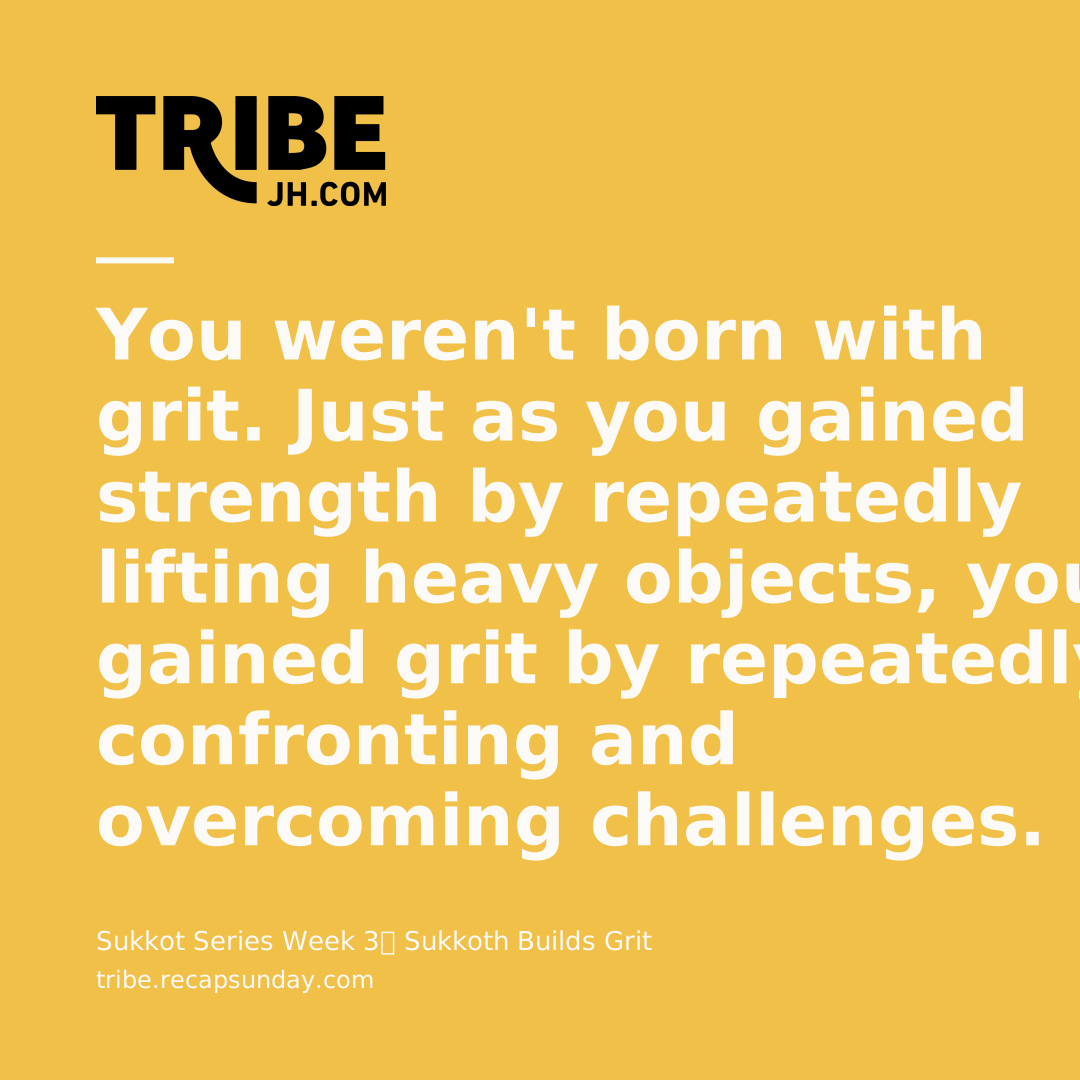
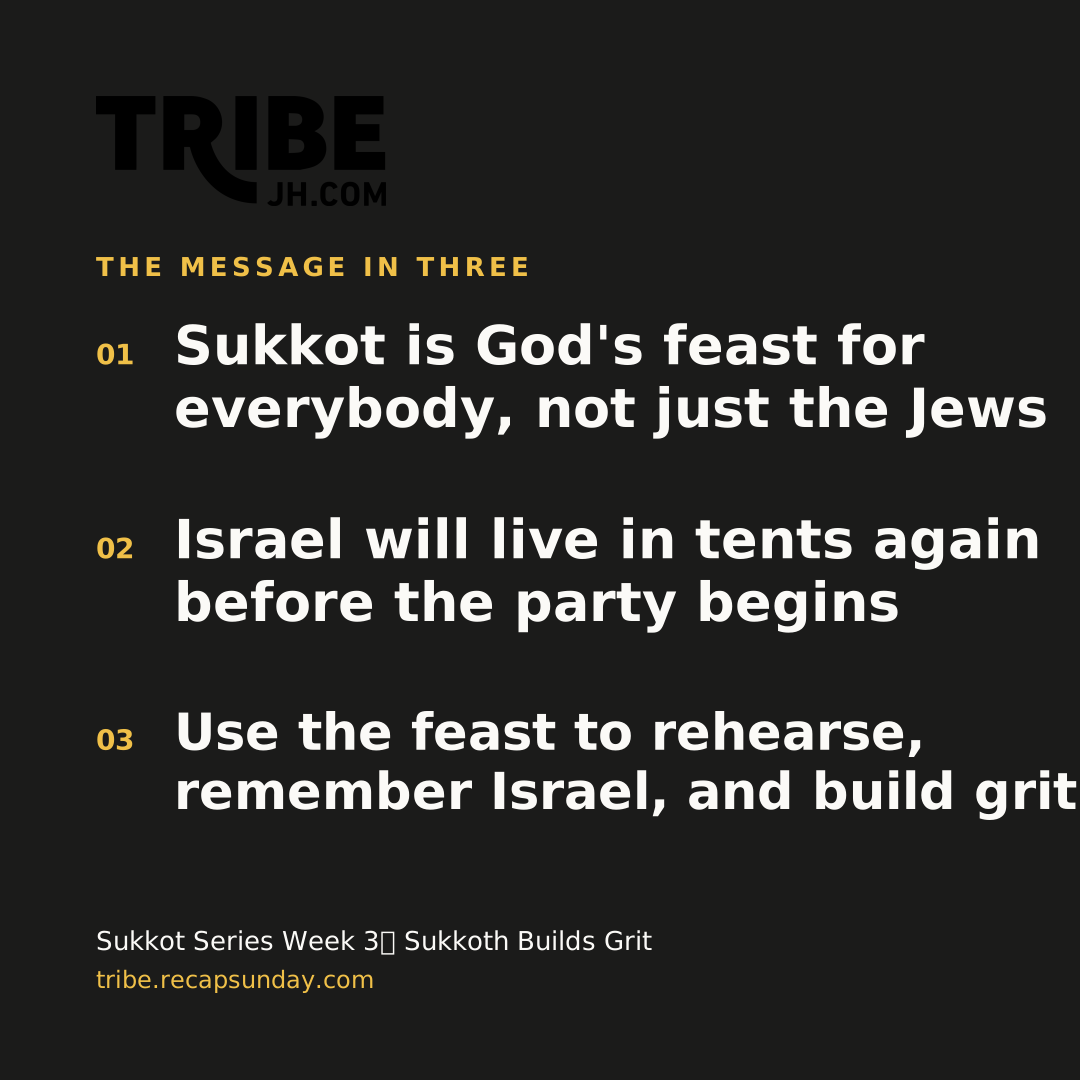
Pastor Brian connected all of this back to the definition of grit he had put on the screen earlier. Grit, he said, has less to do with talent and more to do with relentless determination, and it is built by repeatedly confronting and overcoming challenges, not by being born with it. He read a version of that idea from a speech given at the United States Air Force Academy by a member of the Tribe community. The feast of Sukkot, he argued, is a small, practical, annual opportunity to rehearse days of greater uncomfortability, to remember Israel and stand with her, and to intentionally develop that muscle before it is urgently needed.
He closed the teaching by returning to the harvest image in Deuteronomy 16. The threshing and the pressing come before the drinking of wine and the feasting, and that is where the series has been sitting. Next week, he said, the series turns the corner toward the joy, including the return of Jesus to rescue Israel, the resurrection of the dead in Christ, and the establishing of the kingdom of God on earth.
Touch points
Things you could actually do this week.
Read Zechariah 14 and Deuteronomy 16:13-15 on your own this week and note what you see about the feast of Sukkot and the return of Jesus.
Build or set up a simple outdoor shelter, even just an awning or a spot in the backyard, and spend some time in it away from your phone during the week of October 9 as a small, practical act of dwelling in discomfort.
Pray specifically for Israel each day during Sukkot week, remembering that God has not forgotten her and that hard days lie ahead for her people.
Pick up a copy of Night by Elie Wiesel or When Jesus Returns by David Pawson and begin reading it slowly this week to build a deeper understanding of what Brian has been teaching.
When something uncomfortable or hard comes up this week, pause and treat it as a deliberate opportunity to build grit rather than something to avoid.
Doing a Bible study?
Here is a guide we have prepared for you: the passages
in order, questions for the group, and room to write.
Brian described the feast of Sukkot as God's feast rather than a Jewish feast, saying the Israelites were simply 'the first ones that showed up at the party.' What does it change for you, if anything, to think of it that way?
Brian read Zechariah 14 and noted that even the enemies of Jerusalem will come to celebrate Sukkot during Jesus' earthly reign, with consequences for any nation that refuses. What is your honest reaction to that picture of Jesus as king?
El pastor Brian continuó una serie de varios domingos sobre la fiesta judía de Sucot, que comienza el 9 de octubre y dura una semana entera. Explicó que Sucot es una de las siete fiestas de Dios, no solo una tradición judía, y que es la única fiesta del Antiguo Testamento que, según Zacarías, las naciones seguirán celebrando cuando Jesús reine en la tierra. El tema central del día fue que Sucot construye carácter resistente, lo que él llamó "grit", es decir, la perseverancia apasionada hacia una meta a pesar de los obstáculos, algo que no se recibe de nacimiento sino que se desarrolla con práctica.
Brian leyó varios pasajes que, en su lectura, apuntan a un tiempo futuro en que Israel será expulsado de Jerusalén y vivirá en refugios temporales en el desierto, perseguido por sus enemigos. Usó el relato de los refugiados que hemos visto en las noticias recientes como imagen concreta de lo que esos textos describen. Aclaró que algunos de estos eventos ya tuvieron un cumplimiento parcial, como en el año 70 d.C., pero que habrá un cumplimiento completo y literal en los días finales.
Al cerrar, Brian animó a la congregación a usar la semana de Sucot de tres maneras prácticas: ensayar los días difíciles que se avecinan, recordar y orar por Israel, y aprovechar las incomodidades pequeñas de la fiesta para fortalecer ese músculo del carácter resistente. La semana siguiente prometió enfocarse en la parte festiva y gozosa de Sucot, incluyendo el regreso de Jesús y la resurrección.
---
Pasajes bíblicos usados:
Zacarías 14:1-2, 6, 17
Deuteronomio 16:13-15
Ezequiel 20:35-38
Jeremías 31:2
Apocalipsis 12:6, 14
Mateo 24:15-21
Lucas 21:20-24
Daniel 11:32
Read the full transcript14,606 words
It's just like she looks just like Avery. No. Uh-uh. Absolutely. I oh, hi.
It's so cute. The they have the just
hi. Okay. We were teasing so happy. Did her tank get filled with your Grinchie tank? Yes.
We were teasing Jacob because he's like, she went home to see her family. We're like, you're her family Good morning. Hi, Jennifer. Was it good? Are you happy to be home?
Was it good to be home? Yeah. Sometimes it's weird. Sometimes it's weird. Yeah.
Yeah.
You saw all your friends? They all still live near? They all still live near, like, where you can see them? That's fun.
We
don't have to, so Debatable over here. Well, good morning. We're glad that you're here. If you're joining us on the livestream, welcome, welcome, welcome, welcome, welcome. Good morning.
I'm gonna pray for us to get started this morning. Oh, Lord, we just thank you for every person walking through that door even right at this very moment. Lord, we just invite your presence in this place today. Come and meet us. Come and meet us.
We declare who you are today. In Jesus' name. Yes. Amen.
Always my song.
You're good, declare that this morning. Are good, you're good,
oh, you are good, you're good, oh,
you are good, you're good, oh. Lord, we just declare that this morning that whatever trial we're facing, whatever valley we're walking through, whatever mountain top we're standing on, we just declare this morning that you are good. That your goodness, if we allow it to, we can see it every place. We can see it everywhere because you are never changing. Give us eyes to see your goodness in Jesus' name.
In Jesus' name, we pray we will to We will do We declaring you're worthy, you're worthy of this time, you're worthy of our worship, you're worthy of this Sunday morning, you're worthy of every single minute of every single day that we can give back to you. In Jesus name.
Sing it to him. Let the king of my heart be the wind inside my sails. The anchor in the waves always my me die. You're
never gonna Just remind yourself this morning.
Gonna
Oh, Lord, we just declare that this morning. Sometimes we just have to remind ourselves of your goodness. When your word tells us to remember, to remember what we've seen you do, to stand on the things in the past because you are never changing. We can stand on those things. We can stand on the things we've seen in our own lives.
We can stand on the things we see in your word. I just always picture whatever situation is before me that I'm crying out to him for, I picture him parting the Red Sea. I just picture his goodness, his strength, his might, and then I just apply it, Lord. If you could do that for the Israelites, you can do this for me because you are a loving father. You made a way for us to draw close to you and be close to you.
That's right. We sing about that this morning. In Jesus' name. I love this song because I feel like it's a complete gospel from beginning to end and just a praise response to his plan for us when we sing this song Living Hope. Just think about the words.
My living home. Let's just make
this our prayer this morning. Let's all stand together if you're comfortable. Just stand and just let the posture of your body just line up with the posture of your heart. Worship him this morning. Think about what he did, how he burst, how he burst through that tomb, and even death, hell, and the grave couldn't hold him down.
Lord, we worship you. We worship you. You are worthy today. We don't want these to just be words to songs. We want them to be our worship to you today because of who you are and what you've done.
You're worthy, worthy, worthy.
Then came a morning that sealed the promise you buried by it began to breathe. Out of the silence. The roaring lion declare the grave has no claim on me. Is that good news to anybody? Of the goodness of God.
When I sing that I always in my head I sing, all my life you have been faithful and then my mind says even when I didn't deserve it. All my life you've been so so good even when I couldn't earn it. And the Lord just so gently reminds me that there's nothing that I can do to strive to earn his love. It's just been given freely even before I chose him. Jesus, I thank you that you were good to me even before I was good to you.
You were faithful to me before I was faithful to you. That you laid the foundation. Sing this one more time. All my life.
Of the goodness of God.
Yes, Lord. Gretchen, will you just grab that microphone? And Kim, will you just pray for us? Thank you. As we just transition from this kind of worship to the next, just maybe the Lord to put something on your heart or just pray for the hearts in this room.
I feel like the Lord's just really doing a softening.
Thank you Jesus so much for just who you are. Thank you for what you mean to me, to my family, to this family. Just keep softening our hearts towards you. Help us to keep our eyes focused on you because your eyes are focused back on us. Help us to lay down anything that we're supposed to and then we just, like, we just lay it down at your feet.
You take care of it. Help us to surrender that to you. Help us to not be living in the past, not to be living in the future, but to be living with you, one in your spirit. Just just ask, Lord, that you just speak through Brian, that you just rest on us, rest on our hearts, rest on his words, and help him help those words to penetrate our hearts. Help us to receive it and leave here changed.
In Jesus' name.
As a part of worship, just let's sustain this attitude. Just just as a part of worship, I just feel like let's just turn to someone and it's okay if there's not something that you need prayer for, but just turn to someone near you and just say, is there something that I can pray for you today? And let's just take just a few minutes in this time of worship and let's just lift each other up. We're gonna just keep playing and singing through this. Maybe the Lord's put something on your heart to go to to pray for.
Maybe there's a word or a picture or something. Maybe he would have you share with someone. But just turn to someone near you and just ask them, what can I pray for
you for?
Ready, set, go. And if you're at home and you're alone, just pray in the spirit. Ask the Lord what to pray for. If you're sitting with someone, just pray for one another as we just take this moment. Living
God. Lord, we tell you we love
you and as we continue in this attitude of worship and we fill up our coffee and we get out our bible, Lord, we ask that you continue to speak to us today. Thank you for your presence in this place. Thank you that you understand how important it is for us to gather together, to lift each other up, to encourage one another, and to worship you. We love you, Jesus. Teach us from your word today by your spirit.
Everybody said, amen. Alright, fill up your coffee and get out your body.
Elisha's with us this morning. Go Elisha. Go Elisha. Oh.
Oh. But Oh, I should've been going. Don't trip
me with this.
Okay, anybody? Okay.
Where we're going this morning, I want you to really be able to stay with me. Alright. Are we back, Britt? We're back? Okay.
Stay with me where we're going this morning. We're going to we have we have dabbled our toes into exposure of the material and subject that we're gonna talk about. But today, we're going to maybe maybe step into up to our ankles, just up to our ankles today. That's just the icemaker singing praises to the lord. And as we as we as we venture into these waters up to our ankles, even though we're just going up to our ankles, I don't think it will spin.
You probably can't even hear it on the livestream. You have to dump the ice, put it back in, and then
I just need to be on our way to get here.
I love doing church in this venue. Okay. We're going to wade into waters just up to our ankles today. And even though we're only going up to our ankles, this the waters that we're going to wade into that I'm going to carefully, skillfully, prayerfully, and with balance lead you into, it's probably waters that are unfamiliar at, for some of you, unfamiliar at best. And then on the other end of the spectrum, like, wow, I've never even heard or or thought or considered these things.
But how nice is it to come to church and hopefully learn something new today? Yeah. So Whoo. With that in mind, we are in week three of a series leading up to one of God's feast. I specifically call it one of God's feast, the feast of Sukkot, because it is it is God's feast all throughout the Bible.
Whenever God is speaking of one of seven major feasts, he always says that this is my feast I'm giving to you. And when he says you, it just happened to be the Israelites or Jews that first got to celebrate the feast. It's not their feast. It's God's feast. But it's not it's also not wrong to think of it as a Jewish feast.
They were just the first ones that showed up at the party. Okay? So this is one of God's seven feasts, Sukkot. It starts not this week, but it starts next week, October 9, and it lasts for a whole week. And as a tribe family, we're gonna celebrate it together.
And we have, this year, taken several weeks leading up to that week long feast to talk about Sukkot. Why would we spend four weeks talking about a one week feast? Number one, I think it's pretty safe to say that everybody here in this room, and under the sound of my voice, has probably never celebrated the feast of Sukkot for a whole week. Probably most of you are not even really familiar with it, so it's good to be familiar with it. But there's also a passage that just jumped out to me in vibrant living color that grabbed my attention that I felt like the Holy Spirit say, hey, pay attention to this verse and to my fall feast of Sukkot.
So I want to share that verse with you, and then we're going to continue on in our family discussion. Will will you it's a little bit out of order, but will you jump to the Zechariah fourteen six passage? Zechariah, there we go. Zechariah fourteen six. So, Zechariah fourteen six and if you're taking notes, you can you can write this address down.
In the end, the enemies of Jerusalem who survived the plague will go up to Jerusalem each year and worship the king, the lord of heaven's armies, and to celebrate the feast of shelters. This is the only feast in all of the Old Testament that I have found that the nations will continue to celebrate during Jesus' earthly reign when he comes back to earth. It's that important. So if it's that important that the nations will celebrate it, then it would probably behoove us to learn more about it. And I I I was I was listening to a podcast recently, and I like there was a lot of material that he said that was like, but I really like he gave some language to some some very obvious simple language to what I've had a difficult time describing.
We, here in The United States and in the West, and pretty much most of the modern world, we operate on a solar calendar. But God does not operate on a solar calendar. He does not even operate on a lunar calendar. He operates on his calendar, and the rhythm of the universe happened to get in frequency and line up with his rhythm, so it could be said that God operates on a lunar calendar. Are you with me?
These are not the waters, by the way. I'm just helping you to know. What do I mean by lunar calendar? Just take, for example, Christmas. Christmas always happens on December when?
Twenty fifth. So whether that's a Monday or a Tuesday or no matter what's happening out there in the heavenly bodies, it doesn't matter. It happens on December 25. That's an example of a solar calendar date. Now Easter, even though we celebrate Easter, that happens according to a lunar calendar cycle, which means that Easter, it changes.
It ranges by several weeks every year. Sometimes it happens in the middle of spring break for us. Sometimes it happens while the village is still open. Sometimes it happens after the village is closed. It is it's a big pain for us because we're like, oh, are we going to have a lot of people, or is nobody going to be here for Easter?
Is the town going to be empty? So Easter is an example of a holiday that's celebrated according to a lunar cycle. And I really like what this guy said. It was impactful to me because he finally he just said in some language that's probably common to you guys, but I was like, oh, yeah, the difference between operating on a lunar calendar versus a solar calendar. And the feasts of God, the seven feasts of God stop me if you need any clarification or have a question.
I saw the furrowed brow. There'll be plenty of those today, I wanna take time to answer questions and make connections and comments.
This doesn't have to do with what you're talking about, and it's probably stupid.
But it could be a connection. It's something else that you're thinking about.
I'm sitting
here, but why are you saying I'm
Here comes the mic. I
haven't been here for a while. I forgot about things.
I know it's cute.
I'm Brian.
Hi, Brian. Nice to meet you. I'm Gretchen. Why
the enemies of Jerusalem? I
can't, I just see it and I don't understand.
I know, because that's how baller he is. That's how much of a boss
I'll put that in my bible.
That's how baller
he is.
So there's there's several reasons, but your enemies usually stand in contrast, in opposition, and and stand against anything that you stand for, which is probably why they're your enemy. But Jesus's reign will be so supreme that he is the king of kings and the lord of lords that when he sets foot back on planet Earth, the nations of the world will quake and tremble. They will bring him gifts and homage and acknowledge his divine supreme kingdom leadership over all of the earth to the extent that even his enemies will come to Jerusalem and recognize and honor the feast. And I didn't include it in this verse. If anybody has turned to that verse, read what verse 17 has to say about any of the nations that refuse.
Any nation that refuses to celebrate Sukkot by sending by sending a delegation to Jerusalem, Jesus, king of the earth, will be like, hey, didn't see you at Sukkot this year. Like, what's up with that?
The mic was off. Let's read it just in case someone's listening that doesn't have it in Any front of yeah. It's okay. It's not your fault. Any nation oh, here.
You can get another chance.
And if any of the families of the earth do not go up to Jerusalem to worship the king, the Lord of hosts, there will be no rain on them.
What do you think about that, Gretchen? You're just taking it in?
Yes. I'm taking notes.
Good. We were all introduced to Jesus, the lamb of God, the one who welcomes the little children. Do not forbid the little children to come unto me, and he gathered them to himself, and he blessed them. Jesus that is is the the the humble king riding in on a donkey. That was his first appearance.
But but Jesus, the divine being, has a multifaceted personality. And we will see in the days ahead a dimension of Jesus' personality that has been described all along throughout scripture, but is a dimension of his personality and an expression of his personality that if we are not prepared, we will be so thrown off by that expression or that demonstration of his personality that it could cause us to be offended by him. Blessed are you who are not offended because of me. The Bible describes his return wearing garments that are so red that it looks as if they've been dipped in blood. He'll be riding not on a gentle donkey, but on a horse of war.
And he'll have a sword, and his eyes will flame like fire. And in Revelation, the Bible says that the nations of the earth will cry out, hide us from the wrath of the Lamb. Lamb. We all like the gentle Jesus. But when Jesus returns, he's going into beast mode, not mark of the beast mode, but warrior mode.
Now, why is part of why he's gonna come back like that. We're gonna we're gonna dip our toes into that a little bit. That's part of where we're going today. But I want us as a tribe fam to be at the bare minimum exposed to other facets of Jesus' personality that potentially the humans, have seen in a pre incarnate Jesus. That's a really churchy phrase.
You know what I mean by that? Jesus before he was born as a baby. There are examples in the Bible that that suggest the prophets were like, it's it's the angel of god or it's it's god but he's like a per that was the pre incarnate Jesus. And he's described, I'll send with you going into the promised land. I'll send my hornet ahead of you, and he will drive out the nations.
I I picture a pre incarnate Jesus when he's leading Israel out of Egypt as like a like a Daniel Boone frontiersman character or almost like Strider in Lord of the Rings. Who is this ranger coming over the hills and through the wild places and he's familiar and comfortable with him and he's a great swordsman, he knows the local lay of the land and can lead and guide. There's lots of examples of the pre incarnate Jesus where we get a glimpse of not in a malignant way, a brutal and a savage guy, like a frontiersman. When we see Jesus and he comes in Advent, the first time two thousand years ago, because of the nature of his mission, we predominantly saw Jesus as kind and gentle and laying down his life. When he returns, having already accomplished that, we're going to see a different side and facet of his character.
By way of illustration, I was never raised with a dad, but I did see it in my mom, but in a mom's expression. But if you're raised with a dad, were there ever times in your life where, not pointed at you, but in defense of you, you saw a different aspect of your dad's personality when the papa bear came out. And you're like, woah. Where was that dad? So in a similar way, that could be an illustration for what I'm talking about for what we'll see.
Man, those are a lot of words, we're not even into the notes yet. Here comes the mic. Mhmm. And then flip the little mute button up. Perfect.
It reminds me of the scripture that in the end, every knee will bow and every tongue will confess. Everybody in the heavens above earth on earth. And Yeah. It's the same sort of thing. The enemy's going up to Jerusalem.
Yeah. But every tongue and every knee.
Psalms 23, where does God choose to prepare a banquet for us?
In the presence
of our enemies. Exactly. Jesus said or in so the disciples saw when Jesus turned over the banks, that's what the table where money was exchanged is called. It was called a bank. Not as we think of a bank like an institution, but it's it's what in Hebrew is described as a table where money is exchanged.
If you ever wonder, where'd that word bank come from? Now you know, everybody said. When he turns over the banks in the temple, and I believe it's Matthew, it says that then the disciples, as they saw that demonstration, they were like, oh, and they made a connection. Zeal for your house has consumed me. So those who have been exposed to, really what we have been talking about and are going to continue to talk about, the goal is for us when we see events and when we see an expression of his leadership in the days ahead that may not fit in our traditional mold of nice, comfortable, gentle Jesus, we will be able to say, Oh, I still recognize him.
I still recognize him. That's him. That's him working. If you're taking notes this morning, at the top of your notes, can write Sukkot week three, Sukkot builds grit. Sukkot builds grit.
That's what we're gonna talk about in our conversation today. And I wanna read to you a definition of grit. Grit is a personality trait possessed by individuals who demonstrate passion and perseverance towards a goal despite being confronted by significant obstacles and distractions. Grit has less to do with talent and ability, praise the Lord, and more to do with relentless determination. Those who possess grit are able to self regulate and postpone their need for positive reinforcement while working diligently toward a goal or an objective.
That's a big mouthful, and your hand will get cramped if you're trying to write all of that down, but I love how you get smart and you just take a picture of it, so that you can have that. Now, the trick is, how do we integrate notes from our phone, pictures that we take on our phone, into notes in our notebook? We'll work on that. Take a picture of this. Grit is a personality trait.
I've already read it once.
So,
Amanda has found scriptural justification even though that's not scripture. She says that, I feel like this is a justification for my stubbornness. Yeah, that's that's great. And Corey is Corey's not here to provide a counterbalance point to that. So as we're talking about Sukkot, the feast of Sukkot, if you're like, give me take me back to the source.
What's the genesis of of of this feast of the Lord called Sukkot? I'm gonna put up three addresses for you that you can write down and come back. These three verses, think of them as tiles in a mosaic that that give up a a pretty good picture in this part of the landscape of the huge painting of the sovereign plan and nature of God in dealings with humanity in the context of the entire universe over the span of history. We got a few little tiles here that have a big impact over the entire mosaic. But each one of these tiles found in Leviticus chapter 23 verses 33 through 42, Deuteronomy, which is where we're gonna go today.
Last couple of weeks, we were in Leviticus. Deuteronomy sixteen nine through 12. Nehemiah eight fourteen through 15 is another one of the addresses that make up this the the well rounded, your basic picture of the biblical foundation and justification for Sukkot. It's found in these three passages, and it's mentioned in lots of other places, but I just wanted to keep it simple. I know that you're continuing to write these addresses down, which I love to see your notebooks and your pens scratching and your cameras clicking, or your thumbs making notes.
I love this. Where does the name Sukkot come from? Sukkot is a Hebrew word, and it simply means booth or pavilion or shelter or tent. That's why, depending on your translation of the bible as you read these passages, it may say celebrate the feast of shelters or celebrate the feast of booths. But the word Sukkot that you will hear the Jewish community talking about, all it means is shelter, pavilion, tent, or booth.
Okay? Okay. Okay. Today, I'd like us to focus in on Deuteronomy chapter 16, and we're gonna read a couple of verses 13 through 15. I don't know I don't think I have the the whole passage up here, but let's turn to Deuteronomy 16 in our Bibles, and then we'll hand you the mic.
And would somebody please read verses 13 through 15? And Gretchen's got her eyes up looking for whoever's ready. It's probably somebody on that back row in our VIP section. Might even be Carly. Oh, I I think I saw Carly raise her hand.
Carly is ready to read. Uh-huh. Yep. Oh, look. She's got a bible right here in front of her.
Proverbs 31 woman who can accurately and properly you're in Deuteronomy 16, and I'm gonna have you read verses 13 through 15.
Celebrate the fest feast festival of tabernacles for seven days after you have gathered the produce of your threshing floor and your winepress. Be joyful at your festival. You, your sons and daughters, your male and female servants, and the Levites, the foreigners, the fatherless, and the widows who live in your towns.
Quick pause. Once again, notice this feast is for who? Erbadi. So it would make sense that in the millennial reign that even the enemies, and I would say parentheses former, so current at the time, and former enemies will come to Jerusalem to celebrate Sukkot. Was going down a YouTube hole and there's actually during the Feast of Sukkot in Jerusalem, there's from messianic Jews that that understand the the the prophecies of these scriptures in their proper context.
They have what's called a parade of nations. So during the feast of Sukkot, you get you get, like, hundreds and hundreds of people representing dozens and dozens of different nations, each with their own country flag and dressed as, like, Canadians or or United States, you know, and all their, like, USA garb but from all these different nations, and they go on a cool parade during Sukkot. Like the Olympics. Kind of like the Olympics. Ah, yes.
There you go. Good thinking. So keep going.
That's the move as well?
The tabernacle is like a tent. It was a temporary dwelling for God. There's just so much connection.
Oh, I
love it. Yes. Yes. You're onto it, Colin. Continue, ma'am.
For seven days, celebrate the festival to the Lord your God at the place the Lord will choose. For the Lord your God will bless you in all your harvest and in all the work of your hands, and your joy will be complete.
This festival will be a time of great joy for all. What we're going to focus on today is verse 13, which is up here on the screen. You must observe the festival of shelters for seven days at the end of the harvest season. After the grain has been threshed and the grapes have been pressed. So we are going to get to verse fourteen and fifteen.
Verse fourteen and fifteen is the the these this is the party. These are the party verses. In Jewish culture, the feast of Sukkot because like here, we don't really we have like zero connection to any type of agrarian calendar or rhythm. Like if anything our rhythm is dictated by school and by like the weather like it's hunting season, it's ski season, it's mountain bike season. So so those those external influences probably probably shape our rhythms the most.
In an agrarian society, and when this feast was established by God, this feast took place at the end of the busy summer harvest, the busy summer growing season that culminated with the harvest. How many of you have ever cut or bucked hay before? That is hard work. Once the hay has been baled, you get to follow along on foot pasture after pasture after you take these huge hay bales and buck them up to your buddies on the trailer and get stacked. It is such hard work.
And probably the only thing harder than than bucking hay onto the trailer is loading it into the hay barn when you get towards the top of the barn, and you're on your knees, and it's just nothing but, like, hay grass in the air, and everything is itching, and you gotta take these what are they? 80 pound bales, usually? Might as well be 180 pound bales, you're trying to tuck them up, grass is getting everywhere. It never really paid that good. This feast of Sukkot took place at the end of all of the hard work at the end of a busy summer growing season where crops were harvested, the wheat was threshed and the grapes were pressed, think of in modern Jewish culture, Sukkot is thought of like our Thanksgiving.
If we think back to our roots of Thanksgiving, we're happy for a successful summer growing season and a fall in gathering and harvesting and like, The winter's coming. We've done all of our hard work for the summer, and let's just celebrate and relax. Sukkot is often thought of as Jewish Thanksgiving. At the end of the season, where we're going to focus today is on verse 13. This feast is to be celebrated after two things specifically happen.
What are they? The grapes pressed and the grain threshed. Thrashed. Threshed. Threshed.
I wrote this down in my own notes. Before the party always comes the pressing. Not depressing, but the pressing. Before the party always comes the pressing, and that's what we are talking about. Just as it is uncomfortable dwelling in a sukkah or a shelter or a booth, remember this was the prescribed way to celebrate the feast.
For seven days, you are to live in or dwell in a sukkah, a tent, a shelter, a booth. So every year, Israelites would leave their own dwelling and they would make like a little tent or a booth. When you read these different verses, you'll see like in Nehemiah and also places like Leviticus, it says, Take beautiful branches, branches that you find pleasing to your eye, and construct a little shelter out of them. And for seven days dwell in that. And we're gonna do that in October.
Not that we have to live out there. You take it as hardcore as you want, which I can tell by the look on your face, you're going to really go for it. You're going to get a lot out of it. Dwell in this sukkah like a little tent or shelter or a booth. Part of the idea is to eject us, jolt us out of our common comfortability.
Just as it's uncomfortable dwelling in a sukkah, it is a rehearsal for days ahead. Not only for the church, but also for Israel. I want to go through, and this the water that we're going to wade into just up to our ankles, I wanna read several verses that I believe suggest that Israel will one day live in tents again. When Jerusalem is sacked and Jewish people are under a fierce blast furnace of persecution. Now, before we get into all of these verses, I wanna stop and just take a quick I wanna do two things.
I wanna check-in with you, thoughts, questions, comments. I know that you might not have any questions about what we're going to talk about because we haven't talked about it yet. But I want to check-in with you, number one. Then number two, I want to do a quick diagnostic scale of one to 10 question. As I look around the room, I see so many familiar faces that have been on this journey with us for quite some time.
But I want to quickly ask a diagnostic question of each of you. You can participate in this survey on a scale of one to 10, showing me your fingers. I won't get to hear the feedback from the livestream people unless you, like, make a comment. You can make a comment, and I'll I'll get those. If you're listening to the podcast, well, then just just try to send it to me, you know, telepathy, and we'll see what happens there.
But I'd like to know to what extent the for lack of a better phrase, I'm calling it the Maranatha message, that Jesus has come and that he is coming again and focusing on the he is coming again. How much of that message that we've been on for a long time and really senior pastor Jesus has no intent on us moving on until he tells us to move on, how much of the Maranatha message, the return of Jesus, are you seeing in your own personal reading of of scripture? When you're doing your own bible reading plan or your own quiet time, how much are you seeing this in scripture? 10 being, oh my gosh, every page I turn, I'm seeing the return of Jesus. One being, I I'm not seeing it, and a one to zero is completely fine.
Again, I'm just checking to see where you're at. So show me. Give me some hands. Okay. Yeah.
Yeah. I've seen, like, full full spectrum. Okay super cool so this might be a very similar question but how for how many of you the Maranatha message you're not only seeing it in scripture or maybe you're not seeing it but somehow, someway, maybe through our conversations, it's beginning to enter your bloodstream and be like, oh, when you talk about this, it really resonates with the frequency of my heart. How many of you resonate? 10 being, I'm right there resonating on the same frequency, and one being, I'm just still trying to learn and just pick this up and I'm not quite there yet.
10 and a one. Just curious. Wow, okay. Interesting. Okay, okay.
I will now give you the summary of the evidence collected from the data points that you have given me. Many of you are resonating with the Maranatha message, but not as many of you are able to have the Maranatha message connected and grounded in Scripture. So this is wonderful, the conversation that we're having today, because I want to begin to just ankle deep give you some foundational scriptures for a piece of the puzzle of the Maranatha message. So that was thing number one before we get into these verses. Thing number two is I want to check-in with you.
Thoughts, questions, connections.
I guess I was curious, you know, with the harvest, and Jesus talks about the harvest being ripe and plentiful being souls for the kingdom. How does that relate with his second coming with Sukkot?
So great. So there are a number of Christians who are plugged into the the stream of end times prophecy that have a strong conviction that the return of Jesus will coincide with the feast of Sukkot. If you think of God we think of a harvest cycle. Before Jesus was the planting of the seeds, Jesus comes, like, the seed is is is in the ground. Right now, during this time, we are in the summer of the working and the harvesting.
This epoch of history is the the working of the fields and the harvesting of the fields. After the harvesting of the fields comes what? Two things? The threshing and the pressing. And then according to verse fourteen and fifteen, then what happens?
The party. Does that answer your question? So the connection that you're making, the fields are ripe for harvest. Yes. Now is the time.
Now is the summer. I'd say the late summer, if not the very tail end of summer, of working the fields and harvesting and proclaiming the good news of the gospel. Colin's got more.
Well, yeah, I was just
as far as
the timeline goes, we've also talked about maybe the second coming more being in the spring with Passover. So I was just curious your thoughts. Right. Fall versus spring versus I mean, nobody knows the time and day, but we can
But we are commanded to know the season.
Time of the day? Yeah.
I can give you the season. Oh, okay.
Just throwing thoughts out there.
I can give you the season because we're commanded to know the season, and he tells us to look at the signs to to to be prepared for the season. So many people use that one verse, no man knows the day or hour, as an ejection handle to excuse them from studying into it. But examine Matthew chapter 24 verses eight through 31 where seven different times he says no or realize that we need to know. Now, personally, do I believe if he will come back closer to Passover or closer to Sukkot? One of the the Jewish celebrations during the week of the feast of Sukkot and I I quickly I I I don't wanna get over my head in in contemporary Jewish cultural celebrations of the feast, But one of the things that happens during that week of Sukkot I cannot it might be yom tu tu rah.
People on the livestream are gonna be, like, texting me or sending text messages. Yeah. Don's texting us right now. Oh, good. And we got we got another they said, Maranatha, eight.
Okay. So she's an eight. Good. But one of the things that happens is the blowing of trumpets. And scripture is very clear that at the last trumpet sound is when we can expect to see the return of Jesus.
And there's some beautiful parallels between what's foretold and what we know of through New Testament authors and the book of Revelation in conjunction with Old Testament prophets about this idea of the blowing of trumpets being significant to a a an alert. Something's about to happen. If you heard a trumpet, we'd all stop and pay attention. So what's happening? The first thing we'd say.
We wouldn't hear a trumpet blast and go, oh, yeah. Trumpet. We would start looking around. Something is happening or about to happen. We see we see those elements when the lord comes down in Sinai.
We see those those they the the sound of rushing wind as wind goes through a trumpet at at Pentecost. And in Revelation it talks about trumpets and bowls, and we have been given New Testament references. Paul says, at the last trumpet sound. So back to your question, would he is he more likely to come at Passover? Is he more likely to come at Sukkot?
To me, I don't care when he comes back. Just come back. But it seems like it would be more fitting. It would have more flair, and people would be able to connect more dots if he came back at Sukkot. Is he coming back at this Sukkot?
The pieces aren't on the chessboard quite quite there yet. Yeah. That's I said that. Right? I mean, I really messed Last Sunday.
Yeah. Yeah. Yeah. Last Sunday. Yeah.
Yeah. Yeah. Yom Teruah. Teruah. Teruah.
Teruah. Teruah. It's gonna mess with me. Are we ready to get into these oh, any other questions, connections? And then let's get ankle deep into these verses.
Take my arm. Here we go. I'm going to put the references for all of them on the screen at once, and we're going to go into and read each one of these together. They're all up on the screen now. These are just six passages that that when understood in what I believe to be their proper biblical context, point to this idea that once again Israel will be forced out of the comfortability, living in the relative comfortability of their normal life, and once again cast out into the wilderness of oppression, persecution, and holocaust.
I heard a statistic. No. Not gonna say it because I can't I I I don't I don't know it, and it's not germane. Let's just stick with Zechariah. Zechariah fourteen one through two.
Would somebody flip there? I know that many of these passages seem like they well, they don't seem like I know that many of these passages are in books of the Bible that probably you don't frequent too often. But part of the reason why I asked those two diagnostic questions is so that we can go to these passages in a safe, comfortable, familiar environment like this, where we can have discussion and you can ask questions with the hope that as we talk about these things here, that on your own you feel more comfortable and more confident and be able to connect your own dots. So I understand if you're like, where in the world is Zachariah? And instead of turning to it, have to turn to the table of contents to find its location and then turn there.
That's okay. Good. Fourteen one through two. Lord, would you just speak to us through these verses, connect dots, and begin to build a framework and and and help help things come into focus for for our tribe fam, for our livestream fam, and for for your bride globally as we move into the days ahead. Zechariah fourteen one through two.
Who has that? I have it. Apparently, you do. Gretchen's in a mood.
I saw you open to
it, so Yeah. Watch for the day
of the Lord is coming when your oh, watch. For the day of the Lord is coming when your possessions will be plundered right in front of you. I will gather all the nations to fight against Jerusalem. The city will be taken, the houses looted and the women raped. Half the population will be taken into captivity and the rest will be left among the ruins of the city.
Heavy. Heavy. Heavy.
Frank, do you think this is like the city of Jerusalem? Is like the actual city Jerusalem? Like, know he's coming back on the Mount Of Olives, but do you think, like, this could be metaphorically speaking for, like, you know go ahead.
I love the question. Very good question. There are three possible interpretations for this passage and the passages that we're going to view into. If I can just hold this thought in my brain, one possible interpretation is that it's symbolic, which is where I think you were going. Not that you hold that position, but you're asking it.
The the the interpretation proper application is strictly symbolic. The other is historic. Well, this already happened. The other possible is that there the other possible option to way to interpret this is that there is a future fulfillment that we have yet to see.
That's literal Jerusalem?
Yeah. That includes a literal sacking of Jerusalem. The city of Jerusalem, if memory serves me correctly, throughout history has been sacked and razed over seven different times. And it has happened since the prophet Zechariah wrote these words. So here's something to keep in mind as we look at the major and minor prophets of the Old Testament.
Prophecy always has a multiplicity of layers of fulfillment. That's not to let the prophet off the hook by saying, Well, he he that that was fulfilled in seventy AD. Or for somebody looking for a future fulfillment, well, I mean, it just hasn't been fulfilled yet. I don't say that as a carte blanche, interpret it however you want. The reality is the structure of the books of the bible, genre, the this would fall under the genre of prophecy, the way that God designed and structured prophetic books, he intended for there to be layers of fulfillment culminating with an actual literal fulfillment.
When we read these words in Zechariah fourteen:one that we should quake. The tears should be streaming down our cheeks. And if they're not, it doesn't mean that you're a a callous person. It just means that the weight of these words still has a ways to penetrate into our hearts. And in the days ahead, it will before we see these things actually play out.
And I like how you corrected yourself grammatically. Watch for the day. No. No. No.
Watch. Comma. Pay attention. For the day of the lord is coming. That phrase, the day of the lord, this gives us a grammatic clue.
From the grammar, we can there there should be a a hyperlink to the theme, the larger theme of the day of the lord. Most traditionally, predominantly throughout scripture, when you hear that phrase, the day of the lord, what time period should your brain be making a hyperlink to? His return. Watch for the day of the Lord. We have seen Jerusalem be ransacked.
The last time we saw it was in seventy AD. We have seen houses looted, cities taken in World War II. We've seen it in Spain during the Diaspora that as they looted the Jews, that's what funded the expedition that Christopher Columbus went on to discover a new world when Jews were kicked out of Spain. But when you see this at the beginning, this should create a hyperlink in our brain to this will unfold. The events of the diaspora in Spain, seventy AD, all of those are a foretaste or a rehearsal for what is to come.
These are days ahead when grit will be required. Should we do another one? Ezekiel twenty thirty five through 38. And while you're turning there, I'll hand the mic to Kat.
Just really fast, when you were talking about some of those things that have already transpired in history, are you referring to maybe this has already happened? This passage has already happened as we've or are you saying that this is to come?
Okay.
Because I haven't seen necessarily Both. Both. Or maybe it's both.
It's it's it's it's both and. We have seen a partial fulfillment of this one verse. If we were to take this verse in isolation
Mhmm.
If we were to take it out, then we could say we have seen a literal historical fulfillment several times of this verse. However, it's a bothand. We will see a true culminating fulfillment of this verse in the days ahead because of two reasons. Number one, there are other things that happen in Zechariah fourteen one that have not yet happened. Remember, like, did you guys ever play that that game?
I think it was not operation, but it was like a little game where there was a patient in the bed, and at the foot of his bed, he had a little thing that you could flip up, it had a little red filter thing and you'd slip the card in. Because of the red filter, you could see what the patient actually had, but you had to put together all these clues. Oh, do they have funny bone it is? It's kind of these goofy things. Or similar to Clue.
In Clue, in order to get the bad guy, you need what all things do you need? The murder weapon, the location, and the person.
Oh, the most.
Yeah. Maybe the most. So so so there needed to be Yeah. There we go. There you go.
So you need to have all of these things line up. When you look at this passage and the other passages that we are going to dip our toes into, you will see that some of these things have been fulfilled, that you can be like, Oh yeah, that was a type and shadow, a rehearsal, if you will. But we will see in the days ahead a culminating fulfillment when all of the boxes are checked. And I said there are two things. The other thing that we just talked about for the day of the Lord.
That should create a hyperlink in our brain to future events. Okay. Ezekiel chapter 20 verse thirty five and thirty eight. And I'm gonna be looking to to two members of our our team here today that have been deep in this journey on us to like, if I'm saying, if I'm racing too far ahead or if I'm saying something that needs a little slow down, explain, help help us out. Ezekiel twenty thirty five through 38.
Again, there's coming a future day when Israel will be kicked out of Jerusalem again in the midst of great persecution. They will live in tents again.
In '35 it says, I will bring you into the wilderness of the nations, and there I will judge you face to face.
Quick pause. You could read this and interpret this to mean, am kicking you out of your Jewish homeland and you will live in the wilderness of the nations. If you have ever been to Israel, is so cool to see their nationality is Israeli, but their ethnic heritage comes from literally all over the world. Eastern Europe, Western Europe, the Baltic Region, Africa, all South America, all over the world. It's possible to be like, well, what he's talking about here is the diaspora, the dispersion of Jews.
However, God has not dealt with Israel face to face as in a human face. Think about the return of Jesus. Keep going.
I will judge you face to face. I will judge you there just as I did your ancestors in the wilderness after bringing them out of Egypt.
Where will God deal with the nation of Israel face to face? In the wilderness. Verse 37.
Says the sovereign Lord, I will examine you carefully and hold you to the terms of the covenant. I will purge you of all those who rebel and revolt against me. I will bring them out of the countries where they are in exile, but they will never enter the land of Israel. Then, you will know that I am the Lord.
So there's a there is a a figurative current, what do we call it, present progressive ongoing action of God doing this. And in a way, he does this for us. I mean, where did each one of us when Jesus found us and we gave our heart to him, where were we? All of us. We were in the wilderness of the nations, the party nation, the ski bum nation, the nation of materialism.
We were all out in the wilderness. So it can be applied to us in that way, but we will see a future date when Israel, after the city of Jerusalem has been besieged by the armies, a 10 nation coalition of the Antichrist, will be the city will be ransacked. Again, Jerusalem will be ransacked. Those that are able to flee, pray your your flight doesn't come in the winter. Those are the words of a guy that kinda knew some things that were gonna unfold.
They will they will leave the city, and god says, out there in the wilderness. When I say that Israel lives in tents, what I mean by that is temporary shelter dwelling, not your home. And it could look like maybe a Red Cross camp or some sort of internet it could be like a NATO camp to to to take care of and and house a huge migration of population that is displaced from their land and from their country. That is not too far to imagine because we see it playing out on the news today with other nations and countries and ethnic groups. That is Ezekiel twenty thirty five.
I will bring you into the wilderness. Look at the theme and the pattern. Jerusalem being ransacked. God leading Israel into the wilderness. Let's go to Jeremiah 31 verse two.
And I understand that, for example, in Jeremiah 31, I'm only giving you one verse. Any preacher should be very careful and any listener should be very careful when the guy builds the whole thing off of just one verse. So when you're on your own, go back and read around to get the full context. But Jeremiah 31 verse two, would somebody read that?
This is what the Lord says. The people who survive the sword will find favor in the wilderness. I will come to give rest to Israel. My gosh.
Those who survive the coming destruction will find blessing in the wilderness. And I think yours says, I will come to give rest. Oh, we're gonna see a rescuer emerge. We've seen a savior, but we're going to see a rescuer. And, oh, just the style in which he does it.
Some more. Revelation 12. That's an easy book. Go all the way to the maps and then hang a left. Would somebody read Revelation 12?
Now we see it two times in chapter 12 in verse six, and then jump over to verse 14. Amanda's got it.
Verse six
says, and the woman fled into the wilderness where God had prepared a place to care for her for one thousand two hundred and sixty days. Verse 14 says, but she was given two wings like those of a great eagle so she could fly to the place prepared for her in the wilderness. There she she would be cared for and protected from the dragon for a time, times, and a time and and a half a time.
Now this verse potentially could be loaded potentially could be loaded with lots of commentators making metaphorical extrapolations and assigning meanings and attaching connections that were never intended by the author and are quite a stretch.
Is not The USA.
There you go. Say that again and explain a little bit more, but that is literally the example that I was thinking of. So some people say when
they This read that means we like to read the Bible and then put it into our own lens, especially in in The USA. Just reading the bible through the America lens. And while America has a place now, she's not really in the end times.
We don't see her. We see nations like Israel, Egypt, other nations. We don't see America. You gotta look really hard and stretch the text to to apply anything to our little how old are we? 200 years?
About that? Yeah. It's cute. Our little experiment in democracy. So so and then the woman, oh, who is the woman?
And then flight and wings and dragon, super clear. The woman, we can because a description of the woman, she's wearing a crown with 12 stars. The the length of time that she is there, that's given. So throughout the tribulation, the last three and a half years of the tribulation, which is about one thousand two hundred and sixty days, when great persecution is unleashed during what Gentiles would know of as the tribulation, there'll be there'll be all out assault on the people of Israel, including taking the the Tel Aviv, the airport. Okay.
I don't wanna that that's not in the bible. But the but the basic geographic location is. He set up the enemy sets up the his camp between the holy city and the sea. Tel Aviv, where Ben Gurion Airport's right in between there. But it says that Jerusalem will be sacked.
Now there'll be people that flee out into the wilderness. Israel will flee. There shall be cared for and protected from the dragon. The dragon is super clear. It just says who the the Bible tells us who the dragon is, the devil.
Brian, before we read Luke, was just thinking of what you were saying, and this is a lot of information that you're giving us today, And it's all so good. And I just wanted to, being on the leadership team here at Tribe, just kind of reemphasize because I can see how it would be like a fire hose of information if we haven't been studying it. And, like, it feels important because it's in the Bible, but how do I apply that to Monday morning? And you might say something about that too. But I just wanted to reemphasize that the Lord is putting heavy on our hearts to dig into this, and that's why you're teaching on it so much and end time stuff.
And the Lord just has us, you being the Jesus senior pastor and then you next in the line, just heavy on our hearts to teach about it. So as a tribe family, I just wanna reemphasize the Lord is doing something and he's having us stay here. We're not just I know when Brian's preparing for sermons and stuff, doesn't. He's like, oh, well, let's talk about end times again. What else should we do?
It's heavy on Brian's heart to talk about it and our leadership team to just stay here. And I don't think a lot of churches are doing it. That makes us special and unique, but all we can do is obey the Lord and as Charles Stanley say says, leave the consequences to him.
That's good.
I just wanted
to honor what you're doing, but also for us like, well great, I can't pay my bills and what's the dragon, why do I care? I just wanna say it matters. Yes, it's in the bible, but it matters because the Lord is having us stay here. He's been very clear to just prepare and and help us build grit and help us fill our tank that's empty after a pandemic. And there's just stuff that you're giving us that the Lord has given you that's important even if it doesn't feel like, well, I just wanna have a feel good message.
It's not really what tribe does. Yeah. We obey the Lord, so
That's good. Thank you. How many of you, for the very first time, you practice you you were introduced to a new skill or a new task or a new movement that the very first time you did it, you were awesome at it. None of us. None of us.
Like, I'm looking at I'm looking at Kat and what a great dancer she is. I'm like, Oh my gosh, that's amazing. Okay, show me that. I dislocate my elbow the first time I try one of those swing moves. I'm like, Ah!
But the more she's like, No, no, no. Do it this way. Your arm drops around here. You spin this way. Not this way.
I am like, Oh, I get it. Oh, I get it. What we are talking about, if it feels awkward to you or maybe even uncomfortable or you are just scratching your head, that is normal. Hang in there. I might not be as good of a Bible teacher as Kat is a swing dancer, but I am trying.
Matthew twenty four fifteen through 21. These are the words of the prophet Jesus of Nazareth. And the mic's right there. Amanda will run it around to whoever's wants to read that. Matthew twenty four fifteen through 21.
Kathy's got it. I think she just touched her nose, but I'll take that as a hand raise.
Alright. So when you see the abomination of desolation spoken of by the prophet Daniel standing in the holy place, let the reader understand. Then let those who are in Judea flee to the mountains. Let the one who is on the housetop not go down to take what is in his house, and let the one who is in the field not turn back to take his cloak. And alas, for women who are pregnant and for those who are nursing infants in those days, pray that your flight may not be in winter or on a Sabbath.
Do I keep going? Oh, yeah. One more. For then there will be great tribulations such as has not been from the beginning of the world until now. No, and never will be.
Then those in Judea must flee to the hills. Get out. Leave your house as refugees evacuating the city. Could God not be preparing us for these future events by even visually seeing citizens of modern nations just within these last less than twelve months? We think of refugees as like, Oh, that happens in other countries or in distant places where I'm not quite sure.
These are happening to modern people that are being displaced, and we get to watch their flight livestreamed on Facebook Live or on TikTok or making videos about their apartment block being bombed, and they're rushing out with a jacket and a backpack and a little poodle under their arm. We have no idea where we're going. We have no idea where the rest of our family is. We just have to get out. We're seeing it today, and Jesus is telling us the day is coming.
There's that phrase again, the day, day of the Lord, the great day, the great and terrible day. All of those should create hyperlinks in our brain. When you will see what Daniel the prophet spoke about, and he said that to a Jewish audience who he presupposed that they had an understanding of the prophecies of Daniel. That's all the reason that we need to familiarize ourselves and to press in and to learn about these prophecies. Jesus said it as presupposing our basic understanding of these things.
The sacrilegious object that causes desecration standing in the holy place. Reader, pay attention. Then those in Judea must flee to the hills. That, when he said flee to the hills, that created a hyperlink in the brain of the contemporary listeners knowing there wasn't anything out there in the hills of Judea. That was the wilderness.
Escape. Get out. A person out on the deck of a roof must not go down into the house to pack. A person out in the field must not return even to get a coat. How terrible it will be for pregnant women and for nursing mothers in those days.
Do you remember in the early days of the the as Russian troops were getting closer to Kyiv, when thousands, tens of thousands of people were trying to get out of the capital city on trains, and you saw train stations just filled with thousands of people sleeping for days at a time just on the concrete. Do guys remember those? This is how terrible it will be for pregnant women, for nursing mothers in those days. Pray that your flight will not be in the winter on Sabbath, for there will be greater anguish, yours as great tribulation, birth pains, tribulation, and then great tribulation since the world began. Mark chapter 13 is a parallel to the to the same thing.
You could just write that down. Do I have how about one more? Guys, you're doing it. You're hanging in there. You're doing good.
You're doing really good. Luke chapter 21 verse twenty and twenty three. And
when you see Jerusalem surrounded by armies, then you will know that the time of its destruction has arrived. Then those in Judea must flee to the hills. Those in Jerusalem must get out, and those out in the country should not return to the city. For those will be days of God's vengeance.
The great and terrible day of the Lord.
And the prophetic words of the scriptures will be fulfilled. How terrible it will be for pregnant women and for nursing mothers in those days for there will be disaster in the land and great anger against this people.
Go to '24.
They will be killed by the sword or sent away as captives to all the nations of the world. And Jerusalem will be trampled down by the Gentiles until the period of the Gentiles comes to an end.
So there are a lot of sound biblical scholars way more educated than I am that make a case that this verse was fulfilled in seventy AD. And I will be quick to admit that there are many parallels that were fulfilled in seventy AD. If you're not familiar with what I'm talking about, was seventy years after Jesus died and was resurrected, seventy AD, there was a Jewish uprising trying to throw off the Roman occupying government. And One of the ways that the Roman Empire maintained control was through a strict and heavy, heavy hand. They allowed you to worship your own religion and do your own thing, have your own religious system of government, but you had to say that Caesar was Lord.
And you had to pay taxes, and you had to take a little pinch of incense, and every year, you pay your taxes as part of the census, make a pinch, and and put incense in fire and say, is lord. You didn't even have to mean it, and then you could move on. They would not tolerate anything less than total political allegiance to their system of government. Any nation that tried to slip out from underneath Roman control was dealt with a very heavy hand, as seen historically in Jerusalem in the year seventy AD, where there was a Jewish uprising and revolt that resulted in the city of Jerusalem being squashed to the ground, including the destruction of the temple. Why?
You go to Jerusalem today. There's no Jewish temple. You're like, where is it? It's not there because it was it was wiped off the face of the map in seventy AD, and there was a great persecution and destruction, and many of the citizens of Israel were dispersed. Gentiles include Moors, Muslims, anybody that is not a Jew is a Gentile, including us, and so there is a manner or a partiality of fulfillment that we've seen in history.
But it wasn't completely fulfilled because all of the other things about the great and terrible day of the Lord don't line up. We have not yet all the boxes haven't been checked. Let's say there's 10 boxes that need to be checked. In seventy AD, let's be generous and say six boxes were checked. Six boxes is not 10 boxes.
It's six boxes. That means it's a type and shadow and that there will be a future literal fulfillment. Why are we talking about this? Because I believe strongly that we'll see this with our own eyes in these days and in this generation. To add to what you just said.
Titus was an Antichrist, right? Titus in seventy AD?
Titus in seventy AD was a type and shadow of an Antichrist, so that when we see the real thing, we're like, Oh, oh, I've seen that character before. Pharaoh, King Herod, Nero, Mussolini, Stalin, Pol Pot, Hitler, types and shadow, so we recognize it. As the world goes through what's known as the tribulation, Israel will know it as a time of Jacob's trouble. I'm gonna step out of frame from the camera for just a second, but that's only because I forgot to bring him up here with me. But I wanna grab several books.
I'll show them to you.
Stay right there. You can look at me first.
You can look at her.
Brian, while you're getting the book, have you heard of them the masculine? Those who understand the wisdom of God in those times. It's in Daniel. Have you heard that term? Yes.
Is that well, we will be that. Daniel eleven thirty two is talking about these types and shadows of antichrists. And it says, he will flatter and win over those who have violated the covenant, but people but people who know their God will be strong and will resist him. The masculine.
Those who know their God will be strong and resist him.
Leading an underground movement in Jacob's trouble. Did happen, will happen.
Will happen. Will happen. There there will be a remnant of people who, just like it says in Acts chapter two, when Pentecost happens and Peter stands up and he quotes from the prophet Joel, this that you're seeing among the disciples is that which Joel prophesied. In the last days, I'll pour up my spirit on all flesh. So so Peter was able to make that connection between an Old Testament prophecy and a contemporary event that was happening in his day.
In a similar manner, like Amanda just read, that in the days ahead events will unfold that those who know their God and his ways will be able to say, oh, oh, oh, can connect some dots here. We're not forcing it. We're not looking for it. We're not we're not scouring the Internet and and going into to dark corners on the Internet. There are so many dark corners that are making goofy prophecies, but look closely.
It it requires and demands a very stretching of the text. But as as things unfold on planet earth in the days ahead, the spirit of God will rest on those who have taken the time to to to press in and he'll be able to give he will give wisdom and understanding for the purpose of of smashing fear and positioning us in a place of influence and leadership. This is that so that we can tell people as as the wheels are falling off and our friends are freaking out. It's okay. This is that.
This that we're seeing in the news and unfolding with our own lives is that which was foretold to us. Take my hands. It's gonna be alright. It's be hard. It's gonna require some, oh, what's that word?
Grit. Grit. This is like, are you
gonna tie a bow? Yes. Tie a bow.
A couple of books. A couple of books. When Jesus Returns by David Pawson. It's just in the it's in our bookstore. You've heard me mention this book.
This book, you might have had to read it in high school. I'm looking to our younger students. It's called Night. Not k n I g h t, but n I g h t by Ellie Weitzel. How many of you have read this book before?
Okay. Alright. Wow. It's about a holocaust survivor. Thank you.
And and a lot of the things that that that he went through leading up to being forced into a ghetto, having property confiscated and and his life just ripped out from underneath him, there are some very dramatic parallels that that we can see that you don't have to, like, make a stretch for in our contemporary modern day society. Here in America and around the world. This book is is not light reading. It is heavy reading that requires slow methodical reading through that you have to read it several times to grab a hold of what he's saying. This this messianic Jews named Art Katz and he talks this book is called the final mystery.
Israel and the church, a key to comprehending the last days of this age and the role that Israel plays. Israel is the central figure. It's not America. It's not like United States banking system. It's Israel.
It's all about Israel because God made a covenant with Israel. He has not abandoned or forgotten Israel. Last couple things. These are worth writing down because I took the time to write them down for you. Use uncomfortability of the feast of Sukkot.
What's uncomfortable about the feast of Sukkot? A huge facet of the feast is, as God said, dwell in shelters. Step out and away from the comfort of your own home. What does that look like for us today? If you're gonna build a little tsukkah or set up a little awning in your backyard, sit on your beautiful back patio, like like, whatever the I'll allow you to define it.
That just might mean dwelling for three hours with your cell phone out of arm's reach. The idea is to get uncomfortable for a little while. Use the uncomfortability of Sukkot for three things. Number one, rehearse the days ahead. Days of great uncomfortability lie ahead for the whole world.
And I'm I'm I I say these things not to scare you, to frighten you, not to be an alarmist. Hopefully, you know me. Like, I'm think of myself as like a good time Charlie. Like like, remember, I'm a ski bum at heart. Right?
Ski bums always take the easy road. I like it easy. I like it fun. If it's hard, ew. I disagree with that.
But, well, hard like me subjecting myself to
That's what you used to
be. Yeah. Okay. Thank you. Rehearse the days ahead.
Number two, remember Israel. Use your time of Sukkot in the when we start October 9 to remember Israel. Don't forget her. God has not forgotten her. She is gonna go through heavy chastisement.
Heavy chastisement. Stand with her. Love her. Pray for her. Support her.
Do whatever you can. Third thing is this, lean into opportunities to build grit. Let me read that definition of grit one more time while this stays up here. Grit is a personality trait possessed by individuals who demonstrate passion and perseverance toward a goal, the return of Jesus. Running into his arms, the wedding supper of the lamb, the restoration of righteousness in the end of all things despite being confronted by significant obstacles and distractions.
Grit has less to do with talent and ability. Oh, this person has a talent for surviving the tribulation. Nope. And more to do with relentless determination. Those who possess grit are able to self regulate and postpone their need for positive reinforcement while working diligently toward a goal or objective.
Use the feast of Sukkot to rehearse rehearse the days ahead, to remember Israel, and to lean into opportunities to build grit. And then I wrote this in my notes as the last last things. Everybody likes the drinking of wine. Nobody likes the messiness of the pressing of the grapes. But in order to drink the wine, the grain has to be threshed and the grapes have to be pressed first.
Next week, we're gonna turn the corner, we're gonna stay in the same passage, but we're going to look at the rest of that passage. We're gonna get to the drinking drinking of the sweet wine. The drinking of the sweet wine and the feasting should be a joyous time for everybody. It includes the return of Jesus to rescue Israel, the resurrection of the dead in Christ, and the resting or dwelling with Jesus when the kingdom of God is established on earth. Great and wonderful days lie ahead.
And that's what we're going to focus on next week. Last thoughts, questions, and then let's just see if we can make that 18 inch drop. It is on. Well, let's make sure it's unmuted just real quick. There we go.
Go ahead.
I wanna read you the definition of grit proposed by a member of our community who was recently recognized as a distinguished graduate of the United States Air Force Academy. And in the course of the being so honored, he was, asked to speak to the cadets currently at the Air Force Academy. And I wanna read you what he has to say, a little bit of what he was saying. I will now address the cadets in the room. You are not snowflakes.
You have grit. Recent research shows that when it comes to accomplishment, grit is the most important asset you can have, more important than IQ, more important than your GPA. Grit is not something that you do. It is who you are. It means that when confronted with a challenge, you do not run from it.
You run toward it. It means that you don't quit. You weren't born with grit. Just as you gained strength by repeatedly lifting heavy objects, you gained grit by repeatedly confronting and overcoming challenges. You can thank the academy for the opportunities to do that.
So good.
So think. Develop it. Practice.
Practice. Lifting heavy objects. Being subjected to difficulties, practicing, and preparing gives you grit. You weren't born the good news, none of us were born with it. That's so good.
I like how he said that. Thank you. I like the one of the last things he said is that the Air Force Academy has provided you opportunities. Use Sukkot as an opportunity in a small little practical way. That that could be read again in the form of a prayer over us, but we'll take the words that have gone out into this room and on the livestream, and we'll just turn those into a prayer for us.
That we would use your feast, God, as an opportunity to rehearse the days ahead, to to to think, to consider, to contemplate, to prepare our hearts, to remember Israel, and to take opportunity to build grit into our lives. Consider all that we've talked about and discussed today.
Another way that we can build grit or resistance that's been there all along is the bringing of our tithe and our offering. It feels like a sacrifice sometimes and maybe not to not to others in other times, but it's a small or big way continually a rhythm that we build into our lives that builds grit or resistance because it's hard, but it's worth doing, and then there's fruit that comes from it. And so, when we bring our tithe and our offering to the Lord every week, every other week, whatever your rhythm is, you're whether you've known it or not, good news, you've been building grit in a small way. Now, we wanna expand on that because there's so many so many ways, but don't let the opportunity to bring your tithe and your offering to the Lord ever pass you by, not because tribe needs your money. And I know you know that about our character, but it's because the Lord asks us to in his word, and we're practicing grit, and we're saying, I love you God.
We're saying, I trust you. There are so many stories and opportunities. Maybe maybe one day we'll just have a whole service of of what the Lord's done through people tithing and bringing their tithe and their offering to him. Because God is so faithful, so faithful in his character and his nature never changing it. And it's just like him to say, like, sweet boy or baby girl, whatever, however he talks to you.
Man, I love you so much. I'm giving you an opportunity to love me back. But, Lord, I don't have any money to give. You know, it might be a very human thing to say. I live in Jackson Hole.
I need every single penny I have. Or if you have an abundance, it can go it can go either way. God, I don't feel like I can give that. It needs to go to no, no, no. And the Lord just says, I hear you.
I see that. But I'm asking you to trust me. And he's so faithful to do that when your heart is calibrated with his and you just say, alright, dad, I do. I trust you. You've never let me down or failed me and you never will, so why why would you this time?
Like, once you talk to yourself and like reason it out, you're just like, God is so faithful. So, I love that about his character and that's how we feel here at Tribe when we bring our tithe and our offering to him. We just say I love and trust you. Lord, let this money go and build your kingdom. That's what we do.
And so, you're giving right now in this moment or later, is totally up to you. Just a few practical things. The way that we give here is on our smartphone. That's the easiest way. And you just type a number to 84321, and you can see that instruction on the screen.
If you're watching the livestream, and you just put in the amount that you wanna give. And you can be recurring, it can be one time, but, or you can do do cash and check anytime here at the TMC. There's a black safety box downstairs. And so we get all kinds of treasures in there, not just tithes and offerings, anything that'll fit
in the slot. Tortillas, bitcoins, pieces of bread. Pieces of bread. The purse, they're bringing their tithe in the offering.
So let's just pray while we're here as a family together over over this this morning. And we do it every week, and it might seem just rote and like, oh, we do it every week, but, man, it's important every single time. So we always wanna give time and honor it. So let's pray together. Bow your head.
Close your eyes. So heavenly father, may I just come to you with such thankful hearts? I love you so much. You're such a faithful Abba, a faithful dad. You love us so much and we love learning about all the facets and sides of your character and your nature.
Thank you for the you that we've seen and the you that we have yet to see, we're reading about learning today. Thank you for the opportunity to build resilience and to build grit by practicing things like bringing your tithe and offering, like getting uncomfortable, like doing things that are out of our comfort zone because we know that it's practice. So when things come and we don't have to wait till the end of the age, hard stuff happens every day here in this life, which you said it would in John sixteen thirty three. So we love and we trust you as you hold our hand through those hard things. We just thank you for the opportunity to build grit and resistance through the things that we do that are in our humanness uncomfortable.
We'd love and trust you in that. So, I pray that everyone bringing their tithe and their offering today or in these days to come, whenever their rhythm is. Lord, I just thank you that you're so good, that you bless us for being obedient. It brings joy to your heart. And then the practically speaking, the money goes out and does ministry.
It brings people into your kingdom. We get to love on people in your name because of practical resources, and we just say thank you for that. We love and we trust you in all things. In Jesus' name, we all said, amen. Pastor Brian, I would ask you to do only announcement because it has to do with the page.
Yes. Okay. I
don't know where it went. Next week, we're when you come to service, we're going to put a guide in your hands of practical things that you can do every week for Sukkot, and I'll have that as a handout that you can go through, that you can take your family through, put it on the fridge. There's also there will also be the same version as a PDF online so that our discipleship campuses or people that watch us online, whether you're in Bondurant or Arizona or wherever you are, can print that from online, put it on your own fridge, and we can all do Sukkot together. You guys did an amazing job of, like, hanging in there today as we waited ankle deep into this material and things that are in that have been in the bible all along that we might be seeing for the very first time. Two last things when we dismiss.
If there's anything that you need prayer for, Kim and members of our prayer team will be in this back room here. If there's anything that you need prayer for, go see them. They would love to pray for you. And if you have any follow-up questions, if your head is just spinning and like, say it all again or help me to understand, just come find me after service. I'd love to answer questions or point you to places that you can go for more resources for what we're gonna talk about.
This week was the threshing and the pressing. Next week is the drinking of wine and celebrating. Everybody said Feels. Whoo hoo. Stand up.
Let me pray for you. Lord Jesus, I command a blessing over each and every member of our tribe family. Thank you for in your goodness, you provide opportunities every day for us to develop and stretch and strengthen that grit muscle. It's not something that some people are sovereignly gifted with and others, well, they just don't have it. You provide opportunities every day for us to develop the the habit and the character trait of grit.
I pray not for difficult and hard stuff over our tribe fam. That just happens with life. I pray for the leaning into the opportunity to develop and build grit. Oh, oh, this is a chance for me to build grit. Thank you, Lord.
And help them. Their school, help them with their job, help them with the businesses that they lead. Help them in all the areas of leadership that they have, the teachers that they lead, the staff that they lead, and the the children that they homeschool, the teachers, the the classroom that they teach, every aspect of life Command a blessing over their whole lives. We pray these things in Jesus' name. And everybody said, amen.
I love you guys so much. I want you to have a great week. Build that grit. And remember, you got this.