The passage this message was preached from, in full, with every other passage it reached for.
Exodus 12:1-14passage announced for congregational reading to begin the Passover teaching, though not yet read in the transcript
1 Yahweh spoke to Moses and Aaron in the land of Egypt, saying,
2 “This month shall be to you the beginning of months. It shall be the first month of the year to you.
3 Speak to all the congregation of Israel, saying, ‘On the tenth day of this month, they shall take to them every man a lamb, according to their fathers’ houses, a lamb for a household;
4 and if the household is too little for a lamb, then he and his neighbor next to his house shall take one according to the number of the souls; according to what everyone can eat you shall make your count for the lamb.
5 Your lamb shall be without defect, a male a year old. You shall take it from the sheep, or from the goats:
6 and you shall keep it until the fourteenth day of the same month; and the whole assembly of the congregation of Israel shall kill it at evening.
7 They shall take some of the blood, and put it on the two door posts and on the lintel, on the houses in which they shall eat it.
8 They shall eat the meat in that night, roasted with fire, and unleavened bread. They shall eat it with bitter herbs.
9 Don’t eat it raw, nor boiled at all with water, but roasted with fire; with its head, its legs and its inner parts.
10 You shall let nothing of it remain until the morning; but that which remains of it until the morning you shall burn with fire.
11 This is how you shall eat it: with your belt on your waist, your shoes on your feet, and your staff in your hand; and you shall eat it in haste: it is Yahweh’s Passover.
12 For I will go through the land of Egypt in that night, and will strike all the firstborn in the land of Egypt, both man and animal. Against all the gods of Egypt I will execute judgments: I am Yahweh.
13 The blood shall be to you for a token on the houses where you are: and when I see the blood, I will pass over you, and there shall no plague be on you to destroy you, when I strike the land of Egypt.
14 This day shall be to you for a memorial, and you shall keep it a feast to Yahweh: throughout your generations you shall keep it a feast by an ordinance forever.
Brian referenced Jesus saying 'you won't see me again until you say, blessed is he who comes in the name of the Lord' but did not cite a specific book or verse
The message in order, in a few minutes of reading.
Palm Sunday fell on the same morning as the beginning of Passover, and Pastor Brian used both to frame where the church is in the yearly cycle of what he calls God's family traditions. He gave a brief account of the triumphal entry and then pivoted to the seven feasts of the Bible, which Tribe has been walking through together for several years. The bulk of the message was an introduction to Passover and why the church marks it.
What was said
Pastor Brian opened with Palm Sunday as the occasion. He described Jesus riding down from the Mount of Olives, across the Kidron Valley, and through the Eastern Gate while people spread coats and palm fronds and shouted what he said was the Aramaic word "hosanna," meaning "save us, please." He compared the desperation behind that word to someone treading water for hours who finally sees the coast guard and cries out with their last breath.
He then looked forward to Jesus coming back, noting that the first arrival was on a foal, an unbroken colt, and that the next arrival the Bible describes is on a white war horse. He connected this to what the Old Testament calls the time of Jacob's trouble, a siege of Jerusalem by a coalition of nations, and said that in that moment Israel will turn to Jesus as their Messiah. He paraphrased Paul's argument that if the gospel going to the Gentiles was remarkable, the national repentance of Israel will be even more so.
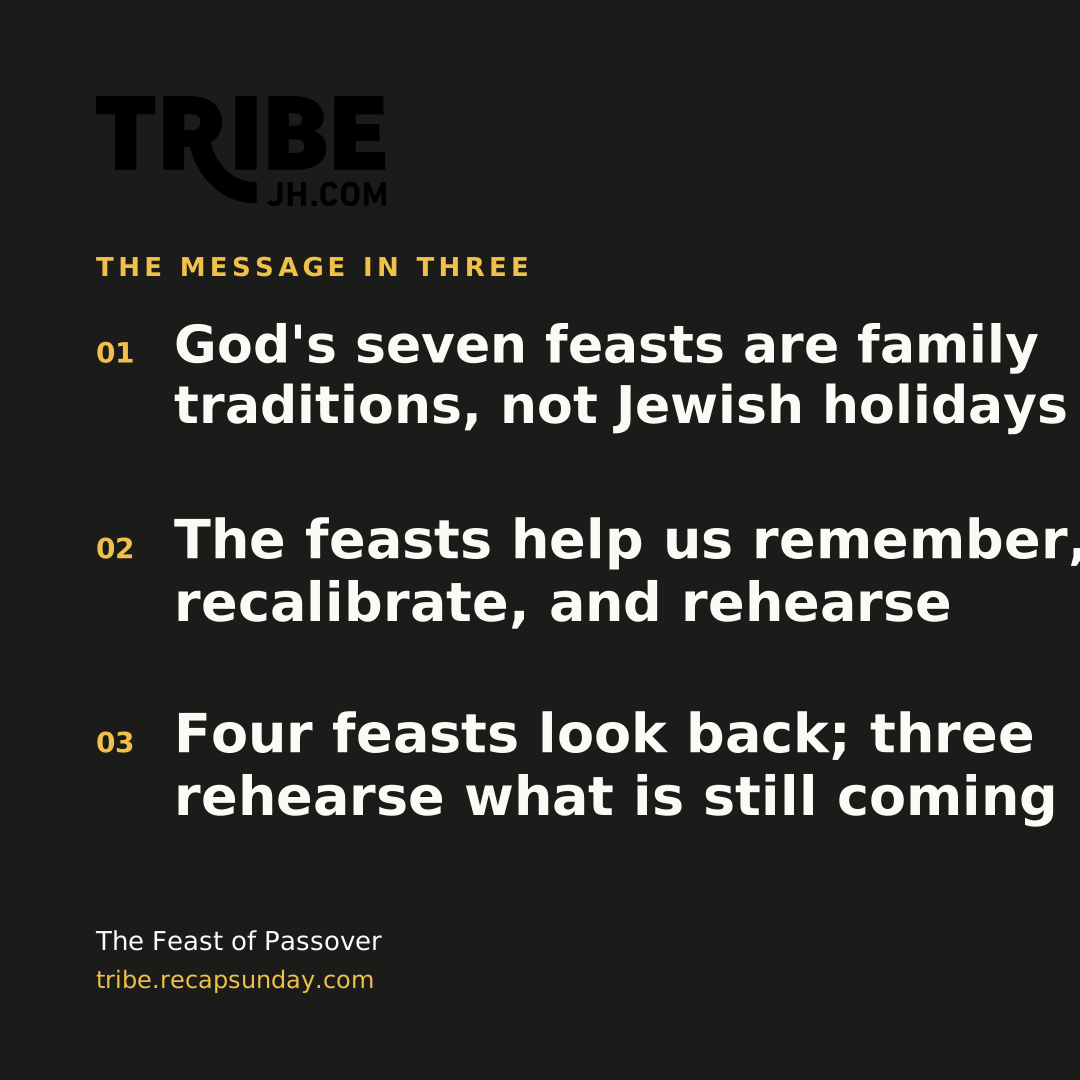
From there he shifted to the main subject. He said God spoke to Tribe some years back and asked the church to recognize and honor the seven major feasts laid out in scripture. The framing God gave, as Pastor Brian described it, was to think of these not as Jewish religious holidays but as God's own family traditions. He pointed to the Old Testament where God calls them "my feasts," and said that if you are in God's family, you participate in the family traditions.
He walked through a chart showing all seven feasts, four in spring and three in fall. Four of them, he said, mark things that have already happened and help the church remember. Three of them are still to be literally fulfilled and serve as rehearsal for events the prophets and Jesus himself described. Passover, which began the night before at sundown with a Messianic Seder, is the feast the church is currently inside.
He gave three reasons God invites Tribe to honor these feasts each year. The first is to remember what God has done. The second is to recalibrate, and he connected this to the disorientation many people felt coming out of COVID, saying God pointed them back to the feasts as a way to resync, the way a guitar goes out of tune the more it is played in the present age. The third reason is to rehearse, and he explained that the Hebrew word behind "holy convocation" in the Old Testament includes the meaning of a rehearsal, a walking-through of what is still to come.
The sermon closed its framing section with Exodus chapter 12 opened for a reading of verses one through fourteen, with the congregation invited to participate as the church moved into the text of the Passover account itself.
Touch points
Things you could actually do this week.
Read Exodus 12:1-14 this week and notice how the details of the Passover point to Jesus.
Take a few minutes to write out your own version of the 'it was sufficient' prayer, filling in the blank with something specific God has done for you and then listing what he kept doing after that.
If you have never looked into the seven feasts God laid out in the Bible, spend some time this week finding them and asking what each one might mean for your faith.
Press into whatever physical or emotional healing you need this week, treating that pursuit as an act of worship rather than a burden, the way Lissa described it during the prayer time.
Come back next Sunday with someone who has never been to Tribe, since Brian mentioned he would rather have a packed room of hungry people than a half-full one of observers.
Doing a Bible study?
Here is a guide we have prepared for you: the passages
in order, questions for the group, and room to write.
Brian described the word 'hosanna' as the desperate cry of someone who has nearly drowned, calling out to a rescue boat with their last breath. When in your own life have you come to God with that kind of desperation rather than a polished request?
Brian said God described the seven feasts not as Jewish religious holidays but as his family traditions, and that if we are going to be in his family we get to partake in those traditions. What family traditions, either in your earthly family or your church family, have shaped the way you understand who you belong to?
Este domingo, Brian comenzó recordando brevemente lo que la iglesia cristiana celebra el Domingo de Ramos: la entrada de Jesús a Jerusalén montado en un burro, mientras la gente extendía sus mantos y ramas de palma y gritaba "Hosanna", palabra aramea que significa "sálvanos, por favor". También mencionó que la próxima vez que Jesús entre a Jerusalén será muy distinta, montado en un caballo blanco como conquistador, en cumplimiento de las profecías sobre el tiempo de angustia de Jacob y el arrepentimiento nacional de Israel.
Luego Brian se enfocó en el tema principal: la Pascua judía y las siete fiestas que Dios estableció en la Biblia. Explicó que en Tribe no celebran estas fiestas para ser más judíos ni por moda, sino porque Dios les habló y les invitó a reconocer estas tradiciones familiares de Dios, en las cuales se puede ver a Jesús. Mostró un cuadro con las siete fiestas, cuatro en primavera y tres en otoño. Cuatro de ellas recuerdan lo que Dios ya hizo; las tres restantes nos preparan para lo que aún va a ocurrir.
Brian explicó que Dios invita a su pueblo a honrar estas fiestas por tres razones: recordar lo que él ha hecho, recalibrar la vida espiritual (como afinar un instrumento que con el uso se desafina), y ensayar los eventos futuros que estas fiestas anuncian. La celebración de la Pascua comenzó la noche anterior con una cena especial de Shabat. La reunión cerró con la congregación leyendo Éxodo capítulo 12.
---
Pasajes bíblicos mencionados
Éxodo 12:1-14
Read the full transcript3,344 words
Say the same thing at the same time? Always. That event queue, do you always say the same thing at the same time? Always. We finish each other's sandwiches.
That's what
I was gonna say.
My sister my sister and my mom do that. My mom and my me and my mom are nothing like me. Was like, no. Yeah. But my dad and I are a lot of it.
Like my dad and I are it. Hi, Ella. Let's stand up, all you prompt people. Ian, I like your face. Looks fantastic.
I do like your face. Your face is looking great today. Alright. Let's sing this together this morning and invite his Jesus.
To We're of above all king. Just think about who
we worship this morning. Who shakes the whole earth?
Who shakes the whole earth with holy thunder? Who leaves us breathless
you. For me. Let's just take a minute. Pillars in the house, if my smile is not leaving now. Let's just take a minute and just think about that line that we just sang, oh Jesus, I sing for all that you've done for me.
We're here today. We stand in this room today. We come here this morning to thank you, to thank you for all that you've done. It's not about us today. It's about worshiping you.
Worthy, worthy is the lamb who was slain to cover for our sin, A spotless lamb. Worthy. Worthy. Just tell yourself today, Lord, I come. Tell him I come because you are worthy.
Not because life is easy, not because I have it all figured out, but because you are worthy. Let's worship him. Sing, worthy is the lamb of a slave. Yeah we sing for all you've done for us today let's just sing this together then we sing of your amazing grace this morning but we just come with such thankful hearts today this is
Jesus, I sing for all that you've done for me.
Yes, lord. We praise you. We thank you today. We just take a second. We just invite your presence in this place.
And not just in this space, but in this space to speak to each one of us today. Huxley, would you mind cracking that glass door for us, please? Let's just let the wind come in. Let's sing holy spirit. Just invite him.
If you need healing, physical healing in this room today, just press into his presence. I just see this picture of just an overflowing well. And all you have to do is get close to it for that living water to splash out. So Lord, we press into your presence today.
Search our hearts, search our hearts.
Search my heart, search my heart today. If
there's anything, Lord, in us today that would keep us from experiencing your presence, Show us, reveal it to us. Search our hearts, oh god. Reveal it to us and let us be quick to repent. And run into your arms. Lord, you are so worthy of our praise and our worship, but you're also so worthy of us letting go of all the stuff, all the garbage, all the bondage, and surrendering it to you so that we can be whole and free.
So that that living water that lives inside of us can splash out onto other people around us. You're worthy of that. You're worthy of us adamantly, passionately pursuing freedom because you've already paid the price for it. Think of your healing as honoring his worthiness. Don't let there be anything, anything that would hinder you today.
Just take it to him. Let's sing this bridge and let this be our life. Let this be our life that day and night, night and day, that incense would arise. The incense of our praise, of our life. That day and night, we would just be so thankful.
We would just bring our worshiper before him. Sing that.
Day and night, night and day let arise. And night, night and day let incense arise. Yes,
Lord. We thank you. It is finished. And as we prepare our hearts for Easter, we remember you riding in to begin what would be the greatest sacrifice we could ever imagine. That this is the week we remember what you did on the cross for us, That you completed it completely.
That it is finished. The work of the cross is a finished work for us. And yet you continue to pour out and pour out and pour out. In the Jewish tradition of Passover, there's a Messian version that we celebrated with some of our friends last night, and there's a section where you say, if you had and then you fill in the blank, then everyone says, it was sufficient. But then it's the next thing.
If you had just parted the Red Sea, it was sufficient. It was all you ever needed to do. But and I I remember I peeked ahead and I was like, there's pages. But then you did this, and then you set us free, and then you gave us your law, and then you and it's the same thing with the cross. Finished.
He did not need to do one more thing for us, yet he shows up in this little tiny place. He touches hearts. He heals us. He heals up our broken hearts. He teaches us about him.
He's such a good, good, good friend and such a good, good, good father. So Lord, we just remind ourselves today how worthy you are. We do not take lightly the privilege it is to come and meet and sing our hearts out to you like this. We tell you you're worthy worthy. Just take a minute.
Just thank him. Lord, you are so worthy and then just fill in the blank. You are so worthy. You only had found me that day lost and broken and called me from death to life, it was sufficient. But you didn't stop there.
You said, now let's go. We have work to do together. Lord, we praise you and we thank you. We ask that you would continue to speak to us through your word today, that you would multiply seats in this room for us. We tell you we love you.
I thank you for every heart that's crammed in this room today that came hungry. I would rather be in a room of 50 people hungry than 400 observers. My favorite worship is when I cannot hear myself leaving. That is the way it should be. Amen?
Well, Lord, we tell you you're worthy. Meet us. Change us. Let us leave those doors today different because we met with you. And everybody said Amen.
Amen. Alright. Kat's gonna maybe move a couple more seats in this room so we can move a few people. We can make another little row if we have a couple more folding chairs. And the lax might need to stay where they are.
I'm not sure.
Good morning. So in the in the Christian tradition, depending on what flavor church you come from, this Sunday is traditionally known as what? Palm Sunday. Palm Sunday. And it is the day that in the Christian church, we remember and memorialize Jesus' triumphal entry into Jerusalem where he filled fulfilled scripture by riding on a donkey.
He he rides down from the Mount Of Olives across the Kidron Valley and up through the Eastern Gate into the city of Jerusalem. And as Christians, we remember the fact that according to the Bible, the tradition is, as recorded in scripture, that people would take off their coats and they would lay them down. And they had gathered palm fronds and they would lay their palm fronds down, and they were singing Hosanna, Hosanna. Blessed is he who comes in the name of the Lord. And the Hebrew word for hosanna, it's actually an Aramaic word, and it means save, please.
Like, save us, please. And there was an intensity and a desperation to it. It would be the word that somebody might use as if they had fallen over a boat, treaded waters, treaded water for hours, were at the end of their strength, and at last, the coast guard comes along, and with their last breath, they're like, save me, save me, help me, help me, help me, before the life ring comes out. That's the meaning behind the word hosanna. It's great.
It's wonderful. This is as much as we're gonna do on Palm Sunday. If you're looking for a Palm Sunday message, that was it. You just got it. I personally am looking forward to the next time that Jesus comes riding into Jerusalem.
And the Bible tells us that he won't come riding on a donkey on a foal, on an unbroken colt, but what will he come riding on? White horse. A white horse. A war horse. A horse that has been trained and made ready for battle.
Jesus came the first time as the propitiation sacrifice, the lamb that takes away the sins of the world. He will come again. But as a conqueror, commander of the IDF ground forces, retaking the city of Jerusalem, liberating it from the 10 army coalition nation that has surrounded and besieged Jerusalem in what the Old Testament describes as the time of Jacob's trouble, which will make the Holocaust in World War two look like a drop in the bucket. But in Israel's darkest hour, in the fulfillment of their chastisement brought about by the loving hand of God, their their hearts will turn. And Jesus himself said, you won't see me again until you say, is he who comes in the name of the lord.
And Israel will have a national repentance and turning towards their messiah. The New Testament says, think of how amazing the world is when you Gentiles got the message of salvation. I'm really paraphrasing here. And Paul says, how much more awesome will it be when Israel connects the dots and receives their messiah who is Jesus born in the little town of Bethlehem two thousand years ago. Okay.
So you just got a Palm Sunday message. You got a return of Jesus message. Now to today's message, we're gonna be talking about Passover. And Passover is a a it is a large umbrella feast that has several different elements to it, and it started last night at sundown with a a Passover special Shabbat dinner. And the reason why we're going to talk about Passover instead of Palm Sunday is because of this, because God said so.
And here's what he said. If you remember, if you've been with our tribe fam for any amount of time, God spoke to our hearts at tribe, and he said, I would like you to recognize and honor the seven feasts laid out the seven major feasts laid out in the Bible. And we're like, okay. But we're not Jewish, and you you got a long way to educate us because none of us really have ever had much to do with the feast. And he's like, it's okay.
We got time. And he said, think of my feast less as Jewish holidays because even though some of us in this room might be like, have some Jew Jewish ethnicity in our background, none of us are practicing or observant or religious Jews. And if you're a religious Jew in here this morning, two questions for you. How'd you get here, and what are you doing? I'm like, so glad you came.
You shall know the truth, and the truth shall set you Free. Free. So none of us are Jewish. So why aren't we doing these Jewish things? And God said, I want you to I want you to think of these seven major feasts not so much as Jewish religious holidays, but more like my family traditions.
And in the Old Testament, God says, these are my feasts. These are my family traditions. Traditions. And if you're going to be in my family, then you get to partake in our family traditions. Now, it's not too much different among our earthly families.
We all have family traditions, and if we had time, it would be fun to go around and to hear some of your odd, sweet, precious, quirky family traditions that are unique to to your family, to the Grubowski family, to the Norman family, to the Lack family. But in God's family, he's no different. He has seven family traditions, seven yearly family traditions. And here, I've got a little chart that I want to show you. The first thing that you'll notice is this is Mark, the month of Mark.
It's March. It's just March. And this line is blank because I didn't want to rush just filling it in. Kind of slow rolling developing this chart. But as you there's there's a lot here.
If you wanna take a picture of it, you can. But these are god's family traditions. There are seven of them. Four of them are in the spring. Three of them are in the fall.
Right now, we are in the family tradition of Passover. You can see the Old Testament references to it. You can see how Jesus is in the feast. We don't celebrate the Jewish traditions to be more Jewish. We don't celebrate the Jewish traditions because because they're cool.
We celebrate them because we see Jesus in them and god has invited us into his family traditions. So we can see Jesus in the feast. We can see these New Testament verses. And then there are four checked boxes and three unchecked boxes. So four of these feasts are for us to help remember what has happened.
Three of these feasts are to help us prepare for and plan and rehearse so that when the literal fulfillment of these verses play out on planet Earth, we will be able to say, oh, oh, this that you're seeing on the CNN news headline is that which the prophets in the New Testament and Jesus himself told us about. And down here at the bottom, we'll see that Jesus has already fill fulfilled the prophet and the priest role. And someday, when he sets up his governmental administration on planet Earth, as the Bible says, he'll rule with an iron scepter, and the hallmarks of his administration will be peace and righteousness and truth that we will see those fulfilled in the soon coming king of Jesus. So this kinda gives you the the the big picture. God invited us to honor and recognize these feasts seven times a year to do three things.
And for those of you who've been with us in the cycle of the feast, God's family traditions for a few years, you can just shout out, what is one of the reasons that God invites us to honor and recognize these feasts? To remember. To remember what he's done. That we can take a special period of time and focus on the wonderful things that he has done in relation to the fulfillment of that feast. So to remember is one thing.
What else? To It helps us. This is a big part of why God invited us to recognize and honor these seven feasts. As we were coming out of COVID, we were like, we gotta make up for lost time and lost ground and go go go. And and the the world and The United States and our tribe family and even us as family and friends were like, we've gotta, like, scramble.
Everything was put on hold, and everything was topsy-turvy for so long. We come out of COVID, and we're like, go, go, go. And we never had time to, like, like, adjust and and grieve things that were lost and and adjust our whole life. I mean, the world is different now. And so as we were asking the lord, how do we, like, get back on track?
How do we resync up with you? He said, well, I it's been in your bible all along. I have these feasts, these family traditions to help you recalibrate, like tuning an instrument. The more you play your guitar, Corey, does it get more in tune or more out of tune? Out of tune.
Out of tune. Because that's just the world that we live in. When Jesus alright. Trick question. Well, no.
Tricky. Not a trick question, but a tricky question for you. Corey, when Jesus comes back and he establishes his millennial rule and reign on planet Earth and you play your guitar for those thousand years, will that guitar, the more you play it, get more in tune or more out of tune? I should give you a multiple choice. Let's make it a multiple choice.
During the thousand year reign of Jesus, will your guitar get more in tune during, a, the thousand year reign of Jesus, or after that thousand year where the age is wrapped up and we're now living in combination with the new heavens and the new earth, and heaven resides on earth and vice versa. Just say B. B, that's right, Corey. Clarifying In the millennial reign of Jesus, there still will be there still people will have free will. Not everybody will bend the knee of their heart to him.
There will still be death. There still will be pain for the world. For Christians, we will have resurrected bodies because we will have a new assignment, but the world will still carry on more or less like it was before Jesus. He will just be the dominant political, spiritual, world leader of the entire planet. So our guitars will still go out
of tune. I was gonna ask if it was a glorified
guitar. Yeah. But at the end of that thousand years, and we're way off the page after that point, then our guitars will never go out of tune. It will always be a powder day with zero avi danger. And then here's the third reason why the Lord has invited us to honor these feasts.
What is it?
To rehearse.
To And when we hear the word rehearse, maybe you think of, like, school play, maybe like Willy Wonka that's coming up. In a few weeks, he went out the door and missed it. He missed his shout out. But you think of a wedding rehearsal, and the reason why you do a wedding rehearsal is so you walk through, you know where to stand, and so that when that day actually comes, you're less likely to go stand off in the wrong place or mess up. In a similar way, the scripture says when in the Old Testament, he says, the this is to be a holy convocation.
We think convocation, a gathering, a congregation, a ceremony. It does mean all of those things in the Old Testament, but the Hebrew word included in that definition is a rehearsal. We are meant to practice, as we celebrate these feasts, practice the future fulfillment of these beautiful family traditions. So to remember, to recalibrate, and to rehearse. Yesterday kicked off the family tradition of Passover, and we should go to that passage now and read about it in Exodus chapter 12.
And we like to have folks participate. And so part of the way that we prime the pump for your participation is by inviting you to take turns reading from the the passages that we jump around to. And so the first place that we're gonna go is Exodus chapter 12, and we're going to read verses one through 14. And so we have a mic in the room. Kat has the mic.
That is for all of our families that are watching the livestream, whether they're traveling or call tribe