The passage this message was preached from, in full, with every other passage it reached for.
Genesis 3:1-11Read aloud and discussed as the first of two parallel Old Testament passages, covering the serpent's temptation, Eve taking the forbidden fruit, and God calling to Adam
1 Now the serpent was more subtle than any animal of the field which Yahweh God had made. He said to the woman, “Has God really said, ‘You shall not eat of any tree of the garden?’”
2 The woman said to the serpent, “We may eat fruit from the trees of the garden,
3 but not the fruit of the tree which is in the middle of the garden. God has said, ‘You shall not eat of it. You shall not touch it, lest you die.’”
4 The serpent said to the woman, “You won’t really die,
5 for God knows that in the day you eat it, your eyes will be opened, and you will be like God, knowing good and evil.”
6 When the woman saw that the tree was good for food, and that it was a delight to the eyes, and that the tree was to be desired to make one wise, she took some of its fruit, and ate; and she gave some to her husband with her, and he ate it, too.
7 Their eyes were opened, and they both knew that they were naked. They sewed fig leaves together, and made coverings for themselves.
8 They heard Yahweh God’s voice walking in the garden in the cool of the day, and the man and his wife hid themselves from the presence of Yahweh God among the trees of the garden.
9 Yahweh God called to the man, and said to him, “Where are you?”
10 The man said, “I heard your voice in the garden, and I was afraid, because I was naked; and I hid myself.”
11 God said, “Who told you that you were naked? Have you eaten from the tree that I commanded you not to eat from?”
Read aloud and discussed as the second parallel passage, covering the feast of Sukkot and its instructions to take fruit and celebrate before God
39 “‘So on the fifteenth day of the seventh month, when you have gathered in the fruits of the land, you shall keep the feast of Yahweh seven days: on the first day shall be a solemn rest, and on the eighth day shall be a solemn rest.
40 You shall take on the first day the fruit of goodly trees, branches of palm trees, and boughs of thick trees, and willows of the brook; and you shall rejoice before Yahweh your God seven days.
41 You shall keep it as a feast to Yahweh seven days in the year. It is a statute forever throughout your generations. You shall keep it in the seventh month.
42 You shall dwell in temporary shelters for seven days. All who are native-born in Israel shall dwell in temporary shelters,
43 that your generations may know that I made the children of Israel to dwell in temporary shelters, when I brought them out of the land of Egypt. I am Yahweh your God.’”
44 Moses declared to the children of Israel the appointed feasts of Yahweh.
Read aloud as a New Testament bridge, with verse 33 'seek first the kingdom of God' identified as the crescendo and connected to the gift-versus-grasp theme
25 Therefore I tell you, don’t be anxious for your life: what you will eat, or what you will drink; nor yet for your body, what you will wear. Isn’t life more than food, and the body more than clothing?
26 See the birds of the sky, that they don’t sow, neither do they reap, nor gather into barns. Your heavenly Father feeds them. Aren’t you of much more value than they?
27 “Which of you, by being anxious, can add one moment to his lifespan?
28 Why are you anxious about clothing? Consider the lilies of the field, how they grow. They don’t toil, neither do they spin,
29 yet I tell you that even Solomon in all his glory was not dressed like one of these.
30 But if God so clothes the grass of the field, which today exists, and tomorrow is thrown into the oven, won’t he much more clothe you, you of little faith?
31 “Therefore don’t be anxious, saying, ‘What will we eat?’, ‘What will we drink?’ or, ‘With what will we be clothed?’
32 For the Gentiles seek after all these things; for your heavenly Father knows that you need all these things.
33 But seek first God’s Kingdom, and his righteousness; and all these things will be given to you as well.
34 Therefore don’t be anxious for tomorrow, for tomorrow will be anxious for itself. Each day’s own evil is sufficient.
Quoted loosely as 'with one glance of your eye you have ravished my heart, my beautiful one, my bride' to illustrate turning eyes from forbidden fruit toward God
The message in order, in a few minutes of reading.
Two Old Testament passages, Genesis 3 and Leviticus 23, were placed side by side to show that God has been telling one continuous story about grasping and receiving, hiding and celebrating. The congregation worked through the texts together, finding the connections before they were explained. The message landed on a single question: are you receiving what God gives, or grasping for what you want?
What was said
The evening started with Genesis 3:1-11, the familiar account of the serpent, Eve, the forbidden fruit, and God walking in the garden calling out to Adam. A few details got attention right away: Eve added "or even touch it" to what God had actually said, and after they ate, the couple hid among the trees rather than staying in God's presence.
The second passage was Leviticus 23:39-44, the instructions for the Feast of Shelters, known as Sukkot. The congregation was asked to read it looking for connections to Genesis before anything was explained. The timing was noted: sundown that evening marked the last day of Sukkot as it is observed by Jewish communities around the world, including in Jackson.
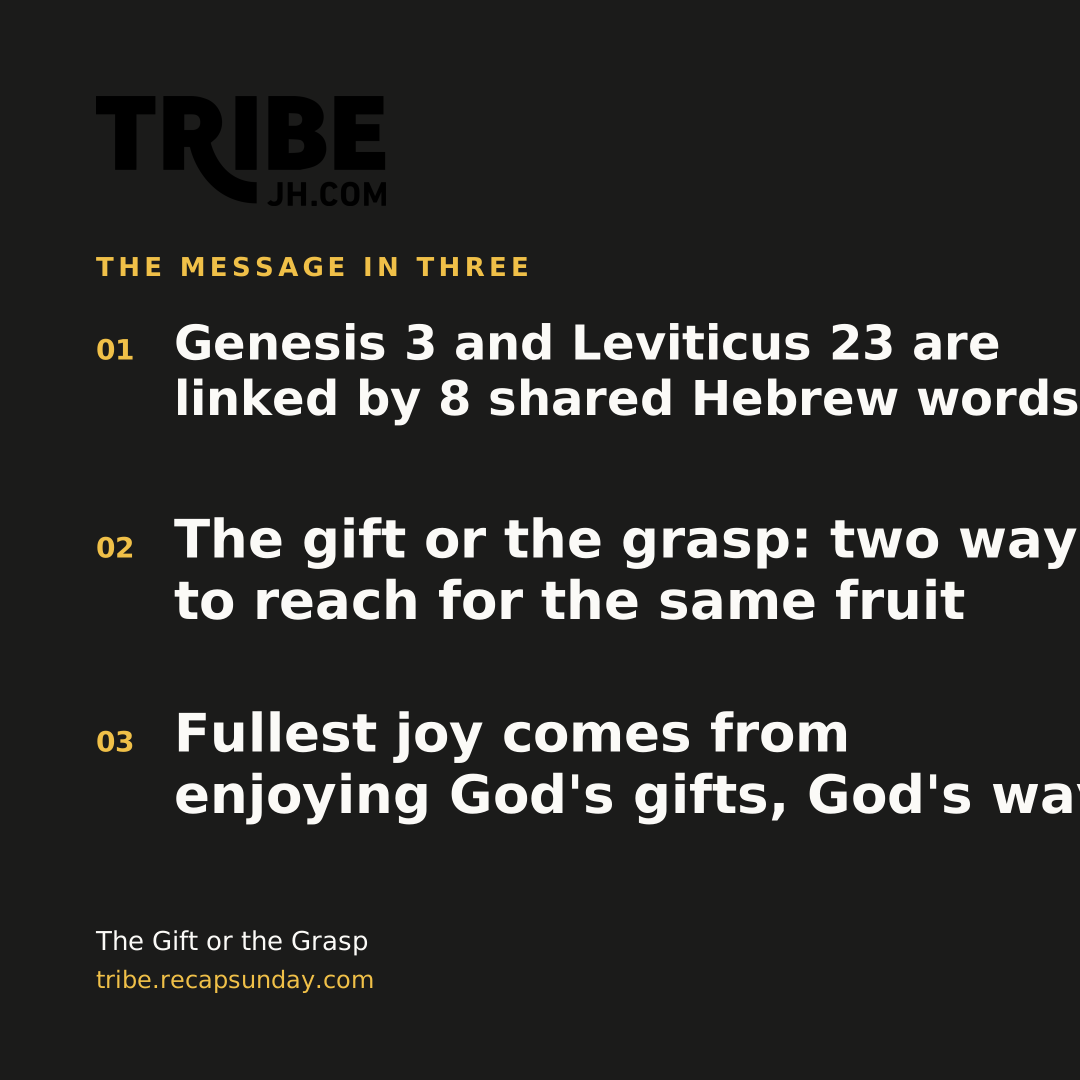
When both passages were put on screen side by side, eight repeated words or near-identical phrases surfaced: tree, fruit, took and take, knew and know, day, presence, and the name of God. The literary technique at work was identified as thematic keyword repetition, a way the Bible draws intended connections across passages that can look unrelated at first glance. Eight shared terms, the congregation was reminded, is well above the two or three witnesses the Old Testament requires to confirm a matter.
The congregation's own observations shaped where the message went. Someone noticed that the instructions in both passages are about protection, not just rules. Someone else pointed out that trees appear in both. Then the observation that mattered most came from the room: in Genesis, Eve took fruit she was forbidden; in Leviticus, God commands his people to take fruit freely as an act of joy before him. One person named it redemption. Another called it redeemed exile, noting that the shelters in Leviticus echo the covering of leaves in Genesis, but this time the people are drawn out toward God rather than away from him. The contrast was stated plainly: in Eden they took the fruit and hid from God; at Sukkot, God commands his people to take the fruit and rejoice before him.
Matthew 6:25-34 was brought in at that point. Jesus telling his listeners not to worry, to look at how God feeds the birds and clothes the wildflowers, and to seek first the kingdom of God, connected directly to the pattern already on the table. The fullest joy comes from enjoying God's gifts, God's way. The sermon's title, offered only after the congregation had worked through the material, was "The Gift or the Grasp."
The application was specific to Jackson. This is a town, it was said, that runs on grasping, visible in garage gear, roof racks, packed calendars, and the constant sense that whatever you have, someone else has more. The question put to the room was not abstract: am I receiving what God gives, or am I grasping for what I want? Having one pair of skis or five is not the issue. What holds your heart is the issue.
Rather than a call to repent of grasping, the close turned toward encouragement. The sense was that many in the room have already been quietly resisting the temptation, waiting on God's timing instead of reaching for what they want. The preacher pointed to Song of Solomon, where one glance of the beloved's eye ravishes the young man's heart, as a picture of what it looks like when we take our eyes off the thing we want and turn them toward God. The righteous person falls seven times and gets back up. The final thought: we enjoy the gifts of God most deeply when they do not rival God himself.
Touch points
Things you could actually do this week.
Read Genesis 3 and Leviticus 23 side by side this week and notice where the same words or ideas show up in both passages.
Pick one area of your life, your gear, your calendar, your relationships, and honestly ask yourself whether you are receiving what God has for you or grasping for what you want.
When the temptation to grasp comes up this week, pause and name it out loud to God instead of acting on it.
If you are a young adult at Tribe, find Bethany or Phil after the service or reach out this week to get connected to the Bible study and fall activities.
If you want to serve at Tribe, even just once a month, talk to the pastor after the service about joining a greeting rotation or another role.
Doing a Bible study?
Here is a guide we have prepared for you: the passages
in order, questions for the group, and room to write.
The sermon points out that Eve added 'you must not touch it' to what God actually said. How do you think small distortions of what God has said can make it easier to cross a line we otherwise would not cross?
One person in the room suggested that God's commands are less like harsh rules and more like a fence built for protection. Where in your own life have you seen that turn out to be true, or where is it still hard to believe?
Esta noche el mensaje partió de una comparación entre dos pasajes del Antiguo Testamento: la caída de Adán y Eva en el huerto de Génesis 3, y la fiesta de los Tabernáculos en Levítico 23. Al poner los dos textos uno al lado del otro, se descubrieron al menos ocho palabras o frases en común, como "árbol", "fruto", "tomar" y "la presencia del Señor". Esa repetición no es casualidad; es la manera en que Dios conecta pasajes para comunicar algo más profundo. En Génesis, Eva tomó lo que Dios había prohibido y se escondió de su presencia. En Levítico, Dios invita a su pueblo a tomar fruto hermoso y celebrar delante de él. La diferencia es enorme: en un caso hay apropiación y vergüenza, en el otro hay recepción y gozo.
La idea central que unió todo fue esta: el gozo más pleno viene de recibir los dones de Dios a la manera de Dios. En Jackson, donde la cultura empuja constantemente a acumular, a escalar, a conseguir más, la tentación de "agarrar" es muy real. Pero el mensaje no fue una reprensión sino un aliento: el Espíritu Santo quería decirle a quienes han resistido esa tentación que Dios ha visto cada vez que eligieron esperar en él en lugar de tomar por su propia cuenta. Se citó también Mateo 6, donde Jesús dice que no hay que afanarse porque el Padre conoce nuestras necesidades, y que buscar primero su reino es el camino hacia todo lo demás.
La conclusión fue sencilla y directa: disfrutamos los dones de Dios de manera más plena cuando esos dones no rivalizan con Dios mismo. Así como en la fiesta de los Tabernáculos el pueblo celebraba ante la presencia de Dios en lugar de esconderse de ella, la invitación esta noche fue a salir del escondite, dejar de aferrase, y festejar delante de él con lo que él mismo da.
---
Pasajes bíblicos mencionados
Génesis 3:1-11
Levítico 23:39-44
Mateo 6:25-34
Cantar de los Cantares (referencia breve, sin versículo específico)
Read the full transcript7,254 words
Lord, we just come before you. We thank you so much. We could sing a million songs and it wouldn't be enough to say thank you of that simple truth that we just sang, that you bought our forgiveness with your life. How often do we just try to run out and get out ahead of you, do our own thing, and we forget that when we truly stop and think about what you paid for us, worthy how worthy are you, that you deserve everything, part of us, every thought. So, Lord, we just give you all the glory in this place.
We just say thank you to you. You. Thank you. Thank you for your precious blood. We ask you tonight, Lord, that there would be a spirit of wisdom and revelation.
For your word tonight that we would just embrace what you have for each and every one of us. You know every single heart in this room. Thank you that none of us are here by accident. We tell you we love you, Jesus. Speak to us and everybody say, Turn around and say good evening.
Good evening. Good evening.
Good evening. Good evening. That's isn't that how you told us to say it? Liz? Yeah, good evening.
Good evening. Sure. Like, I'm glad that you all are here. Thank you for taking time out of your weekend or really starting the beginning of next week by joining us here at Tribe either in your so, there we go. Thank you, guys.
The sound.
Come down a little.
The the media team, when everything goes smoothly, like, we don't even know that they're there. It's just, oh, also, during worship when Lissa said, could you just make stop it? She wasn't like being rude or mean to the sound but she was like, just stop the pad. I know you know that and I know you know that about Lyssa, but I just wanted to, like, defend any honor that could be in question of hers this evening. So, stop it.
We all know that that is not our Lysi. What we're going to do this evening is we're going to look at two passages both from the Old Testament side by side together this evening and we're going to look for differences in and also for similarities and as we consider the similarities, we're going to see a picture that comes together that is is beautiful in each individual passage but when we look at the commonalities, when we overlay them on top of one another, a beautiful, vibrant picture comes alive for us and that's what we're going to look at this evening. So, the first place that we're going to turn is in the book of Genesis. So, if you have your Bible with you this evening, let's turn to Genesis chapter three. We're going to read a few verses together that I'm sure are familiar to many of you if you have had a Bible for a while.
Genesis or as one of my mentors used to say, Genesis. I don't know why you would say it that way but he would say it that way and he was awesome. So, tonight, it's Genesis. Genesis chapter three and I'm going to start reading. We're going to read just verse one through nine and they are up here on the screen.
So, I will start reading. Now, the serpent was the shrewdest of all of the wild animals the Lord God had made. One day, he asked the woman, did you, did God really say you must not eat of the fruit of any of the trees in the garden? Of course, we may eat from the fruit of the trees in the garden, the woman replied. It's only the fruit from the tree in the middle of the garden that we are not allowed to eat.
God said, you must not eat it or even touch it for if you do, you will die. So, she's quoting God. Is that an exact quote of what God said? What part did he did Eve either add or leave out? Exactly.
God never said you must not touch it. He said, of the fruit of the tree of the knowledge of good and evil, you must not eat. He never said, you can't touch it. Just... Okay.
Verse four, you won't die. The serpent replied to the woman. God knows that your eyes will be opened as soon as you eat it and you will be like God knowing both good and evil. The woman was convinced like, if that's not the world's easiest sales pitch, she saw that the tree was beautiful and its fruit looked delicious and she wanted the wisdom that it would give her. So, she took some of the fruit and ate it.
Then, she gave it to her husband who was with her and he ate it too. At that moment, their eyes were opened and they suddenly felt shame at their nakedness. So, they sowed fig fig leaves together to cover themselves. There's nothing wrong with the human body, whatever shape yours is in, God made it beautiful. That's not the point of this passage.
Verse Okay. Eight, when the cool evening breeze were breezes were blowing, the man and his wife heard the Lord God walking about in the garden. What was that like? And so, they hid from the Lord among the trees. Then, the Lord called to the man.
Adam, where are you? I'll have to keep reading. Verse 10, he replied, I heard you walking in the garden so I hid. I was afraid because I was naked. Verse 11, we gotta keep going.
Who told you that you were naked? The Lord God asked. Have you eaten from the tree whose fruit I commanded you not to eat? We'll stop right there. Ugh.
Even in just that, those few verses alone, there would be so much gold to mine and to unpack and to consider and to search out but this is one of two passages that we're going to look at this evening. The second passage is in our favorite book, Yeah. If you've been with our tribe fam for a while, we spent we spent like a fortnight in the book of Leviticus a few years ago. Wasn't it great though? Yeah.
Good answer. So, we're going to turn to the next passage. Leviticus chapter 23. We're gonna read verses 39 through 44. Leviticus twenty three thirty nine through 44.
I'll read it. Remember that this seven day festival, oh, okay. Here's what I want you to be looking for as we read this next passage. Look for similarities either in grammar, sentence structure, thematically, other connections. So, I don't want to ever be found guilty of baby birding you.
I don't want to do all of this whip up an amazing meal and then you come to church and you just go like this. And then I dribble it right into your mouth already chewed and all you have to do is swallow. That raises weak Christians. I want you to consider for yourself. I want you to think for yourself.
I want you to dig into the text for yourself because oftentimes, as you know, when we have a discussion about these passages, your insights, your comments, or your questions are things that I never even saw or thought of and I learned from you as well and so, I won't baby bird you if you won't baby bird me. Deal? And everybody said, deal. Verse 39, look for the similarities. Remember this seven day festival to the Lord, the festival of shelters or in your translation, it may say the festival of booths or it may say the festival of tents or it may say the feast of Sukkot begins on the fifth day of the appointed month.
After you've harvested all the produce from the land, the first and the eighth day of the festival will be days of complete rest. On the first day, gather branches from magnificent trees, magnificent palm fronds, boughs, leafy trees, and willows that grow by the streams. Then celebrate with joy before the Lord, your God, for seven days. You must observe this festival to the Lord for seven days every year. This is a permanent law for you and it must be observed in the appointed month from generation to generation.
For seven days, you must live outside in little shelters. All native born Israelites must live in shelters. This will remind each new generation of Israelites that I made their ancestors live in shelters when I rescued them from the land of Egypt. I am the Lord your God and so, Moses gave the Israelite these instructions regarding the annual festivals of the Lord. This conversation that we're going to have tonight flows particularly well because at sundown this evening which we are about in is the last day of the annual feast of Sukkot.
So, Jews all around the world, even in Jackson Hall, are winding down celebrating and honoring this feast and so, I think it fits. It pairs quite well. Now, it is your turn. We have a mic that we can run around through the room. I would love to hear what your thoughts are and the reason why we have the mic in the room is so that everybody who is watching the live stream or will go back to watch the conversation that we're going to have this evening, they get to hear your wonderful, insightful contribution to our conversation this evening and so, what similarities or what parallels or what connections do you see and let me just say this, if you are sitting there and you're like, oh boy, I they're both in the Bible.
Okay, you're off to a great start. So, you're having trouble making connections or overlaps, it's okay, alright? So, I'd love to hear from you. What observations do you see in the text that match one another or are similar or connections that you're making? What do you see?
Lisa has the mic in the room. Oh, making her way.
Well, I I did see.
Okay. Well, I do have this to say.
They pick on me. We've got some new visitors here tonight. We aren't going to leave him a bad impression.
And no, they're they're they should see how tribe is normally and so.
I'm just older and wiser, okay?
Well, she just turns around. She's to talk too well.
Well, he was given directives like. Oh. On the Sabbath, you will rest on that seventh day.
Okay.
Like, don't eat from that tree and you will rest. So.
Okay. Alright.
He was given instructions.
Yes. In the garden, God gave Adam and Eve instructions. Right. In this passage in Leviticus, we can see God giving instructions. Right.
Okay. Alright. Alright. I'll allow it.
Thank you, Jane, I'm in calling.
Kinda just to build off of what Nancy said instead of looking at God as someone who puts a lot of rules and is really harsh, it's kind of like putting a fence around your home as protection to bless you. So kind of the same thing with the fruit. He kinda maybe sounded like a mean God. Don't eat that thing that looks so beautiful and yummy. But when God, like, gives you, you know, something to obey him that is something you shouldn't do, but you want it so bad, everyone else does it.
Listening to him is really just for your protection, your health, and like the day of rest. Like, that could seem really unproductive to a lot of people, but I can't. But really, it's his protection to, like, bring more health to your body, to rest like he did and reset. So I think sometimes looking at God's commandments not as these harsh rules but as offense that protects you and keeps you healthy and on the right path is something that I've been kinda trying to look at.
Oh, that's good. Two things. Number one, hold on to what you're saying because we're going to come back around to it. Thank you for pulling a fill on me. And then number two, what you're what you're saying is, I see God's protection in the form of fence in both of these passages.
That's great. Yes. Yes. Insightful. Colin, what do you have?
Maybe it's not a connection. I was just thinking Adam and Eve's, it says, so they hid from the Lord amongst the trees and then in the shelter, you're maybe not hiding but you're borrowing away or you're you're staying in your shelter for in the made of trees for.
Oh, I like it in both passages, trees are mentioned.
There you go.
Okay. Let's do let's do this. Let's do this. Let's... I'm gonna put up both of these passages next to one another and it's in this next slide here.
So, take a look at the screen. If you're listening to the podcast, it's gonna be tough for you. You should just switch over to YouTube and for me, there's a there's a monitor in the back of the room even though it's really on a large screen. It's still challenging for me to read but you have it here. Maybe it's a little closer for you.
So, these two passages are are both on one page. Genesis on the left, Leviticus on the right. Then, I've gone ahead and I've highlighted either words or phrases that are either identical or near identical. This is a good spot to go Did you ever think that there would be that many parallels or connections We've talked about this at Tribe many times. The Bible often uses a literary technique to help us draw intended hyperlinks to key principles and that literary term is called thematic keyword repetition.
These two passages are a great example. How you can take two seemingly unconnected passages as you read them in the larger context of the story. Okay, I'm reading about Genesis, the fall of man, okay? Adam and Eve sin in the garden. Oh, okay.
That's a bummer and then you go on with the narrative. You get all the way to the book of Leviticus and Leviticus has a bunch of laws and rules and we get to the feast of the Lord and then we get to the feast of Sukkot. Okay, you need to do all this stuff and celebrate it for seven days and live in shelter. Okay? And perhaps, your brain as you were reading Leviticus which hopefully you do because it's very nutritious for you.
Maybe when you got to Leviticus chapter 23 and you read about the feast of shelters, maybe your brain never made that jump back to Genesis three but look, it's been in your Bible this whole time. Look at all of the similarities. First, I want to point out in Genesis chapter three, the woman saw that the tree that's in green. Leviticus in verse 40, tree is common. Then, at the end of verse six, she took, that's in blue and then in Leviticus 23 and verse 40, it says, you shall take, take, and took are different conjugations of the same verb.
Some of it's fruit. In Genesis, fruit is also similar in Leviticus 40. And they knew that they were naked is similar in Leviticus look all the way down at verse 43 to know. And then in Genesis verse eight, the garden, walking in the garden in the breeze of the day, Leviticus chapter 23 verse 40, you yourselves on the first day and then, from the presence, they hid from the presence of lord in Genesis but then, in Leviticus 23, you're supposed to do something in in his presence. Adam and Eve hid from his presence but God is giving an instruction in Leviticus 23.
I want you to do this in my presence, not behind me, not hidden from me, but right in front of me. Are you with me so far? Okay, I have I've I am the lead pastor of Tribe but I'm seeing tonight once again, I have I'm a teacher. Like, my gift is teaching and Yeah, that makes sense. Okay, I got another chart for you.
Go to that next slide, please. If you ever wanted to know those words in Hebrew, here they are and so I just broke, I just broke those words down. So, you can see the parallel she took and then in Leviticus, you shall take. In Genesis, from its fruit and then in Leviticus fruit, these are either the same or the very similar words. That is the response that makes my heart thrill.
Trees, trees, they knew so that they may know the day on the day in the present from or in the presence of before in the presence of Yahweh is repeated. Yahweh is repeated. God, Adonai, and God is repeated there. So, how many in those few verses, how many words are repeated between both of those? How many?
Eight. Eight. Similarities. Now, we know that in the Old Testament, perhaps even in the book of Leviticus, when a person goes to court, accusations are brought against them in order for a matter to be confirmed or ratified. The Bible says, the testimony of how many or more witnesses must have a cooperating story?
Two or three witnesses. How many do we have here? Eight. So, what I'm trying to say is God is yelling at us, not in a mean way but in a pay attention to this. There's something here that he wants to impart to our hearts.
This is really important. Eight similarities within just these few verses, something's going on. Are you following me so far? The question is, What's he up to? Let me ask you.
What is he up to with these two passages? There's something that he has for us. Oh, a question.
You're quick. So, you're talking about the similarities And I don't know why my brain is seeing the differences.
Oh, okay.
Because I mean, in Genesis, they are doing what the Lord told them not to do. Oh. In Leviticus, he's telling them what to do to praise him and to obey him. Well, obey and obey but they didn't obey in Genesis. So, I don't, you know, that's that's just not working in my head like that.
I think that that that it's a little bit of a burr under your saddle as you're trying to sort it out And that burr under the saddle is there for itching. You gotta scratch like, what is going? Take the saddle off. Take the blanket off. Let's get down to it.
What is he, what could he be getting at? Were you going to share something? Okay, okay. I'm coming. I'm coming.
Oh, sure.
The thing that I saw was redemption. It looks like the Lord is trying trying to redeem. It would say, like in Genesis, you know, I don't see it exactly now but she, Eve took from the fruit and then in Leviticus, he says, I want you to take this fruit on the no no no day. So, that's the word that came to my mind initially. And that's God's character and nature, of course.
Wow. So, rightly discerned Amanda that is part of God's intention. Our God is a god of redemption. In the pantheon of other gods out there, only, only the God of the Bible is a god of redemption. I'm going to redeem God says in his heart, I'm going to redeem the error that was made, the sin that was committed in the garden and every year, I want you to be mindful of what Eve did and each year we get to practice undoing what Eve did as we walk out the plans and instructions of the Lord.
So, redemption is a huge part of connecting these two passages together. That is a fantastic observation, Amanda. Are those thinking eyebrows or are those, I have a question eyebrows.
Yeah, come on. Ma'am, which eyebrows are you showing us?
Don't forget to pack your angry eyes. What movie is that from? Alright. Alright. We can still all go to church together.
You have to get my obscure movie references. Yes. What were you gonna say, Bethany? Love to hear from you.
It's funny. Yeah. I was thinking about saying something. So I guess my eyebrows told the story. I...
The thing that I was writing down... The thing that I had written down was redeemed exile. Because I felt like in this first passage in Genesis that God exiles them from the garden, and that's where, you know, they have, you know, shelters in the form of, like, you know, at least leaves covering their bodies and things like that. But then here, the... It's kind of a redeemed exile because they're pulled out of Egypt, but it's, like, for their good.
Like, they want to be out of Egypt, but it kind of appears a bit like an exile as well. And and then add in all the parallels we've already made of, like, the shelters and the trees and all those things. Oh,
that's a great parallel. Can I add a parallel that I'm thinking about to tag on to what you just said, the parallel of undoing exile? So in the garden, they left his present. We kind of talked about this. They left his presence.
But in the feast of Sukkot, the command is to come into his presence. Okay, look at this. A big bridge that can be built between these two passages that connects them is in one passage, Adam and Eve are taking what God has forbidden versus receiving what God has given. In the garden, Eve saw fruit that was pleasing to her eye. In Sukkot, we are commanded to seek out fruit and branches that are pleasing to the eye.
In
the garden, Eve took what she did not have permission to take. In Sukkot, we are commanded, invited to harvest fruit and beautiful, freely branches. In the garden, they hid from God. In Sukkot, we are invited to celebrate before God. You're thinking.
In Eden. They took the fruit and hid from God At Sukkot, God commands us to take the fruit and rejoice before him. Now, let's bring it home Yes, Elizabeth. And while Elizabeth is has something to share, let's bring it home into the New Testament because Jesus has something to say about this.
I just I just see there's no reason to hide.
There's no reason to hide. That we need to write lyrics to a worship song to that. No reason to hide. There was a reason to hide. Wow.
But because of God's beautiful plan of redemption.
Right. So, there's no reason.
Yeah. There is no longer any reason to hide but that old dirty devil is still up to his same tricks. Yeah. You won't be accepted. You still carry the shame.
You should hide from God because he saw where you were on Friday night. What you were doing late in our. Well, shame
just keeps you in the cycle. So. Yes. There's no reason to hide.
There's no reason to hide. Bethany, let's turn to Matthew as as Bethany is sharing. Matthew chapter six.
I'm not sure if this is where you're going.
Well, let's find out.
But communion because...
Communion?
Yeah.
Oh.
Because we killed Jesus and now we eat Jesus.
If you're new to tribe, if you're new to Jesus and Christianity, she is correct. Let's rip that band aid off now.
But but, like, with to elaborate, like, the... This, like, super horrible, sinful thing that we as humans did, which was kill Jesus for no good reason. Now, God says, take and eat. This is my body. This is my blood.
So, the very thing, the very sin that we committed is like a gift that we receive in order to be in the presence of God.
You don't need to raise your hand but how many of you see the connection, the hyperlink that's forming in her brain? My hand is raised. I see it. So, the first time we took Jesus's life at the cross, humanity. None of us are without sin.
All of us are culpable. Then, as we celebrate communion because Jesus rose from the dead, he says, take my body and eat. That old, that's good. Okay, Matthew chapter six. That's not where I was going but that's a fantastic hyperlink.
I don't know if I have this up there. Matthew, there it is. Matthew chapter six. Let's look at verses 25 through 34. Matthew chapter six verse 25 through 34.
I'll start in verse 25. Jesus is speaking because these letters are read in your Bible. So, you know it's Jesus. That is why I tell you not to worry about everyday life. Whether you have enough food or drink or enough clothes to wear, Isn't life more than food and your body worth more than clothing?
Look at the birds of the air. Look at the birds. They don't plant or harvest or store food in barns. For your heavenly father feeds them and aren't they far more valuable to him than aren't you far more valuable to him than they are? Can all your worries add a single moment to your life?
And why worry about your clothing? Look at the lilies of the field and how they grow. They don't work or make their clothes. Yet, Solomon and all of his glory nor in the latest fall trend from Steele was dressed as beautifully as they are. And if God who cares so wonderfully for the wildflowers that are here today and thrown in the fire tomorrow, he will certainly care for you.
Why do you have such little faith? Then he really gets to it. So, I'm telling you, don't worry about these things saying, what will we eat? What will we drink? What will we wear?
These things dominate the thoughts of unbelievers but your heavenly father already knows all of your needs. And this verse is the crescendo. Seek first the kingdom of God above all else and live righteously and then he will give you everything you need. And then he reiterates in verse 34. Not as a indictment or a chastisement.
So, don't worry. That's not what he's saying. He's saying, so, don't worry. Don't worry about tomorrow. For tomorrow will bring its own worries.
And then, he's like, trust me, I know. Today's trouble is enough for today. This perhaps is worthy for you to jot down in your notes. The fullest joy comes from enjoying God's gifts, God's way. Let me ask you this really quick.
At the beginning of our conversation, did I tell you the title of the conversation we're having tonight? You you need that. You need that. Let let's put that slide up there. Maybe this would've tipped the scales a little bit for you to understand where we're going.
The title of the conversation tonight, there's room at the top of your notes is the gift or the grasp. The gift or the grasp. Can you see how in the garden, Adam and Eve were grasping? They're reaching. They're striving.
They're grasping. And then in Leviticus, this feast, God's family tradition was given as a gift which brings us to our our first big takeaway. The fullest joy comes from enjoying God's gifts, God's way. If you've lived in Jackson for very long, you know that this is a town full of people consumed with grasping for what they think they want in life. And if you're unconvinced of that, all you need to do is look in their garage or on their roof rack if that's their house.
A ski box full of skis Bikes on bikes on bikes on the rack. Toys stuffed in the garage and in the backyard grasping and if I be honest, it's kind of tempting. Isn't it? When it appears as though they have all the answers. It appears as though they ate the fruit, their eyes have been opened they have the knowledge between good and evil, and they're not dying.
This town at all levels, junior high, high school, college, young adults, my age, older. This town especially perpetuates a culture of grasping. Which brings me to the question for your consideration this evening. A brave soul will ask this, am I receiving what God gives or grasping for what I want? I'll put that slide up on the screen.
Am I receiving what God gives or am I grasping for what I want? That slide did not make it in there. Listen to my mouth. The question is, am I receiving what God gives? Or am I grasping for what I want?
Apart from Jesus the human heart must continue to grasp I need just a few more centimeters underfoot this season. I mean, I've got one hundred four underfoot but if I had some big, fatty powder skis, 108 underfoot, oh, I'd be so happy and then when it becomes spring ski mission season, Oh, I don't want 108 underfoot. I want like 97 underfoot. I need one, I need one more, I need a skinnier pair of skis. I need 87 underfoot.
Yeah, but there's a few that do and those are my people that I'm called to reach. Those are my people that I'm I'm talking to because I was one of them. All of these other analogies for all y'all. Now, I'm talking to my people for a moment. Apart from Jesus, we are left to just grasp and grasp and claw and when we obtain and get, that's not enough.
We need more. We need more. We have this insatiable appetite to take if we if it's denied us, we'll do anything to get it even if it's not what God has for us because we're buying this lie, this narrative that says, okay, you skied sixty days last season. Yeah, but we got all those people. They got one hundred days on their passes this season.
I mean, I think I got four days on my pass last season and that's more days than some have. Grasping, grasping, grasping. Are you receiving what God gives or are you grasping for what you think you want? As Christians, we are invited to live a life of modeling how to put all of those things in their proper place by putting Jesus first and receiving what? All of those other things according to his way and his timing.
Is having more than one pair of skis bad? No. Is having a drift boat and a raft bad? No. When they are in their proper place.
Jen, yes. Calendars. So, she said, we're talking about gear but what about our calendars? Say a little, say a little bit more, Jen. Oh, yeah.
I mean, for maybe for someone else. Yes. Yes. Yes. Yes.
We're talking about gear but I'm asking about calendars like, could it apply to anyone else besides me to your calendar? Like, how you spend your time?
How you spend your time?
What I like to do is I try to stay in my lane. With my giftings or with my how I spend my time and stay in your lane. Don't get out of your lane.
Yeah. Trust him. He has something to say about your calendar. Now, this is the point of our conversation as we wind down this evening where I at as a as I deliver God's word, I was at a crossroads and all week, I was heading down, let's say, the left fork and the left fork was asking you, you know, I I I like to do a good old blistering altar call of like like asking you to identify where it is in your life and in your heart that you're grasping right now And you are like Adam and Eve. Repent of that.
Stop grasping and enter into the season of Sukkot where you receive what God has for you and instead of hiding it from him, you celebrate before him. That's not the fork that I'm gonna take. I'm gonna take the right fork because as I was marinating on this message this week, I felt like the Holy Spirit say, you are going to be speaking to a room full of people tonight that I want to recognize that they have resisted the temptation of grasping and instead are living by faith in the feast of Sukkot to wait on the Lord's timing and in his manner to take what he has for you. So, if you can hear, even though it's my voice speaking to you right now, the Holy Spirit would want to whisper to your heart that he has seen the decisions that you have made in the secret. To not fall for the temptation that Eve did but to wait for the Lord's timing and in his way and the Lord says, if you're not in the midst of that that season of feasting before his presence, the Lord says that right around the corner, according to his way and in his timing, he's gonna tell you, go for that thing.
The Bible says, you can't give a cup of cold water in my name without me creating a record of that. Every single time you have denied yourself he sees it. Every single time that old dirty devil has come to try to whisper in your ear, you deserve this. You should be getting that. You should have that.
You should take this. I know that... No. No. No.
No. No. But it's okay. Grasp for it. Reach for it.
Take it. And every single time you've said, no, I'm not gonna do it. Jesus is like, whoo. We got a disciple right here. He calls around the angels and he says, did you see how she just denied herself?
Did you see how he let that opportunity go? It might have cost him a little bit of integrity. He might have needed to like, you know, weasel the situation a little bit but he could've gotten and he said, no, I'm not going to do it. The Bible says in the song, in the book of Song of Solomon, with one glance of your eye, you have ravished my heart, my beautiful one, my bride. When we take our eyes off of the fruit.
Remember the Bible says in in Genesis that Eve saw the fruit and it looked good for the taken. But in Song of Solomon, the young man says to the young woman, with one glance of your eyes. Meaning, when we take our eyes off of that thing that either our flesh or the world tells us that we should be grasping for. When we take our eyes off of that thing and we turn and we redirect our gaze to Jesus. He's like, look at you.
Look at you. Oh you of little faith. That was not a a accusation or condemnation. He was saying, are you kidding me? With that little bit of faith that you have, You you you chose me instead of...
He's like, look what you did with just a little bit of faith. Look at you. So I want to pastorally encourage you this evening with the words of Jesus. Seek first, not your own ambition, position, stuff, relationship, fill in the blank. He goes, just put me first.
And watch what I do with your life. And so this evening, I just want to encourage you for every single time that you have done that, the Lord sees that and he's pleased with you and he's cheering for you and he's excited for you and even if you're like, oh, I mean, maybe I did that that one little thing but then, that old dirty devil's trying to remind you of the seven other things that you are like grasping for. He knows that too and what does the Bible say? The righteous man falls down seven times but he what? Gets back up.
Just get back up. Here's the last takeaway you can write it down if if you want. We enjoy the gifts of God most deeply when they do not rival God himself. We enjoy the gifts of God most deeply when they do not rival God himself. Now, that's a great point.
That's a great spot for us to just close our eyes and take care of a little business with the Lord. Maybe you need to repent but I think what the Holy Spirit wants to whisper to your heart this evening is encouragement. I saw. I saw when you denied yourself. I saw when everybody else was grasping and you waited for my instruction.
And what my plan for you, my desire for you is that you would feast and you would have all of those things but they wouldn't have your heart and you would celebrate before me, not hide from me. So, Jesus, I pray for my friends and as we take just a moment for the Holy Spirit to whisper to us would you just whisper words of encouragement to us? That you've seen those moments Just let him whisper to your heart for just a moment. Thank you. Jesus, you're so good to us.
We'll stay in this attitude of worship. Just a couple minutes, we'll be out of here but every time we gather here at Tribe, we just we bring our tithe and our offering to him and it is an act of worship and that passage that we read in Matthew six thirty three, I see, this is just my observation. I see tithing in there. Seeking first the the kingdom of God. There's no actual text that says, you have to give X amount and at this time but that just stirs in my heart.
It's giving, it's an act of worship when we bring our tithe. It's not just because the church needs your money. It's an act of worship and it changes us and it recalibrates our heart to what is important to our fathers. That and reading your Bible and spending time and worshiping all those things keep our heart calibrated to the Lord and so that's why we do it. We bring our tithe and above and beyond that and offering.
We ask the Lord, what would you have me give? Because he knows your heart better than you. What what is holding on to me? Speaking of grasping, boy, money sure can be a temptation whether we have a lot or a little. So, that's why we bring our tithe.
So, I'm just going to pray over that. Just have a couple quick announcements and we'll we'll be out of here. Heavenly father, thank you so much for who you are. Thank you that your character and nature never change. You are so faithful and you never fail.
We just love you so much as we bring our tithe and our offering to you whether it's now or throughout the week. We just say thank you for keeping our hearts calibrated with yours. Holy Spirit, help us to listen and obey the voice of your Holy Spirit when he speaks both big and small. We want to be so tender and sensitive to that. Thank you.
For who you are and for the local church when this money comes in, we use it to help the needs of our community and to bring people closer to you. So, Jesus, we say thank you. Help us to be good stewards always of what you give us and what goes out. We thank you so much in Jesus name. Amen.
The way that you give here is at Tribe is very simple. You see on the screen, there's a QR code. You can scan it there from your phone if you'd like or we have a black box on the way out that you can scan or if you have something physical, you can drop it in anytime there. Just real quickly, if you are coming to Tribe and you're calling Tribe home, we would love to plug you in somewhere even if it's just once a month. This place is so beautiful and there's already a lot of stuff done but it does take a tiny army every Sunday for us to kind of re speaking of calibration, recalibrate the chairs and get the kids stuff ready and all of that.
So, if you would like to serve here at Tribe, please come talk to me right after. We would love to get you on a greeting rotation or whatever is meaningful for you and then, the last thing, Bethany, would you raise your hand and Phil raise your hand? If you're a young adult, will you go see them afterwards if you don't know what's going on with young adults? I know there's a Bible study starting soon. I know that there's a lot of off season activities happening.
So, if you don't have the number and you're on that, if you're not on that feed, please go see them and we'll talk about young adults but let's get out of here. If you'll stand to your feet, Brian, will you come praise out?
This coming week, you know how last spring, I was invited on a tour to go to Israel, then the war with Iran broke out and that trip didn't happen. Well, trip's back on. I leave this week and then I'll be back in like a week or two. I can't remember when I come back. Just whatever the app tells me, I go and do.
So, I'll I will be gone but then I'll come back. Have lots of stories. So, let me pray for us. Lord Jesus, help us. You be the boss of our lives, of our stuff, like Jen so awesomely said, our calendars you are in charge of all of those things and we just want to receive from your goodness.
Lord Jesus, I command a blessing over each and every person here this evening. Lord, that we would feel your face smile upon us when we make the choice not to grasp but to receive all of the good things that you have for us from your timing and your way. I command a blessing over each and every person here this evening. Lord, this fall, help us to fill our freezers full of meat. Give us a great week.
We pray these things. In Jesus name, the strong son of God and everybody said, amen. I love you guys so very much. There are some delicious cookies in the lobby. Have those.