the Olah burnt offering instructions, read aloud by members of the congregation
1 Yahweh called to Moses, and spoke to him from the Tent of Meeting, saying,
2 “Speak to the children of Israel, and tell them, ‘When anyone of you offers an offering to Yahweh, you shall offer your offering of the livestock, from the herd and from the flock.
3 “‘If his offering is a burnt offering from the herd, he shall offer a male without defect. He shall offer it at the door of the Tent of Meeting, that he may be accepted before Yahweh.
4 He shall lay his hand on the head of the burnt offering, and it shall be accepted for him to make atonement for him.
5 He shall kill the bull before Yahweh. Aaron’s sons, the priests, shall present the blood and sprinkle the blood around on the altar that is at the door of the Tent of Meeting.
6 He shall flay the burnt offering, and cut it into pieces.
7 The sons of Aaron the priest shall put fire on the altar, and lay wood in order on the fire;
8 and Aaron’s sons, the priests, shall lay the pieces, the head, and the fat in order on the wood that is on the fire which is on the altar;
9 but its innards and its legs he shall wash with water. The priest shall burn all of it on the altar, for a burnt offering, an offering made by fire, of a pleasant aroma to Yahweh.
woman breaking alabaster jar and pouring perfume on Jesus's feet, Judas objecting to the waste
1 Then six days before the Passover, Jesus came to Bethany, where Lazarus was, who had been dead, whom he raised from the dead.
2 So they made him a supper there. Martha served, but Lazarus was one of those who sat at the table with him.
3 Mary, therefore, took a pound of ointment of pure nard, very precious, and anointed the feet of Jesus, and wiped his feet with her hair. The house was filled with the fragrance of the ointment.
4 Then Judas Iscariot, Simon’s son, one of his disciples, who would betray him, said,
5 “Why wasn’t this ointment sold for three hundred denarii, and given to the poor?”
6 Now he said this, not because he cared for the poor, but because he was a thief, and having the money box, used to steal what was put into it.
7 But Jesus said, “Leave her alone. She has kept this for the day of my burial.
8 For you always have the poor with you, but you don’t always have me.”
9 A large crowd therefore of the Jews learned that he was there, and they came, not for Jesus’ sake only, but that they might see Lazarus also, whom he had raised from the dead.
10 But the chief priests conspired to put Lazarus to death also,
11 because on account of him many of the Jews went away and believed in Jesus.
12 On the next day a great multitude had come to the feast. When they heard that Jesus was coming to Jerusalem,
13 they took the branches of the palm trees, and went out to meet him, and cried out, “Hosanna! Blessed is he who comes in the name of the Lord, the King of Israel!”
14 Jesus, having found a young donkey, sat on it. As it is written,
15 “Don’t be afraid, daughter of Zion. Behold, your King comes, sitting on a donkey’s colt.”
16 His disciples didn’t understand these things at first, but when Jesus was glorified, then they remembered that these things were written about him, and that they had done these things to him.
17 The multitude therefore that was with him when he called Lazarus out of the tomb, and raised him from the dead, was testifying about it.
18 For this cause also the multitude went and met him, because they heard that he had done this sign.
19 The Pharisees therefore said among themselves, “See how you accomplish nothing. Behold, the world has gone after him.”
20 Now there were certain Greeks among those that went up to worship at the feast.
21 These, therefore, came to Philip, who was from Bethsaida of Galilee, and asked him, saying, “Sir, we want to see Jesus.”
22 Philip came and told Andrew, and in turn, Andrew came with Philip, and they told Jesus.
23 Jesus answered them, “The time has come for the Son of Man to be glorified.
24 Most certainly I tell you, unless a grain of wheat falls into the earth and dies, it remains by itself alone. But if it dies, it bears much fruit.
25 He who loves his life will lose it. He who hates his life in this world will keep it to eternal life.
26 If anyone serves me, let him follow me. Where I am, there will my servant also be. If anyone serves me, the Father will honor him.
27 “Now my soul is troubled. What shall I say? ‘Father, save me from this time?’ But for this cause I came to this time.
28 Father, glorify your name!” Then there came a voice out of the sky, saying, “I have both glorified it, and will glorify it again.”
29 The multitude therefore, who stood by and heard it, said that it had thundered. Others said, “An angel has spoken to him.”
30 Jesus answered, “This voice hasn’t come for my sake, but for your sakes.
31 Now is the judgment of this world. Now the prince of this world will be cast out.
32 And I, if I am lifted up from the earth, will draw all people to myself.”
33 But he said this, signifying by what kind of death he should die.
34 The multitude answered him, “We have heard out of the law that the Christ remains forever. How do you say, ‘The Son of Man must be lifted up?’ Who is this Son of Man?”
35 Jesus therefore said to them, “Yet a little while the light is with you. Walk while you have the light, that darkness doesn’t overtake you. He who walks in the darkness doesn’t know where he is going.
36 While you have the light, believe in the light, that you may become children of light.” Jesus said these things, and he departed and hid himself from them.
37 But though he had done so many signs before them, yet they didn’t believe in him,
38 that the word of Isaiah the prophet might be fulfilled, which he spoke, “Lord, who has believed our report? To whom has the arm of the Lord been revealed?”
39 For this cause they couldn’t believe, for Isaiah said again,
40 “He has blinded their eyes and he hardened their heart, lest they should see with their eyes, and perceive with their heart, and would turn, and I would heal them.”
41 Isaiah said these things when he saw his glory, and spoke of him.
42 Nevertheless even of the rulers many believed in him, but because of the Pharisees they didn’t confess it, so that they wouldn’t be put out of the synagogue,
43 for they loved men’s praise more than God’s praise.
44 Jesus cried out and said, “Whoever believes in me, believes not in me, but in him who sent me.
45 He who sees me sees him who sent me.
46 I have come as a light into the world, that whoever believes in me may not remain in the darkness.
47 If anyone listens to my sayings, and doesn’t believe, I don’t judge him. For I came not to judge the world, but to save the world.
48 He who rejects me, and doesn’t receive my sayings, has one who judges him. The word that I spoke, the same will judge him in the last day.
49 For I spoke not from myself, but the Father who sent me, he gave me a commandment, what I should say, and what I should speak.
50 I know that his commandment is eternal life. The things therefore which I speak, even as the Father has said to me, so I speak.”
Paul's plea to offer our bodies as a living and holy sacrifice as the true way to worship
1 Therefore I urge you, brothers, by the mercies of God, to present your bodies a living sacrifice, holy, acceptable to God, which is your spiritual service.
Hannah weeping at the altar, promising to give her son back to God's service if she conceives
1 Now there was a certain man of Ramathaim Zophim, of the hill country of Ephraim, and his name was Elkanah, the son of Jeroham, the son of Elihu, the son of Tohu, the son of Zuph, an Ephraimite.
2 He had two wives. The name of one was Hannah, and the name of other Peninnah. Peninnah had children, but Hannah had no children.
3 This man went up out of his city from year to year to worship and to sacrifice to Yahweh of Armies in Shiloh. The two sons of Eli, Hophni and Phinehas, priests to Yahweh, were there.
4 When the day came that Elkanah sacrificed, he gave to Peninnah his wife, and to all her sons and her daughters, portions;
5 but to Hannah he gave a double portion, for he loved Hannah, but Yahweh had shut up her womb.
6 Her rival provoked her severely, to irritate her, because Yahweh had shut up her womb.
7 As he did so year by year, when she went up to Yahweh’s house. Her rival provoked her; therefore she wept, and didn’t eat.
8 Elkanah her husband said to her, “Hannah, why do you weep? Why don’t you eat? Why is your heart grieved? Am I not better to you than ten sons?”
9 So Hannah rose up after they had finished eating and drinking in Shiloh. Now Eli the priest was sitting on his seat by the doorpost of Yahweh’s temple.
10 She was in bitterness of soul, and prayed to Yahweh, weeping bitterly.
11 She vowed a vow, and said, “Yahweh of Armies, if you will indeed look at the affliction of your servant, and remember me, and not forget your servant, but will give to your servant a boy, then I will give him to Yahweh all the days of his life, and no razor shall come on his head.”
12 As she continued praying before Yahweh, Eli saw her mouth.
13 Now Hannah spoke in her heart. Only her lips moved, but her voice was not heard. Therefore Eli thought she was drunk.
14 Eli said to her, “How long will you be drunk? Get rid of your wine!”
15 Hannah answered, “No, my lord, I am a woman of a sorrowful spirit. I have not been drinking wine or strong drink, but I poured out my soul before Yahweh.
16 Don’t consider your servant a wicked woman; for I have been speaking out of the abundance of my complaint and my provocation.”
17 Then Eli answered, “Go in peace; and may the God of Israel grant your petition that you have asked of him.”
18 She said, “Let your servant find favor in your sight.” So the woman went her way, and ate; and her facial expression wasn’t sad any more.
19 They rose up in the morning early, and worshiped before Yahweh, and returned, and came to their house to Ramah. Then Elkanah knew Hannah his wife; and Yahweh remembered her.
20 When the time had come, Hannah conceived, and bore a son; and she named him Samuel, saying, “Because I have asked him of Yahweh.”
21 The man Elkanah, and all his house, went up to offer to Yahweh the yearly sacrifice, and his vow.
22 But Hannah didn’t go up; for she said to her husband, “Not until the child is weaned; then I will bring him, that he may appear before Yahweh, and stay there forever.”
23 Elkanah her husband said to her, “Do what seems good to you. Wait until you have weaned him; only may Yahweh establish his word.” So the woman waited and nursed her son, until she weaned him.
24 When she had weaned him, she took him up with her, with three bulls, and one ephah of meal, and a bottle of wine, and brought him to Yahweh’s house in Shiloh. The child was young.
25 They killed the bull, and brought the child to Eli.
26 She said, “Oh, my lord, as your soul lives, my lord, I am the woman who stood by you here, praying to Yahweh.
27 I prayed for this child; and Yahweh has given me my petition which I asked of him.
28 Therefore I have also given him to Yahweh. As long as he lives he is given to Yahweh.” He worshiped Yahweh there.
The message in order, in a few minutes of reading.
This message was the fifth installment in Tribe's ongoing series through Leviticus. Pastor Brian walked the congregation through the Olah offering in Leviticus 1, a free will burnt offering, and drew a line from that ancient practice to Paul's call in Romans 12 to present our bodies as living sacrifices. The whole direction of the morning was toward a moment of personal surrender.
What was said
The series has been running long enough that Brian acknowledged some people might wonder why a New Testament church spends this much time in Leviticus. His answer, as it has been throughout the series, is that the great lengths God goes through to make right relationship possible are worth sitting with slowly. The book is full of beauty if you are willing to look past the blood and the fat and the mold on the walls.
The Olah offering is introduced in the very first chapter of Leviticus, which is itself significant. Unlike some sacrifices that are triggered by a specific sin or ritual requirement, this one is brought out of the person's own free will, tied to celebration, gratitude, or the completion of a vow. The congregation worked through the text together and noted a few details: the animal must be male and without blemish, the very best from the herd; it must come from the worshipper's own flock, not someone else's; and the worshipper places his hand on the animal's head before it is killed.
That detail about the hand drew some attention. Jay pointed out that putting your hand on the head of a large animal is an intimate and potentially frightening act, not a casual gesture. Brian picked that up and connected it to the idea that an offering has to be meant. The laying on of hands represents a real transfer, a real moment of choosing, not a reflexive or coerced gesture.
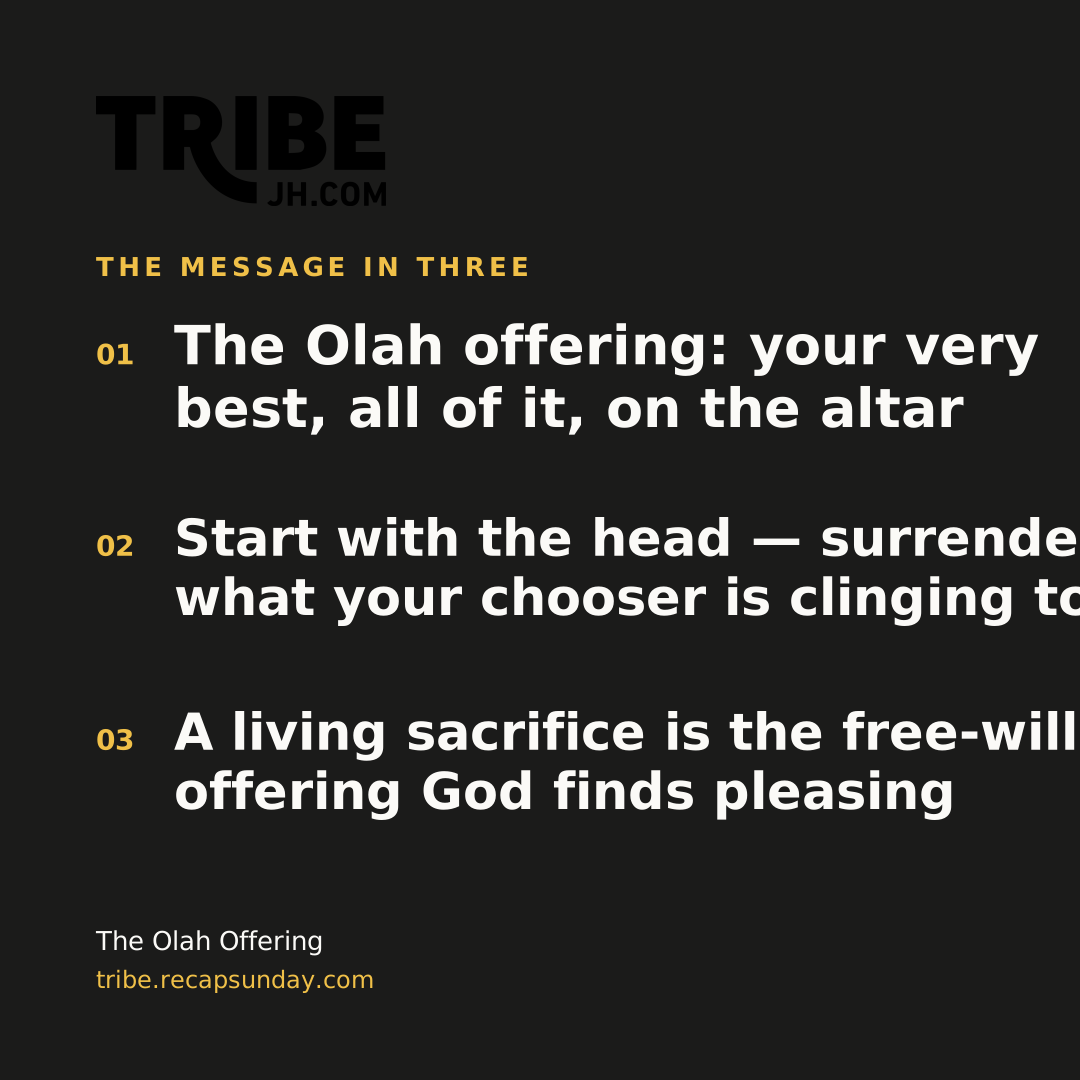
What distinguishes the Olah from the fellowship offering covered the previous week is that nothing comes home. In the fellowship offering, most of the meat feeds a celebration. Here, the entire animal, head, entrails, legs, everything, goes onto the altar and is consumed by fire. Brian pointed out that the head goes on first. It is the seat of choice, of desire, of will. When that goes on the altar, he said, everything else follows more easily.
The congregation's discussion brought in the woman with the alabaster jar in John 12, and the way Judas framed her gift as waste. Brian noted that Jesus did not agree with that framing. The costliness of the offering, the fact that it could have been used more efficiently, was precisely the point. Amanda added the story of Hannah, who promised her son Samuel to the Lord's service before he was even conceived, and then kept that promise. The pattern is the same: the hardest thing to give is often the thing being asked for.
Romans 12:1 was where Brian landed the message. Paul urges believers to offer their bodies as living sacrifices, holy and acceptable to God, and calls that the true and proper form of worship. Brian drew a direct line from the Olah to that verse. The invitation at the close of the service was not to identify one area to surrender, but to consider putting the whole thing on the altar, fears, plans, pain, and healing included, and to mean it the way the worshipper in Leviticus 1 had to mean it when he looked the animal in the eye.
Touch points
Things you could actually do this week.
Set aside a few minutes this week to get on your knees and tell God out loud that you are giving him the specific thing you find hardest to surrender.
Open Leviticus chapter one and read through it slowly, writing down every detail you notice in the margin of your Bible or a notebook.
Listen to at least one episode of the Bible Project podcast series on Leviticus that was sent out in the text blast.
When you wake up each morning this week, say out loud, 'Lord, here I am, you know every part of me, speak to me,' and then sit quietly for a moment before your day starts.
Read Luke 17 verses 17 through 19 and ask yourself honestly whether you are more like the one who turned back or the nine who kept walking.
Doing a Bible study?
Here is a guide we have prepared for you: the passages
in order, questions for the group, and room to write.
Brian talked about how the fellowship offering required you to bring an animal from your own herd, not someone else's. Where in your life are you tempted to let someone else carry the weight of your relationship with God?
Jay noticed that laying your hand on the head of a large animal would have been an intimate and maybe even frightening act. What does it look like for your own offerings to God to carry that same weight and intentionality rather than just going through the motions?
Esta semana Brian continuó la serie sobre Levítico, enfocándose en un tipo específico de ofrenda llamada la ofrenda Olah, descrita en Levítico capítulo uno. A diferencia de otras ofrendas donde parte de la carne se llevaba a casa para una celebración, en esta ofrenda el animal entero, el mejor del rebaño, sin defecto alguno, se quemaba completamente en el altar. Brian señaló varios detalles importantes del texto: el animal tenía que venir del propio rebaño del que ofrecía, no del de otra persona; el oferente ponía su mano sobre la cabeza del animal en un gesto íntimo y deliberado; y la cabeza del animal se colocaba primero en el fuego, como símbolo de rendir el centro de nuestra voluntad y nuestros deseos.
La conversación en la congregación fue rica. Se habló de cómo este tipo de ofrenda no era obligatoria sino voluntaria, nacida de gratitud, como cuando alguien celebraba el nacimiento de un hijo o el cumplimiento de una promesa. Alguien conectó esto con la historia de los diez leprosos en Lucas, donde solo uno regresó a agradecer a Jesús. También se habló de cómo Jesús mismo es el cumplimiento de todo lo que esta ofrenda prefiguraba: el cordero sin mancha que entregó todo, sin reservarse nada, comenzando en el huerto de Getsemaní con su acto de rendición antes de caminar hacia la cruz.
La invitación final fue la de Romanos 12:1, donde Pablo llama a los creyentes a presentar sus cuerpos como sacrificio vivo. Brian invitó a todos a considerar no solo un área de sus vidas, sino entregarlo todo al Señor, la vida entera sobre el altar, de la misma manera que el animal completo era consumido por el fuego. Muchos en la congregación respondieron arrodillándose en oración.
---
Pasajes bíblicos mencionados:
Levítico 1:1-9
Lucas 17:11-19
Juan 12 (la mujer que derrama el perfume sobre los pies de Jesús)
Romanos 12:1
1 Samuel 1 (la historia de Ana)
Génesis (el jardín del Edén y la maldición)
Deuteronomio (la maldición del que cuelga en un madero, citada de memoria)
Read the full transcript8,786 words
Let's pray together. Lord Jesus, we invite your presence in this place today. We tell you that we're here for you. And before we even sing a note today, we just calm our minds. We quiet.
We quiet the storm and we just say, Lord, we focus on you. And you're the reason we're here. That we come freely before you, we lift our hands before you, we worship you. Just tell them, just remind yourself today, I'm here for you, Lord. I'm here to meet with you.
Come by your Holy Spirit this morning. Let's just pour out our affection on his feet today sing that again. We set our hope on you. Just declare. We set our hope the everlasting god one more time we said our hope you we said our hope on you Lord, we just remind ourselves this morning of your goodness, of your faithfulness.
Yay. Lord, we just remind ourselves of who you are today. We remain confident not in our own strength or our own circumstances but we remain confident today in you because of your goodness, your great love for us. We give you all the praise and glory in here, and Lord, we just ask as we dig into your word today, That you would set a fire. Set a fire in our hearts today.
If we're lukewarm, lord, we pray that you would just send your fire today. Fresh and new today that we would let go of yesterday's ashes and that we would seek you fresh today. Set a fire down in my soul Lord, if there's anything that would hinder us from experiencing more, more of your fruits of your spirit today, show us. Show us because you've already poured it out. Whatever we need today, Lord, show us what might be blocking us today from experiencing what you've done for us.
You need more joy today, more patience. Just ask him for it today. That comes through Every time I sing this, I hear the Holy Spirit whisper to me. Oh, you want more? Okay.
What are you willing to surrender to make room for more? Because he's not holding back. But sometimes our vessel is so full of the world, it's so full of worry, It's so full of other things, control, anxiety. But he's trying to pour, but it's already full. And he's a gentleman, and he says, I'll pour it out, but you have to make room for me.
So as we sing this, just ask him, Lord, what would you have me surrender again today to make room for you to pour more, more of the fruits of your spirit into us? Just dare to ask him, Lord, what is filling that space that you're longing to pour your spirit into? And just lay it down today. Just lay it down to the best that you can do. Just say, lord, help me.
Help me lay down my control, my worry, my own plans, my anxiety, whatever it is, my apathy. Remove it so that there's room in me for you
to pour more, more, more.
And the midst We're Lord, I just always get overwhelmed that you don't have to do anything. You don't have to do anything more for us. After what you did on the cross. But you're so good and you love us so much that you continue to pour out and pour out. You don't have to do anything for us.
You don't have to show up in this place. Every Sunday but you do. You don't have to meet me on the couch in the morning when I have a bad attitude or I'm my brain is scattered, but you do because you're good. And just the slightest glance of our eye ravishes your heart. What an amazing love.
We can't even fathom because we love conditionally, but you love unconditionally. You're so good. Let it just be a practice that we wake up in the morning and we just say, Lord, here I am. You know every part of me. Speak to me.
Convict me because you are good and you long to be close to me. So we ask that today as we dig into your word, would you come and speak to us today? Come and speak to us through your word. We love you, Jesus. We love you, Jesus.
We pour out our affections. That's what we're doing here. We're coming to honor you together because you told us to for one thing, to gather and to lift up your name and to encourage one another. So that's what we do today. Lord, we ask that you would bring each person in this room expected for what you're going to do, not only just what you're going to do in each of our own hearts but what would you maybe want to speak to each of us for someone else in this place today?
You use your body to encourage one another. So maybe the lord will speak something to you through the message today and maybe it's for you and maybe it's meant for you to share with someone else. A word of knowledge, encouragement, to remind them today that the lord loves them. So, be listening for his voice today. Be listening for him to speak to you today.
Jesus, we love you. Amen. Have a seat. If you can find one, maybe hot stuff. You can scooch in.
There's plenty of seats available. Get out your Bible. There's, I think, some more coffee. There's some more food and we're gonna dig into god's word together.
Good morning. Depending on how you're counting, this is either week five or seven of a series that series of conversation. Have you ever spent this long in the book of Leviticus? No. Have you ever enjoyed the book of Leviticus as much?
No. Do you want us to keep going with this series? So I do I I when I plan out series of conversations to have, something will stick out to me. And I'll be like, oh, that's that's that's good. And sometimes, as I develop it, it's like what we would call a one off.
It just stands alone, and it's one message, and okay, awesome, great, we're conversation. Other times, as I'm developing the conversation, I quickly find like, oh, this needs to be split into two conversations. And sometimes conversations develops into four conversations. Okay, four weeks. And I'll do what I just call series notes.
And on a document, I'll just put the big points that I feel like the Lord wants us to hang out on to unpack and develop. Okay. And then I'll go back and develop those. And I know where the series is going, unlike the TV show Lost, whereby season five or like
Or severance.
Or some would say severance. Your innie really likes this series of conversations that we're having in the book of Leviticus. And every week, I think, like, okay. I think that I think that we have mined all of the gold out of this series of conversations that we have. And I always ask the Holy Spirit, you got anything else?
And for the last three weeks, he's been like, oh, yeah. I got one more thing. Alright. Let's develop that. And then I get to the end of that.
I'm like, okay. I think we're good. Do you have anything else? And he's like, yeah. But have you seen this?
I'm like, oh, that's so good. We gotta talk about that. And so this particular series of conversations we've been in the book of Leviticus for most of the winter now. A good portion of the winter I mean so if you only conversations, we're on week five. If you count the amazing conversation that Renee facilitated, we're week six.
If you count the amazing conversation that Justin facilitated just last week, we are in week seven. So week five or seven, depending on how you're counting. The last time that I was here, I said that we were going to specifically look at two different we're going to look at two different types of specific offerings. And the last week that I was here, we covered one type of specific offering. And this week, we're going to look at another specific type of offering.
So let's just do a quick review for so that you can you can jump in. If you remember week one, we talked about how Leviticus is a divine blueprint for holiness, showing Israel how to create a sacred environment where God can dwell among his people. And I hope that as we've gone through this series of conversations, you have been able to move beyond getting hung up on this idea of why are we spending so much time in Leviticus? Like, we're under the new covenant. We're in the New Testament.
Why are you spending so much time in the book of Leviticus? Like like, why do we even need that book? Well, hopefully, this series of conversations is helping to answer that question for you. There is so much beauty in the book of Leviticus. You kinda have to look past or look through all the blood and fat on the altar and and mold on the walls and all kinds of various fluids that God's got thoughts and ideas on and all of these things.
But there's some real beauty in the great lengths that God goes through through in order for us to have right relationship with him. Week two, we talked about how the God of the Bible is a consuming fire who will never compromise holiness for love. Week three, we talked about how the blood brings us closer to God. The sacrifice of an animal, the sprinkling of blood on the altar is not just to make an angry god to buy us a little bit of time with an angry god. Like, he's always mad at us.
He's always disappointed. He's always upset. He's always, like, poised, ready to fling a lightning bolt from heaven to strike us down for our ocean of iniquity. But if an animal is killed, he's like, you're off the hook. You're lucky this time.
You know, like the belt was undone, he was about to pull it out. Sacrifice an animal. Okay. You're lucky. You're not getting the belt.
That's not how God operates at all. If you if you have that mentality, and it's a human mentality to have, you're missing the book of Leviticus, which is probably why the Lord has us in this series of conversations for so long. Just so it can really sink in and penetrate. It is the blood. When our life essence is transmitted to this animal, this animal surrenders its life.
And then through the blood, we get to go into the presence of the lord. And if you're like, wait. What? Then you should listen to week three. The blood brings us closer to the lord.
And then week four, according to my counting, we talked about how when a certain type of sacrifice is brought to the Lord, the idea is that some of the parts of the animal are laid on the altar. That is, as it's burned up, the smoke rises and ascends to the Lord. But in this particular sacrifice, a fellowship offering, the idea was that you take most of the meat home with you. But what was that unique condition about bringing most of the meat home with you? You have to doesn't say you have to throw a party.
What does it say? It doesn't say that. You're just jumping too far ahead.
Try again,
You gotta what? You gotta eat it all when? That day. Yeah. On the third day, it's bad.
You have to eat it all on the first day. But if you don't, you can eat some on the second day. But on the third day, it's no good. And the purpose for that, Chris, there we go. You gotta throw a party.
And so that was one of the specific offerings that we talked about the last time I was here. This week, we are going to talk about a different type of offering. And to help supplement what we've been talking about and going through, Lisa, on the text blast, sent out a link to a podcast series on this topic. How many of you got the podcast? I don't dare ask how many of you opened and started listening, because that just breaks my heart.
How many of you got the text? Okay. Alright. Good. Good.
Good. Good. So here is that podcast series. It's done by Bible Project. And just like with anything, you have to eat the meat and spit out the bones.
As they were going through the scroll so they're I don't know if they're Seattle or Bend or Portland or something. And some of that, like, super West Coast vibe kinda comes through, and you're like but it's easy. You just pick out that bone and spit it out. It was also right about, I think, maybe during the time of COVID. So, like, some of that, like, gets in there, but it's easy enough.
Like, pick out those bones, spin them out, because there's so much great, great meat that they they talk about. So by chance, has anybody clicked on that link and started one of those podcasts? Yes, of course. Oh, my heart's so happy. Yes, yes, my heart is happy.
My heart is happy. So I really encourage you. I'm not saying thus saith the lord, but I will say this. This, this, and this is what the god of the bible whom you claim to follow and pledge allegiance to has for us as a tribe family. I'm not saying the lord says you better listen to the podcast because, like, if I have to do that, like, blech.
Ain't nobody like that. But he has us on this series for a long time, for a re I this is not me. I'm not like, what would be really good and fun? I know. Let's really, like, have people beating down the doors to the church by spending seven weeks on the book of Leviticus.
That's gonna really bring them in. No. No. No. I I really I really when it comes to ministering unto the lord, I could I could care less about y'all.
I could care less about your approval of my series. I'm always open to feedback, gentle, sweet, loving feedback. But, I'm not preaching the we're not having these conversations for me. We're not having these conversations for you. Like, what what do you want to hear?
These series of conversations are out of obedience to what the lord wants to do in his church. Does that make sense? And to supplement the series of conversations that we're having, this podcast series is really good. With that in mind thank you. With that in mind, you can write the title of this morning's conversation that we're going to have.
This is we're going to talk specifically about the Olah offering. And if you have your bible with you this morning, would you turn to the book of Leviticus and click on chapter one? How about that? One. Back in we'll go through it yet again.
Or the sixth, apparently. Alright. Leviticus chapter one. And interestingly enough, we're gonna start in verse one, and this is the very first specific type of offering described in the book of Leviticus. Adam has the mic in the room.
Quick shout out to Connor. When I was gone last week and Justin was speaking, The mic was going around the room. The livestream audio was captured beautifully, and so I got to be one of those people that we talk about every week. If you're not here, we have a lot of family and folks that are traveling, and they still get to tune in and participate with the conversation through the livestream and the podcast. So Connor, great job on audio and capturing this.
Adam, great job running that mic around. So it's important whenever we have something to contribute, use the mic so that we all get to get the goods from it. Leviticus chapter one, would somebody please read verses one through nine? And you can you can bite off the whole thing, or you can just read some and pass it on. Verses one through nine.
Now the Lord called to Moses and spoke to him from the tabernacle of meeting saying, speak to the children of Israel and say to them, when any one of you brings an offering to the Lord, you shall bring your offering of the livestock, of the herd, and of the flock. If his offering is a burnt sacrifice of the herd, let him offer a male without blemish. He shall offer it of his own free will at the door of the tabernacle of meeting before the lord. Then he shall put his hand on the head of the burnt offering, and it will be accepted on his behalf to to make atonement for him. He shall kill the bull before
I don't know if he gave it to me.
He shall kill the bull before the lord and the priests, Aaron's sons, shall bring the blood and sprinkle the blood all around on the altar that is by the door of the tabernacle of meeting.
I'm just gonna go over.
And he shall skin the burnt offering and cut it into its pieces. The sons of Aaron, the priest, shall put the parts, the head, and the fat in order from the wood that is on the fire upon the altar. But he shall watch wash its entrails and its legs with water, and the priest shall burn all on the altar as a burnt sacrifice, an offering made by fire a sweet aroma to the Lord.
Woah. Okay. Quick question. As you look at this passage here, would you say from our growing knowledge of the Aaronic priestly sacrificial system, would you say that this is a sin offering or a free will slash love offering? Sacrifice.
This would you say this is a sin sacrifice or a free will sacrifice?
Same? Ill, blameless, the washing, the way they laid them out. The you know, we've we've learned about the priest putting his hand on the head of the bull, and that takes away the sins of the people once a year. So that's what I thought of.
Great. So this this is a commonality among all of the sacrifices. It needs to be male, and it needs to be perfect and blameless, the very best from the flock or the herd. So that that happens all the time. This particular instance that you're noticing, the giver of the sacrifice places his hand on the head of the animal his hand on the head of the animal.
Okay. So, yep, that tends that kind of does sound like a a sin offering, but there's some clues that might give you conflicting or contradict contradictory idea. What do you see, Gretchen, and here comes the mic.
Listen. I have different versions, and
hers doesn't say this.
But in chapter three, mine says
Oh, chapter three.
I'm sorry. Verse three.
Okay. Of what we do first.
I haven't finished my coffee yet.
It where is it?
Yeah. Oh,
yeah. It says, if his burnt if his offering is a burnt sacrifice of the herd, let him offer a male without blemish. He shall offer it of his own free will.
There. There.
But Lizzie's doesn't say that.
Your mom doesn't say that.
What does yours say? I I love everybody's eyes are either in their phone or in their bible. This makes pastor Brian so happy.
New King James, and I have NLT. Verse three says, if the animal you present as a burnt offering is from the herd, it must be a male. No defects. Bring it to the entrance of the tabernacle so you may be accepted by the Lord.
Correct. So in this particular verse, your translation brings out with a little more clarity or vibrancy the type of offering that this is. So, Amanda, yes, you are right. There are some characteristics of a sin offering, laying the hands on them. Interesting.
Okay. But we see from reading plainly that this is an offering, a free will offering of your own free will from prior conversations that we've had. Can you think of the type of instance or scenario that would trigger a person bringing a free will offering to the Lord? What might the occasion be? What do you think?
To bring a free will offering. This type of offering. Yeah. Okay. Birth of a baby.
Check. Free will offering. Bam. What else? What?
Fasting. Fasting. At the end, the completion of a vow. Free will offering. Bam.
On the grill. What else? And and all of these can be summarized. Celebrations. There you go.
There you go. Celebrations of gratitude to the Lord out of your own free will. I want to bring this sacrifice to the Lord out of your own free will. Now let's look at some of the specifics about this type of offering. And we don't need to, like, draw any spiritual conclusions.
We don't need to, like like, jump in super deep, but I would like us to take note of some of the specifics in this offering. What are some what are some of the steps or specifics about this offering? And I'll just tell you this. The reason why I want you to look and to discover these things for yourself is so that when we connect some dots, when we extrapolate some deeper spiritual meaning from this, my goal is that you would go, woah. That's amazing.
And it was right here in the text all along. And if if if old PB could pull this out of the text, what's what could be in chapter two that the holy spirit would show me out of this? If he can show that big dummy, what could he show me? And then you you you you scratch a little deeper in chapter three. Scratch a little deeper in chapter four.
And we first start by looking at the surface level. What are some specific details or aspects that you notice about this particular offering? You can say it. Gotta a male. Yep.
So no defects, you can substitute either out in your margin of your bible, you can make a note, or you can just have in your mind. It has to be the very best. Your very best pair of skis. Your very best outfit. Your very best whatever tool or resource you use for work.
Your most favoritest thing. The very best. Okay? What else do you see?
Everything is very ordered. The wood is in order. The parts of the animal are laid on the wood in order. Everything is in order.
Parts of the animal are in order. The wood is laid out in order. This is interesting. Perhaps it's because we're just getting into the book of Leviticus, but there's only one other place, which we're going to talk about next week, where it specifically talks about the ordering of the wood. Most of the time, the sacrifice has to do with just the animal, what to do with the animal, how to bring the animal, how to prepare the animal, what gets laid on the altar, what gets taken outside of the camp.
But this particular instance, and I think it has to do with because it's in the first chapter. We have some instructions about the wood. Next week, we're gonna talk more about the wood on the fire. Can't wait. Yes.
Let's do the mic.
Any clarification before we before I move on in my brain. Are you saying that a free will offering can't be one that atones for sin?
Because it does say making you bread again. The important thing you're gonna understand, you will you will accept it to death in the place of pure Christ.
Are you thinking them mutually exclusive? Exclusive? Or
Not necessarily. Not necessarily. So, again, I am I am a baby student in in these offerings, offerings, and this podcast series helps so much.
Sure. I I this is only one sentence, if I may read. This is from the Blue Letter Bible. It's saying the Septuagint translated the adjective without blemish In that verse with the word, amamos, Peter employed this same Greek adjective to refer to the death of Jesus as an offering of the lamb to atone for our sin in first Peter.
Well, that's where we were going with the message today. So if you would just close your bible while the
worship Just clarifying. You may continue, but I in my head, I have to know. I think it means both. I mean, you can bring a free will offering, sorry, to atone for your sin. I I think I don't think they're separate.
Yes. They don't have to be.
So there are some sacrifices that are mandatory, that, there are certain instances that trigger a compulsory sacrifice. This happened, so now this must happen sacrificially. Sin, guilt, the high priest going into the holy of holies one day a year, the day of atonement. There are other sacrifices that happen out of there's no particular thing that that mandates or necessitates it. A free will offer it, if you will.
Admittedly, this passage looks like it combines elements of both. But what triggers this offering is, as Brian mentioned just a moment ago, the fulfillment of a vow celebration. Thank you. And so in this particular instance, the text appears as though it's a free will offering out of you the own volition of your heart as a way of saying thank you, and I love you. And as an added bonus, it purifies us and and gets that person back into right standing with God.
So would you be satisfied with my answer of both and?
So, my mind hopped to, Luke 17 when Amanda asked that question when Jesus said he'll healed the 10 lepers. It's verse 17, and Jesus Jesus asked, didn't I heal 10 men? Where are the other nine? Has no one returned to give glory to God except this foreigner? And Jesus said to the man, stand up and go.
Your faith has healed you. And and so he had healed the other nine, and then yet again, he said, your faith has healed you. And so he brought forth that volitional. He had to walk back to Jesus and thank him, and he brought back that offering of not only having fun with the priest and being healed, but he chose to go back to God and offer out of his own free will gratitude.
Was that a footnote in your bible or a hyperlink?
Hyperlink.
Okay. I need a pen because I'm gonna write that in in my bible as a hyperlink. Oh, where was that? Luke
17 Wow. 17 through 19.
Luke. It was always like.
Yeah. It that didn't mean the other nine were in sin. Right? Wow.
Wow. Yeah. So good. Okay. Other details about this offering.
What do you what do you notice about, similar to what Gretchen said? There's an order to this. And the the reason why we we spend time to, like, let's really look and consider the details. It's because when we notice the details, it's like that's what creates the opportunity in our hearts to bite in to that juicy, fruit filled center. The good stuff is in the details.
What are some other details that you notice about this offering? I love that you're looking and considering.
Okay. What stands out to me is the fact that it's at the entrance of the tent.
Mhmm.
The offering is offered at the entrance before anybody goes in. And the the one that I listened to today of the bible project, they talk about the transferring by the laying on of the hand. So by an act of will, somebody puts their hands on an animal. By an act of will, somebody even brings the animal in the first place. And I feel like Jesus is the pure and spotless lamb who died to take away the sins of the world.
However, it requires something from us to receive it. And I've been debating on whether or not to even bring it up because then we're talking about Arminianism, and we're talking about Calvinism, and we're talking about universalism. Like, Jesus died once for all for everyone's sins.
Mhmm.
But it doesn't mean that everyone automatically gets into the
tent. Agreed.
So that's what I see.
A detail that I notice is look at the end of verse two. Whose herd or flock flock does the sacrifice come from? Whose herd or flock does the sacrifice come from? Yours. Not your moms, not your dad's, not your youth pastors, not your pastors, not your husband, not your wife, your flock.
It must be it must cost you something. How many husbands will stand before god in judgment and be like, my wife and I read the bible together every morning. My wife took us to church every week on and on and on. And the lord's like, yeah. But what did you bring from your herd, from your flock?
What other details stand out to you? Let's look at verse eight specifically. J, you might have something unrelated to verse, and then let's look at verse eight specifically.
It really stuck out to me laying laying your hand on the head. That just seems like such a, like, intimate thing. Like, I know, like, some of us might have, like, pets at home, we touch them all the time, but, like, for me to, like, put my hand on my wife's head
or, like,
or, like, a kid or, like I think about, like, approaching, like, a large animal. Like, if you hunt, like, after you shot something, like, when you approach it, you're, like, or, like, or even, like, a horse. Like, I remember, like, touching a horse. You're just like, wow. Like like, it's a very, like, intimate thing to do, and I just see that that's such, like, a integral part of the sacrifice.
This is, like, a really intimate and maybe even, like, scary thing to do sometimes.
Woah. That's really good.
Alright.
Instead of me connecting that dot for a spiritual meaning, Jay, you connect those those dots or two for a deeper spiritual meaning. We have the instructions. Lay your hand on the animal's head. Okay. You're seeing you're you're you're seeing that detail, and you're on your way to extracting the the the really good, meaty, spiritual point that the lord has for us.
So tell us a little bit more. Connect those dots for us.
Yeah. I just think whatever whatever we're offering needs to, like, have a bit of that fear or, like, intimacy to it. Like, I remember my parents would always, like, force me to, like, apologize to my siblings after we did something, and, like, your, like, knee jerk reaction is, like, I'm sorry. Like, you're like, whatever. Like and your heart's not really in it.
And I me, specifically, I would oftentimes need, like, a little bit of time to, like, actually be really repentant and, like, actually mean my apology. And so same same thing, like, with the Lord. Right? Like, I think it's so important that it is this intimate thing, that it is something that is hard for us to do. It might be, again, scary or, like, yeah, difficult to do, but we gotta mean it.
We gotta mean it. Brian, imagine looking into the eyes of the animal that's about to die that you selected and brought forward.
I think when you say that, it makes me think of Jesus in the garden when he was so I don't wanna call him stressed, but he was sweating blood. And that seemed like a very scary situation or something that he you wouldn't want to voluntarily go through. But then I also when we're talking about the transmission of sin, it makes me also think of the other garden, garden, the Garden of Eden when man was cursed. And one of his curses was that he would have to toil and sweat. And we talked earlier a few weeks ago about the life being in the blood, and Jesus sweat blood in a different garden.
And I just I'm not I don't think I fully fleshed out all of that idea, but I just feel like God was purposeful in that demonstration or in that yeah.
Garden, toil, something has to die. Yeah.
Jesus became a curse for us when we were cursed, and here, we are we in this time, we're giving offerings and transferring these these sins, and it's making us right with God. And Jesus the curse that was brought upon us, Jesus gave his blood, but it started in the garden when he dripped the blood from his brow. Sorry. This is all new to me.
I just let her know. Alright.
This is good. This is good. The Bible says in the Old Testament, cursed is anyone that hangs on a tree. The Bible says in the garden as a result of Adam and Eve's sin, part of the curse that was pronounced was that the ground would produce thorns. Jesus on the cross took the symbol of that curse and had it smashed into his forehead what the enemy thought would be gloating and triumphal to to crown the head of the king of the universe with the filthiness and the iniquity of man's embodied in thorns and stickers.
And if you've ever been running barefoot in the grass just like being a kid again and then you step on a thorn or a goat head, like and the enemy intended that to be mockery and shame. And the harder the enemy pressed that curse into Jesus, the result was blood flowing that purified man from his sin. You lose dirty devil. Verse eight. What body part is specifically yeah.
Verse eight. What did I say? Verse eight. What is what part is specifically mentioned in verse eight? The head.
You ever burned the head of an animal? I haven't, but can't be good. Why the head? It represents the locus or the the center, the throne of the chooser. My chooser exists in my my head.
Right? Well, this looks like a good business idea. Well, I think that I want to do this. Well, I have seen this, and I want to go there. I want to do that.
I want that. If you put the head on the fire and it's burned up, everything else will follow. Start with that which is most challenging and difficult to give. I remember after I got saved, I was a Christian for a number of years, and then I went to a a youth event where I heard the speaker talking about going all in. And at that event, I stopped being a Christian, and I became a disciple.
And I was like, you can have it all. You can have it all. You can have it all. And, you know, tears, and it was awesome, and the music and everything. And then I go home, and I'm not like a teenager at this point.
Like, I'm like I'm like a young adult. I was married. And and, like, the next morning, he's like, I can have it all. And I was like,
yeah. Yeah. Yeah.
Sure. Yeah. Yeah. And he's like, let's start with all of your Beastie Boys CDs. And I was like, oh.
Anyway, it's CDs at that point. And long story short, big stack of CDs and one and one sledgehammer later. That was a lot of shards of plastic to clean up off the driveway. But but, like, start there with that that that locus, that that center of what was occupying a place in my heart that it shouldn't have, and then everything else was so much easier that followed after that. The Bible says in verse eight, put the head on the altar.
It's a picture of surrender. Then in verse nine, if we we kind of read some of these things together, what else is placed on the altar? The and the The fat. Wash the head, wash the intrails, the legs, and then put it on. Let me ask you this.
From the text, what parts of the animal are not put on the altar? From what you can read of the text, what parts of the sacrifice are not put on the altar? K. So it does say to skin it. It says to wash the organs.
Now we're playing anatomy. Yes or no? That belongs to the priests, brother. Alright. The end of verse nine gives you the answer.
Other parts of the animal are specifically mentioned. We gotta wash some things. We gotta do some things. But then, the last part of verse nine is conclusive on what parts of the animal go on the altar. What do you see?
There you go. Say it again, Chris. The entire animal goes on the altar. Various parts of the animal are given for different types of sacrifice. Last week that I was here, we talked about how just some of the animal was placed on the altar and its blood was sprinkled for a thing, and then you take the entire animal.
And you gotta eat it all in one day. And if you don't, well, you you get a second day. But the idea is for you to have a feast. In this particular instance, with the Allah offering, how much of the animal is intended to be consumed by the flames? The whole thing.
The entire animal. What is the the what is the caliber or the condition of the animal that's intended to be brought? The very best. The very best. The breeding stock.
The one that would win the Eukanuba prize. The four h grand champion on the fire. The entire animal is intended to be consumed by the flames. Now I hope for some of you, you would think that seems a little exorbitant. That seems a little unnecessary.
Like, that doesn't seem to be the most the the wisest use of the very best. Don't beat yourself up for thinking that way. That's actually good, reasonable economics. That's good thinking. Why not sell the very best for breeding stock?
Why not wait and do the the block party barbecue sacrifice? But there is a type of sacrifice that the Lord finds particularly pleasing when we take the very best of fill
in the
blank, your time, your talent, your treasure, whatever, and allow it to be consumed on the altar to be burned up. And if that sounds like, like, I don't know if that that's really the best use. You're not a bad person. You you're you're thinking, and I like that you're thinking. But we saw Jesus address this mindset.
You don't need to turn there. But remember in John chapter 12, when the woman breaks open the alabaster jar, she pours it over the feet of Jesus, and then Judas, who is in charge of the money and the finances, was like, you could have done 10 different better things with that expensive jar of perfume. But Jesus didn't didn't chastise her. In fact, he turns to Judas and is like, you've missed the point. The point is this woman gave everything.
She laid it all at my feet. I have received this offering, and it's a pleasing aroma. And we know how this story plans out. The Bible literally says that the fragrance filled the house. Here's the last last verse.
I'll put it up on the screen. Really bring this home. Romans twelve one. Paul is talking, and he says, so friends, beloved, dear ones, people who I'm investing my life in, people who I want the very best for, dear, treasured, precious, honored. Brothers and sisters, I plead with you to give your bodies to God because of all that he has done for you.
And let them be a living and holy sacrifice, the kind that he will find acceptable. This is truly the way to worship him. In that garden that Brian mentioned, he said, Lord, if it be possible to skip this cup of suffering, can we find another way? But then he's being human acknowledging that this is gonna cost a lot. And then he said, nevertheless, not my will, but your will be done.
And he laid his life down in that act of surrender so that the walking it out, and in Jerusalem, you can go and see there's they call it the Via Dolorosa on the way to the cross. The walking it out was was the easy part. The hard work had been done in his heart in the garden. Today, the invitation is for you to think about and consider Would the Lord be inviting you to make an Olah offering of your life? Yeah.
Yeah. Yeah. You're a Christian. Awesome. These were Israelites.
Yes. You have told him before. But what about today to bring an offering of our life? That we would lay our bodies on the altar and give our bodies to God. And what's the reason why?
Because of all that he's done. He held nothing back from you. So here's the invitation, and it's okay. The the LifeGene camera can just stay right there. But the invitation is for you to take a moment, consider.
And I almost gave you an easy out by saying, if there's an area or an aspect of your life that you're being called to surrender to the Lord, pray no. Just just throw the whole thing on the fire. My choices, leadership of my life, my fears. This is invitation to throw the whole kit and caboodle, my pain, my healing onto the altar. Lord, I give you everything.
And you might be saying, I give you everything all over again today. It's okay. But here's how I would like you to respond to the Lord's invitation to lay everything as a living sacrifice. Just whenever you're ready, if you just slip out of your seat right where you are and you get on your knees and you turn your chair into an altar where you can meet with the Lord. Just right where you are.
Okay? So listen, consider, count the cost. As Jay said earlier, look that animal in the eye and then lay it on the altar. Speak to us. As you finish conducting business with the Lord on your knees, let's all stand together and sing that last part again.
As a free will offering from our hearts, telling you that we love you and trust you.
Be our prayer today, not just in these last couple minutes we're sharing together, but just this whole week, maybe you wake and you focus on that. Just giving everything to him. In the book of first Samuel, at the very beginning, I think of Hannah. And if you remember, she could not have kids, and she was weeping at the altar when they went for their annual sacrifice. And the priest thought she was drunk.
And he's like, Eli was like, what are you doing? She's like, no, I'm just grieving because I can't have kids. And he said, oh, in that case, then may you be blessed and may your prayers be answered. And she had a son. And she said in that speaking of sacrificing it all, she told Eli in that moment, if the Lord gives me a son, I will give him back to service.
And she did. And as a mom, you know, my flesh is like, that might be where I draw the line. So for me, just Amanda, like, to give up my son, oh, oh. And she got to see him every year, but sure enough, as soon as he was weaned and old enough, he went back and she gave him to Eli for the service of the Lord, and it's an incredible story. So whatever that fill in the blank is for you that feels so hard to give up, Just know that it helps us rely on the Lord and him only.
Because if everything is figured out, if we don't ever have to do anything hard, we don't really need the Lord. And that's kind of attention to manage. It's like a love hate relationship with that fact. Because if everything is ready, then we just don't need him. And he wants us to want him.
He wants us to need him because we do. So let that be kind of what we think of. And our tithe and our offering, which we bring as every part of a tribe family kind of feels the same way whether bringing a tithe or above and beyond that an offering is easy or hard it's like giving our best you know some some people think it's not textually necessary, but some people think you just give right off the top. It's a great idea of your paycheck. Give the first, whatever the amount is, you give right off the top.
Not what what's left over, not after the Dave Ramsey budgeting, whatever, like, just right off the top. Oh, but sometimes it might feel like more than I can afford this month. That's okay. Because God is our provider, not our budget. Those are good to have.
Have these things. Have plans. But God is our provider. God is the one who sustains us, and we need him in all things. So you guys can have a seat.
And I'm just gonna pray over the offering, whether you're giving now or another time. And before I pray, just practically speaking here at tribe, we don't pass buckets. But if you have cash or check, we have two boxes. One right here with the logo on it as you leave, and then there's another black metal box right outside the front door. You can put cash or check-in there.
Giving online, tribejh.com anytime, and then I'll know the most efficient way usually is through our phone, our smartphone, and you can see the instructions on the screen there. You send a number to 84321. Put in the amount. So let's pray together. Heavenly father, thank you that even though it's tough, you require us to bring our best.
You designed it so brilliantly where that keeps our heart humble and reliant on you, and we can still be strong and independent at the same time. Thank you for that brilliant system that you put in place. Lord, I pray for everybody here, whether tribe is their home or not, Lord, that you would just speak to our hearts individually about the tithe and the offering and how you wanna work in that. And we know that money can have a grip on our heart. It doesn't have to, but it can.
And so that's so brilliant how you designed it, where we bring a portion of our finances to our local church, not only to keep our heart in calibration with you, but it also does the local and global work of the ministry of the big c church. What a brilliant plan. We love you, Lord. We thank you for everybody here. How you're softening our heart, not only to financial things, but just things of your word, things of you, your character, your nature.
What an honor it is to be your hands and your feet to our nation, our sphere of influence. We love you and we thank you for that. In Jesus name, amen. Two quick announcements. The first one is that we'll be having Easter service not here at the TMC, and Easter isn't for a few weeks.
It's on Sunday, April 20. We're gonna go back to the verge, the Virginian in the big conference center. It's the same place where we had Easter last year. So we'll have a nice Easter service, wear your your Sunday Easter hats, whatever you do. It's not what we do here in Wyoming.
I'm just thinking of the South. Yeah. You're where you're coming, what you're
coming at. Then we'll have
a lovely Easter service. We'll have a shared meal like we did last year. More details on that. And then we'll have a cornhole tournament. Because what says, praise the Lord and the resurrection of our savior, then good old fashioned cornhole for the kingdom.
So that's April 20. So don't come here on that day. We'll just have one service at 10AM on that Sunday. And then the second thing is this, next week at 6PM at the Wart Hotel, it's a ticketed event, and you can see it on the screen. But this is a very interesting fella, and I don't know how to say his name.
Layoy Ashlarif? He was born in Saudi Arabia, but and he's a Muslim, and he's coming to Jackson next week to speak. But the interesting thing about him is that he likes the Jews, and that's not usually a combination that you see. And so he's for peace. He's for antisemitism.
He's not wanting he doesn't think they're being treated correct. So very, very interesting mix. It says Jewish Christian Muslim coexistence? Question mark. So keep your mind open and come see him if you're able next week.
It's not a tribe thing, but Rabbi Zelman from here in town invited us. You know, we've been supporting them and loving on our Jewish community here, and they're they're bringing him in. So for a Jewish community to bring in a Muslim speaker is very interesting to me. And so, yeah, please come if you can. And, Brian, if you wanna say anything more of that, you're welcome.
But will you come praise him?
Don't get thrown off by that word coexist. Nothing triggers my gag reflex quicker than that bumper sticker. Coexist. Just scrape it off your car right now before I go and check the parking lot. However, if you if this event is framed properly in your mind, it's a fantastic event to attend.
And the proper way to frame it, as Amanda says, it's interesting. I would invite you to be curious and come and listen to what he has to say about the treatment of Jews around the world by the religious faith of Islam and to support our Jewish friends here in the community and to consider for yourself the things that he presents. He's been on CNN, Fox News. He's got a gigantic following. He's well spoken.
And so I'd invite you all you can buy your tickets, like at the little table before you walk in and so, we'll remind you of this next week but but please make plans to attend that. Would you stand up and could I pray for you? Lord, may the sacrifice of our lives be a pleasing aroma in your nostrils. And don't be mad. I'm talking to you guys, not the lord for a second.
And don't be mad when on Monday morning, he reminds you. Don't reach your hand onto the grill. You've already laid that down. Help us, Lord. Help us.
Help us. Help us to leave what we laid on the grill. Help us to leave it there. I command a blessing over each and every member of our tribe family here today. We pray these things in Jesus' name, the strong son of God.
And everybody said, amen. I love you guys so very much. Have a great week. Hang in there. Winter can't last forever.