extended reading covering the eye as lamp, serving two masters, and not worrying because God provides
22 “The lamp of the body is the eye. If therefore your eye is sound, your whole body will be full of light.
23 But if your eye is evil, your whole body will be full of darkness. If therefore the light that is in you is darkness, how great is the darkness!
24 “No one can serve two masters, for either he will hate the one and love the other; or else he will be devoted to one and despise the other. You can’t serve both God and Mammon.
25 Therefore I tell you, don’t be anxious for your life: what you will eat, or what you will drink; nor yet for your body, what you will wear. Isn’t life more than food, and the body more than clothing?
26 See the birds of the sky, that they don’t sow, neither do they reap, nor gather into barns. Your heavenly Father feeds them. Aren’t you of much more value than they?
27 “Which of you, by being anxious, can add one moment to his lifespan?
28 Why are you anxious about clothing? Consider the lilies of the field, how they grow. They don’t toil, neither do they spin,
29 yet I tell you that even Solomon in all his glory was not dressed like one of these.
30 But if God so clothes the grass of the field, which today exists, and tomorrow is thrown into the oven, won’t he much more clothe you, you of little faith?
31 “Therefore don’t be anxious, saying, ‘What will we eat?’, ‘What will we drink?’ or, ‘With what will we be clothed?’
32 For the Gentiles seek after all these things; for your heavenly Father knows that you need all these things.
33 But seek first God’s Kingdom, and his righteousness; and all these things will be given to you as well.
34 Therefore don’t be anxious for tomorrow, for tomorrow will be anxious for itself. Each day’s own evil is sufficient.
feeding of the five thousand, used to illustrate giving God something to work with and his multiplication of small offerings
5 Jesus therefore lifting up his eyes, and seeing that a great multitude was coming to him, said to Philip, “Where are we to buy bread, that these may eat?”
6 This he said to test him, for he himself knew what he would do.
7 Philip answered him, “Two hundred denarii worth of bread is not sufficient for them, that everyone of them may receive a little.”
8 One of his disciples, Andrew, Simon Peter’s brother, said to him,
9 “There is a boy here who has five barley loaves and two fish, but what are these among so many?”
10 Jesus said, “Have the people sit down.” Now there was much grass in that place. So the men sat down, in number about five thousand.
11 Jesus took the loaves; and having given thanks, he distributed to the disciples, and the disciples to those who were sitting down; likewise also of the fish as much as they desired.
12 When they were filled, he said to his disciples, “Gather up the broken pieces which are left over, that nothing be lost.”
13 So they gathered them up, and filled twelve baskets with broken pieces from the five barley loaves, which were left over by those who had eaten.
referenced loosely as 'in Isaiah, no one is righteous, no not one' to reinforce universal sinfulness
1 Who has believed our message? To whom has the arm of Yahweh been revealed?
2 For he grew up before him as a tender plant, and as a root out of dry ground. He has no good looks or majesty. When we see him, there is no beauty that we should desire him.
3 He was despised, and rejected by men; a man of suffering, and acquainted with disease. He was despised as one from whom men hide their face; and we didn’t respect him.
4 Surely he has borne our sickness, and carried our suffering; yet we considered him plagued, struck by God, and afflicted.
5 But he was pierced for our transgressions. He was crushed for our iniquities. The punishment that brought our peace was on him; and by his wounds we are healed.
6 All we like sheep have gone astray. Everyone has turned to his own way; and Yahweh has laid on him the iniquity of us all.
7 He was oppressed, yet when he was afflicted he didn’t open his mouth. As a lamb that is led to the slaughter, and as a sheep that before its shearers is silent, so he didn’t open his mouth.
8 He was taken away by oppression and judgment; and as for his generation, who considered that he was cut off out of the land of the living and stricken for the disobedience of my people?
9 They made his grave with the wicked, and with a rich man in his death; although he had done no violence, nor was any deceit in his mouth.
10 Yet it pleased Yahweh to bruise him. He has caused him to suffer. When you make his soul an offering for sin, he will see his offspring. He will prolong his days, and Yahweh’s pleasure will prosper in his hand.
11 After the suffering of his soul, he will see the light and be satisfied. My righteous servant will justify many by the knowledge of himself; and he will bear their iniquities.
12 Therefore will I give him a portion with the great, and he will divide the plunder with the strong; because he poured out his soul to death, and was counted with the transgressors; yet he bore the sin of many, and made intercession for the transgressors.
The message in order, in a few minutes of reading.
This was the second and final week of Brian's series on tithing, wrapping up a summer triplet of conversations on worship, scripture memory, and giving. He walked through Matthew 6, Luke 7, and John 6 to build a case that giving is not a church fundraising mechanism but a spiritual discipline tied directly to love, trust, and surrender. The congregation joined in discussion throughout, making it a shared conversation rather than a straight lecture.
What was said
Brian opened by naming why Tribe does not talk about tithing often, then pushed back on that hesitation. Jesus, he noted, talks about finances more in the gospels than he does about hell, because Jesus understands the connection between where our money goes and where our hearts actually are. Giving disciplines the flesh and reflects the heart. That sentence became the frame for everything that followed.
The first aspect of tithing Brian drew out was love, using the passage in Luke where Jesus says the woman who has been forgiven much loves much, while the person forgiven little loves little. Brian pressed on the Pharisees as the intended audience for that statement. They believed they had little to be forgiven for, so they showed little love. The congregation worked through the idea together, landing on the point that Jesus was dismantling a false moral accounting system. All of us, Brian said, are no different from that woman. The depth of love we show toward Jesus has a direct relationship to how seriously we reckon with how much we have been forgiven.
The second aspect was trust. Brian returned to Matthew 6, where Jesus moves from treasure and the eye to worry about food and clothing, and finally to seeking the kingdom first. Connor pointed out in discussion that the whole passage, including all the familiar anti-worry verses, is anchored in the section about money. Brian put it plainly: giving trains the heart to trust Jesus with every aspect of life. Many people trust Jesus in theory but keep their finances at arm's length. That gap, he said, is worth examining honestly.
The third aspect was giving Jesus something to work with. Brian used the feeding of the five thousand in John 6, where five loaves and two fish became twelve baskets of leftovers. Ashlyn shared that she had seen something like this happen in Mozambique on a mission trip, where the team chose to feed the village children first, went without themselves, and watched the food multiply. The principle Brian drew from the passage was that surrender opens the door for the Lord to act. He used a tightrope and wheelbarrow illustration to separate belief from trust. Believing the tightrope walker can cross is not the same as getting in the wheelbarrow.
Brian connected this to Tribe's ongoing financial support of Foundations for Nations, a church in Riverton in Wyoming's Wind River area, described as the poorest county in the state. He named that as a collective example of the congregation putting love, trust, and something to work with into practice at the same time.
Brian was clear that he was not sharing these things for Tribe's financial benefit or his own. God is the source for him personally and for the church, he said, and even if no one gave another dollar, God would remain faithful. He shared the teaching because he believes it serves the congregation's own growth. He closed with a quiet moment inviting people to let the Holy Spirit address anything in their own lives, including a word he felt was for people whose calling and occupation are either confused with each other or being manipulated into alignment on their own terms rather than surrendered to the Lord's direction.
Touch points
Things you could actually do this week.
Open Matthew 6:19-34 this week and read it slowly, noticing which verses you have seen only as standalone quotes and what they mean when you read them together.
Think honestly about one area of your life where you are relying on your own hustle or control rather than trusting God, and bring it to him in prayer each morning this week.
Ask yourself whether your calling and your occupation are aligned, and if something feels off, spend time this week in prayer asking God what surrender in that area would actually look like.
Fill out a connect card so the Tribe staff can pray over your specific prayer request this week.
If you are not already getting the Tribe text updates, add the number to your contacts so you stay in the loop on what the community is doing.
Doing a Bible study?
Here is a guide we have prepared for you: the passages
in order, questions for the group, and room to write.
Brian said that Jesus talks more about finances in the gospels than he talks about hell, and that Jesus understood the connection between the affections of our heart and our bank card. Where do you see that connection most clearly in your own life?
Brian used the story from Luke 7 about the woman who anointed Jesus's feet to make the point that the degree of our generosity is connected to how much we feel we have been forgiven. Do you find that connection convincing, and does it show up anywhere in your own experience of giving?
Brian pasó estas semanas hablando de la mayoría en forma de tres conversaciones de verano: adoración, la Palabra, y los diezmos. Este domingo cerró el tema del diezmo explicando que Jesús habló más sobre el dinero que sobre el infierno en los evangelios, porque él conoce la conexión que hay entre los afectos del corazón y la billetera. Dar, dijo Brian, es una de las formas más prácticas de disciplinar la carne y de revelar lo que realmente hay en el corazón.
El mensaje giró en torno a tres aspectos del diezmo. Primero, el amor: así como la mujer que ungió los pies de Jesús dio de manera extravagante porque sabía cuánto había sido perdonada, nuestra generosidad refleja qué tan conscientes somos del perdón que hemos recibido. Segundo, la confianza: cuando damos, entrenamos el corazón a confiar en Dios con cada área de la vida, en lugar de aferrarnos a nuestros propios recursos o esfuerzos. Tercero, algo con qué trabajar: igual que el muchacho que entregó sus cinco panes y dos peces, cuando ponemos lo que tenemos en las manos de Jesús, le damos a él algo con qué actuar a nuestro favor. Brian fue claro en que comparte esto para el beneficio de la congregación, no para el de Tribe, porque Dios es la fuente tanto para la iglesia como para cada persona.
---
Pasajes bíblicos usados
Mateo 6:19-34
Lucas 7:47
Juan 6:5-13
Read the full transcript9,288 words
So, we prepared for a packed room. This is what we give. When we have 70 the week before, I love you. Only the people that are here on time. Get the full worship experience.
Really love god. Parker,
you're free to dance today. This is the time where we stretch out. If you're watching on the livestream, if you're watching on the livestream, this is your cue to stretch out. Let's stand up. Hi, Chris Bates.
Hi, friends. You can have a front row today. That's right.
You are. That's right. You are.
Let's invite the Holy Spirit today. How about that?
Here, and I know you'll feel me. Come down. Spirit, when you move, you live a high path. When you fill a room, you're here, and I know you're moving. I'm here, and I
think about these words. You. You've been so, so good to me. Yes, you have. Before I took a breath,
reckless
of god oh you're singing over us today. When I was your foe, when I was your foe, still your love far from me. But we thank you that your love isn't reckless like out of control that your love isn't reckless like we think of it but that your love is reck reckless in the sense that we can't understand in our human brain how you would give up everything. You would give up everything and lay everything down for us before we even chose you. Then in the world's eyes, that's reckless, but but Lord, you're so calculated that you laid everything down as a covenant promised to us before we even chose you.
So Lord, we choose you again today. We receive the sacrifice of what you did on the cross for us. That if you never did one more thing, you've already paid it off. So good, so good. You're so worthy of our praise.
We thank you for your
name
even when we're going running, in even when we're hurting. You never give up on us. Thank him this morning for his goodness. You're never gonna let. You're never gonna let me.
He's not gonna let you down because he already paid all the price. Before you deserved it, earned it, nor could you. Remind yourself this morning. Are. We thank you for your goodness in this place today.
All we have to give back to you is our worship, our praise. We come before you today. I ask that you would search every heart in this room, that we would be changed by your presence today. Thank you, Lord, that nothing is hidden from you today. Even our deepest, darkest wounds, every joy.
So Lord, we just come before you with open hands today and we give it all to you again. There's so many times in your word, God, that that you have made it such a way that we have relationship with you that we have to come fresh each day. Just like the manna in the desert that it didn't last. And that wasn't because you couldn't do that, but it was because you wanted to see us to seek you fresh each day so we come before you today. We come before you fresh.
We lay all our stuff down. We say we love you. We surrender to you today. Give you
an
offering and a sacrifice of praise, and we lay our lives down again for you. Whatever we've picked up that isn't of you, Lord, we just lay it back down. Search our hearts. Search our lives till we see you face to face. Refine us.
Refine us. Tell you we love you. We love you. And everybody said, amen. What great worshipers in here today.
There's coffee over there. There's fruit. I think Ashlyn brought some goodies. So help yourself. Greet someone this morning.
Say good morning. It's a good day to be in the house of the Lord. The Lord.
It picture day? Is it picture day at work? Yeah. Look at you all slick back. Looks good.
Church is like a box of chocolates. Never know who you're gonna get at the service. And looks like today, we've got this. Crew. Right.
Yeah. Who would dare who would dare be the cherry filled chocolate that you that gets that tricks people. Who likes the cherry filled chocolates? Oh. Who likes who who likes the caramel filled chocolates?
Yeah. Yeah. And then you bite into the cherry filled chocolate. And you're like, I'll just put that one back. Or the coconut one when you're thinking it was a caramel.
You like the coconut or that gets you? You're coconut. Alright. Well, see there's box of chocolates. There's something for everyone.
Yeah. And they're for cat. Yeah. You can save all of your cherry filled chocolates for cat.
Wait. I mean, I have a clarifying question.
Okay. Here we go.
The cherry filled chocolate or chocolate
covered cherry? Both. Yeah. Yeah. I guess.
Yeah. Yeah. Either of those. Is there a chocolate in the box of chocolates that we can all agree on doesn't need to be there? I like.
Alright.
That's why it's an assortment.
There, it's an assortment and this morning, we have a unique assortment of believers here and it is it's it's so great to see y'all. We have been in a triplet of conversations this summer where we've been talking about worship. We spent a couple of weeks talking about worship. We've spent a couple of weeks talking about the importance of burying god's word deep into our hearts. And then this third little third conversation in a triplet of conversations that we're having, we're talking about tithing.
And we haven't talked about tithing too much here at Tribe over the history of Tribe for a couple of reasons. Number one, when the pastor talks about giving money generationally, it just like like, wait. We're we're talking about money at church, but remember we said this last week. In the gospels, Jesus talks more about finances than he does about hell. Jesus talked about it a lot because he knows the connection between the affections of our heart and our bank card.
And so he understood that connection. For us, we tend to think like, well, I guess if I really think about it, yeah, maybe, but he understands us way better than us. And so we have been talking about tithing. Last week, we started a great conversation on tithing. This week, we're gonna talk a little bit more about tithing as we continue this conversation.
I think this will be the last week that we talk about tithing. So maybe six more coming. No. No. No.
We've got we got a lot of other ground to cover. I feel like there are there's a there is a queue of conversations in my heart that the Lord wants us to, like, get into. And so I think this is going to be the last week on tithing. We've done two weeks on these others and so, it would just be balanced in my heart if this were the last week that we were to talk about it but as we also say at Tribe, Jesus is a senior pastor. So we go with what he wants to talk about.
And this week, if you're taking notes, you can write the title of our conversation at the top of your notes, love, trust, and something to work with. And this really sums up you hear this week in and week out. You might hear it so many times at the end of our conversation that it becomes you tune it out, but I wanted to take a little bit of time to slow down and really explain why we say what we say at the end of every service. We talk about worshiping him in three distinct beautiful ways. We worship him with song.
We worship him by honoring the word that is preached. And here's what I mean by honoring the word that is preached. We don't just tune out, but like you do every week, you have your notebook open. You have your bibles open. You're flipping around through pages.
You're off on your own bible study. How many of you that's ever happened to you at church? Like, the preacher's talking about something, and then you're off on a side quest. Do you know what that is? That's holy spirit ADD.
Like that is and that's why Connor is on staff. Thank you, Connor. You're hired for another week. I love it. I love it when during church I mean, you don't have to tell me because I'd like to think that you're, like, you're fully focused and engaged on, like, what we're exactly talking about.
But I love holy spirit side quest because you know what that means. That means that you're making connections. You're finding something interesting or fascinating, and off you go on a rabbit trail and the holy spirit's like, come here. Let me show you this. Come here.
Talk about this. Hey, write this down and we'll come back and visit it later and so, we worship the lord through song. We worship the Lord by honoring the word that's preached. We don't just, like, in one ear and out the other, but we consider it. We meditate on it.
We study it. And we worship the Lord with our tithes and offerings. And you'll hear as we get into today's conversation, you'll hear more about what I mean by worshiping the lord with our tithes and offerings. Why don't we dive into god's word this morning? So if you have your bible with you, would you please turn to Matthew chapter six?
We've been here before in times past and in your own personal study, I'm sure that you've been here before but Jesus has some amazing words for us and I wanna pray for us as we read this passage in Matthew chapter six because the tendency is for us to be like, oh yeah, yeah, yeah, yeah. I've read that before. You just rip right through it. So, let's let's pray together. Holy Spirit, help us.
Help us. Jesus, you revealed the Holy Spirit to us and precious, wonderful, Holy Spirit, you love to reveal Jesus to us. So, we ask that we would read this passage with fresh eyes today. That your logos word would leap off of the page and become Rhema revelation to us. Help us, Lord.
In Jesus' name, everybody said, amen. Amen. And my own prayer is, Lord, help me to read today's passage. I've been chewing on it all week. Help me to read today's passage with the words of Jesus not like a guru.
Like, these are these are like, wow. That's that's really good, and it it makes a lot of sense. And we've heard these words from a lot of different voices throughout the ages. But I just want the power of the living word of Jesus to impact our heart and not be like, oh, that's good pop psychology, right? Okay.
Well, let's read it and then we'll see. Matthew chapter six, would somebody please read verses 19 through 21? I would love to hear somebody read whose last name is Abad and gonna be. I was trying to be clever, but I did want Maddie to read.
Don't store up for yourselves treasures in on earth where moth and rust destroy and where thieves break in and steal. But sort out for yourselves treasures in heaven where neither moth nor rust destroys and where thieves don't break in and steal. For where your treasure is, there your heart will be also. You
know, that's that you did so good. And I love to continue. Like, why don't let's let's keep reading because it's this is where we're gonna live today, but it's his words are so poignant and so powerful. And can you imagine a person, I'm sure you could think of them right now, who has never heard, like, the these words of Jesus in the in the bible for we we have spent so much time. We're so familiar with them.
But there are people that you work with, people that you interact with every day that have never heard these words. Okay. Let's keep reading and let's go all the way through 34 because it kind of just fits together, and it's it's good. You got this.
The eye is the lamp of the body. If your eye is healthy, your whole body will be full of light. But if your eye is bad, your whole body will be full of darkness. So if the light within you is darkness, how deep is that darkness? No one can serve two masters since either he will hate one and love the other, or he will be devoted to one and despise the other.
You cannot serve both God and money.
Quick pause. Jesus is never ever ever saying that that having money or making money is bad. Money is neutral. It's like a spoon. The spoon doesn't make you fat.
It's what you okay. It's neutral. Therefore,
I tell you, don't worry about your life. What you will eat or what you will drink or about your body, what you will wear. Isn't life more than food and the body more than clothing? Consider the birds of the sky. They don't sow or reap or gather into barns, yet your heavenly father feeds them.
Aren't you worth more than they? Can any of you add one moment to his lifespan by worrying? And why do you worry about clothes? Observe how the wildflowers of the field grow. They don't labor or spin thread, yet I tell you that even Solomon in all his splendor was adorned like one of these.
If that's how God closed the grass of the field, which is here today and thrown into the furnace tomorrow, won't he do much more for you? You of little faith. You don't worry saying, what will we eat, or what will we drink or what will we wear? For the Gentiles eagerly seek all these things, and your heavenly father knows that you need them. But seek first the kingdom of God and his righteousness, and all these things will be provided for you.
Therefore, don't worry about tomorrow because tomorrow will worry about itself. Each day has enough trouble of its own.
Thank you. I would like to primarily limit our observations to 19 to 21, but because we covered a lot of ground in the reading, if you have a a detail or something that stands out to you from the broader passage that we read, I would love to hear from you. What what stands out to you and or a love for us to use our sanctified imaginations. What if you were hearing those very first words as you were sitting on the hillside listening to this rabbi teach two thousand years ago out in the Judean wilderness? What comes to your mind?
What do you think of? Or what do you see here in the text?
Yeah, if I were to hear this for the first time, I think I would immediately evaluate my personal desires and feelings in my heart or what's important in my heart. Personally, I love God, but as I go through different seasons in my life, I want different things from life, And sometimes they can try to override override that desire which steers my habits, steers my worship, steers my focus, which I feel like that person said.
His message is so contra the way of the world. You know, one of my one of my favorite bands growing up was Rage Against the Machine. And, you know, they're nonconformists, and they they rebel against, you know, the status quo and the established they ain't got nothing on Jesus. Jesus was the OG rage against the status quo in normal path. Because we're all susceptible to these things.
That's so good. Connor and then Ella. I
always love reading passages like this that have a bunch of, like, one of my youth pastors used to call them heavy hitter verses. Yeah. There's so many. Bunch of those ones that like out of like, just are quoted as like single verses and stuff, and you read them all in context, you're like, woah. I didn't realize that like half of these are all from the same passage.
Like, and so, to the, like, sitting there listening to it, it's just, like, one after another of, what is this guy saying? Like Yes. Just the just how captivating that would be because of how different and how, like, well said and put together it is, which is super awesome. And then I love too that, like, I feel like especially the latter half, looking at the whole thing, like, hear all those don't worry about tomorrow kind of versus quoted all the time, but that that whole section started with money, and that out of context, we don't really realize that, like, Jesus intentionally put that first because he knows how controlling of us that can be.
Yes. You know how many coffee mugs there are that comes from this little passage alone?
When I heard like, when I read this passage for the first time, the last, like, verse 21, Wherever your treasure is, there the desires of your heart will also be. And I feel like kind of what to you and what Brian other Brian is saying. Other Brian? Other Brian? Which ones?
Anyways I'll
be other Brian.
Perfect. But, like, inherently, it's not bad to, like, desire security or, like, desire, like, wanting to provide for your family. But I think when I read this, if my heart is there, I'm not my heart isn't actually trusting God to do that. It's like I'm trying to take that control of like, I'm gonna provide for my family. I'm gonna have security, and that's where my heart is.
But this verse, think challenges that where it's like, wait, if the desire is your heart there, but your desire should be like the Lord is gonna provide and the Lord is gonna, yeah, provide that security. Does that make sense?
It's very challenging. You can go right here. Oh. Okay. Thoughts from
the worship team in the front row.
Then we'll close it. I
I have a Jesus' rock band name knock off. Rage Against the Evil One.
Oh. Press it in as a shirt. Bam. Okay. Corey's like, we'll workshop that.
But
It's a good starting point. Also if
you We got something to work with. And then verse 33, really, like Conor was saying, is the heavy hitter for me because it's a lot of don't do this, don't do this, very contra contraindicating, know, contrasting what the world says to do, and he says don't do that. And then he says, seek the kingdom of God above all else and live righteously, and he will give you everything you need, which for me, that that tends to come back to me more often than some of the don'ts. Kinda having grown up in a do don't type of thing where something to focus on and continue to remind myself and check my heart to do of seeking the kingdom of God above all else because so often we have things that like Brian number one was saying tends to bubble up above seeking the kingdom of God above all else.
Yeah.
I just keep thinking about the Lord's prayer here. Like, I think it's a good illustration of your will as it is in heaven. Mhmm. Because it's like what you do here should be his will as it is in heaven. Right?
So lay up your treasures here in heaven. Fix your eyes to your master in heaven. Fix your eye to the things of heaven. Like, so we're here, but we're called to be constantly bringing down heaven.
I like it.
Oh, thanks. So,
Jesus is talking about worry. He's talking about our material possessions. He's talking about the pursuit of things either in the kingdom of heaven or of this Earth and then he says, choose the things of kingdom of heaven. They pay eternal dividends but as Connor pointed out, it's all tied back to money. He ties it back to money.
So, here's here's the bottom line of of today's conversation. Giving disciplines our flesh and it reflects our heart. There's lots of different things that can be done to discipline our our body, our desires, force them through surrender into conformity of a life shaped by Jesus. But one and Jesus knows this. One of the most practical ways is through our Apple Pay, through our wallets.
I will go to the mission field in Ghana. I will beat my breast and sing my heart out. Those things are great. I will serve. I will be at church every week.
Though those are great. They have their place. But then Jesus is like, what about this area? And we lock up, we tense up, or we deflect, or we dismiss. But Jesus knows.
He knows. Because giving disciplines our flesh and it reflects our heart. Now, let's talk about from this passage that we just read. Let's talk about three aspects of tithing. Three aspects of tithing and here's the first one, love.
Let's turn to Luke chapter 47. No. Luke seven. Luke seven. Luke seven verse 47.
Jesus is speaking. Remember, this is the woman that comes and anoints Jesus's feet. In verse 47, Jesus says this, I tell you, her sins and they are many have been forgiven. So, she has shown me much love. But a person who is forgiven little shows only a little love.
What is the hyperbole of what Jesus is saying by the last part of that statement? But a person who is forgiven little shows only a little love. There's some there's what is Jesus getting at? But, yes, he did pay the the legal debt for her sins, but there is a he's ex he's he's exposing a fallacy in the human psyche, A false belief in the human psyche. Now reciprocity there you go.
And it is so here's the idea. A person who is forgiven little shows only a little love. Now you may need to have pulled up from your hard drive the the bigger context of what all is happening here. But who else was in the company of Jesus saying these words? There was that woman.
There were some disciples. And then who else? Pharisees. Alright. So now let's connect some dots.
Did the Pharisees need did the Pharisees show a lot of love? No. Why? Because they I think you're connecting the dots. Maybe I'm just not doing a good job of, like like, helping you connect the dots.
The pharisees showed little love because in their minds, what? They didn't break the laws. They've only been forgiven a little bit. So they only showed a little bit of love. So what is the Joy, help us out.
What is the why is this statement hyperbole? What is Jesus really saying here? Or what is he getting at? Yeah. And here comes the mic so you can dazzle us with
No pressure.
Help help all PB out here.
Well, when
okay. I'm just gonna process this out in front of everybody.
Yeah.
You said that about the pharisees and they were forgiven little, so they showed little love, it made me think, like, they show little love because they feel like they're more in control, and, like, I'm doing fine on my own kind of without God. And so the hyperbole of love, is that what you're asking me?
The hyperbole of this statement that Jesus is saying. Okay. Is is the Yeah.
I think the teachers don't know because they don't know what hyperbole means.
I got I got hyperbole, but I have no idea.
Alright. I got alright. Alright.
Connor's about to jump out of his seat. Hyperbole is an extreme exaggeration.
Yes. Okay. Yes. Yes.
The extreme exaggeration of love and forgiveness being connected?
Yes.
Are we going back to tithing or giving?
We will in a We will in a moment.
But that's not part of this right now?
Correct. Okay. Correct.
Correct. Okay.
The other people in that room that heard him, he was probably looking in my imagination. He was looking right at them. Were the Pharisees. Okay? If hyperbole is an extreme exaggeration, he was he referenced her in my imagination by gesture of hand, and they were many.
Well, everybody knew that because the pharisees were like, oh, if only Jesus knew the reputation of this woman that was at his feet right now. So everybody in the room knew her past and her her her sordid past. He points at her, but he's talking to the Pharisees and to us. He who has been forgiven little only loves a little bit. But anybody who has been forgiven much loves a ton.
The hyperbole was directed at the Pharisees because because what is the reality of the of the connection between the sins of the woman and the sins of the pharisees?
Okay. And and the irony that they are the spiritual leaders of the group, but yet he's pointing out that they show the the least amount of love.
Yes. So there's hyperbole, irony. Mhmm. What other words can we use? Thank you, Joy.
I tell you Nice job. Her sins, and there are many, have been forgiven. So she has shown much love.
Okay.
Keep going.
I was just gonna say, you know, we all know this scripture and I've thought of this scripture a lot. What's coming in focus for me is that they are many have been forgiven. And they've been forgiven because she asked for forgiveness, because she loved Jesus. So I'm like making this connection that sin is sin is sin regardless of how big or how many, but it's how much you have asked for forgiveness for your sin that he's referencing. Sense like Certainly.
I've always thought of this passage as the the Pharisees actually didn't sin as great as that woman. Honestly, I've thought of it that way because they followed the law and they never, you know, did the things that this woman did and so they couldn't love as much and as deeply because they hadn't messed up as bad and I think that that's really dangerous for the people that have followed Jesus and never greatly on paper messed up. But but the covenant is that like he says even if you look at someone with disdain, it's the same as murder. You know? And so I'm having this revelation that it's the the depth of what you have asked for forgiveness from from the deep well of forgiveness he's already given.
Fantastic. You are saying you're saying two you have two thoughts in what you just said. One of the thoughts has to do with asking of forgiveness. One of the thoughts is your accounting methods. Let me see if I can weave your two thoughts together with an accounting analogy.
So Jesus pays the price for the forgiveness of the sins of the whole world. His blood is that precious because the Bible says that without the shedding of blood, there is no forgiveness of sins. The Bible says that. Jesus shed his blood for the forgiveness of our sins. So it's asififcom breaking god's law, committing a sin costs x amount of dollars from from your account.
Jesus, by going to the cross, puts a large amount of money that will cover every single sin that you ever pay. So the the balance is in the account, but it does not become available for withdrawal until you ask for forgiveness. Right. Everybody in the whole world has a huge account of forgiveness available to them, but the but it's but it's but it stands un accessed until a person asks for forgiveness. Then Jesus goes, I will apply that to your account.
Great. The other thing that you're saying in that statement is the accounting standards. What most of us like to do is when it comes to moral accounting, we have a different standard of accounting than the Lord does. And what we tend to do is, well, if I murder somebody, that's pretty bad. Make a withdrawal.
Make a big withdrawal. But if I make if I tell a lie to get out of meeting somebody for lunch that I didn't really want to meet and I am kinda busy and so and then, you know, excuse, excuse, excuse. But then you tell a lie for not meeting that person for lunch, which I've never done. We think that that's a little thing. And therefore just a little amount needs to come out.
We will not be judged when we stand before a holy god at the end of our life based upon our accounting system. We will not be judged and stand before holy god based upon a comparative accounting system. Well, yes, I've messed up and yes, I've blown in. I did. But lord, lord, lord, lord, lord, all of the other girls in my class, and and and then there's me.
The lord's like, oh, that is so dangerous, and it's so easy for our heart to fall into. Jesus with this word, with this phrase, he is dismantling the the false account moral accounting system that we tend to want to subject ourselves to. Because the truth is, for all have sinned and fall short of the glory of God. The truth is, in the book of James, the Bible says, if a person keeps all of the law and stumbles at just one point, he's guilty of breaking the
entire
corpus of law. No one is in Isaiah. No one is righteous. No. Not one.
It don't matter if you grew if you invited Jesus into your heart at seven years old and went to church bible camp and have grown up loving Jesus. I don't mean to say that diminutively to you. That's wonderful, that is great. But you must avoid the trap of falling into a false accounting system. Because here is the truth, and the reality is that all of us are no different than this woman.
And they are many. Have been forgiven of so much. Therefore, part of the the other part of the equation is we should love much. It sometimes it makes me mad in my flesh, but if I'm operating in the spirit, it grieves my heart to see a person come to church week after week, month after month, year after year, year after year, and they go through the religious motions. Because they're like, I'm I'm basically a good person.
Oh, you have no idea. You have no idea. You're gonna You're going to present your account ledger before a holy god, and he's gonna be like, this is his math is totally incorrect. Now here's the ledger that I have been keeping track of that you will have to give an account for. So the idea to make the connection between this passage and our finances with giving is that this woman made an extravagant expression of her love and devotion to Jesus because she was aware of how much she had been forgiven.
When we talk about tithes and offerings on our staff text, we're like, hey, who's doing offering and announcements? We we we put those things together and whoever says announcements, whether it's me or Connor or Amanda, we often talk about, lord, as we bring a portion of our finances to you, we tell you that we love you. You can write this down. Giving reflects our heart and is a practical way of expressing our love for Jesus. We can tell him, I love you and boy, he loves to hear that.
We can serve and volunteer. We can bring a meal. We can sign up to go to Wind River on a mission trip. We can we can love what he loves by attending a gathering on the town square in support of the Jewish community here calling for the release and return of the remaining hostages still held captive in Gaza. Those are all great and wonderful, and they have their place.
But there's but Jesus knows us so well. He's like, let's touch on that little spot in your heart with our finances. You don't need to answer me out loud, but have you ever thought of and I'll just say it because Jesus says it. The amount of your the the the degree of your generosity relates to there's a correlation between your love for Jesus. And if you want to argue with me on that, I am not trying to manipulate you.
You just should spend some time reflecting on this passage. Giving reflects our heart and is a practical way of expressing our love for Jesus. So not only do we say, Lord, I love you, and here's a portion of my finances, whether you tithe here at Tribe or the local church wherever you're from. But there's also a a second dimension of tithing, another aspect, and it's our trust. Let's look at Matthew chapter six.
Which is right where we were and oh yeah, I was going to I was going to have us read 24 through 34 but it was just so good this morning that we've already covered that. So, let's just we don't need to read it again. Three aspects of tithing. Number one, it's an expression of our love. Number two, it's expression of trust.
And Connor touched on this earlier. He's like he's like, look at the material possessions. Look at all these heavy hitting verses. It has to do with where do we place our trust? And somebody else said it over here, like, trust in your own resources, in your own strength, or do you trust in the Lord?
Jesus is reading the mail of all of the human hearts by saying, look, I get it. You place your emphasis on material possessions. You place your emphasis on I have to I have to be the one that that provides security. I have to be the one and God gave you great talent and creativity. He gave you entrepreneurial ideas.
All of those things are amazing. They are fantastic. But when those in our own efforts supersede our trust of the Lord, that's when things get out of balance. So you can you can write this down. Giving trains our heart to trust Jesus with every aspect of our life.
Did you know that have you ever have you ever been to like like I I haven't been, and there's nothing wrong with it medically if you get into the religious part of it. But like acupuncture, right, like you can you can like touch one thing in your elbow, and then your, like, headache goes away. Like, how did how is that connected or relieved? Jesus knows the human heart and the psyche, and he knows that what he's trying to do is get us to stretch our trust muscle in him. And he's like, oh, let's touch on the area of your finances.
That really reveals how much you trust me. Maybe those things are obviously and abundantly connected in in your mind. But for most people, there is either a disconnect or cognitive dissonance. They choose not to. I don't want to think about it.
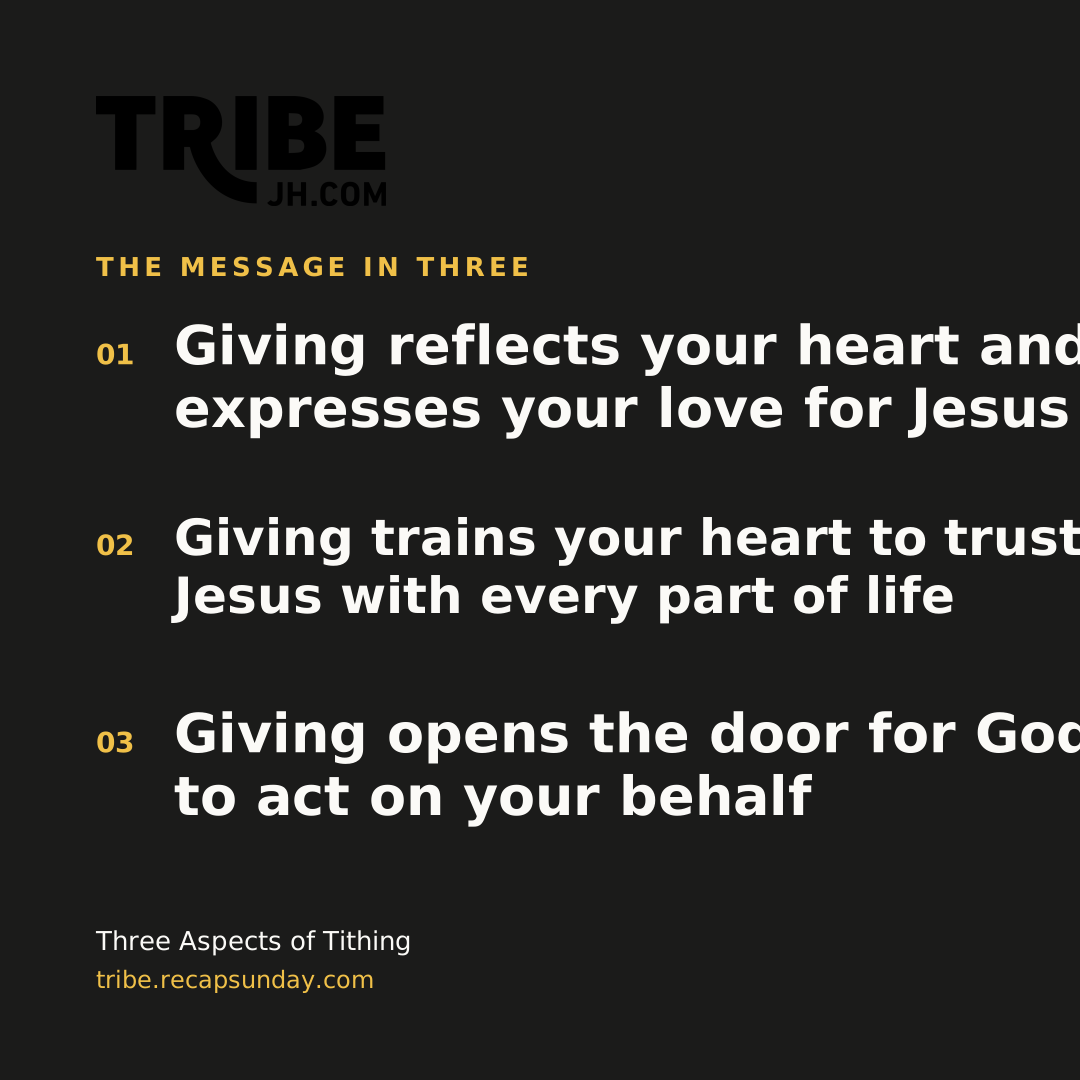
We're gonna have some more discussion on this on this next room because we're gonna read a a new story. Turn over to John. Three aspects of tithing. Love, giving reflects our heart and is a practical way of expressing our love for Jesus. Trust, giving trains our heart to trust Jesus with every aspect of our life.
And then here's the third thing, something to work with. John chapter six. I know you've read this story too. Jesus and the Lunchable. What?
Oh, you don't have the reference? Joe?
How dare you not read Ryan's mind?
Here comes the bus. I just throw Joe under it. Joe? I will just
He was like for the he's like it's Joe and Doug.
Don't click on it. Don't click on it, but in the next slide, do I have the bottom line? Yeah. Go back. Don't look.
Good job, Joe. Joe. Okay. Joe. John chapter six.
Let's read verse would somebody please read verse five through 13? You're doing great. You're doing great. And we'll have the mic in the room.
Jesus soon saw a huge crowd of people coming to look for him. Turning to Philip, he asked, where can we buy bread to feed all these people? He was testing Philip for he already knew what he was going to do.
That rascal. He's you know, he's always doing that. Yeah. Right? Do you know that about Jesus?
He's always up to something.
Philip replied, even if we worked for months, we wouldn't have enough money to feed them. Then Andrew, Simon Peter's brother, spoke up. There's a young boy here with five barley loaves and two fish. But what good is that for this huge crowd? Tell everyone to sit down.
Jesus said, so they all sat down on the grassy slopes. The men alone numbered about 5,000. Then Jesus took the loaves, gave thanks to God, and distributed them to the people. Afterward, he's did the same with the fish. And they all ate as much as they wanted.
How far am I going?
Through 13. After
everyone was full, Jesus told his disciples, now gather the leftovers so that nothing is wasted. So they picked up the pieces and filled 12 baskets with scraps left by the people who had eaten from the five barley loaves.
Woah. Woah. How much did the disciples start with? Five loaves, two fish. What did they end up with?
12 basket full. Feeding everyone.
Could
be 15,000. Let's let's just say that. Yeah. He is the same yesterday, today, and tomorrow. Why?
Why do we clean so tightly to stuff and things. I have to manage this. I have to be in control of this. I have to figure this out. No one else will take care of my family except for my hustle.
I love you Jesus but stay out of this area. I've got to figure this out. And what does Jesus do? Amen. Okay.
My kids hate that phrase in my house. When they when they're like and I just say, hey, man. Like, that that's on you. Okay. Oh, yeah.
I hate it worse when they say it back to me. Hey, man. Let's go all the way back to Ashlyn here, and then we're gonna tie a bow on things.
So when you say, like, Jesus is the
same yesterday, today, and forever, I've actually seen that miracle, like, happen. And another element that, like, maybe doesn't get hit on in that is is you have to be you you go in willing with a self sacrifice. There's not a we're doing the ministry. There's five loaves, two fishes. I'm ministering to these people, therefore, I should eat.
The miracle happens when there's, like, the love and the trust and also that element of it is what God is doing in this place is more important than than my needs. God will cover my needs in the long term in addition to in the short term. And, like, when we saw this happen, we, like, brought we brought bread in and, like, sugar cane. And we're like, we're gonna feed the kids and we're also gonna, like, feed ourselves. And then there were, like, tons of kids.
And I was all, like, okay. Cool. We will feed the kids.
Where was this? This is in Mozambique.
I was like, we'll feed the kids and and we'll go hungry. It's it's fine. It's okay. And like, the level of multiplication and what God provided was insane. But it came after that what God is doing here is more important than me eating.
Mhmm. Yeah. And the like the whole not just the kids, the whole village, all the ministry workers, everyone ate, and there was buckets left over. Like, it's Yeah. It's insane, but it came after the sacrifice.
Amazing. So we can believe that the Lord will take care of us. Years ago, there was this, like, daredevil who threw a narrow part of Grand Canyon like back before there were all kinds of rules and regulations and the government closed off parts of the Grand Canyon. And he stretched a tightrope across it, and he would draw these huge crowds because, like, our morbid curiosity, they were like Can he do it this time? So he would go from one end of the tightrope, and then he would come back across the tightrope.
And, you know, as the day warmed up, the air currents were blowing, and he was swaying in the wind. And then he would, like, get a wheelbarrow and put a wheelbarrow on the tightrope, and he was balanced on the edge with the wheelbarrow. And he would say to the large crowd, how many of you believe that I can take this wheelbarrow all the way across the other end of the tightrope and back? And all the hands went up and people will scrap she screaming and shouting and cheering like, I believe you could do it.
I believe you could do it and
he would point at somebody with their hand raised and be like, why don't you come get in the wheelbarrow? There's a difference between belief and trust. We give Jesus something to work with when we surrender a portion of our finances and giving opens the door for the lord to act on our behalf. Giving opens the door for the lord to act on our behalf. So one of the things that Tribe collectively, you all have done is we have given our time, we have given our talent like with our helping hands and our treasure financially to a small, little, growing church community in the poorest county in all of Wyoming, and it's just over the hill in Riverton, Wyoming with the the work that that we're starting.
With the work that they're starting. Excuse me. We as a collective family have put these these three aspects of tithing into practice. We've given to a church over there called foundations for nations because we love Jesus and wow, you guys are doing amazing work. We love Jesus.
We will we'll we'll give to you. We have given because we trust the lord. We don't just believe but we trust the lord. We put our money where our beliefs are and we are actively giving the lord something to work with so that not in a slot machine vendor sort of way but we just trust you, lord, that as we give to this other growing ministry that built their own church. How many of you have been to Wind River before with us?
Yeah. Yeah, a lot of you have and we'll go again one of these days. But as we're giving to this like church for them to have property and to build a building like you don't think that's not going to come back to us somehow some way? And so when you give, you are giving the lord something to work with and a lot of us as a barrier to tithing think, well, I really don't have anything to give you. I'm not in a secure financial position or somebody else gives or like, I think a lot of people think I'm I'm too young.
We have elementary students that that tithe. I don't know if it's their allowance or what, but it's beautiful to see. Mom gives her her allowance and then she says, how much do you want to tithe? And she's like, let's tithe this amount and then that come from like mom's account or whatever but I can just picture how that exchange works. When we give, we give something we we open the door for the lord to act on our behalf and would you go back to the bottom line one more time?
Giving disciplines our flesh and it reflects our heart. I've said this a bunch. I'll say it one more time. But you, you, you don't pay my salary here to work at Tribe. My identity is not as a pastor.
It is my assignment. My calling is to be a shepherd, to lead, love, and shepherd the people of this valley. I'm fulfilling that calling through this assignment, but god is my source. I want to say that maybe to free you and maybe in some way, I don't know. That helps your heart or not but I share these things with you because listen, I have learned valuable lessons throughout the years on tithing and I share them with you for your benefit, not for my benefit or for tribe's benefit.
God is our source and God is the source for tribe. If none of you gave a nickel from here on out, god would still be faithful. I don't know what that would look like. I don't know but he's he's faithful. And so I share these with you for your growth and for your benefit.
So let's take a little a moment. And who knows? The Holy Spirit may have you off on a rabbit trail about something else. Deal with let the Holy Spirit deal with you on that. Maybe it has to give with have to do with giving.
But let's just invite the Lord to just whisper to our hearts for a moment. And then we'll worship the Lord in one other way. Us to release the tight grip we have on our own life. I'm trying to hear accurately. Help me to say it that accurately reflects your heart, Holy Spirit.
But I think the Lord would say that some of you have either confused your calling with your occupation or you're trying to manipulate me to agree with the alignment of your calling and occupation. And he says, both of those are wrong. And you need to repent and come under submission to my leadership and my authority. I am only blessing your current trajectory in an effort to try to get your attention to surrender to my leadership. And the Lord doesn't say this in a mean or threatening way but he's like, I've got a lot of other options that I could deploy to get your attention.
He's not mean, but he's like, please, please do not forsake my long suffering and my patience pouring out of my generosity. Don't confuse that with my agreement with your trajectory. And he's like, you know that I'm speaking to you. The lord would say, lord, you you know that I'm speaking to you if right now you're like, and by way of just a quick example, Isaac is a great example of an alignment between his calling and his occupation. Isaac is a licensed electrician in the valley and he does like local specializes in low voltage stuff like AV stuff.
But his calling is to be a minister of the gospel. To live and when needed to say the truth of the gospel. Isaac has a reputation growing in this valley of honesty, integrity, fair pricing, hard work. Those are truths and principles of the gospel. That's his calling, and his vocation is to be an electrician.
He doesn't need to, like, put on, like, a priest collar and, like, wear, like, the minister stole and, you know, walk around because he lives. And I know many of you, many of you have there's an alignment between your your calling and your occupation. But the Lord would say, don't try to manipulate me. You're only fooling yourself. So Lord, I pray for that person or those hearts in here that there's some unalignment that they would repent, they would grow trusting you more and more.
And there would be a beautiful alignment so that as they surrender their fishing loads, you can feed thousands Alright, Connor.
I love how the Holy Spirit works because he had something queued up in my mind that builds right on top of that. We read John six, and when Jesus asked that question, where can we buy bread to feed all these people, he looks at Philip. And the following line says, he was testing Philip for he already knew what he was going to do. I can I can picture him with this little smirk on his face like, hey, hey, Philip? What do you what do you think we should do?
And Philip very easily could have been like, alright. All 12 of us, we'll go around and we'll see who's got money and we'll pull something together and we'll make it happen. Like, taking it in his own strength and he's like instead, he's like, Jesus, I got no idea what we're doing. Like, it's in your hands. And I think in that same way, like, we can so easily be like, we'll make it happen in our own strength.
And with our jobs too, like, I'm just gonna do this thing and run with it. And Jesus is like, I want all of it. Like, in the same way that the forgiven little is hyperbole because we it's not possible to be forgiven little. Like, in the same way, we all, if we really look at it, don't have a lot at our hands. Like, all that we have is monopoly money.
Right? Like, Jesus has the ability to take it and use it for his kingdom to do amazing things, but until we surrender it to him, like, it's just kinda cheap. I get the picture of, like, an eight year old trying to go to a candy store with monopoly money trying to buy something. It's like, that's not gonna work. But Jesus invites us in.
That's what he's doing with Philip in that picture, is he's inviting him in to surrender, to do something miraculous rather than him trying to do it in his own strength. Yeah. We're gonna pray over the offering with that in mind. So bow your heads and pray with me. God, thank you that we get to worship you in so many different ways, God.
Whether in worship or with your word, God, and with surrender and giving. God, thank you that we get to practice this thing. It's it's a spiritual discipline because it's not easy. So be with us as we engage in practicing surrender to you, God, and practicing our giving, our generosity. And take these small loaves and fish that we give you, God, and multiply it.
We know that you can, God. We know that you do, that you sustain us in ways that don't even make sense when we surrender to you, God. So we give you everything, and we partner with you. We want in, God. We wanna say yes just like Philip, just looking back to you rather than finding our own solutions, God.
We give it all to you. So do with it what you will, God. We pray this in Jesus' name. Amen. We don't pass buckets here at Tribe, if you're new, but we do have a little lockbox back at the back of the room and a black box on the outside for cash or check.
You can give online at our website, tribejh.com, or you can do a text to give. If you don't already have a contact, it's super easy to just throw that number in as a contact for Tribe, and then it's just as easy as texting a friend after that. You just type in give in any dollar amount, and it works. As far as announcements go, there were connect cards all over. If you're new, we would love to have a record of your visit and to be able to engage with you.
If you're not new, but you don't get these text blasts that we send out for reminders of service or events that we're doing, fill that out so that we can keep you in the loop on things. And then on the backside of that, there are prayer requests, and our staff gets to pray over those every week. We would love to join you in prayer. Thank you, Ashlyn. Was it Ashlyn that brought Goodies today?
Woo. Thanks for Afton Coffee Company. They donated it. Let's go. That's awesome.
Come on. We love having goodies here. Everybody loves having goodies on Sunday mornings. But those are provided by us or, like, by different people. So there's a sign up sheet on the fridge if you wanna join in on doing that.
And then Tuesday nights, have a young adult service, 20 30 that meet here. We break bread together, and it's a great way to get a bunch of hungry people living out of their cars to get here to come and do life together and to hear from the word. And so we've got a sign up sheet as well for meals there, and that is a huge blessing for so many of those people. And then we just ask that you join us in praying week in, week out for tribes next home. That is something that our staff does ad nauseam, like night and day.
Like, we are always praying for tribes next home. And right now, specifically, we have two places this month that we're looking at, And that happens a bunch. There's always places that we're looking at, and we're always in prayer.
Liz is always looking over fences.
Exactly. Anytime there's a for sale sign, like, somebody's making some texts. Exactly. So just continue joining us in prayer for that, both for the direction from the Lord and where he would have tribe go next and for the provision to make it happen financially. Right?
Yeah. You wanna come and pray us out? Thank
you. Let's stand up. Would that be alright if I prayed for you this morning? Jesus, we love you. We love you and we trust you with every aspect of our life.
We ask Holy Spirit, you know like, our our our flesh is so strong and it wants to control and be in charge. Help us, Lord. Help us to to exercise that trust muscle. Lord, out of the overflow of our heart, may our lives be lived to make your name famous. I command a blessing over each and every person here this morning.
Thank you for bringing us together. We pray these things in Jesus name, the strong son of god and everybody said, amen. I love you guys so much. Have a great week and remember, you got this.