David playing the harp to drive away the tormenting spirit that troubled Saul, used to illustrate worship as a weapon in combat
14 Now Yahweh’s Spirit departed from Saul, and an evil spirit from Yahweh troubled him.
15 Saul’s servants said to him, “See now, an evil spirit from God troubles you.
16 Let our lord now command your servants who are in front of you to seek out a man who is a skillful player on the harp. Then when the evil spirit from God is on you, he will play with his hand, and you will be well.”
17 Saul said to his servants, “Provide me now a man who can play well, and bring him to me.”
18 Then one of the young men answered, and said, “Behold, I have seen a son of Jesse the Bethlehemite who is skillful in playing, a mighty man of valor, a man of war, prudent in speech, and a handsome person; and Yahweh is with him.”
19 Therefore Saul sent messengers to Jesse, and said, “Send me David your son, who is with the sheep.”
20 Jesse took a donkey loaded with bread, and a bottle of wine, and a young goat, and sent them by David his son to Saul.
21 David came to Saul, and stood before him. He loved him greatly; and he became his armor bearer.
22 Saul sent to Jesse, saying, “Please let David stand before me; for he has found favor in my sight.”
23 When the spirit from God was on Saul, David took the harp, and played with his hand; so Saul was refreshed, and was well, and the evil spirit departed from him.
David strengthening himself in the Lord after Ziklag was raided, used to illustrate worship as a calibration tool
1 When David and his men had come to Ziklag on the third day, the Amalekites had made a raid on the South, and on Ziklag, and had struck Ziklag, and burned it with fire,
2 and had taken captive the women and all who were in it, both small and great. They didn’t kill any, but carried them off, and went their way.
3 When David and his men came to the city, behold, it was burned with fire; and their wives, their sons, and their daughters were taken captive.
4 Then David and the people who were with him lifted up their voice and wept until they had no more power to weep.
5 David’s two wives were taken captive, Ahinoam the Jezreelitess, and Abigail the wife of Nabal the Carmelite.
6 David was greatly distressed; for the people spoke of stoning him, because the souls of all the people were grieved, every man for his sons and for his daughters; but David strengthened himself in Yahweh his God.
7 David said to Abiathar the priest, the son of Ahimelech, “Please bring the ephod here to me.” Abiathar brought the ephod to David.
8 David inquired of Yahweh, saying, “If I pursue after this troop, will I overtake them?” He answered him, “Pursue; for you will surely overtake them, and will without fail recover all.”
The message in order, in a few minutes of reading.
Brian opened with a brief, honest update before turning to the main subject: worship, what it is, why every person already does it whether they know it or not, and what it can actually do for you in the middle of real life. This was the first of two planned weeks on worship, sitting inside a longer stretch of conversations about the word, worship, and tithing as three foundational practices for anyone following Jesus.
What was said
Before the sermon proper, Brian told the congregation plainly that the Israel trip he had announced and promoted was being pushed to a future date. He said the response from Tribe fam had been tepid at best, and when he went back to the Lord in prayer, he felt like the trip had been about 51% his own initiative and 49% the Lord's leading. He framed it not as a confession but as a straightforward update, and said he thought a longer runway, announced in the fall for a spring break departure, would serve everyone better.
The main conversation opened with a question to the room: how would someone you actually do life with, a coworker or a friend on the river, define worship? The answers that came back, and the stories people shared, landed on a simple observation. Everyone worships something. Brian put it this way: God, when he was building man, added a mechanism in our being that innately will devote allegiance and affection, protect, and invest in something bigger or greater or higher than us. One person in the congregation described years of near-obsessive devotion to Bob Dylan before knowing the Lord, spending money, time, and energy in ways that fit any reasonable definition of worship, even if she would not have used that word then. Brian quoted Bob Dylan back to the room: it may be the devil or it may be the Lord, but you gotta serve somebody.
Brian then separated three related but distinct things. Thanksgiving is the natural human response to encountering the deeds of God. Praise is the natural human response to encountering the character and attributes of God. Worship is the natural, normal human response to encountering the presence of the Lord. He walked through several biblical moments where a person encountered the presence of God and their body hit the floor, Moses at the burning bush, Saul on the road to Damascus, and said his prayer for Jackson Hole is that God would cold-call people on the river, on the trail, mid-route on a climb, and produce exactly that kind of moment.
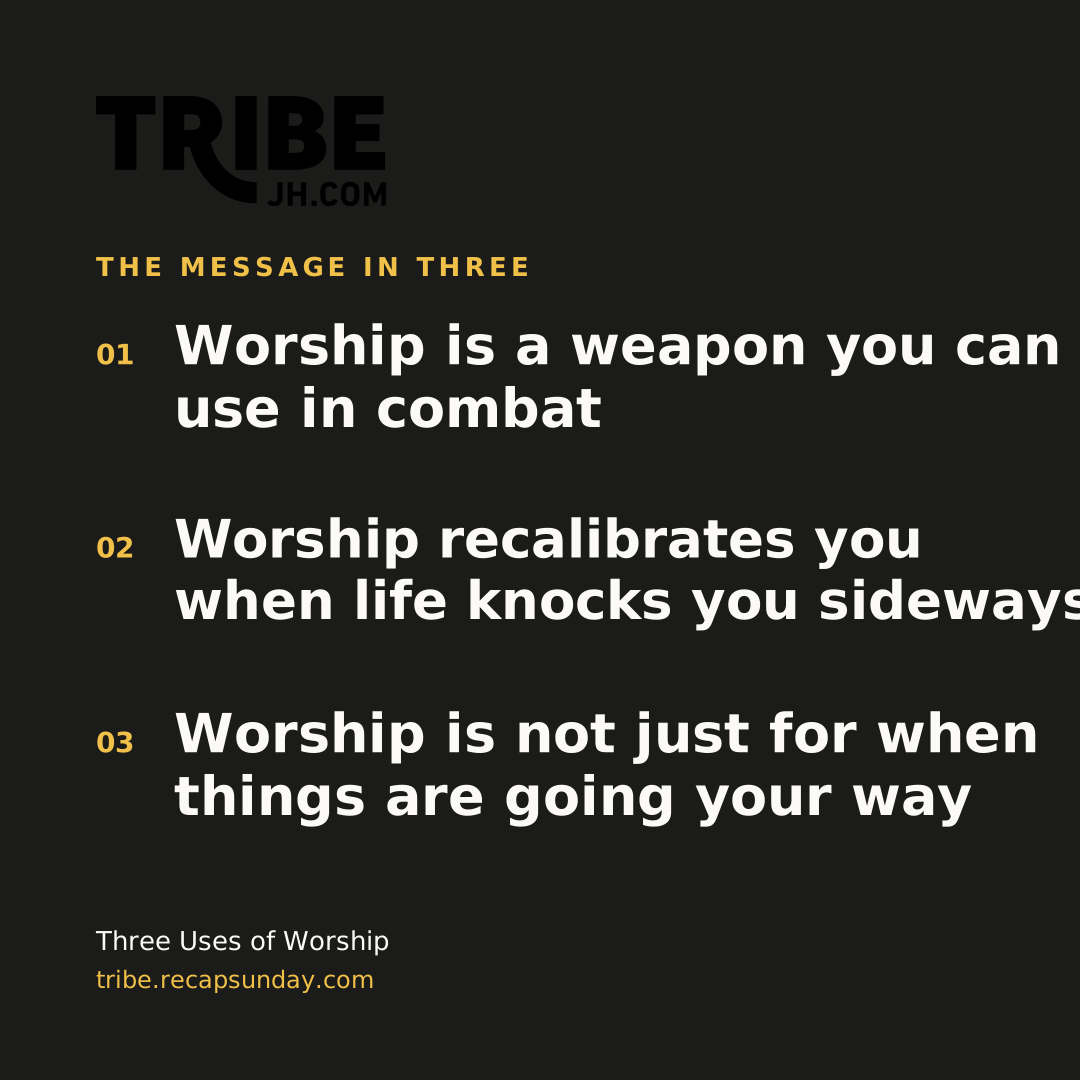
The body of the sermon was built around three uses for worship, which Brian called his three C's. The first is combat. He read from 1 Samuel 16, where David plays the harp for Saul and the tormenting spirit goes away. A woman in the congregation added her own testimony: on October 7, she and her husband were in Israel when the attacks began, and they started singing the song "It May Look Like I'm Surrounded." She said the peace that came over them was immediate and real. Brian's point was that worship is not only a natural response to feeling good. It is a weapon, and most people never use it that way because they do not even know they are in a battle.
The second C is calibration. Brian read from 1 Samuel 30, where David returns to Ziklag to find it burned and his men talking about stoning him. David strengthened himself in the Lord, and only after that did he quiet down enough to inquire of the Lord about what to do next. Brian said worship gets your mind right before you fire off the texts or start defending yourself, and a calibrated heart greases the wheels of being able to hear from God.
The third C is celebration, drawn from 2 Samuel 6, where David dances before the ark with all his might. Brian said celebration is probably the most instinctive use of worship for a believer, but if celebration is the only time you worship, you are in trouble. The analogy he used was going to work: you do not go because you feel motivated every day, you go because you have built discipline around it. Worship works the same way. The goal is to build enough muscle memory that when life comes at you, the trained response is to turn toward the presence of God rather than toward distraction or self-protection.
Touch points
Things you could actually do this week.
Pick one Bible verse from the memorization series and repeat it out loud every day this week until it starts to stick.
The next time anxiety, fear, or a hard situation hits you this week, put on a worship song instead of reaching for your usual distraction, and sing along even if it feels awkward.
Think of one person in your life who is outside the church and pray this week that God would reveal himself to them the way he revealed himself to Saul on the road to Damascus.
If there is someone you have not forgiven, bring that specific name and situation to God this week and ask him to apply his forgiveness to it, even if you have done it a hundred times before.
Before you make a decision about a difficult situation you are facing right now, spend a few minutes in worship first to get calibrated, and then ask God what he wants you to do.
Doing a Bible study?
Here is a guide we have prepared for you: the passages
in order, questions for the group, and room to write.
Brian said that every human worships something, and that self-worship is probably the default before a person meets Jesus. Where do you see that playing out in the people around you, and honestly, where do you still see it in yourself?
One person in the room described worshiping Bob Dylan before she knew the Lord, spending her time, money, energy and thoughts on him. What did you give that kind of devotion to before you followed Jesus, and how did it leave you?
El pastor Brian comenzó reconociendo ante la congregación que el viaje a Israel que había anunciado no llegó a cuajar. Explicó que, al volver al Señor en oración, sintió que quizás se había adelantado, y que la idea de ir a Israel sigue en pie pero para una fecha futura con más tiempo de anticipación para que todos puedan planificarlo bien. También habló sobre lo que es el culto, recordando que todos los seres humanos adoramos algo, ya sea a Dios, a nosotros mismos, o a cualquier otra cosa que ocupe el centro de nuestra vida. Usó el ejemplo de alguien que antes de conocer al Señor adoraba a Bob Dylan con una devoción total, para ilustrar que la adoración es algo que todos hacemos, aunque no lo llamemos así.
La conversación central giró en torno a tres usos de la alabanza a Dios mediante el canto. Primero, como arma de combate espiritual: así como David tocaba el arpa y el espíritu atormentador se apartaba de Saúl, nosotros podemos usar la alabanza cuando sentimos depresión, miedo o angustia. Segundo, como herramienta de calibración: cuando todo se derrumba a nuestro alrededor, como le ocurrió a David al regresar a Siclag y encontrarla quemada, la alabanza nos vuelve a centrar y nos prepara para escuchar la voz de Dios con claridad. Tercero, como celebración: alabar al Señor cuando las cosas van bien es más natural, pero la disciplina está en aprender a adorarlo también en los momentos difíciles, no solo cuando uno tiene ganas.
El pastor Brian cerró invitando a todos a imaginar su situación más difícil en este momento y a practicar cantarle al Señor en medio de ella. También mencionó las ofrendas como un acto de adoración y disciplina, y anunció que ese mismo domingo habría un evento en la plaza del pueblo para expresar apoyo a la comunidad judía local, seguido de la proyección de un documental sobre lo que ocurrió el 8 de octubre de 2023.
---
Pasajes bíblicos mencionados:
Salmos 150 (leído en su totalidad durante el servicio)
1 Samuel 16.14-23 (David toca el arpa para Saúl)
1 Samuel 30.1-8 (David se fortalece en el Señor en Siclag)
2 Samuel 6.14 (David danza delante del Señor)
Salmos 91 (mencionado de pasada, sobre refugiarse bajo la sombra de sus alas)
Read the full transcript10,155 words
Who's ready to worship? Ain't nobody ready to worship. Let's stand together. Let me pray for us as we get started. Oh, Lord, you know and you see every single one of us.
Lord, we bring what we bring in here today with us and burdens and joys. And lord, right now, we just use praise as a weapon in this place against the plans of the enemy in our lives. This is how we fight our battles right here, drawing close to you in worship. So Lord, come. Come.
Come have your way in this place.
This is how I fight my battles. Is how I fight my battles.
This is how I fight my battles this this how
this is is how how I I fight fight my my battles battles with praise yeah but we fight it
right here right now Holy Spirit, this we welcome your presence in this place. And as we worship you that you would come by your presence and take care of business in this place. Search our hearts right now if there's unrepentant sin, that we need to come to you with and lay at your feet and ask for forgiveness so that we can enter close because there's nothing that compares to your presence.
Yes, Jesus. Just give
him permission today. Give him permission.
There's nothing worth more your presence. I've tasted and seen. I've tasted and seen of the sweetest where my heart becomes free and my shame is We
thank you and we praise you this morning that in your presence is where healing is found. In your presence, we hear our identity. Lord, we just praise you and we thank you this morning. That no matter where we find ourselves this morning, we were hurting or broken this morning that, Lord, in your presence, we are made whole. We just run to you, Father.
We run to you this morning. Just take a minute and just let him speak to your heart. He's here in this room right now.
Jesus is calling.
So have you come to the end?
Have you come to the end of yourself? Do you thirst for a drink from the well Jesus is calling. Oh, come here. Oh, come to Christ is risen.
Come here. Just run to him this morning. Run to him.
Oh, come to the altar. The father's arms are open wide. Forgiveness was born with the precious blood
Let's just take a minute and I just feel really strongly that if there's anybody in this room right now with unforgiveness in their hearts, He just wants to remind you that he paid for our forgiveness with his blood, with his life. So that we could be forgiven even though we didn't deserve it. And maybe you need to forgive someone that maybe you feel like doesn't deserve it. And I just feel like the Lord's just reminding me. It's like you didn't deserve it.
In fact, he died for us before we even chose him. He paid it all. So just do just do a little bit of work with the Lord now, right now. Ask him to search your heart. Lord, is there any unforgiveness in me?
And you may have come to him a million times with this one thing. Come to him again this morning. Ask him to apply his forgiveness to the situation. Because in our own strength, can't do it. We can't do it.
Search your heart. Let him search your heart. Maybe you need to write something down or go to somebody. He takes forgiveness very seriously.
Sing hallelujah Christ is risen
Lord, we just thank you. We thank you this morning that it is done. It is done that we can rest in the finished work of the cross today. Do a work in us today as we dig into your word. Oh, what a savior we serve because you rose again.
You are living and active. Thank you. Thank you. Thank you, Jesus, that we can come freely like this and worship you, that you made a way. We tell you we love you this morning.
Prepare our hearts for what you wanna speak to us through your word today. Search us. Search us. Search us today, Lord. Refine us.
That's our prayer. To be more like you. We love you, Jesus. And everybody said, amen. Turn around and say good morning to someone.
It's volume one. If you need
more or less, if it's hot
Okay. It's
gonna be crowded to get up in here today.
Good morning. Good morning. How is everybody this morning? Wonderful. Good.
Yes. Lissy worship was amazing. So good. Bethany on keys. Amanda getting a break.
She's so on break. She's like, I'm just gonna break out of here. Okay. So let's see. What do I wanna I mean, I know what I wanna start with, but I haven't thought of exactly how I'm gonna say it.
It it think when I say it, you're gonna be like, oh yeah. Okay. Cool. Like not a big deal. And you might even say like, yeah, I kinda knew it.
I'm Sometimes I can be a little bit slow. Okay. At least
I knew it.
You don't have to be so fast to agree. But I wanna give you I wanna give you a quick update on the on the Israel trip. So our dear friend Susan Yeah. That's great. You can leave that there.
Our dear friend Susan, you know, who got married last summer, and if you're newer to Tribe, you may you may not know who she is, but she got married to this, like, amazing caveman guy, Caleb. Right? And they are they partner or Susan founded an organization that works in Israel with Israelis to do service projects and foster relationships between Christians and Israelis Americans and Israelis. And she said, hey. Why doesn't tribe plan a trip to come to Israel?
Will you throw up that that graphic? And so we had been talking about this for some time now, and in my best intentions, I was like, let's just make this happen. Like, let's just let's just do this trip. Let's just pick some dates. Like, you're never gonna like do it unless you like do it.
So let's just do it. So I mean, I put a lot of time into this silly little graphic.
And
then we like like text blasted it. We talked about it. We did sign ups like gauged the interest. And I will say this from our tribe fam. The interest for this trip was tepid at best.
If not completely like uninterested. Okay. Thank you, Lizzie. Some people, but but very few. Yep.
And a lot of people are like, oh, this sounds really good. Like, oh, this sounds super cool. But then that's kind of as far as it went. And so I don't ever gauge my obedience on your reaction because I don't ever have to stand before you. Right.
But based upon the response, was like, oh, lord. Did I miss miss it or something? And so I went back to the lord in prayer. And he's like, yeah. You kinda forced it.
And I was like, oh, okay. So what do you want me to do? And he's like, well, just tell him. Like, this might have been this might have been, like, you know, like like like 51% PB and 49% like like the Lord. And what I think that means is it's yes for Israel, but it's a it's a question of when.
I think that there's going to be a better win. Yes. Yeah. Yeah. So so two things.
Two things. Number one, I just wanna it's not like I need to confess anything to you, but I just wanna share with you. Like, hey. Like like, maybe sometimes I don't always have the best hero ring, from the Lord, and surprise, I'm human. And then the other thing is I think that the the Lord and Susan and Caleb will have a better time for us to go to Israel.
And the third thing is when we do go, I think giving you a longer runway. Like like, announce it, like, in January and then or, like, announce it in the fall, and then we go, like, over spring break or something like that so that you can plan well ahead, have a nice long runway. Because it ain't cheap to get over there. So and it ain't cheap once you're there. So list, do I do I feel like I said what I needed to say.
No. Okay. So do you feel like I did like Did I say it all and write? I missed it. Yeah.
I missed it. Yeah. You're being gracious to let me off the hook that easy. But, okay. So can everybody be like, ah, about Israel and like let's just move it to a future date.
Okay.
And we don't know why.
And I'm not quite sure why. Yeah.
Yeah. Yeah.
Okay. Now, next. Oh. And let's go to, the title of the conversation that we're gonna have today. I know absolutely nothing about music.
Whoops. Is that your wooden leg? Strap it on tight. So I know nothing absolutely nothing about well, know about worship, but I know absolutely nothing about music. But you'll see why I titled the sermon this later in our conversation.
But this is the title of the conversation that we're gonna have, and it is coming right on the heels of two weeks of conversations that we had about the importance and the power of burying God Alright. Oh, okay. There goes the other leg. The conversation that we're gonna have today comes right on the heels of two weeks of conversations that we've been having about the importance and the power of burying God's word deep into your heart. And somebody made the comment recently about not just rote disconnected from your heart memorization, because the pharisees all did that, and they completely missed Jesus.
But when we bury God's word deep into our heart, and the best way for us humans to bury something into our heart is to repeat it, to memorize it, to meditate on it, it stands the best chance of penetrating deep into our heart. And when God's word penetrates deep into our heart, that's what has the power, the capacity to change and transform our lives. So how how are we doing on memorizing some bible verses? Yeah. Alright.
Good. Good. So when we when we the more word we bury deep into our heart, it's more resourceful that right on the heels of burying God's word deep into our hearts that that would partner like a left and a right leg, even if there wouldn't, to talk about worship. And we'll talk about worship for two weeks, and then I think like a trifecta. I'm not sure well, I guess we'll get to it in three weeks, but we're gonna talk about tithing.
Not just our finances, but but other things in our life. So the word and worship and tithing. That's kind of where we've been, where we are, and where we're going for the next few weeks. And these messages, conversations, are intended to be very manageable. Some of the conversations that we have are are are deep and and challenging and stretching introduction of concepts or material maybe that that the Lord wants you to be exposed to but you don't have any experience with and you're like, ah, what is this?
And some conversations that we have are intended to be more foundational. Foundational. And so that's what we're that's what we're looking at. Memorizing God's word, meditate on meditating on it is foundational. If you follow Jesus, you spend time in his word and you memorize it.
If you follow Jesus, you spend time interacting with him through worship. So if you have your bibles with you today, would you open up to Psalms one fifty? Psalms one fifty. And I'm gonna turn there as well. Today, as with every Sunday that we've gathered together for the last couple of years, we engage in a model of conversation in the format for digging into the word and coming to church together.
When it comes to digging into God's word together, I would like this to be less of a monologue and more of a dialogue. And so I want us to have a conversation about the things that we're gonna talk about today. And so we welcome your questions, your comments, your connections. As you are as we're going through what we're gonna talk about today, if there's a question that pops up, let's just talk about it. Okay?
And we also have a mic in the room so that all of our families that are watching the livestream or traveling or away for the summer get to be a part of the service today. With that, Kat has a mic. And would you voluntell somebody to read? I'll I bet one person could tackle all of Psalms one fifty in its entirety. Amazing.
He volunteered.
Oh, he volunteered. Alright.
Alright. Okay. Praise the Lord. Praise God in his sanctuary. Praise him in his mighty heaven.
Praise him for his mighty works. Praise him in his unequaled greatness. Praise him with a blast of the ram's horn. Praise him.
Oh, and sound effects sometimes are allowed. Yes. Sorry. I threw you off, Joe.
Dang it. Praise him with the Liar? Liar and harp. Praise him with the tambourine and dancing. Praise him with strings and flutes.
Praise him with a clash of cymbals. Praise him with loud clinging clinging cymbals. Let everything that breathes sing praises to the Lord. Praise the Lord.
I love that. Look at the end of verse six. Let everything that has breath sing praises to the Lord. And then the writer was like, and how do I finish this?
Praise the Lord.
Praise the Lord. One more time as if he just absolutely couldn't resist. We're just gonna be talking about worship for two weeks, and I often feel this way whenever the Lord would like me to to launch into, like, a a new series of conversations that we're having. But I feel like, especially with worship, I feel like it's like handing you a thimble of water and trying to use that to describe the ocean. Like, there's so much that we could talk about with worship, and I know that each of you who have walked with the Lord for any length of time or have encountered the presence of the Lord in worship that you're like, oh, I could just go on and on and on and on.
And so I wanna I wanna say that right up front. When we're done with today, if you're like, yeah, but you didn't about this, and you forgot to mention this, and how about I know. I know. The best that I can do is just give you a little thimble of water as we're trying to talk about the vast ocean. And so in terms of worship, there are lots of ways to worship the Lord.
We're going to primarily just today we'll see where the conversation goes. But today, we're primarily just gonna talk about worshiping the Lord through song. Worshiping the Lord through song. And we need to have a quick getting on the same page in terms of defining worship. So if I were to ask you, how would you define worship?
Or if I were to ask you, what do you worship? You may like, here you are sitting in church, like, uh-uh. How do I answer that? And, like, we always wanna give these like like Sunday school answers. So in order to promote a little more honesty in you, let's answer this question in terms of think of somebody that you do life with.
And if they were asked the question, how do you define worship, or what is worship, or what does worship mean to you? How might they, people that you, like, live with or work with or or or play with in the mountains, how do you think somebody not in this room would answer that question? Think about it. What do you got?
If you're asking them, are
they asking them? If they if you are asking them, which is probably conversation that you have on the deck at the bird all the time. Hey, man. What are your thoughts on worship? You probably have that all the time.
But if you were to ask a coworker or somebody that you went to school with or something, what do you think they would think about this idea or concept of worship? Yeah. Foreign. Okay. Say say it one more time in the mic.
Very foreign. It's very foreign. Tell us, like, elaborate.
Friend that mentioned that same I had a friend that mentioned that same word. He's like, worship. Like, he he was, like, perplexed. And, like, yeah, it was interesting. I because he doesn't it's foreign because he doesn't know the lord.
So it's a entity that's undef I don't know. Undefined or
Totally unknown to him.
Unknown. He was it was it kinda like it grabbed him and he just his his reaction. It was interesting to see. So
Wow. Yeah. That's okay. There we go. Was by chance, was that conversation at the bird?
And
I one of my dear friends grew up very structured Methodist, all about the pomp and circumstance of, you know, just very ceremonial. And when she would come to church with us, she was like, yeah. I don't get into that raising your hands and all that stuff. Mhmm. Now and she's been here to tribe as well.
Mhmm. Now she lives in Park City and goes to a church called The Well. I've never been there. All she talks about is lifting her hands and praising and how she feels in the presence of Jesus. Wow.
And she had never experienced that before in the church she grew up in. Interesting. And was very hesitant to even think about raising her hands or singing praise to the lord. So Mhmm. It's a it's a release that I I hope more people get to experience.
Certainly. But so many people around here, you know, while you don't see the Catholic church doing it. You know? Mhmm. And you don't see first b doing it.
Mhmm. Some people do it in first b. Sure. But I just wish people could feel the the freedom Sure. Of worship.
Sure. And to be fair, I know that that's not where you were going to comment. Different strokes for different folks.
Yeah.
I had a I had a had a youth leader one like back before the civil war when I was doing youth ministry. Mhmm. Some things still hang on. And no. No.
No. You can't high five at side jokes Oh, I can. In church. It's a conversation, but not against me. And and he was like like love Jesus, ran hard after God.
Every time we would do worship, he would just like sit and bow his head and fold his eyes. And I was like, bro, come on. You're a youth leader. Like, help us model. He's like, well, this is how I worship.
I love like, I love worshiping and getting into worship, and this is how I do it. And I was like, alright, bro.
I think for me, worship is what you give your heart and your time and your attention and your resources to. Okay.
So this is really interesting because part of the way that we are wired as humans is to worship and give our allegiance to something bigger or more grand than us. And we do that in the same way that we metabolize food. Like, we just do it. But to but you could talk to people about metabolizing food, they're like, you know, they may or may not have any kind of scientific understanding of that process, but they know that they do it. But worship is something that is like like like you you said earlier with that comment.
Like, if you were to ask them like consciously, they would be like, what? What an interesting paradox. Everybody does it. Few people know that they do it. Oh.
Oh. Oh. Yeah. Yeah.
While she had the mic, I thought I would jump in. Yeah. I think, like it was touched on earlier that in society and around the world, when there's a call to worship, it may be different than what I think worship is. And for me, it's admiration and love and everything my heart can pour out for the God that created life itself. And the call to worship around the world can mean very stoic, very religious, very I don't know just totally different than the way non denominational or charismatic churches.
We tend to necessarily follow those religious orthodox type methods of worship. I think it's a freedom, is I guess my point. It's a freedom that I feel personally to worship God, to express him my love.
I love that. Anybody ever been to a church where they around the perimeter of the inside of, like, the room, they have arrows on the floor to run so everybody runs in the right direction. Different strokes for different folks. Oh, yeah. Listen.
Yeah, please. I
was just thinking in my own life before it was surrendered to the Lord, and I think that the world might not wanna acknowledge, like, I worship that, but your actions if you've traced your actions, you know what you worship by your time spent, your attitude towards things. And I know this sounds silly, but this is an honest true story. Like, I worshiped Bob Dylan before I knew the Lord. I really truly did. I wanted to know every facet of his life.
I wanted to know every song, why he wrote it, where he went. I traveled everywhere he was, and I also would defend him with my life. I mean, I lost so many friends similar to when you, like, come to know Jesus because if someone would like, oh, what are you listening to? And I'd be like, here we go. I wouldn't even wanna tell people because I was like, if they imitate him when I say Bob Dylan, I can't talk to him anymore.
And I know that sounds funny, but it's absolutely true. Like, I mean, deep obsession where I had my headphones in for about two years, never taking them out except a shower. And it was because I was made to worship and the enemy was like, here you go. Here's something, and I'll give you books, and I'll
give you no. No. No. No.
You can pour all of your stuff. And guess what? It's gonna be empty.
Mhmm.
But if I can just keep you on this long enough to keep you and so I think that if you the world if someone had said, do you worship Bob Dylan? I think I'd be like, that's that's an interesting word for that. But I would have said, yeah. Like, define worship for me, and then I would have been like, oh, a 100%. Like, it's where I spent my
time and my money and
my energy and my thoughts.
Mhmm.
So my point is I think that the world does fully understand worship. I just don't think that because that word is so holy that they would say that word.
There's a lot of power to that word.
Yeah. Yes. A lot.
And to quote Bob Dylan. And listen, well, help me correct this if I get it wrong. It may be the devil or it may be the lord, but you but you gotta serve somebody. It
may
be the devil or it may be the lord, but you gotta serve somebody. Gotta stand for something. So worship to all get us on the same page just before we, like like, move on with a conversation. Every single human in within the sound of my voice and that will watch the livestream and that will listen to the podcast, we all worship something or multiple things because we are created and designed to worship. God, when he was building man, added a mechanism in our being that innately will devote allegiance and affection, protect, invest in something bigger or greater or higher than us.
Even if that is, and I'll need to explain it after I say it, yourself. Many, most would worship themselves or the marriage or the kid. Let's talk about self worship for just a moment. I would say that's probably the default before a person meets Jesus, what they worship themselves. They are the priority.
Their own desires and ambitions, likes, dislikes are the highest source of truth and knowledge. And they will defend and protect. They will promote themselves. And with everyone around them worshiping their own god of themselves as well, Everybody has their focus so turned inside that that in a group of, like, lost noonies here in this town, you're worshiping yourself, and you're worshiping yourself, and you're worshiping yourself, and then you just interact with one another, and you're on the river together, and you're hiking together, and you're skiing together, and you're working together. And there seems to be a level of camaraderie and cohesion and friendship.
But number one, there is a a a lack of genuine connection because you're really only worried about or focused on connecting with yourself. It's yourself. There is a lot of self worship. You are your own god, and that's partly why your own god. And that's partly why people who worship themselves as their own god place themselves as the highest priority, their ambitions, their desires.
They protect their wounds. They they mask their flaws and their faults because if you're gonna worship a god, it better be perfect. That's why a lot of them don't like to come into this room because they are confronted, number one, with their selfishness. Number two, they're confronted with a different god. And they see and they're in a room of people that are praising, worshiping.
The word that you used was adore. A bigger, a different god than them. Instinctively, most of us do not want to step into the thunder dome. Two men enter, one man leaves. So they don't even step into it.
But to worship the lord requires an acknowledging that you aren't what is that quote? I'll mess it up. Master of my fate, captain of my own destiny. But if you can drop your pride long enough to draw close to him, to consider him, to have an open mind, to have an open heart, to have him reveal himself to you, something a lot like worship naturally begins to happen. Jen Green.
I think along those lines on the on the flip side is that some people tend to have the opposite worship in the form of negative where they're obsessed with their failures and obsessed with I can't do it. As a coach, I've seen that, and I think it's important to examine your heart and say, what? Am I elevating myself, or am I tearing myself down? But either way, it's still self.
Imagine worshiping a god that loathes you. Right? I mean, that's people do it because we have to worship something. There is no such thing. And if you are sitting in this room under the sound of my voice this morning, and you're like, I don't worship anything.
You are in the most grave danger. You are up to your eyeballs in deception. And I love you enough to tell you. And the god that you probably worship is most certainly probably yourself. Okay.
Thanksgiving, praise, and worship. We'll define these terms, and then we'll and then we'll talk about Brian's three c's of worship. This is not this is not up there. This is just kind of coming to me. Okay.
Praise is the natural human response when we encounter the deeds of God. Excuse me. Don't write that down. I caught myself. Yes.
Delete. Thanksgiving is the natural human response when we encounter the deeds of God. Like, you can't find your car keys, and you're like, Lord, I know that nothing is hidden from you. Help me to find my car keys. And you're like, yeah.
Check this jacket pocket. Let me check the other jacket pocket. There are your car keys. Lord
Thank you.
Thank you for helping me find my lost car keys. We have encountered his deeds. Lord, thank you for that good report from the doctor. Lord, thank you for getting me that job. Whatever.
When we encounter the deeds of God, the norm like, and you don't even have to be saved. Thank the Lord I had a day off and it's a powder day. You know? Thanksgiving. Praise is the natural, normal human response when we encounter the character of God.
Praise. And we sing about a lot of praise and worship is praise. When we have encountered the attributes of God, his mercy, it may still come out of our mouth as thank you, but it's praise. Thank you for your great mercy. Thank you.
I praise you that you are a god of the future. I praise you. I praise you, lord, for your great kindness and patience. Thanksgiving is the natural human response when we encounter the deeds of the lord. Praise is the natural, normal human response when we encounter the character, the attributes of the Lord.
And then there's worship. Worship is the natural, normal, human response to encountering the presence of the lord. You can look all throughout the bible, stories in the Old Testament, and sneezing is a natural response to a tickling of the optic nerve behind our eye. It this proves true true all throughout the bible. So Naaman, the leper, he goes to the prophet in the Old Testament.
He was he was a not from Israel, but he had this condition, a skin disease, couldn't get it cured, goes to a prophet in Israel. God tells him, hey. Or through the prophet, like, hey. Go dip in the Jordan River seven times. On the seventh time, he comes up out of the river, and his skin is fresh and clean.
He's been healed better than a shower with the Irish Spring body soap. And then he's like, wow. Thank you. He wants to give a gift. The prophet's like, yeah.
Keep your keep your money. And then he says, can I just take some of the dirt back with me from the land of Israel back to my hometown so that he can stand on this dirt and thank the Lord for what he did and praise the Lord for the attribute of healing? But then worship is something altogether different. Worship is when a person encounters the presence of the lord. It can be exuberant.
Your hands can be raised. Maybe you need to take a lap, or maybe you fall to your knees. Most often, when people encounter the lord, the Lord's presence, it is a very humbling and dare I say terrifying or in an Old Testament biblical way, a terrible experience. Experience. Or Because in in some way or measure, the Lord pulls back the curtain of what you you think of him.
He pulls back the curtain of that and allows you to see him for who and how he is. And you're
like, oh.
Oh. What examples come to your mind of a bible character encountering the presence of the lord and their reaction? I can think of a couple, but I'd love to hear what you're thinking. Moses, alright, tell us a little bit more. Oh, okay.
Yeah. Yeah. Gotta get the mic. Thank you, Cat.
Well, when he first used the burning bush
Oh, I hadn't thought of that one.
He like wants to hide, but then takes his shoes off because he's on holy I mean, he's told to take his shoes off because he's on holy ground. Yeah. And then when he's on Mount Sinai and he's in the presence of the Lord, he falls on his face. Yes. And there's multiple I mean, I can't think of all of them, but like every time someone encounters the Lord in the bible, feel like they fall on their face.
Yeah. Yes. What's another story you can think of from the bible of somebody encountering the Lord, whether they knew and worship the lord or it was like a cold call. Oh, yes. A bright light on the road to Damascus.
Yes. Saul falls, and he says, who are you, lord? Oh, god. I ask that you would encounter young adults in this valley, on the river, on the trails, in their drift boats, in their kayaks, as they're racking up at the base of a climb, even mid route, Lord, on the single track, wherever it is at their job, that you would just more and more just cold call, reveal yourself to people, that they would fall to their knees and be like, who are you, Lord? That they would be confronted with the idolatry of worshiping the God of themselves, and they would see how pathetic and pitiful and broken and fallible and vastly superior the god that they've been worshiping is compared to the one true living god, Yahweh.
Lord, there's a verse that says, oh, Lord, that you would rend the heavens and come down. Reveal yourself to this city. And, god, we ask you go after the most hard hearted, god mocking, idol worshiping, last person that you would ever think to get saved, go after them. Conquer their heart, Lord. Reveal yourself to them that they would worship you.
And anybody in here that would agree would say, Three reasons for worship. And I'm primarily talking about worshiping with song by singing, whether it's in a congregational setting or in your earbuds when you're out and about or in your car or on the bus out to the village. I'm primarily talking about singing. Air moving over your vocal cords and making the sound even if it's as bad as a clanging cymbal like my voice. Worship for combat.
A lot of people experience the blows in the attacks of combat. Few people realize that they are in a battle. Can you imagine being in a battle and not even knowing it? Worship can be used as a weapon in combat. Let's read this passage really quickly in first Samuel chapter 16.
Let's go to the worship warfare guru in first Samuel. First Samuel 16. Okay. I'll read this. Verse 14 through 23.
Hey. Has anybody seen it was it was on the it doesn't seem like there was a lot of fanfare about this, but there was a a series. I don't even know on what platform it was, but it's called the life of David. Did anybody raise your hand if you saw one or more of those. HouseOf David.
Amazon Prime. Okay. Amazon Prime. Yeah. You you all got a subscription to Amazon Prime?
Don't be saying that you don't. Or you got your buddy's password. It's it's interesting. HouseOfDavid. Okay.
HouseOfDavid. It's it's worth watching. And eat the meat, spit out the bones. So first Samuel chapter 16, I'm gonna read verse 14 through 23. Now the spirit of the lord had left Saul and sent a tormenting spirit that filled him with depression and fear.
Raise your hand if you are afflicted regularly no. Don't. By depression and fear. For you. Yeah.
Or or if you wanna be set free, do it, and we will pray for you. Alyssa will come to your house with the lyre and sing over you, and you will be set free. And Gretchen's got the tambourine. I'll bring the clanging cymbals. Some of Saul's servants said to him, a tormenting spirit from God is troubling you.
We could dive deep into the theology of that, but their the Old Testament understanding of the supernatural realm was was somewhat limited. So they attributed great and wonderful and amazing and mighty things to the Lord and all of the bad stuff. They just put it all in one box, acts of God. That is not the correct New Testament fuller revelation of the nature and character of God that we have today. Okay.
Let us find a good musician to play the harp whenever the tormenting spirit troubles you. He will play soothing music, and you will be well and you will soon be well again. Alright, Saul said. Find me someone who plays well and bring him to you. One of the servants said to Saul, one of Jesse's sons of Bethlehem is a talented harp player.
Not only that, he's a brave warrior, a man of war, and has good judgment. I love that you can be a musician and a warrior. Those two words could be synonymous. He is also a fine looking young man, and the Lord is with him. So Saul sent messengers to Jesse and said, send me your son David, the shepherd.
Jesse responded by sending David to Saul along with a young goat, a donkey loaded with bread, and a wineskin full of wine. So David went to Saul and began serving him. Saul loved David very much, and David became his armor bearer. Then Saul sent word to Jesse asking, please let David remain in my service for I'm very pleased with him. Verse 23.
Look at this. And whenever the tormenting spirit from God troubled Saul, David would play the harp, and then Saul would feel better, and the tormenting spirit would go away. Do you ever you probably would not identify it in your own life or heart as a tormenting spirit because you're not spiritually mature enough to name it. I'm not dissing you. I'm just being real with you.
You acknowledge that something's dogging your heels, mindset or patterns, or a frustration, or or acknowledge a feeling of depression. Did you know that drawing close into his presence through worship can be like a weapon of war for combat. The bible says that in his presence is fullness of joy. The bible says that in the Lord, there is no darkness whatsoever nor shatter of shadow of turning, that God is pure light. There can be no darkness in his presence.
Oh, come to the altar. That's what that song is. Now it's about confession of sin, which is great and wonderful, but why not run to him like it says in Psalms 91 and hide underneath the shadow of his wings through worship.
Yeah. Just gonna back you up with some testimony or whatever. Please. But on October 7, when Jacob and I were in Israel, and they were like we spent probably the first half of the day being terrified and changing our plan like 17,000,000 times. We're gonna go to the North with Susan.
We're gonna try to go into Jordan. We're gonna try and get a plane out. Like we just were freaking out. And then Jacob and I just kind of spontaneously started singing the song that we sang today. It may look like I'm surrounded, but I'm surrounded by you.
And we were singing that over and over again. And the peace that came over us, like it didn't matter what was going on. It didn't matter that like reports were coming out of exactly what Hamas was doing, that Hezbollah was starting to gear up to attack the North. Like we were so filled with his peace just from singing that song over and over again.
Yeah. It works. It works. It just works. It just works.
So I have had the incredible privilege of working with members of the Navy SEAL community, and every single young man that goes into BUD's training has not been born with the habit or pattern of running towards danger. Now they may have some inclination towards it, but through BUDS training and afterwards in the forging of a warrior, they have to be trained to run towards danger. And in a similar way, when we experience, just in this specific example alone, was it fear and depression, our instinct is to anesthetize. Our instinct is to avoid. Our our instinct is to try to, like, distract ourselves.
Even though worshiping is natural, it doesn't come natural to us. We have to boss ourselves around and train ourselves when we encounter these things to press into the presence of the Lord through worship because worship can be used in combat. You're in a war. What weapons will you fight with? So one c of worship is that of combat.
The next c of worship is that of calibration. Worship can be used for calibration. I love using David for this. Hang a right, and let's go to first Samuel chapter 30. So a little bit of background before I I read this.
David is being chased by Saul. Oh, how the story has turned. He was brought into his courts now. He's being Saul is breathing murderous threats over David's life. David is running for his life.
In fact, things are so bad that David hides in enemy territory with the Philistines, who are Israel's sworn enemy. And David, with his men, go to fight a particular battle. While they are gone out of the town of Ziklag, another tribe, people group, kingdom of people come and raid the town of Ziklag, and they take off they take everything. That's where we pick up this story. Chapter 30 verse one through eight.
Three days later, when David and his men arrived at home in their town of Ziklag, they found that the Amalekites, everybody go, oh, had made a raid into the Negev in Ziklag. They had crushed Ziklag and burned it to the ground. They had carried off all the women and children and everything else, but without killing anyone. Imagine coming like you've been down in Rock Springs, you've been over in Dubois or whatever. You come up through the canyon or you come up over Toggedy Pass and use you know where the town of Jackson is, and all you see is just this pillar of ash and smoke and fire coming up like, oh, no.
This is bad. That's what's happening here. When David and his men saw the ruins and realized what had happened to their families, they wept until they could weep no more. David's two wives, Ahinoam from Jezreel and Abigail, the widow of Nabal from Carmel, were were among those captured. David was now in great danger because all of his men were very bitter about losing their sons and daughters, and they began to talk of stoning him.
And this is probably underlined in your bible already. But David found strength in the lord his god. Then he said to Abathar the priest, bring me the ephod. So Abathar brought it to him, and then David asked the lord, should I chase after the band of raiders? Will I catch them?
And the lord told him, yes. Go after them. You will surely recover everything that was taken from you. Worship is a perfect calibration tool. Do you find yourself out of whack, out of balance, off centered, off kilter?
Are you are you being besought by challenges, obstacles, hurdles? Do you keep knocking your head against something that you can't make any progress with, any headway with? You you might need to get recalibrated. We talk about that a lot here at Tribe. Worship can be used as a tool for calibration.
Look at the situation that David found himself in. The fit had hit the sham. You can say that in church. Can't say it the other way, but that's okay. What does David do?
He could defend himself. He could run. He could fight back. I'll take all of y'all along. He could start swinging.
He could defend. He could cower. He could hide. What does David do? But David strengthened himself, and you can underline that word put out in your margin, calibrated himself in the Lord.
How do we do that? That? Worship. World is coming at me. The boss has made false accusations against me.
My my friends, they're they're on this really weird thing right now where I I'm on the outside, and they think that I've done this or said this, but it's not really true. Instead of, like, rushing to fire off a bunch of texts to defend yourself, what if you were to just withdraw and press in to the Lord? And then watch what happens. After this, he says, ah, after calibration, he's like, I will inquire of the Lord. Do I think that's a good idea?
But he had to get calibrated first. He had to get his mind right first. Only after you get your mind right first are you then with a reasonable head where the where your priorities and your emotions have come back into center, back into balance, are you able to say, okay, Lord? Because before that, David could have said, like, Lord, strike them all dead. He could have said, Lord, open up the ground and swallow them.
Like, break the legs of my enemies. Because he does say that in Psalms some from time to time. But then he says, bring me the Ephesians, which is this without going too deep into that. And then he inquires of the Lord. When his heart is calibrated, it lubricates, greases the wheels of being able to hear the instructions of the Lord.
Start with worship. Ready for the last one? You can use worship for celebration. Combat, calibration, oh, and celebration. We think that worship of the Lord is only good for or useful for celebration.
That's just one of and remember, all I'm bringing is a little thimble. You could probably come up with a dozen, two dozen, five dozen other things for occasions for worship. These are just little three that we're talking about this week, and we'll we'll talk about more next week. Last passage. Second Samuel chapter six verse four through 14 for celebration.
And David danced before the Lord oh, did I tell you the address? Second Samuel chapter six verse 14 and oh, there it is. Okay. Thank you, Ella. And David danced before the Lord with all of his might, wearing a priestly garment.
So David and all of the people of Israel brought up the ark of the Lord with shouts of joy and the blowing of ram's horns. It's a little more instinctive, especially if you follow the Lord, to to go to him for celebration? Great. Wonderful. Good job.
That celebration of coming into his presence when you feel like it, that's great. We have to train ourselves through pattern and repetition and encountering his presence to come into his presence through worship in these other times for combat, for calibration. But if you need to start with celebration, great. The only tricky thing is if you only worship the Lord when you feel like things are going your way, that's rough. Imagine if you only worked out when you felt motivated.
Imagine if you only went to work when you felt motivated to go into work. But you go into work every day because it's not about motivation, it's about discipline. And you've built discipline into your lives about going to work or being a good student, committing to a a sport. You understand about discipline. In some ways, it's just like that with worship.
You build in that muscle memory. It may not come natural to you, but in the same way that seals are trained to when they hear, when they encounter danger like the rest of us would run from it, they're trained through discipline to run towards it in a similar way when we encounter all kinds of circumstances in life that we would train ourselves to turn to worship. That's powerful, and that will get the attention of the world around us. Bad guys that are trying to chase us, it gets the attention of heaven. Look at that.
Let's practice, and then you have all week to continue to practice. We'll talk about it more next week, and then we're gonna talk about one or two more aspects of worship. But this is far as we'll go this week. Let's let's do one more thing before we worship the Lord in one other way this morning with our tithes and offerings. I want you right now to think about a difficult situation in your life.
Maybe it has to do with like a current work situation. Maybe it has to do with I have no idea what's gonna happen at the end of this summer season with like my job or my housing or or maybe it's a health thing, maybe it's a finance thing, maybe it's a relational thing. How am I ever going to recover from this thing that has happened in my relationship. And up until this moment when you've thought about it, there's so much uncertainty. There's so much ambiguity.
There's so much like like darkness or or fear or unknown or just or or pain. Let's do in a a quick mental exercise where picture yourself in that darkest moment. How am I gonna like pay all of my employees this next pay period? Something. And now picture yourself singing this song in that situation.
And let's just do an imaginative exercise of how this song, singing praise and worship, can alter that circumstance. Let's just try it. Picture that scary thing. Now let's sing this. It may look like I'm surrounded.
It feels hard sometimes to leave a situation where you're worshiping the lord and you wanna serve in his presence. But good news, you don't just have to be at church on Sunday morning to do so. You can do it 24 seven, three sixty five. So, as we kinda switch orders of the service, we will just stay in this attitude of worship like we've been talking about today. And every time we get together corporately, we bring our tithe and our offering to him.
And what a perfect example of worship to the Lord that requires discipline. So as we bring our tithe and our offering, it's a way we do say, Lord, we thank you for who you are. We trust you. Our finances that, yes, we worked hard for in the natural, given to you, who can do a supernatural thing with them, is an active worship and an active trust. So we say thank you when we bring our tithe.
So we're gonna bring our tithe and our offering. I'm gonna pray over it. We have just a few announcements, and then we'll get you guys out of here. So close your eyes for just a moment. Heavenly father, thank you so very much for who you are and how your ways and methods sometimes change with how we're being obedient, but your character and your nature never change.
And you are a god who provides. You are a God who loves. You are a God full of mercy and grace and peace. And we just thank you that our identity found in you never changes either because of what Jesus did on the cross. And as we bring our tithe and our offering today to you, we say thank you.
Thank you for hands that can work. Thank you for a body that can function. Thank you for breath in our lungs. We have endless things to be thankful for for you even when circumstances don't line up. Thank you that we can worship.
It's kind of a stick it to the enemy. It's the easiest way to stick it to the enemy. He sticks it to us all the time and so we worship and we say in defiance, we see you, we call you out enemy, and we say, we worship because our God is good. And so we just thank you for that as we bring our tithe And Lord, I just pray, practically speaking, as this local church called tribe, that every penny that comes in will just go to do the work of the ministry, go to do things that will bring people to you. We thank you that we get to partner with you in that area.
In Jesus' name, amen. Practically speaking, the way we give it tribe, there's a few different ways. Our website, tribejh.com, has a giving link. There's a wooden bucket with tribe logo right here at the door, and then there's a black deposit box outside the door. But we have a new number, which is how you text to give, which is the easiest way.
It's not as fun as our 84321, but it's it's what we're doing. So you might take a screenshot or take a moment to just Ella, let's just leave that up for a few minutes, and you can put it like a new contact to your phone. My my typing has a name. He's on my favorites list. Yeah.
With my family and Tide. It's not very creative.
I have
to do better.
Tide. Mister Tidey. Just a few announcements. So you've seen these little sheets. They're down by the coffee.
They're up by the door. And it's just praying here at Tribe. This is intent Ladnisha, our prayer leader here at Tribe. She's on staff. She's just leading some intentional prayers.
So if you have there's four different dates. And if you have the time, it's just an hour from six to seven here at the TMC. You just come and pray and it's not an event where you have to be here at six. Just pop in and there's just, I think she has about three or four things each time, very intentional for our city, for our, you know, just that we're going to pray for. So, come in if you can do that.
Grab one of these to help you remember. And then on the fridge as you're leaving, there's a couple ways that you can serve this local church slash family slash living room that we are in called tribe. And if you wanna bring a meal on Tuesday evening, it's when the young adults meet here in this very room. You don't have to stay. You don't have to whatever.
You just have to bring, drop food, and go and that's a way that you can I I was going to say worship in time today but you're not only worshiping bringing food but you are honoring the Lord and being in obedience to those who are worshiping? So bringing a food is a way to serve. Also, Sunday goodies, these delicious donuts that you were eating today through service. Somebody has to bring those. And today, it was Nancy.
So we thank you for that.
But if you wanna get
on that list, you can sign up for both meals and Sunday treats on the fridge. That would be very helpful. You know, like, we're a family whether you know someone well or not. We're a tribe family. We're all in the body of Christ, and we serve each other in the ways that we can.
Good question. Type give, and then once you put this number in, type give and then the number that you wanna that you wanna give. And it'll give you some instructions back just like the old one did. Nancy, million is spelled m I l l I o n. Okay.
The other thing is you get a text blast that we sold this place in the word of art. Yeah. Whoever needs that. That's how you spell it. Today is the first Sunday of the month, so we're doing what Tribe has been doing, partnering with our local Jewish community who we've become good friends with.
And just as a way to say, we love you, we support you, you are chosen by God, and we are your brothers and sisters in Christ, we go to the Town Square at 05:00, not picketing, not rioting, not doing what we saw in Colorado last week. We just go with our friends, and we just say we see you, and we love you, and it blesses them immensely. So if you wanna go to Town Square at 05:00 today, that's happening. And then right after that at 06:00 at the wart, so you can just walk a block or less down to the wart, they're showing a film. Do we have a slide of it or not?
The film is called October 8, so it's not in theaters. It's just something that'll be shown. I don't we might not. And appropriately named, it's the day after October 7. What happened and why?
And so you would think just as a human if something as horrific as what happened on October 7 happened. No matter if you're an atheist or a believer or this or that or whatever, you would just think as a human, people would react in a way of compassion and aid and like the Red Cross, you know, jumping to tornadoes and stuff like but it was very, very interesting how the world responded the day after October 7. No matter who you are or what you believe. Instead of aid, it was, generally speaking, met with hate and then all the things that happened on the college campuses and all of that. So it's a film about that.
It does say an RSVP is required. So if you we'll leave this up and you can confirm your attendance. Info at Wyoming for Israel, the number4.org. So, come check that out. So, if you're interested in that, it might be an intense film.
You might it'll be intense and in a good way. So would you like to pray us up? Okay.
There's a connect card in your seat if there's, if you don't receive that text blast and you'd like to stay in touch with what we're doing at Tribe, you can fill that out. Leave it in that wooden box or on your seat. There's also opportunity to fill out a prayer request. We tackle those on Mondays at staff meeting. We take them very seriously so you can avail yourself to the backside of that card.
I went ahead and RSVP'd for all of you for this so, like, you don't need to send an email there. I would really really encourage those of you like under the 35 year old demographic. All of you can come, but but especially 35, if you're in college or just out of college, this is so eye opening and so revealing what we the narrative that been spun on college campuses and in this country and around the world. It is provocative, and so I would encourage you to attend this film. On the town square, how many of you are familiar what happened in Boulder last week?
Gathering not too unsimilar to ours was firebombed by an Islamic jihadist. And so join us on the town square today, and keep your head on a swivel. Stand up. Let me pray for you. I'm running to that battle, not away from it, because I love Jesus.
Lord Jesus, help us expand our desire and capacity to worship you. And when we press in to worshiping you through song, Lord, would you just do something amazing in our hearts? That's my prayer. I command a blessing over each and every person here today. Give us a great week, Lord.
Help us to enjoy this incredible weather, the sunshine, and delight in your presence. We pray these things in Jesus' name, the strong son of God. And everybody said, amen. I love you so much. Have a great week.