The passage this message was preached from, in full, with every other passage it reached for.
Matthew 12:1-14primary passage read aloud at the opening, covering the disciples eating grain on the Sabbath and the healing of the man with the deformed hand
1 At that time, Jesus went on the Sabbath day through the grain fields. His disciples were hungry and began to pluck heads of grain and to eat.
2 But the Pharisees, when they saw it, said to him, “Behold, your disciples do what is not lawful to do on the Sabbath.”
3 But he said to them, “Haven’t you read what David did, when he was hungry, and those who were with him;
4 how he entered into God’s house, and ate the show bread, which was not lawful for him to eat, neither for those who were with him, but only for the priests?
5 Or have you not read in the law, that on the Sabbath day, the priests in the temple profane the Sabbath, and are guiltless?
6 But I tell you that one greater than the temple is here.
7 But if you had known what this means, ‘I desire mercy, and not sacrifice,’ you wouldn’t have condemned the guiltless.
8 For the Son of Man is Lord of the Sabbath.”
9 He departed there, and went into their synagogue.
10 And behold there was a man with a withered hand. They asked him, “Is it lawful to heal on the Sabbath day?” that they might accuse him.
11 He said to them, “What man is there among you, who has one sheep, and if this one falls into a pit on the Sabbath day, won’t he grab on to it, and lift it out?
12 Of how much more value then is a man than a sheep! Therefore it is lawful to do good on the Sabbath day.”
13 Then he told the man, “Stretch out your hand.” He stretched it out; and it was restored whole, just like the other.
14 But the Pharisees went out, and conspired against him, how they might destroy him.
read before communion to address scheming, jealousy, friendship with the world, and God giving grace to the humble
2 You lust, and don’t have. You murder and covet, and can’t obtain. You fight and make war. You don’t have, because you don’t ask.
3 You ask, and don’t receive, because you ask with wrong motives, so that you may spend it on your pleasures.
4 You adulterers and adulteresses, don’t you know that friendship with the world is hostility toward God? Whoever therefore wants to be a friend of the world makes himself an enemy of God.
5 Or do you think that the Scripture says in vain, “The Spirit who lives in us yearns jealously”?
6 But he gives more grace. Therefore it says, “God resists the proud, but gives grace to the humble.”
7 Be subject therefore to God. Resist the devil, and he will flee from you.
paraphrased, I have been crucified with Christ, it is no longer I who live but Christ who lives in me, used in the two men enter one man leave illustration
20 I have been crucified with Christ, and it is no longer I that live, but Christ lives in me. That life which I now live in the flesh, I live by faith in the Son of God, who loved me, and gave himself up for me.
The message in order, in a few minutes of reading.
This service was the third week Tribe has spent in Matthew 12, following Jesus and his disciples through the grain fields and into the synagogue on the Sabbath. Brian built on the running theme that being with Jesus sets us free from the constraints of an old religious wineskin, pressing deeper into why the Pharisees responded to that freedom with a plot to kill him. The congregation worked through the text together before Brian brought in Paul and James to sharpen the point.
What was said
The conversation opened with the congregation itself making the connections. People noted that the disciples were Jews who knew the same Torah the Pharisees knew, yet walked freely because they were with Jesus and trusted him. One person pointed out that the Pharisees could only see what was happening, while the disciples were actually tasting it, drawing on the phrase "taste and see that the Lord is good." Another tied it to the woman with the issue of blood: the disciples were pressing close to Jesus too, but only one person in the crowd reached out in desperate need and felt something happen.
Brian then pressed on the Pharisees' reaction specifically. Their entire constructed identity, their authority, their social standing, all of it was being confronted directly by Jesus' words and actions. Rather than receive that confrontation as an invitation, they experienced it as a threat to everything they had built. He compared it to a mansion made of twigs: painful to admit it is worthless, easier to get rid of the person exposing it.
That led to the passage from 2 Corinthians, where Paul describes the knowledge of Christ as a fragrance that smells completely different depending on who encounters it. To those being saved it is life. To those who are perishing it is death and doom. Brian was direct: there is no neutral third option. Investigating, considering, staying on the fence is still a posture of resistance, and resistance puts a person on the death side of that fork.
He pressed further with the image of two men entering and one leaving. Either you die, as Paul describes it, crucified with Christ, no longer you but Christ living through you, or you put him on the cross and remain the boss of your own life. Brian connected this to the final judgment, describing it as an accounting where the first question will be what you did with Jesus, followed by a review of what was done under his direction versus what was done in his name but without it.
James chapter four sharpened the same point from a different angle. The crowd noted how the Pharisees fit James's description precisely: people operating out of fear and a refusal to relinquish power and control, scheming to protect what they had built. Brian pointed out that God opposes the proud but gives grace to the humble, and that this grace is not only for salvation. It is the supernatural enabling power for daily life, the resource that runs out when you try to muscle through on your own and flows freely when you ask for help.
Brian grounded that in a plain example: a husband and father coming home wrung out after work, with nothing left to give. The self-reliant version ends in short tempers and retreat. The grace-dependent version begins in the driveway with a quiet prayer asking Jesus to be a good husband and father through him, and then the Holy Spirit directs what happens next. The service moved from there into communion, which Brian framed around the cup Jesus chose at the Last Supper, the cup associated in Jewish custom with a marriage proposal, and what it means that he said he would not drink of it again until that day in the kingdom.
Touch points
Things you could actually do this week.
Before you walk through the door after a hard day, sit in the driveway for a moment and ask Jesus to be a good husband, father, or friend through you instead of trying to muscle through on your own.
Pick one situation this week where you normally rely on willpower and instead pray a simple 'Help me, Lord' before you step into it.
If you have unconfessed sin or a grudge sitting on your heart, take a few minutes alone this week to name it before God and receive his forgiveness.
Write down one area of your life where you have been watching from a distance, seeing what God is doing but not tasting it, and ask him to help you move from observer to participant.
If something is weighing on you, fill out the prayer card on your seat and leave it in the box, or reach out to someone in the Tribe fam and ask them to pray with you.
Doing a Bible study?
Here is a guide we have prepared for you: the passages
in order, questions for the group, and room to write.
Brian talked about how rule-following apart from a heart connection with Jesus actually puts distance between us and God rather than earning us right standing with him. Where have you seen that pattern show up in your own life?
Several people in the room pointed out that the Pharisees could see everything Jesus was doing but never tasted it, while the disciples were close enough to actually experience him. What is the difference between observing Jesus from a distance and actually tasting and seeing that he is good, and what has moved you from one to the other?
La congregación siguió estudiando Mateo 12:1-14, donde los discípulos cogen granos en sábado y Jesús sana a un hombre con la mano paralizada. Brian usó estos dos momentos para mostrar que vivir cerca de Jesús nos libera de una religión reducida a reglas sin corazón. Los fariseos, en cambio, vieron cada acción de Jesús como una amenaza a su posición y su poder, y por eso conspiraron para matarlo. La conversación fue abierta, con miembros de la congregación aportando sus propias reflexiones sobre por qué los fariseos reaccionaron así, y cómo es fácil caer en lo mismo hoy.
Brian leyó dos pasajes adicionales para profundizar la idea. En 2 Corintios 2:14-15, Pablo dice que el mensaje de Cristo huele a vida para quienes lo reciben, y a muerte para quienes lo rechazan, sin que haya punto medio. En Santiago 4:2-7, el apóstol confronta directamente el orgullo y los deseos propios que nos mantienen lejos de Dios, y recuerda que Dios da gracia al humilde pero se opone al orgulloso. Brian explicó que esa gracia no es solo para la salvación, sino el poder sobrenatural de Dios para vivir cada día, especialmente en los momentos en que uno no tiene nada que dar.
El servicio terminó con la Cena del Señor. Brian explicó que Jesús tomó la copa de propuesta de matrimonio durante la Pascua, y que al ofrecerla a sus discípulos estaba haciendo una promesa de pacto con ellos. Compartir ese pan y esa copa es una forma concreta de tocar por fe lo que Jesús hizo. Brian cerró invitando a todos a no salir con cargas sin antes pedir oración con quienes estaban disponibles en la parte de atrás del salón.
---
Pasajes bíblicos usados
Mateo 12:1-14
2 Corintios 2:14-15
Santiago 4:2-7
Read the full transcript8,137 words
Be in God's word together, whether you're reading it from the paper bible or it's on your phone. Matthew chapter 12, we're gonna read verses one through 14, whoever would like to start. Make sure that the mic is unmuted. It is on. There you go.
You got it. Okay. Awesome.
At that time, Jesus went through the grain fields on the Sabbath. His disciples were hungry and began to pick some heads of grain and eat them. When the Pharisees saw this, they said to him, look, your disciples are doing what is unlawful on the Sabbath. He answered, haven't you read what David did when he when he and his companions were hungry? He entered the house of God and he and his companions ate the consecrated bread, which was not lawful for them to do, but only for the priests.
Or haven't you read in the law that the priests on Sabbath duty in the temple desecrate the Sabbath and yet are innocent? I tell you that something greater than the temple is here. If you had known what these words mean, I desire mercy, not sacrifice, you would not have condemned the innocent for the son of man is lord of the sabbath.
Keep going. Yep. We'll go all the way to 14, and whoever wants to continue reading verse six. Nine? Yes.
Nine is exactly what I meant.
Then Jesus
went I don't sit.
Yeah. My sorry. That's my lisdexia.
Got it. Got it. Then Jesus went over to their synagogue where he noticed a man with a deformed hand. The pharisees asked Jesus, does the law permit a person to work by healing on the Sabbath? They were hoping he would say yes so they could bring charges against him.
And he answered, if you had a sheep that fell into a well on the Sabbath, wouldn't you work to pull it out? Of course, you would. And how much more valuable is a person than a sheep? Yes. The law permits a person to do good on the Sabbath.
Then he told then he said to the man, hold out your hand. So the man held out his hand and it was restored just like the other one. Then the pharisees called a meeting to plot how to kill Jesus.
Woah. That escalated quickly. So if you've been with us for the last few weeks, we've been camped out on this passage. We've been talking about it. The first week that we started this conversation, we we were talking about the the the main bottom line takeaway.
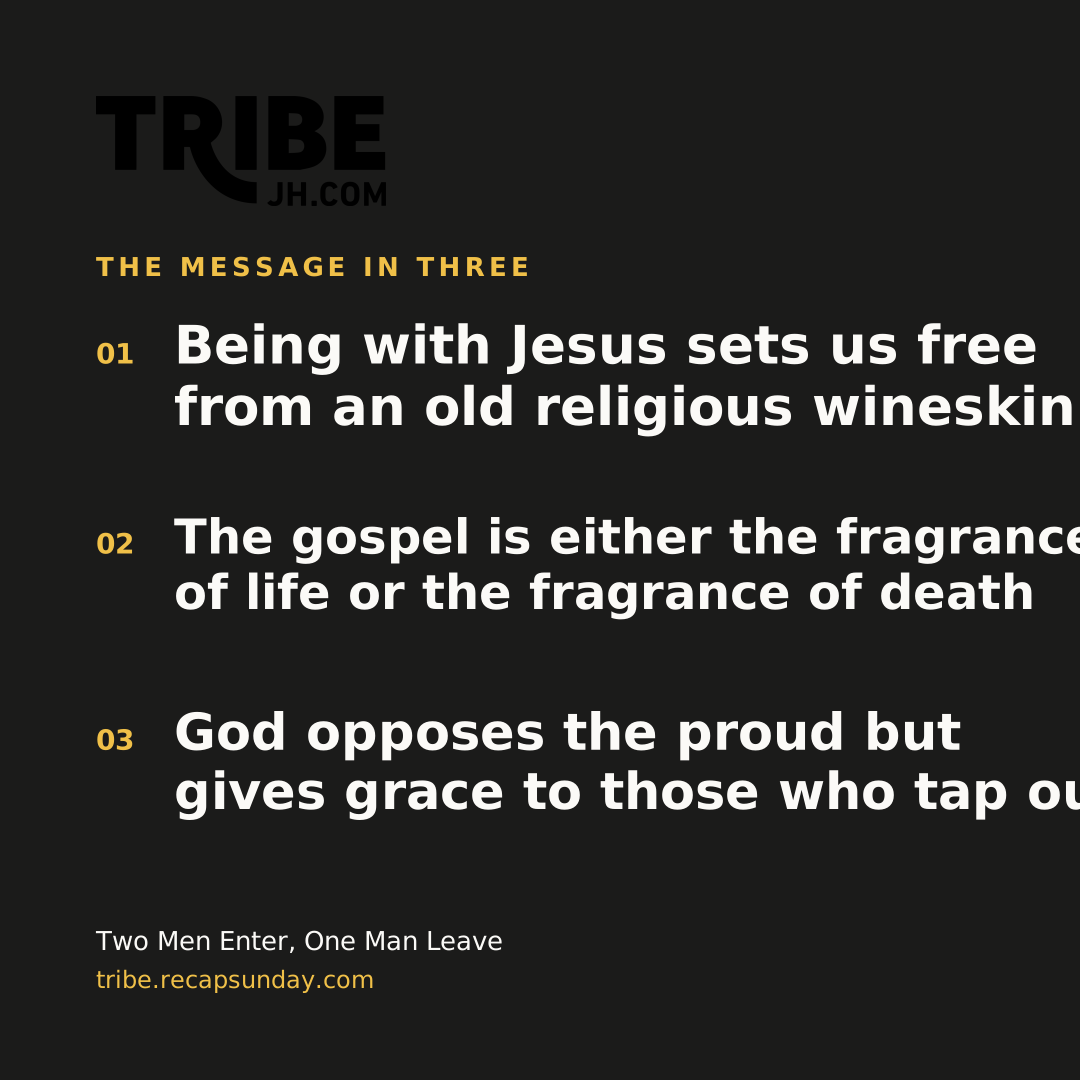
The bottom line takeaway that we see demonstrated by the disciples is this, being with Jesus sets us free from the constraints of an old religious wineskin. And if you're having trouble connecting the passage that we just read with this main takeaway, then I would like to invite you, somebody that has been here for a few weeks, to help connect those dots for folks that are just getting here. So how do you connect the dot the dots between what we just read and what we saw hint hint of the disciples? How do you connect that with this big takeaway? Who would like to help us out?
Don't be scared. It's just a new room.
Repeat the question one more time.
Alright. Thank you. My wife, Lisa. So what we just read. We just read it.
How what kind of connection can you make between what we just read and this takeaway? This main idea that we've been focusing on. And hint, it happens with the disciples in the grain field, but then is reinforced by Jesus' words and his further demonstration at church. Lisa's letting all of y'all off the hook.
I just need to think through on that one.
Think the first thing that just comes
Either that or I'm a bad teacher.
Well, do you want? A show of hands. Think that, you know, just when in our own life when we've always seen things a certain way, it's hard for us when the Lord wants to move in a new way. And I feel like this story is a great reminder that we have to let go of what and how the Lord has moved in the past because he might be trying to do a new thing.
Alright. That's great. Do you have more?
Yeah.
Oh, good. It is.
I I was just gonna say when he does the says the parable of if you had a sheep that fell into a well on the Sabbath when you work to pull it out, like, he's directly saying put relationship over the law.
Okay. Alright. Ah. And you would connect put relationship over the law with?
Being with Jesus sets us free from the constraints of an old religious wineskin.
Yes. That is a beautiful connection point. How about let's let's add to what she just said. What do you have? Let's add to what she said.
What do you see? What are you pulling from this? Renee.
So I've been mulling over this for a couple weeks, actually, diving into what actually the priest did that was can like, Jesus referred to, well, the priest went in. They worked, but it was okay for them. You know? And And so I looked back on that and basically, they offered sacrifices which was work, skinny animals, gutting animals, doing all the things, right? Offering all the offerings was work And they saw the disciples doing something that looked like work to them.
And in my mind, I don't see them picking a couple grains and popping them in their mouths. They were doing something that looked like work. They were gathering, and they were voracious men. They were hungry.
Mhmm.
So I feel like the connection there is that when you taste and see that the Lord is good, it requires something that
might look like a little bit of work.
Interesting.
Sacrifice of time, sacrifice of energy, sacrifice of reputation, sacrifice of you know, maybe you gotta get up a little earlier. Spend a little more time in the work. Maybe you need to actually worship on your own. And maybe the old religious wineskin is coming to work on or coming to work on Sundays, coming to church on Sundays.
On a powder day.
On a powder day. Scratching that itch like, okay. Check that box as you say. And so it's what happens outside of the walls of the church gathering, I feel like, is where you're going to taste the new wine.
Oh, that's great. That's great. We looked at this story a few weeks ago. We've been here for a few weeks, and we see the disciples walking through the grain fields. And I don't know what image you get in your imagination.
This is not like like Coop's truck driving through the middle of the cornfield as he's chasing a downed drone on Interstellar. They're not, like, walking through the cornfields, but they're walking along a path right near, and they're there's likely grain fields on either side. Right? So they're walking along. They pick sheaves of wheat or grain, whatever.
They roll them in their hands, separate the wheat from the chaff, and they're having a little trail snack on the way. And the Pharisees are right there dogging their heels, and they see it. And the Pharisees it triggers something in the Pharisees because religious dogma talks about if you're going to be a good Jew, you need to strictly adhere to the law and follow the rules. Following those rules apart from the heart connection of relationship, It actually just rule following separates us from fellowship with Jesus as brokered by the Holy Spirit. And so, we fall into this religious trap.
Well, I'm I'm I'm following the rules. Therefore, I have right standing with God. It actually puts distance between us. But when we spend time with Jesus just like the disciples do, just like the disciples did. It sets us free from the constraints of an old religious wineskin as demonstrated by the disciples.
They were free, and they were hungry. Jesus didn't condemn them. Hey, guys. Guys. Knock it off.
He defended them. How awesome would it be to have Jesus defend
you?
And then he gets in the face of the pharisees. He teaches them, and then he's like, really? You're still not getting this? Come on. Let's go.
And then he takes them to church. And in the middle of the church service, he performs another miracle, and then he teaches again. Jesus afflicts the comfortable, and he comforts the afflicted. The miracle happens. And then last week, we talked about the interesting response of the pharisees.
What you can just tell me. What was the response of the pharisees after he saw the disciples satiating their hunger, after he taught them, after he performed a miracle, and after he taught them some more in the church, what was the Pharisees' reaction? They wanted kill him. And this is where we ended up spending some time last week. And I wanna engage with you again.
And let me ask you let me ask the question, and then, Amanda, you can say your contribution. Is it relevant to the question I'm about to ask? Or you can withdraw the hand raised. The question that I want to ask you is, and we talked about this some last week. Why was it the reaction of the pharisees to want to kill Jesus as a result of all that they had seen and just heard?
Why was that their reaction? And if your wheels are turning and thinking, fantastic. That's exactly what we want. I want you to engage with the text. I want you to consider.
I want you to reread. I want you to put yourself in in that church service where you see this. Why do you think that was the reaction of the pharisees? What do you think? And then you can hand the mic right next door.
You can arm wrestle for who goes first.
Who goes first? Renee
hit on this a little bit and it's what I was thinking last Sunday as well how the Pharisees were only seeing all the actions, but they weren't tasting anything.
Oh.
And how the disciples, they someone brought it up last Sunday that maybe Jesus was the first one to take the grain and roll it in his hands, and then he ate because he was human and he still got hungry. And then the disciples then, we're using our godly imaginations, were like
Yep. Yep. Wait.
We can do that?
And so they were like, let's go and all had some little trail snacks because they're able to not just see Jesus do it, but taste and see that he was good. Yeah. And how the Pharisees throughout the whole entire story that we're reading had multiple opportunities to taste Jesus, to taste the new wine, see how he's changing the lives of the people that he's walking with, but instead in their hearts of hearts, it was so hardened and all they could do is see. Yes. And it's easy for a lot of us to get into that scenario in our lives.
We can see all this goodness happening around us, but we can't taste the goodness. We're still mad and filled with bitterness and hatred. But we have to let ourselves, like Renee said, maybe get up earlier, pray more, worship more. We have to start tasting and seeing that the lord is good.
And that's so great. It reminds me of it reminds me of the woman with the issue of blood. Right? The the story goes that people are pressing all around him, jostling him, bumping him because of the huge crowds that are following him. But there was only one woman who pressed through all of the crowds with her great need to touch the hem of Jesus's garment.
And Jesus was like, woah. Hold up. We're gonna stop the whole train here because something amazing just happened. The the the the disciples were there pressing in, touching the hem of Jesus' garment, having fellowship, close relationship with him. The disciples were there, but they had missed out.
I love it.
Okay. What I was gonna say is that we talked a couple weeks ago about the building with gold versus building with sticks. And these pharisees have built a mansion out of twigs and they've used their old religious wineskin. They're they're very proud of it, and they have a lot of power on earth because of it because everyone looks at them and thinks they're awesome because of it. And Jesus is saying, your wineskin is cracked.
It's actually a piece of crap. And they are pissed because they're they have to either admit that all that they're putting their energy into is for not. Mhmm. And so it's it's really painful for them to have to face that. So instead, they're like Yes.
This uppity preacher. Yes. Get rid of them.
Yes. Yes. Yes. They are confronted.
Your wineskins crack like this.
Your wineskins crack. And then on the back, it says, we should get rid of this uppity preacher. See you next week at Tribe. I I really love what you said because of Jesus' words, Jesus' actions, and the actions of disciples is a confrontation, a direct, aggressive frontal assault confrontation on their carefully constructed life and persona. And and it caused them to despise Jesus.
Wow. Okay. Okay. Okay.
Yeah. Additionally, just the sentence on the wall being with Jesus, I think we I would add in, like, being with him and trusting him. Trusting him sets us free Yeah. From the constraints because they wanted to kill him because they didn't trust him. They did not believe that he was who he said he was.
And the disciples did. So they were bopping along into the field having you know, they were the disciples were Jews too. They had the same law. They had the same they knew everything that the pharisees knew from the Torah, and yet they had the freedom. You know, their constraints were taken away because they were with Jesus and they trusted him.
They're like, if this they'd already given up their lives to serve him and to be with him. But the pharisees in one way are like, I don't blame them for being so whatever they were because they did you don't know what you don't know. And until they let down their pride and their guard, like you were saying, Ian, how could you trust how can you enter that until you trust the Lord?
Right. So how about this? In in some way, I hear a little bit of tone of you kind of defending the pharisees, which you're you're not wrong to do.
No. No. Don't take that. No. Take that away.
Oh. I I just try to see it from all angles.
Like Yes.
Instead of just being like, oh, the bad guy's the bad guy. Like, why is he that way?
Like, I
like just looking at it from all the angles.
And what I want yes and. Yes and. Think about the patience that Jesus is demonstrating. How many times he takes another run to mow over the grass different ways over the the principle that he's trying to get. I'm lord over the Sabbath.
The Sabbath was made for man, not man for the Sabbath, and then a powerful demonstration of a miracle. But as we as we continue down this road that we've been on, we spend more time thinking and considering the response of the Pharisees. And why is it that the Pharisees conspired to kill Jesus? And as we continued on in our conversation, I I want to do do you have a question or a comment? You got something or keep going?
Okay, I'll keep going.
I I
I have something. All right, ladies and gentlemen, she has something. Let's hear it.
Well, hopefully, I can verbalize this, but I'm gonna jump off of this last conversate comment and say that, bottom line and say that I can see it from this Pharisees or I am defending the pharisees in this case because they are operating in fear. And they it's almost like when Jesus was on the cross and said, father, forgive them for they know not what they do. And they don't I believe we're looking at a text where they don't really know they they are operating out of fear. So they're looking down, and they're seeing them eating in the fields and doing things they're not supposed to do on Sunday, and they're like,
oh, oh, we're not supposed to
do that. Look. Look at these people. Look what they're doing. Look here.
And they're just fearful that they they wanna follow the rules, and they want everybody else to follow the rules. And it's we do fall in we do fall into that all the time as humans because we we are kind of we live in a world that has rules. Right? So we we are already prone to wanting to wanting to follow the rules or sometimes breaking the rules. But I think that the pharisees probably were, really operating out of place of fear when they, number one, criticized Jesus and also wanted to catch him in the very active healing on Sunday.
Then they thought, well, if we can prove they're just trying to trying to prove him wrong or hold him accountable or under the law. But they, you know, they they basically holding him accountable under the law, but they couldn't do it because Jesus always wiggles out of that. Oh,
Jesus. That Jesus, he's operating and is submitted to a higher law and lived his life in under perfect submission and in harmony because of close fellowship with his father. He was he was submitted under a higher law and that law, and the bible calls it the law of the spirit of life in Christ, is a law that is higher or transcendent than our laws that we establish in terms of religious adherence, which is another word for dogma. So now let's turn to the next place in our Bibles. Turn to second Corinthians chapter two.
We're we're still kind of marinating on this idea of the Pharisees and their what is up with this desire to wanna conspire to kill Jesus? Second Corinthians chapter two verse fourteen and fifteen, it's up here on the screen, and I will read it for you. Paul is speaking and he says this, but thank God, he has made us captives and continues to lead us along in Christ's triumphal procession. Now that he uses us to spread the knowledge of Christ everywhere like a sweet perfume, our lives are like a Christ fragrance rising up to God. But this fragrance, here it comes, this fragrance is perceived differently by those who are being saved and by those who are perishing.
That tense that is used in the Greek is the present progressive ongoing. To those who are perishing, we are a dreadful smell of death and doom. Worse than my rock shoes after a day of climbing. Death and doom. But to those who are being saved, we are a life giving perfume.
And who is adequate for such a task as this? So Paul shows us what's up with that optional response where either it's it's it is it is one of two choices. The message of Jesus, life with Jesus, following Jesus' leadership is either the fragrance of life or if we resist, if we reject, if we rebel, is the fragrance of death. Now, I know what some of you may be thinking. Can't there be a third option which is just neutral?
I'm just exploring. I'm just investigating. I'm just considering. You are allowed to do that, of course. But I'm telling you that as long as you consider, investigate, try it out, maybe go on a couple of coffee dates with Jesus kind of thing.
As long as you're in that camp, you are in the camp of considering the gospel to be the fragrance of death. And this is partly what we we talked about last week, and we're gonna continue to kind of marinate in because my my my shepherd's heart really wants you to grab a hold of these things that we're talking about, even though the words that I'm saying could be very challenging and maybe even offensive to you. If what we're talking about right now is is offensive to you, well, great. You already know what side of the fence you fall on. Death.
But for a person and I don't want to ostracize other folks in this room, but I I wish I could ask you, by show of hands, for how many of you don't raise your hands. But by show of hands, how many of you once thought that a relationship with Jesus was essentially the fragrance of death? Oh, it's my parents' religion. Oh, it's like all these rules. Haven't got it.
But then in your great need, you cried out to Jesus as your savior, got wonderfully saved, and now to the best of your ability, you're following his leadership and you're like, oh, he's just so nutritious and wonderful and he is the fragrance of life. All of us start out with him being the fragrance of death. That's where we all start out. There is no such thing as a tabula rasa neutral. This your sin is fatal long before the cradle because it creeped in through your navel.
You inherited a sin nature that puts you at odds and enmity with Jesus. But a court whether you're a Calvinist or Armenian, he sovereignly touches your heart simultaneously as you're crying out to him. And he when you die to yourself and receive his life, he becomes the fragrance of Christ. And so I don't have this on the screen, but if I were to title this morning's conversation, it would be something like two men enter, one man leave because somebody will die. Either you will die.
I have been crucified with Christ. So there is no longer I who live, but Christ who lives in me. And then he gets to express his life through you. Or and I know this might sound extreme, but it is true. Or you will put him on the cross and he will die and you get to continue to live your life as the boss of your own life.
And the bible says in the book of Proverbs, there is a way that seems right to man but ends in Jay has a question. While Jay is making this contribution, let's turn in our bible to James chapter four. And this will be this verse will be our last verse. Andy, if you
don't mind throwing that last slide back up there. I just looking at that verse, I get a picture of fire, and I think about to people who are being saved or perishing by fire, like, obviously, the fire smells different. Like, me, when I'm around a campfire, like, I love the smell of campfire. Like, it's a great place of conversation. It's got great memories associated by it.
But for people that are in California or or have fires that are destroying things, that fire smells very different. It's bringing death and destruction. And likewise, like, at the end of our lives, like like, our lives as a whole, like, we are being refined by fire. And so when we like, God and the Holy Spirit are oftentimes compared and likened to a fire. And when we look at our lives and we think about throwing our lives into the fire, a lot of us are greatly distressed because it's gonna burn.
Like, everything that is not eternal in our life is eternally worthless.
Come on.
And so, that goes in that fire, either it's all gonna get burned up or it's gonna come out refined. And things that are the precious things like gold and diamonds, like, those are what stay. And if you don't have that in your life and you're not confident that your life is gonna come out of the fire refined in something beautiful, that's really
scary. Sobering. Yeah. When you stand in judgment at the great throne room of God and give an account for your life, He'll be like, let's see. Gretchen.
We don't like that. Gretchen Norman. Welcome. Let's take a look at your life. Click on a big old giant jumbotron screen.
Whole life is played just you and him. And then it'll be time to give an account. The first question will be, what did you do with my son? Did you murder him or did you die? Two men enter, one man leave.
Once you have once righteousness has been imparted to you through the sacrifice of Jesus on the cross and you lay down your life and you invite him into your heart to make him the leader of your life, Awesome. Then we go into the reward phase, and it is like that fire. All the things that you did in my name but not directed by me will burn up. Every single thing that you did, said, thought, and all those things that you said no to according to the direction of the leadership of Jesus that you did in his name under his leadership is pure gold, and it will be refired. Well done, my good and faithful servant.
Come and enter into the rest and receive the war reward of your master. Come on. Oh, that we would live for that. Did I tell you where to turn next? James Jesus.
Alright. We're gonna read this, talk about it a little bit, and then let's celebrate communion together. Okay? James chapter four verse two through seven. I will read this.
Now James, this is a heavy hitting brother. Right? I mean, with his words, he is stacking bodies like cordwood. The whole book. James chapter four verse two through seven.
You want what you don't have, so you scheme and kill to get it. He is not handling us with those little kitten gloves. He loves us enough to tell us like it is, and he spent time with Jesus. He is Jesus' half brother. Thank you.
I was gonna say brother-in-law, but that I was like, it's not worth it. Half brother. Half brother. You are jealous of what others have, but you can't get it. So you fight and wage war to take it from them.
Yet you don't have what you want because you won't ask God for it. And even when you ask, you don't get it because your motives are all wrong. You only want what will give you pleasure. People will put other people to death for their pleasure. And if you are thinking, mm-mm, that is so naughty, of somebody else, you better first look at yourself.
You adulterers. Wow. Okay, James. Don't you realize that friendship with the world makes you an enemy of God? I'll say it again.
If you want to be a friend of the world, you make yourself an enemy of God. This once again, Paul, just like Paul, James is forking the road. Do you think the scriptures have no meaning? Do they carry no weight in your life? Do you surrender your life to the word of God and follow its leadership in any way?
That's what he's saying. They say that God is passionate, that the spirit has that he has placed within us should be faithful to him. And God gives grace generally. As the scriptures say, God opposes the proud, but he gives grace to the humble. Now that word grace, it is often historically churchy associated with the the unmerited favor of God unto salvation For it is by grace that you have been saved.
Yep. Got it. Got it. Got it. But if grace is only for salvation, then why does Paul often introduce and conclude many of his letters by saying, may grace abound to you.
May you overflow with the grace of the Lord when he's writing to Christians. If grace is only for salvation, then why do we need more than just 100%? Paul is saying more and more and more. It is because grace means so much more than just unto salvation. Grace is his supernatural enabling power to do what he's called you to do.
It is his super on your natural. He gives grace to those that have died in the arena. I can't do this on my own. I need your help. And he's like, I got you.
But for the heart that says, I got this, he goes, okay, man. Hey, man. And he will, in his loving kindness, he will not violate your free will. But for the person that, when we talk about this a lot, cultivates that relationship with the Holy Spirit. Help me.
Help me, Lord. Work through me. Quick example and then your comment. Like, what does that mean? What does that mean?
You've had a long hard day at work. You're a husband and you're a father of some littles. You've had you you're wrung out at work. You've been slaying dragons all day at work. You're exhausted.
You just wanna come home and, like, have some chill time. But you know wifey and the kids are, like, ready for dad to come home so that he can be the human jungle gym for the next three hours. This is what the supernatural empowerment of the Holy Spirit looks like. You pull up in the driveway and you go, me and myself, I am wrung out. I got nothing left to give.
If you say, okay, pull yourself up by your bootstraps, come on, cowboy up and do this, God's like, see how well that works. Short fuse, short temper, you're yelling, you're fussing, and then you, like, retreat to your man cave, And it didn't go so well. What it looks like for the grace of the Lord to be on your life is when you sit in that driveway and you're like, Jesus, will you be a good husband and father through me. I surrender to you. Help me.
Help me. Help me. Close the door. Lock your truck. Walk in the door.
And then the Holy Spirit will whisper to your knower. Hey, Read a book with your daughter. Hey. Tell your wife who hasn't even started dinner yet. Like, you got dinner, and you, like, call up Domino's.
Whatever, like, whatever it is. Like, whatever it is. She's just gonna be glad she don't have to cook that night. Are you are you picking up what I'm putting down? Jesus, you be a good father through me.
Holy Spirit, you be a good husband through me.
No. That's great. Great practical way to think about it. I was just gonna say God opposes the proud, and I was thinking about the Pharisees and that they were in that position of power and control. And that's where I just I don't think they really wanted to relinquish that.
And so they saw Jesus as a threat to their control and and their lifestyle of of power and and authority. So, it's kinda, you know, nothing changes really even today. People in control and power and, you know, they don't they don't wanna relinquish that. And so, that's going back to the surrender thing.
He is a threat. We like to think of Jesus as as sweet, gentle Jesus, you know, like, blessing the babies and bouncing them on their knees. He is literally the most threatening, intimidating, strong human to ever set foot on planet Earth. And if if meekness, which is a godly biblical attribute, is power under control, He demonstrated that perfectly humbling himself unto death even death on a cross dying a criminal's death. He came in to Jerusalem the first time riding a what?
A donkey. Not really like the image and persona of a conquering champion, but y'all he coming back again. And what does the bible say his return will be like? He came the first time riding on a donkey. How will he come a second time?
Riding on the clouds on a horse for war. He is the skull crusher. We'll save that for another sermon another time. Let's do this with the the moments that we have remaining. How about you take a moment and I dare you.
I dare you to set foot on the mat with Jesus. And if there's some things in your life that you need to wrestle through with him, he he will roll with you on the mat. He popped Jacob's hip out of its socket. So he walked with the for all the rest of his days with a limp. He doesn't mind wrestling with you.
Because that's kind of who we are as humans. Our our our self preservation instinct is so strong. He knows that about us. But what he's looking for, he has abundant grace. Heaps and heaps and heaps and heaps of grace to give to you in your life, in your situation, whatever it is that you're going through.
But as long as you don't submit, he's like, alright. He's looking for you in your heart to tap out. And then he's like, I got you. I got you. I got you.
And as evidenced by that, he will go so far as to surrender his life unto death. And then he gave us a remembrance, a a a visceral tactile remembrance that he paid the ultimate price for us so that we may be empowered by his grace. And Christians have been celebrating this meal for two thousand years. Ella, could I get that mic from you please, ma'am? The bible records that on the night that Jesus was betrayed and crucified, he was celebrating the Passover meal with his disciples.
And he said, oh, I have eagerly desired this meal. Because at this meal was the pronunciation of a new covenant, a new way to have right standing with God. The bible has the words of Jesus recorded. And he said that during the meal, Jesus took bread, he blessed it, and then he broke it. He gave it to his disciples and said, take and eat for this is my body which is given for you.
And then the bible records that during the meal, Jesus took another cup. There were multiple cups that were dranken from, drink did, that the disciples drank from. We can we take our faith but not ourselves seriously. And, during the Passover meal in which he said these words, there were a variety of cups during the sequence of the dinner that that you drink from. Jesus could have picked from any one of those cups, but the disciples all watched his hand move to this particular cup.
That's why the bible says, then during the meal Jesus took another cup. The cup that he selected would have been known to every single person at that table as the cup of a marriage proposal. When a young man would propose in marriage to a young woman, they would come over for dinner, they would have a meal, And then at a certain point during the meal and, you know, everybody knew it was coming. He didn't, like, spring it on her. He would take the marriage proposal cup and he would stand up.
And at that meal, he would pronounce his vows of the covenant of a marriage proposal to the young woman. Today, what we have is an engagement ring. You know, when he gets down on one knee and he and he does that? Well, in Jesus's day, the young man would make the the pronouncement and then he would set the cup on the table. If the young woman received the cup and drank from it, it was her way of saying yes.
And then, the young man at the dinner table, there'd be great happiness and joy and celebration. And then, the young man would hold up that same cup and he'll he'll he would say, I'll not drink again of this fruit of the vine until I drink it anew with you on our wedding day. So when Jesus said, holding the cup, take and drink for this is my life's blood poured out for you, and it ratifies or conform confirms a new covenant that I'm making with you in my life's blood. And then he said, I'll not drink again of this fruit of the vine until I drink it anew with you in the kingdom. Behold, the cup of salvation, the cup of the new covenant, the cup of eternal life, the cup of betrothment.
So, I ask that as we come to the communion table today that you would perform a miracle right here. That you would transform these simple common elements into a sacrament, which is simply a means of grace where we can touch you by faith. So that as we enter into this meal with you, that we would somehow, someway, you would release a special connection of your presence with our hearts. Touch our hearts, Jesus, as we partake of this meal. We pray these things in Jesus' name.
Amen. If this were my meal, I would say that all y'all are welcome. But this is not my meal and Jesus has established that this is an exclusive meal. This meal is not open to just anyone. This meal, the meal of communion, is open to those who have invited Jesus into their heart, made him the leader of their life.
And there are two, So, there are two exclusions. Number one, if you have not invited Jesus into your heart, this is these are his rules, not mine or the church's, but this meal is for believers, those who follow Jesus. The second exclusion is if there's anybody here in this room that has unconfessed sin in their heart. The bible says that if you receive communion and there's judgment towards your neighbor or unconfessed sin in your heart, then the bible says that you actually drink judgment upon yourself. Here's the good news.
You can take care of both of those things right quick and in a hurry. Before you come to receive communion, you can invite Jesus into your heart, make him the leader of your life. And before you come to take communion, just do a quick inventory. Lord, what would you bring to my heart? You're right.
I am sorry. Please forgive me. And he's like, it is forgiven under the blood. So, I'm going to invite Jay to come forward. He's gonna help me serve communion this morning.
And the way that it will work is you can do can you do that? I'm done with that thing jamming me in the eyes. Just hold it over there. Thank you. Or prop something up.
Thank you. The way that it'll work is I will stand here with the bread. Jay will stand here with the cup. Our communion is open to anyone who calls on the name of the Lord to be saved. You self select if you want to receive communion, and there is no judgment on anybody here in this room that chooses not to receive communion.
The way that we'll do it is we'll go from the back to the front. Just come forward by rows, and you will receive the bread. And then, we take the bread and dip it into the cup and then you can file around and go back to your seat. We'll start from the back and then move towards the front. Y'all come on.
Oh, facing grace on the ending
Take a moment. Amazing grace. And just talk to him from your heart for just a moment. Thank you, Jesus. How we love you.
My one defense, my righteousness. Oh, God, I want
you. One more time together.
Lord, I need you. Oh, I need you. Every hour, every
So, as we finish here, we're going to leave in just a few minutes, but we want to worship the Lord together in one more expression. And bringing our tithe and our offering to the Lord, we call it an act of worship because that's what it is. It's a sacrifice and it says, I love you and I trust you and with this hard earned money that I have worked so hard for, I give a portion of it to you, Father, because I trust you with it. So, when we do that together, whether it's tribe, your local church, or somewhere else, it doesn't matter. It's not at all about tribe.
It's about our heart posture towards the Lord when we think about worshiping and offering sacrifice. And so, it's a triple win. Firstly, when you bring your tithe and above and beyond that, your offering, you're honoring the Lord and his word and it pleases him. Secondly, you're helping practically and physically do the work of the ministry. That's where our tithe and offering goes, to do the local work here in town, and then as we say to the uttermost bounds of the earth, it does practical ministry work.
And then three, it blesses us because it's sometimes tithing feels easy, sometimes it feels hard. That's okay. It's really, really, really good to get out of your comfort zone and to stretch yourself because God is so faithful and he's never let us down. So it's good for us. So it's a triple win.
So we're gonna just pray. There are ways to give here. Practically speaking, we don't pass buckets, but there is a little wooden box right there on that table as you head out. If you have a check or cash, if you wanna put that in there, that's great. If not, the most practical way is on our website or sorry, tribejh.com is our website.
You can do that. But the most practical way is on your phone, our little computer in our pocket. So it's just like you're texting a friend. You open up a new text feed and you say 84321. I say say because I'm usually texting and driving, like, with my voice, with my voice.
So just go to 84321 just like you're texting a friend and you simply type in the amount you want to give. It's that simple and it's that easy and it is such a blessing and an honor to be able to do that. It really is. Let our hearts if you if tithing feels error to you, I would encourage you just to to do it until it doesn't feel that way because God is faithful and because God will honor you for honoring him. So let's pray together as an act of worship as we bring our tithe and our offering to him.
Heavenly father, you are so worthy of all of our praise and all of our worship. This is all for you. Everything we do here is for you. You are always the guest of honor. And as we bring our tithe and our offering, whether it's today or when we get paid or whenever it is, Lord, we just thank you for the opportunity that you allow us to partner with you and what you're doing to help share the love of Jesus, to be the hands and feet of Jesus to this community and beyond.
What an honor it is to partner with you, the creator of the universe, to do something practical. I pray that every single penny that is brought in, Lord, will be stewarded well and to your pleasing, and I just thank you for blessing everybody in this room and the families they represent who are giving today. Show your goodness to them perhaps in new ways that they haven't experienced. Let them encounter you in new ways, Lord, just to emphasize your faithfulness. We love you and we thank you so much.
Even we don't see results, we trust you infinitely that they're there. In Jesus' name, amen. Amen. Really, the only thing to say before, Brian, if you'll come and pray us back out, if you would like to bring treats, today we had breakfast burritos and donuts and all those things. This is just like we're like a family.
Please feel free to bring those, but let us know. There's a sign up sheet on that table, that you can sign up just once a month, once a year. We don't care. Just bring it. One more thing.
Press that. We don't care. Just bring
We don't care. That's that was so rude. Sorry. On your seat, there are tribe cards. We take those very seriously.
If it is your first time and you wanted to to be added to our list, sometimes we blast out, like, hey. Meeting in the conference room today or, like, it could be anything, anything with Tribe. We'll send you a message, but also on the back, there's a place to write a prayer request. If there is something that you are that's really on your heart or your mind or it's weighing you down, It could be huge. It could be teeny tiny.
It does not matter. Write it on there if you'd like, and we pray over every one of those cards every Monday, very seriously. We also have prayer in person available for you. Lanisha, if you'll raise your hand. Lanisha will be in the back today with some partners back here in this little living room area.
Please don't leave if you feel a heavy burden. What a joy it is to be in a community, whether you're best friends or don't know them, it doesn't matter. This is a community of the Lord and to be able to just pray with somebody and have them join their faith with yours for whatever it is you're dealing with. I promise it'll be whether you feel an immediate lift or not immediate, it is powerful. So, Lanisha and her team will be back there to do that for you.
Pastor Brian, please come pray us out today.
Alright. Let's see. Just before you get out of here, what Amanda said, prayer in the back if you need it. Also, there is a certain member of our family that just off the couch out of the blue audition for a spring high school play, and they got a role in Willy Wonka, and that's Oliver Lax. So let's get psyched for him.
He didn't get anywhere. And He got he is a Oompa Loompa. Oh, no? Oh, he is Willy Wonka. Alright.
So please refer to him for the next three months as mister Wonka. And would that be alright if I pray for you? Alright. Stand up. Lord Jesus, thank you so much for today.
Thank you so much that you have offered your life for ours, that we can receive your empowerment, and all we gotta do is die. Help us to die daily to ourselves so that we can live our life empowered by your spirit. Thank you so very much. And, father, I pray for my boys in this row. Keep them safe.
Keep them dangerous. And, Lord, I thank you that all of those tourists in their fur lined one piece ski suits, their legs are already tired, and they're rolling into the handlebar or over to the spur because they can't ski no more, and there's gonna be plenty of fresh snow for us this afternoon. I command a blessing on each and every member of our tribe family here today. We love you, Jesus. We pray these things in Jesus' name, the strong son of God.
And everybody said Amen. Amen. I love you. I want you to have a great week. And remember, Kat, you got this.