a man is not justified by observing the law but by faith in Christ, read aloud by a congregation member
15 “We, being Jews by nature, and not Gentile sinners,
16 yet knowing that a man is not justified by the works of the law but through faith in Jesus Christ, even we believed in Christ Jesus, that we might be justified by faith in Christ, and not by the works of the law, because no flesh will be justified by the works of the law.
17 But if, while we sought to be justified in Christ, we ourselves also were found sinners, is Christ a servant of sin? Certainly not!
18 For if I build up again those things which I destroyed, I prove myself a law-breaker.
19 For I, through the law, died to the law, that I might live to God.
20 I have been crucified with Christ, and it is no longer I that live, but Christ lives in me. That life which I now live in the flesh, I live by faith in the Son of God, who loved me, and gave himself up for me.
21 I don’t reject the grace of God. For if righteousness is through the law, then Christ died for nothing!”
the cloud and glory of the Lord filling the tabernacle after it was constructed
34 Then the cloud covered the Tent of Meeting, and Yahweh’s glory filled the tabernacle.
35 Moses wasn’t able to enter into the Tent of Meeting, because the cloud stayed on it, and Yahweh’s glory filled the tabernacle.
36 When the cloud was taken up from over the tabernacle, the children of Israel went onward, throughout all their journeys;
37 but if the cloud wasn’t taken up, then they didn’t travel until the day that it was taken up.
38 For the cloud of Yahweh was on the tabernacle by day, and there was fire in the cloud by night, in the sight of all the house of Israel, throughout all their journeys.
instructions for burnt offerings from the herd, flock, and birds, read aloud by congregation members
1 Yahweh called to Moses, and spoke to him from the Tent of Meeting, saying,
2 “Speak to the children of Israel, and tell them, ‘When anyone of you offers an offering to Yahweh, you shall offer your offering of the livestock, from the herd and from the flock.
3 “‘If his offering is a burnt offering from the herd, he shall offer a male without defect. He shall offer it at the door of the Tent of Meeting, that he may be accepted before Yahweh.
4 He shall lay his hand on the head of the burnt offering, and it shall be accepted for him to make atonement for him.
5 He shall kill the bull before Yahweh. Aaron’s sons, the priests, shall present the blood and sprinkle the blood around on the altar that is at the door of the Tent of Meeting.
6 He shall flay the burnt offering, and cut it into pieces.
7 The sons of Aaron the priest shall put fire on the altar, and lay wood in order on the fire;
8 and Aaron’s sons, the priests, shall lay the pieces, the head, and the fat in order on the wood that is on the fire which is on the altar;
9 but its innards and its legs he shall wash with water. The priest shall burn all of it on the altar, for a burnt offering, an offering made by fire, of a pleasant aroma to Yahweh.
10 “‘If his offering is from the flock, from the sheep, or from the goats, for a burnt offering, he shall offer a male without defect.
11 He shall kill it on the north side of the altar before Yahweh. Aaron’s sons, the priests, shall sprinkle its blood around on the altar.
12 He shall cut it into its pieces, with its head and its fat. The priest shall lay them in order on the wood that is on the fire which is on the altar,
13 but the innards and the legs he shall wash with water. The priest shall offer the whole, and burn it on the altar. It is a burnt offering, an offering made by fire, of a pleasant aroma to Yahweh.
14 “‘If his offering to Yahweh is a burnt offering of birds, then he shall offer his offering of turtledoves or of young pigeons.
15 The priest shall bring it to the altar, and wring off its head, and burn it on the altar; and its blood shall be drained out on the side of the altar;
16 and he shall take away its crop with its filth, and cast it beside the altar on the east part, in the place of the ashes.
17 He shall tear it by its wings, but shall not divide it apart. The priest shall burn it on the altar, on the wood that is on the fire. It is a burnt offering, an offering made by fire, of a pleasant aroma to Yahweh.
the tent of meeting set up outside the camp where anyone inquiring of the Lord would go, and God speaking to Moses face to face
7 Now Moses used to take the tent and pitch it outside the camp, far away from the camp, and he called it “The Tent of Meeting.” Everyone who sought Yahweh went out to the Tent of Meeting, which was outside the camp.
8 When Moses went out to the Tent, all the people rose up, and stood, everyone at their tent door, and watched Moses, until he had gone into the Tent.
9 When Moses entered into the Tent, the pillar of cloud descended, stood at the door of the Tent, and spoke with Moses.
10 All the people saw the pillar of cloud stand at the door of the Tent, and all the people rose up and worshiped, everyone at their tent door.
11 Yahweh spoke to Moses face to face, as a man speaks to his friend. He turned again into the camp, but his servant Joshua, the son of Nun, a young man, didn’t depart from the Tent.
my old self has been crucified with Christ, used to illustrate the Thunderdome battle of the will
20 I have been crucified with Christ, and it is no longer I that live, but Christ lives in me. That life which I now live in the flesh, I live by faith in the Son of God, who loved me, and gave himself up for me.
The message in order, in a few minutes of reading.
Brian opened a new series of conversations by asking why the Pharisees, after watching Jesus heal a man's withered hand on the Sabbath, retreated and began plotting to kill him. The question was not rhetorical. He genuinely wanted the room to think it through together, and several people did, before he tied it to what he called the central truth of the series: for a life-giving relationship with God, something has to die.
What was said
The conversation about the Pharisees drew several responses from the room. One person said the ego, wounded by having its traditions questioned, produced something monstrous. Another pointed to the deep investment the Pharisees had in the Mosaic Law as the path to God, making Jesus a direct threat to what they understood as right relationship with him. A third brought up Romans 8:7, that the mind governed by the flesh is hostile to God and cannot submit to his law, and Brian read it aloud as a kind of anchor for everything that followed.
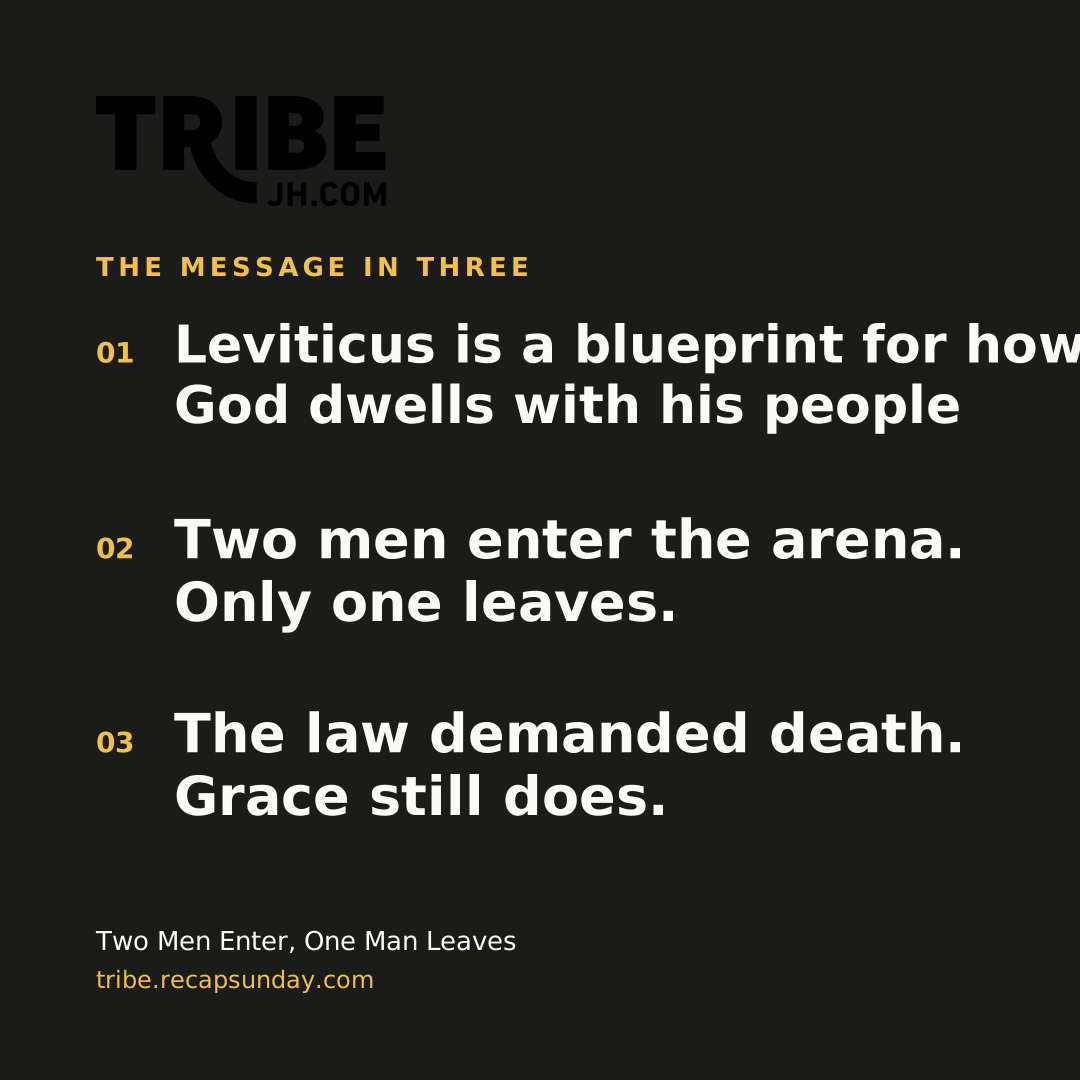
From there Brian introduced the series proper. The plan is to move back and forth between Galatians and Leviticus, using Galatians as the interpretive lens and Leviticus as the territory. He framed Leviticus not as the graveyard of Bible-in-a-year resolutions but as, in his words, a divine blueprint for holiness showing Israel how to create a sacred environment where God can dwell among his people. He put that alongside the Bible Project framing that the whole Bible is a unified story leading to Jesus, and said if you hold both of those ideas, Leviticus becomes navigable.
To give the room a running start, Brian read the closing verses of Exodus 40, where the glory of the Lord fills the completed tabernacle and Moses cannot enter because the cloud has settled on it. That moment, he said, is precisely where Leviticus begins. The tabernacle is built, God's presence has moved in, and now Israel needs instructions for how to approach him at all.
The congregation then read Leviticus chapter one together, passing the microphone through the first seventeen verses covering the burnt offering regulations, which required an unblemished male animal, specific placement at the altar, a particular sequence of cutting, washing and burning, and in the case of a bird, wringing off its head. Brian let the strangeness of the text sit in the room. Someone asked whether the imperfection of animals was itself a consequence of sin entering the world, and Brian confirmed that the Bible does say creation groans for redemption, so yes, that framing holds.
A thread running through the questions was who could actually enter the tent of meeting, and when. Renee found Exodus 33:7-11 in real time, which describes an earlier tent, set up outside the camp, where anyone inquiring of the Lord could go, while the people watched from the entrances of their own tents and Moses spoke with God face to face as one speaks to a friend. That passage also notes that Joshua, Moses' aide, did not leave the tent. Brian noted that the tent of meeting described there is distinct from the later tabernacle, where access became progressively more restricted and the high priest could enter the innermost room only once a year, with bells on his robe and, according to the historian Josephus, a rope around his ankle in case he died inside and had to be pulled out.
Brian then brought up the Thunderdome scene from Mad Max Beyond Thunderdome as an image for what he sees happening spiritually throughout all of this. Two men enter, one man leaves. In Leviticus, a man and an animal enter the sacrificial process, the animal dies, and the man walks out reconciled to God. In Galatians 2:20, Paul says his old self has been crucified with Christ, and it is no longer he who lives but Christ who lives in him. Brian put those two things next to each other and said the arena has not changed. Every decision, every crossroads, is still a Thunderdome moment between your will and God's, and both cannot leave.
He closed by distinguishing conviction from condemnation. Condemnation, he said, starts with specifics and snowballs into a broad verdict that you are just a loser. Conviction does something different. It whispers about one thing and says, come here, let's talk about this. That distinction, he said, is how you know whether it is the Holy Spirit or the enemy speaking when you are standing at one of those crossroads.
Touch points
Things you could actually do this week.
Pick one specific situation in your life right now and, instead of letting it sit in isolation, consciously pray over it and ask God to overlay his goodness onto it.
When something goes wrong this week and you feel the pull to handle it your own way, pause and ask yourself honestly which man is leaving the arena, you or Christ.
Read Galatians chapter 2 verses 15 through 21 slowly, and sit with verse 20 long enough to name one area where your old self has not yet been crucified.
If you sense the Holy Spirit nudging you about one specific thing, not a broad pile of failures but one thing, run toward it rather than away from it and talk to God about that single area.
Fill out a connect card at the next gathering so you can be on the text blast and stay connected to what Tribe is doing.
Doing a Bible study?
Here is a guide we have prepared for you: the passages
in order, questions for the group, and room to write.
Brian talked about overlaying God's goodness over the circumstances of your life, the way an opaque projector shines through whatever is on top of it. What does that actually look like in a situation you are dealing with right now, and what makes it hard to do?
Several people offered reasons why the Pharisees responded to Jesus healing the man's hand by plotting to kill him, including wounded ego, defending what they saw as the established path to God, and demonic forces trying to stop the Messiah. Which of those resonates most with you, and why?
Brian abrió la conversación con una pregunta sencilla pero incómoda: ¿por qué los fariseos, al ver a Jesús sanar a un hombre en el día de reposo, no se alegraron sino que comenzaron a planear cómo matarlo? La congregación respondió con ideas que se fueron complementando: el ego herido cuando se cuestionan las tradiciones, la defensa de lo que ellos creían era el camino correcto hacia Dios, y la posibilidad de que fuerzas espirituales reconocieran al Mesías y quisieran detenerlo. Alguien citó Romanos 8:7, que dice que la mente gobernada por la carne es hostil a Dios y no puede someterse a su ley, y eso ató todo junto.
A partir de ahí, Brian presentó la serie de conversaciones que viene: un recorrido entre el libro de Gálatas y el libro de Levítico. Leyeron Levítico 1 en voz alta, con todos sus detalles sobre sacrificios de toros, ovejas y tórtolas, y la reacción fue honesta: es un libro difícil, extraño, y muchos lo abandonan a mitad del camino. Pero el punto central que Brian quiso dejar fue este: en el sistema sacrificial, algo tenía que morir para que el ser humano pudiera estar en presencia de Dios. Eso no ha cambiado. Lo que cambió es quién murió. Usó la imagen de la película "Mad Max Beyond Thunderdome", donde dos hombres entran a la arena y solo uno sale, para describir el combate entre nuestra voluntad y la voluntad de Dios. Gálatas 2:20 fue el texto que lo resumió todo: "Mi viejo yo ha sido crucificado con Cristo."
Brian cerró con una distinción importante entre condenación y convicción. La condenación del enemigo apunta con el dedo y termina diciéndote que eres un fracaso. La convicción del Espíritu Santo te llama suavemente hacia una sola cosa que Dios quiere tratar contigo. La pregunta que quedó en el aire para todos fue personal: en este momento, ¿en qué área de tu vida estás en esa arena, dudando entre tu voluntad y la de Dios?
---
Pasajes bíblicos usados:
Mateo 12:12-14
Romanos 8:7
Gálatas 2:15-21
Éxodo 40:34-38
Levítico 1:1-17
Éxodo 33:7-11 (mencionado por la congregación durante la discusión)
Read the full transcript9,364 words
Thank you so much for allowing us to come here this morning, to be with one another in your presence, Lord. I pray for a time of worship together, that our hearts are open to you, that our ears are open to you this service, for all the ways that you're always speaking to us. Holy Spirit, come Fill this room. Change us today. We love you.
We praise you. In Jesus'
name, amen. Amen. Let's sing to him this morning. I just see this picture while I'm singing that, and I've said this before. I just picture for my own life.
You know those old school opaque projectors? And they were like the young people are like, man. It was like a box with a light in it. In order to show words on the up on a wall or something, you would put a clear piece of Phellum. Phellum, which is a cool word.
And then it had birds on people with that stuff. It had the words on it, and it would reverse them, and then it would shoot out a thing and show them on the wall really big. Kinda like a projector, but it was called opaque projector. And so if you put your hand on top of it or whatever, you can see that also on the wall, but it's shitting. It's shining down the wall.
It had a loud fan that cooled the bulb. Was yes? Michelle, you know how put big projector. When I sing this, I just picture, like, the box of that projector is, like, our life. It's Yeah.
All the things we have going on. And to apply his goodness, I just picture, like, it doesn't make all the circumstances of life disappear. Right? I mean, they don't just they don't just, you know, evaporate and then, oh, wait. I don't have to actually pay my bills anymore because I said God's good.
You know? Thank you. Yeah. Yes, Joe. I wish you to that.
But with an opaque projector, you overlay it. So I just need to just make sure you're reminded. When you think of his goodness, you take all the circumstances of your life, you take all the things that are going on, all your relationship, relationship, and you just overlay his goodness over the top of it. And with an opaque projector, it just shines through it, and so all you see is the words on the top. So that's the picture I always get when I sing this, like, you're good.
You're good. Yeah. But, you know, it's my it's my flesh. Yeah. But, you know and he's like, just overlay my goodness and let my goodness shine on top of all that stuff.
So when we sing, it's just the best way that you know how to say, Lord, I'm applying. I'm overlaying your goodness over every situation. And maybe just take a minute and just name them. Come on here. Take a minute and just name what those things are to the Lord just between you and him.
Like, Lord, you know this situation. You know the report I just got from the doctor. Thank you, Jesus. And just, like, applying your goodness. Show me how you're gonna move and work in that situation.
Are the king of kings and the lord of lords and that you sit on the throne and the angels sing, holy, holy, holy, that your name is the highest above everything else, and yet, at the same time, we can draw close to you today because of your holy spirit in this place today. What a cool setup that you didn't just go to heaven and leave us here, but your holy spirit is here right now moving. You can close that door if you want to. Or a mom can go. Lord, we just ask that your presence fill this entire building right now and that our worship would go up from this place and fill this valley.
Peace would come in your presence. That healing would come in your presence. We tell you you're all that we want today. You're the only voice that you wanna hear. Draw us close to you as we sing this one more song.
We just that they wouldn't just be words, but they would be the cry of our heart. Lord, I just remember twenty five years ago when I gave my heart to you and I heard this song, I just I thought, Lord, let this always be the cry that I would be close to you. Even when I don't have it all figured out or know which way to turn under, my heart's cry would be draw me close to you. With you. Amen.
Come and have your way. In Jesus name, everybody said. Amen. Amen. Great worshipers in here today.
There's a little coffee over there. How's the temperature feeling here? It looks good. Yeah. It's
Okay. Can I use this? Sure. Quiet. Shh.
Not a funeral parlor. We're a library. Thank you, Joy, last week for doing some good. Very good. Were they good?
Yes. I always feel like there's I take away more from Joy's, Like like, oh, this right here is so good.
From Joyce show you up too bad.
Right. Then I do from my own. Why couldn't I have said it like that?
Because you're not a woman.
Yes. Alright. We look forward to you too, Brian.
Okay. I just need mom and dad. Please. Yes.
Yes. You need you need you need a a what a man brings and what a woman brings. Not that Joy and I are married. I'm married to daddy. But we need a mom's voice and a dad's voice.
And we have such a great deep ministry bench here. And today's definitely gonna be a a man's message. But it's for women also. It's not, like, directed towards men, but it's a guy message. And I want to pre congratulate you on being here for today's message because I've thought a lot about it.
It's gonna be the beginning of a conversation, several conversations that we're gonna have. And I would suggest to you that the conversations that we're gonna have are not they're not elementary level. My goal is for you to feel loved and challenged through these messages. And so we're gonna we're gonna get right into the series of conversations that we're gonna have. It came from something that I've said just a few a little while ago.
Just put that for there you go. It came from something that I said and as part of a message, like, some time ago, and it really stuck with me. And as part of the introduction, let's go ahead and turn there to Matthew chapter 12. This is not going to be our main text this morning, but it'll be a good starting place. Matthew chapter 12.
And while you're turning there waiting for that page to load, let me just read it. And you'll be like, oh, yeah. I think you'll you'll be like, okay. This is alright. This is where we were.
Matthew chapter 12, I'm gonna read just two verses, verse twelve and fourteen. And Jesus is speaking, and he says this, how much more valuable is a person than a sheep? Yes. The law permits a person to do good on the Sabbath. Then he said to the man, hold out your hand.
So the man held out his hand, and it was restored just like the other one. Pause right there. We'll finish the sentence in a moment. So if you remember, we were talking about this, and we were talking about how something about being in the presence and being with and being around and doing life and doing relationship with Jesus produces freedom. Because what had just happened?
What had just happened was Jesus was walking through the grain field. Remember the disciples were picking wheat off the stock, rolling it in their hands, eating the grain. The Pharisees freaked out. You can't do that on the Sabbath. That's work on the Sabbath.
Then Jesus is like, alright. Let's downshift. Let me explain this to you. And then he talked about the Sabbath, that that the Sabbath was made for man, not man for the Sabbath. And when we spend time in close relationship with Jesus, he sets us free from religious dogma and these man made rules and traditions.
And then he's like, you know what? I can tell that you're not getting it, Pharisees. Let's go to church. We're calling a church meeting. So then he goes into the synagogue.
He explains again, and then he sees a man with a withered hand, and this is on the Sabbath. He heals the man. So he's taught them. His words are life. He's the Pharisees have seen what the disciples are doing.
They've literally seen the miracle right in front of their eyes. Tradition says that the man was a worker of stone. I don't know how they get this tradition. It's not in the text. We don't know what he did for a living, but tradition says that he was a worker with stone, and he had some sort of nerve damage so that as this ailment progressed, that his his stone carving got, like, less less.
I mean, he couldn't have a he couldn't work, and then now he's destitute and out of work. This miracle happens, and he's able to create once again. But we then get to the last sentence in verse 14. Then the Pharisees called the meeting to plot how to kill Jesus. Wow.
That escalated quickly. We talked about why that response was from the Pharisees. What did he do that was so bad that warranted these I would call them reasonable men. They weren't like like in a movie. They weren't caricatures of just like violent, evil, plotting, scheming men, like, come they are?
They're they were just they were human. But something with that interaction and that encounter with Jesus caused murderous desires to rise up within them. And we talked a little bit about why is that? And so today, as the beginning of a series of conversations we're gonna have, I would like to open up conversation to hear from you what are your thoughts or questions, comments, or connections that you might have about the why. Why were these Pharisees driven or motivated to begin discussing how do we kill this guy?
Why was their reaction so vehement? What are your thoughts on that? We've touched on it a little bit. Yes. I love it.
So we have a mic that will pass Yeah. To Yeah. It's weird. In our in our little cozy living room setting, I could hear you just fine. But we have a lot of families that are traveling all the time here in Jackson.
A lot of families that watch the livestream. And so when we get to hear your question, comment, or connection in the mic, then all of our livestream stream families get to, like, join in. So what do you got? What are your thoughts?
Okay. So hearing it and just pondering on it a little bit, I think the human ego was hurt when traditions were questioned. And I think the battle is with our flesh. So when Jesus was kind of putting the fire to the flesh a little bit, I think the ego was so hurt that it created such monstrous ideas of of calling Jesus to death. So good.
Well said. Yeah.
With the Pharisees having been so deeply invested in the Mosaic Law, it was, in their perspective, the way that people reached God. And so they were defending what they saw as connection with the Lord. With how it was that was.
So I think that you are totally right about the the, like, the deep root. But I also think that you are right with a there is a significant layer there of almost like it was self righteous, but some righteous indignation trying to defend the Lord in their Jewish tradition as an established way of having right relationship
with him. And the letter of the law being so important in that Yeah. To them.
Yeah. So here's here's what's great to jump a little bit ahead, but we're gonna be talking about the law in this series of conversations through the book of Leviticus. So if you're brand new to church, we can jump right into the book of Leviticus together. You'll love that one, man.
Mhmm. My thought is that we fight not against flesh and blood, and I feel like the spiritual darkness, wickedness, powers, principalities recognized the miracle, recognized Messiah from the very beginning, and they're like, oh, no. They gotta snuff this out right away. So it was just like, here goes the battle. We start now.
You know?
Another dimension. Another dimension. Another dimension. Of contributing factors that resulted in that. That there was there was some demonic spiritual forces at play.
That the the demonic forces trying to shut down the arrival of the Messiah prophesied all the way back in Genesis chapter three, the head the skull crusher will come someday. And they're like, this is that dude. We gotta stop him. I like it. Was he was there a hand yeah.
Alright, Brian.
Come on. It reminds me of that verse where it says Yeah. I think it's in Romans eight where it says the cardinal mind is hostile to God and cannot submit to his law. Oh, I see. And when I think about I just think that that's a perfect instance of that and that these guys were very knowledgeable of the law and know all the right things to do still can't humble themselves to just believe in Jesus and do what is right.
That verse is so valuable.
Renee's gonna get it. Renee?
I'm just Let let's find it and then read it.
Say it again. What paraphrase
The carnal mind is hostile to God. Yeah.
Yeah. Roman's eight seven.
What it
what is it?
Romans eight seven.
Okay. Here comes the mic, and then let's read it. This is this is really good. Thank you, Brian. This is
so good. Love that connection. Romans eight seven says, the mind governed by the flesh is hostile to God and does not submit to God's law nor can it do so. Those who are in the realm that of the flesh cannot flee to God. Woah.
And that's what was so threatening to them because of what Chris said. That they were like, no. No. No. We're good.
We have right standing with the law because we are following the law. Mhmm. So we're going to spend a couple of weeks bouncing between the Old Testament and the New Testament, and we're going to look, compare and contrast, if you will, a book in verses that come from a letter that Paul wrote to the church in Galatia with, like, literally the most law ish, lawy, lawified book of the Old Testament, Leviticus. Let's look at Galatians. So this is gonna be our, like, our our home text, at least for this week and maybe a few more weeks.
Galatians chapter two. And would somebody please read verses 15 through 21? You can read all of it in one shot, or you can split it up.
That is good. Okay. We
who are Jews by birth and not Gentile sinners know that a man is not justified by observing the law, but by faith in Jesus Christ. So we too have put our faith in Christ Jesus that we may be justified by faith in Christ and not by observing the law, because by observing the law, no one will be justified. If while we seek to be justified in Christ, it becomes evident that we ourselves are sinners. Does that mean that Christ promotes sin? Absolutely not.
If I rebuild what I destroyed, I prove that I am a lawbreaker. Mhmm. For though the law for through the law, I died to the law so that I might live for God. I have been crucified with Christ, and I no longer live, but Christ lives in me. The life I live in the body, I live by faith in the son of God who loved me and gave himself for me.
I did not set aside the grace of God. For righteousness could be gained through the law. Christ died for nothing.
Oh, there's so much to unpack there. But here's the I often think in movie clips, and so in just a moment, I wanna share a movie clip with you. But I think it was in the eighties, Mel Gibson, Mad Max Beyond Thunderdome. Do do anybody remember that movie? Okay.
Yeah. Yeah. And it's firmly cemented deep in my mind. Tina Turner. Yes.
Yeah. Okay. Okay. Yes. Yes.
And so it's this post apocalyptic movie where, like, water and gasoline are, like, the two most precious commodities in, like, the world. And you have these roping gangs committing atrocities and violence in a war for gasoline and for water. But in this particular rendition of Mad Max, they settle all of their disputes in this place called the Thunderdome. The Thunderdome. And so everybody gathers to watch these two the these two men settle their disputes.
And the idea is that two men enter the Thunderdome and then it becomes a fight to the death. But only one man leaves alive. Or alright. I'll just show you the the clip. Awesome.
Yep. Crank it way up, please. Go. Go. Go.
Go, please.
A bad seed in the place.
Nope. Not a bad seed in place. Anybody anybody grow up with a a schoolyard playground that had that, like, dome jungle gym that was like a miniature version of the Wow.
Put people in it and say it to me. I think I think we did. I think
we I think we did. So I I have for the next couple of weeks, we're gonna bounce back and forth between the New Testament and everyone's favorite book, Leviticus. And with this series of conversations, I have two goals. My first goal it's it's not up on the screen, but my first goal is I want you to see and encounter the beautify the beautiful and terrifying experience of entering the combat arena with Jesus. Two men enter, one man leaves.
And I want you to see the beauty of the book of Leviticus and the incredible lengths that God goes through to have relationship with us. This is not a four week milk toast series on, like, tips and tricks for godly parenting. Although the principles and things in here, you will it can apply. This is not this is not four weeks on, like, having godly finances. Mhmm.
But you can take what we talk about here and apply it to every aspect of your life. What we're gonna talk about is not it's not Christianity light as the Lord has been challenging me on these things. There's literally death involved, and the opportunity to surrender my life in the arena of combat, wrestling it out. But what's on the other side of the arena? And seeing that struggle of life and death as God first introduced it to mankind through the Mosaic law and the sacrificial system.
That's a lot. It's an audacious goal. But together, I think we can cover some great ground here and grow in our relationship with the Lord. Right? Mhmm.
Alright. With that in mind, we've read from the book of Galatians. Let's now introduce ourselves to the book of Leviticus. Hang on left, and let's go to Leviticus chapter one. We're not gonna go, like, all the way through the book.
Don't worry. I'll let you read about, like, skin disease Mold. Mold, reproductive bodily fluids, all you can It's read those really interesting. All on your own. Leviticus chapter one.
Oh, and and I'm gonna go there. And before I read Leviticus we're gonna read together just a few verses from Leviticus chapter one, but let me give you a little bit of background by reading to you from Exodus chapter 40 verse 34 through the end. So here's what's happened in the book of Exodus. It is the chronicle. It is the story of God hearing the cry of his people, Israel, in captivity, in Egypt, in their dramatic, miraculous rescue from slavery, being led out of Egypt through the Red Sea, and now here they are in the wilderness at the base of Mount Sinai today.
If you looked on the map, it would be known as Jabal Al Luz. That's the name of the mountain in Saudi Arabia, and they're camped at the base. We know the story of Moses going up onto the mountain, receiving the law. We think most often of the 10 commandments, and you're right. But there's also a lot of instructions that God gives Moses that we have recorded here about, I want you, Moses, and Israel to carry my presence with you.
And here are the instructions for you to have right relationship with me and for you to be able to host my presence. And then he gives Moses the instructions for the tabernacle. That's a really churchy word. The tent of meeting, that's another really churchy word. But think of it as it really was a tent, and this is God's place where he would live and dwell on earth with the Israelites and carry physically and spiritually his presence.
So God gives Moses all of these instructions. Moses tells the people, the people construct a tabernacle, a tent, a dwelling place for the Lord's presence to dwell. And then at the end of the book of Exodus, we have these words in chapter in verse 34 of chapter 40. Then the cloud covered the tabernacle and the glory of the Lord filled the tabernacle. Moses could no longer enter the tabernacle because the cloud had settled down over it and the glory of the Lord filled the tabernacle.
Now whenever the cloud lifted from the tabernacle, the people of Israel would set out on their journey following it. But if the cloud did not rise, they remained where they were until it lifted. The cloud of the Lord hovered over the tabernacle during the day, and at night, fire glowed inside the cloud so the whole family of Israel that's really cool. What does your translation say? Mine in the NLT says family.
I like that. A million people, one family? Oh, I like family. What what does your translation say? Leviticus what now?
This is Exodus. We were in Exodus. I I rewound the tape just a little bit to give us some runway. Exodus chapter 40, and I don't know. That was 30.
No. That's okay.
You're so good.
Firmly touch. I achieved that. Thank you.
This just says all the Israelites.
All the Israelites. Alright. Alright. So mine says, glowed inside the cloud so the whole family of Israel could see it. This continued throughout all of their journeys.
So that gives you a little bit of background. The tabernacle is constructed. Now as we get into the book of Leviticus, let's read verses one through 17. And whoever has the mic, just read a few verses. You can hand it off.
Read a few verses, and then somebody else can. Leviticus chapter one verse one through 17.
The Lord called to Moses from the tabernacle and said to him, give the following instructions to the people of Israel. When you present an animal animal as an offering to the Lord, you may take it from your herd of cattle or your flock of sheep and goats. If the animal you present as a burnt offering is from the herd, it must be male with no defects. Bring it to the entrance of the tabernacle so you may be accepted by the Lord. Lay your hand on the animal's head, and the Lord will accept its death in your place to purify you, making you right with him.
Then slaughter the young bull in the Lord's presence and Aaron's sons. The priest will present the animal's blood by splattering it against all sides of the altar that stands at the entrance to the tabernacle. Then the skin, the animal then skin the animal and cut it to pieces. The sons of Aaron, the priest, will build a wood fire on the altar. They will arrange the pieces of the offering, including the head and fat, on the wood burning on the altar.
But the internal organs and the legs must first be washed with water. Then the priest will burn the entire sacrifice on the altar as a burnt offering. It is a special gift, a pleasing aroma to the Lord.
We're gonna continue reading. But if you were to make a bullet point list of all of the things that needed to happen just to get us to the first nine verses
Yeah.
I mean, I've already gone cross eyed. Like, what? I can't. You got a whole book of this? This is like this this book is like the graveyard of all of the people that have the New Year's resolution of reading a bible in a year.
They get to this point in, like, like, February or March, whatever they are, and they're like, I just can't. So let's keep going. You'll persevere. Ernest Shackleton, their family motto is by endurance, we conquer. Reading?
Yeah. Or you can hand it off. We're gonna get all the way to chapter 17 today's book. Yeah? Verse 17.
Starting at ten. Right?
Yes. Yeah.
If the animal you present as a burnt offering is from the flock, it may be either a sheep or a goat, but it must be male with no defects. Slaughter the animal on the north side of the altar in the Lord's presence, and Aaron's sons, the priests, will splatter its blood against all sides of the altar. Then cut the animal in pieces, and the priests will arrange the pieces of the offering, including the head and fat, on the wood burning part of the altar. But the internal organs and the legs must first be washed with water, then the priest will burn the entire sacrifice on the altar as a burnt offering. It is a special gift and a pleasing aroma to the Lord.
If you present a bird as a burnt offering to the Lord, choose either a turtledove or a young pigeon. The priest will take the bird to the altar, wring off its head, and burn it on the altar. If you are new to Christianity, this would
be such a weird first day. Yes. If this is your first day ever in church Raise
your
hand
if we
get you.
You and the things
got those thunder don't flip. Alright?
He makes it weirder. Oh, yeah.
That's true. The priest will take the bird to the altar, lean off its head, and burn it on the altar. But first, it must drain its blood against the side of the altar. The priest must also remove the crop and the feathers and
throw them into
the ashes on the east side of the altar. Then grasping the bird by its wings, the priest will tear the bird open but without tearing it apart. Then he will burn it as a burnt offering on the wood burning on the altar. It is a special gift and a pleasing aroma to the Lord.
Quick question.
Go. Hand them. Oh.
I was gonna say something
real quick. Yeah. Yes. So I love the book of Leviticus. You keep dogging on it
and maybe you speak for all
the people. But I love it because it speaks of God's order.
Mhmm.
And he's so precise, and it and it would be weird if you read that for the first time and you're like, what? Are we tearing? But there's and I'm sure this is what we're gonna talk about, but there's purpose in all of it and there's symbolism in all of it and the beauty of even, like, sprinkling blood, which seems weird, is so beautiful because it's connected to the cross. So I love it. Don't worry.
Here. Yes.
And I'll comment on what you just said in
a moment. Okay.
My question is, the herds being blemished as far as choosing the unblemished sacrifice, was animals being blemished and not being perfect a part of the original sin? Is that the reason that they're they're not all perfect, I guess you could say?
Take another take another run at your question. I'm not quite picking up what you're putting down, but I think it's a really good question.
Nothing. So there were what caused that? Was that the original sin, or was that just Oh, that's good. The way things Sure.
Kinda played out? Yeah. That's great. So the Bible says that the rage of man extends to the heavens. And what that means and implies, and Paul expounds on in the New Testament, is that through one man's sin, sin entered and permeated the world.
The Bible says that creation itself groans for redemption from the son of God. And those several verses that just bubbled up tell us that sin is what has caused this world to be less than perfect, even expressed through the DNA and mutations, non beneficial mutations of livestock?
Makes perfect sense. I've just never thought about
it. Yay.
This series of conversations is working. So I have this on the screen, cause now I'm going to look at Amanda considering what she just said. And listen to this. Leviticus is a divine blueprint order, in stems, for holiness, showing Israel how to create a sacred environment where God can dwell among his people. And if any of you are fans of the Bible Project, those those guys from, like, the West Coast Seattle, they they put up the little videos.
Many times, I feel like that's about as deep a theology as I can handle as a three minute video with motion graphics. I could get that. But they say that the Bible is a unified story that leads to Jesus. Mhmm. Mhmm.
Those were the two things that you just said in in your comments on Leviticus. And so if we read the book of Leviticus as a treasure hunt for two things. Number one, seeing or knowing, keeping in our mind, that the Bible is a unified story that leads to Jesus, number one. And number two, that Leviticus is a divine blueprint for holiness showing Israel how to create a sacred environment where God can dwell among his people. We're like, okay.
I think maybe I can I can try to wade into the book of Leviticus? Joy.
Speaking of the bible project, at the end of Exodus, when they go through the like, an overview of the book, they have what you just read. Moses, the temple has been built, and Moses is standing outside the temple and can't get in because now we need Leviticus, like you're just saying now, is this blueprint for holiness where he's laying out all the different steps that can make it so that Moses and the people can dwell or can go in to god's presence. Whereas before, they weren't able he wasn't able to until they went through these steps.
Yes. Okay. You want a trick question?
Go. Always. Was
there ever after the the tabernacle was constructed, the tent, was there ever a time when just anyone could go in? No.
Don't think so. I I think I if I remember specifically at the end of Leviticus, Moses goes in. And so, like, you can see that there's a there's a contrast between those two. But to the outer courts, yes. I think anyone can go in.
Not the holy moly.
Hit you. How about answer. So it would it would take a a little bit of digging for me. We there's no text that says, and now anyone may enter. But it says that oh, oh, okay.
We can Google this. We can Google this. It's bubbling up a fragment. The tabernacle, the tent of meeting the tent of meeting was set up just outside the camp. Mhmm.
See, these are some cute words to look up on your Google. Are you The dental meeting was set up just outside the camp and people could go there to inquire of the Lord.
Are you wanting to look Moses? Yes. Let's look it up. That's way too long to Google.
Yes. You can Google.
People watched. Like, they didn't
all just go in there.
But then when Moses would go to inquire of the Lord, the cloud would come down. Yeah. And everybody would stand at the edge of their tent. But there is textual a strong textual suggestion that prior to Leviticus, anybody could go in the tent and inquire of the Lord. Then there was the golden kennel thing and what and switch it on.
What was the capacity of the tent? How many people would it hold? I'm just throwing it out there.
Good question. Was there a line? Yeah.
Really? Yeah. There are millions of of is one thing.
It's just bible project. It's white with a little blue, like, text thing. Any question or thing, you can get that app. It's free. And then any question you have on the bible, it'll give you a three minute video, like an animated video.
It's amazing.
Yeah. It's amazing. Bible project is is great. Like with anything, you gotta eat the meat and spit out the bones. But listen.
So there was there was a period where it would seem as if anybody could go in to inquire of the Lord. And then God's like, oh, you're not treating me with with holiness. And we need to you're you're wearing your shoes inside the house, tracking the mud on my nice carpet that I need to be treated with respect.
Was his presence there?
His presence led them his presence led them on the exodus. The the cloud, the pillar of fire and the pillar of cloud, so it's it's interesting to to dig into and consider. So for a life giving relationship with God, Something has to die. And if you don't like that, when you get to be the boss of your own planet, you can set it up however you want. And if you don't believe that, you're Morning.
Morning, you're in the wrong church. And or God brought you to this church so that you can know the truth, and the truth will set you free. Mhmm. This is the way the God of the Bible operates. The Bible says that he dwells in unapproachable light.
The Bible tells us in the book of Isaiah that my ways are higher than your ways. My thoughts are higher than your thoughts. His standard, because he is absolutely perfect, his standard is absolute perfection. No flaw, blemish, nothing. Jesus says, be holy as
I am holy. They give out, like, strands of rope for you to tie onto your leg just in case, like, it drag you out?
Mhmm. Literally on the hem of the garment of the high priest that was allowed to go into the temple once a year on the day of atonement, had little jingle bells. Mhmm. And this is not in the Bible, but it is written by the author Josephus, who was a contemporary of Jesus as a historian, described how the high priest would have to tie a rope around his ankle so that if he, not having made the proper sacrifices for himself to atone for his own sin. When he went in to sprinkle the blood on the mercy seat, the atonement, the lid of the ark, if he didn't get it all right and he went in there, God's holiness would break out and kill him.
And now he had a dead body in there. How are you gonna and so they were, like, pull him out.
So this was the v VIP section, not the general admission.
Yeah. So watch yourself back there in the VIP section. Are you good? Yes, Renee.
Circle back to that scripture you were talking about about the people going into the tent?
Oh, yeah. Yeah. Yeah. Yeah. You found it.
Yeah. Yeah.
Deuteronomy, First I'm guessing
of all.
Or
Exodus. We are going through the bible of year like we always do every year. Oh. And literally just finished Exodus, and I literally just said, oh, get ready.
We're gonna go through Leviticus. We're in Leviticus. We're in Leviticus.
But we're on, like, a three years situation.
Read the bible and well, hopefully, before it's death, you part.
And then immediately, sorry, Lord. Sorry, Lord.
It's your word.
I'm sorry.
There's good things through all of it. This is the tent of the meeting that you're talking about that was built outside of the camp, and it's in Exodus 33 Mhmm. Verses seven through 11. So I wasn't just making it up?
You weren't making it up.
This is how was confirmed.
Fact check. Real
time. So now Moses used to take a tent and pitch it outside the camp some distance away, calling it the tent of meeting.
Anyone inquiring of anyone inquiring of the Lord would go to the
tent of meeting outside the camp. And whenever Moses went out to the the tent, all the people rose and stood at the entrances of their tents watching Moses until he entered the tent. As Moses went into the tent, the pillar of cloud would come down and stay at the entrance while the Lord spoke with Moses. Whenever the people saw the pillar of cloud standing at the entrance to the tent, they all stood and worshiped, each at the entrance to their tent. The Lord would speak to Moses face to face as one speaks to a friend.
Then Moses would return to the camp, but his young aide Joshua, son of Nun, did not leave the tent.
Come on. He would linger. He would linger. So how about that, Joy? Throw throw that out at your next Awanis.
Like, could anybody go into the tent of meetings?
That's a great question.
Like, no. And then you say, wrong. You could.
I do have a footnote that says the ten of meeting is different from the
tavern. Mhmm. Yep. Sure. Yep.
Let's let's be clear. Let's be clear on that. Okay. You wanna split? We can both be right.
I'll allow it. Okay. Listen. For this is something that you need to know. If you are investigating the claims of the God of the Bible and his one and only son Jesus, if you are dating Jesus, like, you know, we hang out together once a week.
If you have gotten married to Jesus and you are in a life giving eternal salvation covenant relationship with Jesus, no matter where you are on your journey, you need to know this about the God of the Bible that you probably haven't heard on popular TV evangelists say, and you don't hear it on k love, for a life giving life giving relationship with God, Something has to die. Mhmm. Two men enter. One man weeps. In the book of Leviticus, a man and an animal enter.
The animal dies. The man gets to leave. Two men enter two people. One man leaves. Something has to die.
Mhmm.
Another quick question. Yes. In verse seven, at the end or towards the end, it says, in my yeah. ESV. And everyone who sought the Lord would go out to the tent of meeting, which was outside the camp.
It does not talk about necessarily at this time, anyway, someone going in and especially someone not of the priesthood. Am I am I reading that correctly?
We'd need we'd need to, like, look up somebody's livestream historically to to to see what they posted. Well, should I plant well, they weren't really planting anything as they were wandering through the wilderness. You know, should I should I focus on cheaper goats this season? I better go inquire of the Lord and I'm gonna film this so that everybody can see. Like, you know, we don't know.
This why would you go to the the tender, like the compound, like the the kind of enclosure area where the tent of meeting was. Why would you go there and then stand out? It would be as if a person went to church, but they just, like, stood out here in the parking lot. Like, what what are you doing? They said, come on in.
And so I think it is safe and reasonable to assume from the sentence structure of the text that they went right on in.
I would only have to see one person dragged out, not to go inside. Okay. I'm just I'm just saying. I'm very little.
Right. Right. No. That I I like that. It's called the fear of the Lord.
Isaac, did you have something? Leo, would you take that mic back there to Isaac? What's tabernacle? That's the fear of the Lord.
Yes. I interpret that as they stood outside and Moses would they would come Moses would come out and they would inquire to Moses. Moses would go back into the tent, and then the pillar would come down. And God would say, tell Joe Schmoe no or yes or he has to do this
to whatever.
I can visualize that. Alright. Yeah. I'm just And I
think I think everyone stood outside their tent because they it was almost a like, oh my gosh. What's gonna happen? What's gonna happen? Like, they'd be standing outside to see what would happen to Beershoef Shmoop.
Like the Thunderdome?
Yes. Oh, well, uh-huh. So I love for let me all pray here. I love for us at Tribe. Not everyone may be comfortable with that in this room or maybe in the church that you came from, but here in this tribe fam, I welcome your sanctified creative imagination because you probably are thinking more about the tent of meeting and Moses and the fear of the Lord and death than than perhaps you ever have.
What was that actually like? So I I love it. And I know that for some of you who are like, I want the preacher to just tell me. That's not necessarily how we roll here. I want you to investigate and to dig and to consider and to pray and ask the Lord.
You go into the tent of meeting and inquire of the Lord for yourself. Yes, sir. This is just for clarity. Was the tent
of meeting absent an ark of covenant part
of the that's a good so now you're thinking. You're trying to build the mental picture.
Tabernacle and the ark of covenant where they had to do sacrifices and things like that to access that. Right? Mhmm. But it was the the tent of meeting didn't quite have the ark of the covenant yet, which was what Moses came down with the tablets.
So I think if we were to look back at the book of Exodus, the what we would what we would see linear unfolding with the story is nation of Israel comes to the base of Mount Sinai, which is a beautiful picture of a marriage proposal and the acceptance of a covenant. The cloud comes over like a hoopah, a
marriage
canopy. The people see the terrible presence, awe inspiring, shaking your boots, terrible, not not Shiva or Vishnu, but awe inspiring presence of the Lord. And they stand at their tents and they say, Moses, you go up, hear from the Lord, and we'll do everything he says. Moses goes up, the tablets are written, Moses comes down, They see the people. He's been up on the mountain for forty days.
They get way off into the weeds. Moses is like, that's it. Snaps the tablets. He has the disciplination of Israel. Then he's like, now if I have to come back down here again, goes back up on the mountain, this time God makes Moses write it.
I wrote it the first time, the second time you're writing it, dude. Mhmm. So he spends another period of time up on the mountain in the presence of the Lord. He writes down while God gives him these instructions. He comes back down with the tablets.
And then if my timeline of the book of Exodus is correct, he tells them to make a an ark or a chest out of acacia wood, overlay it with gold, have two cherubim, spiritual beings that are that form the atonement, and then there's the construction of a a dwelling place for him. So I this is probably a really long winded answer.
Well, of course, time line shows that's towards the end or latter part of them being in the right?
It's that it's the latter part of them being at the base of Mount Sinai in the very beginning of their forty year wandering. So if my timeline is correct and and dig in there for yourselves, the ark of the covenant has been constructed. It is in the tent of meeting, but none of the other articles that he gives them instructions for, the labor, the basin
Staff.
The air so so in the ark Mhmm. In the ark is the the 10 commandments, a jar of manna, and Aaron's staff that buds. Mhmm. That's in the tent of meeting. But then there are also instructions for constructing other things like barbecue tongs and labor and bacians and other things like that that get added to what then becomes the tapper back.
Right.
So, I mean,
they had to transport the yard with them.
Yes. Yes. So Yeah. Yeah.
Just trying to make it all make sense.
I I love that you're trying to construct a mental picture. Go for it. Okay.
It feels kind of on topic now that
we've gone in a different direction.
Oh, yeah. Whatever we were Bring
us back. When we first read chapter one of Leviticus and then with your talk about something has to die and then a sacred environment, it just made me think about if I sinned back then, what it would cost. And now whenever I sin, I find myself god forgive me. And then, like, we move on so fast and just actually thinking about, like, no. Our sin is serious.
And, like, it caused something. And then even our talk about how careful and precise we had to be to be in God's presence. Like, all
these little details, Mhmm. Like, we don't even
have to think about it anymore Right. Because of Jesus. Right. So just how lucky we are, but also how now if we're not careful, it can be watered down Mhmm. Like, in our minds because we don't take it as
seriously.
Beautiful What summary of the entire book of Galatians. Mhmm. Which is what Paul is driving at. Let's go to Galatians chapter two verse 20. We'll put it up on the screen here, and we're gonna land the plane with this.
Galatians chapter two verse 20. Paul says this. Think about this phrase. Two men enter, one man leaves. My old self has been crucified with Christ.
It is no longer I who live, but Christ lives in me. So I live in this earthly body by trusting in the son of God who loved me and gave himself for me.
It doesn't bother us.
Yes. The baby talk doesn't bother us. It certainly doesn't bother us. Not at all. Her contribution
is welcome. Yeah. And the kicking is so cute. Can't see. Just hold it.
Shoulder. Oh, yeah.
I apologize. Beautifully said. Beautifully said. Yep. This scripture off the charts.
I feel God's support.
Last question. See if you're and haven't clearly or overtly stated this, but let's see if you're picking up what I'm putting down. The Thunderdome, the arena of combat. What is that a battle of between the two people? You were kind of all too.
The flesh. Bless. The flesh. Or another way to describe it is your will. Every every decision, every thought, every crossroads that you come to, you are stepping into an arena of combat.
Who will win? You both cannot. Evil. Your will will die. My old self has been crucified, brutally, publicly, violently.
Or Matthew that we what we just read at the beginning of our conversation. Jesus does this amazing thing. The Pharisees retreat and plot how they might, what, kill him. Jesus is in the combat arena with your will. Two men enter.
Two men cannot leave, either with your choices, with the exercise of your free will that you have been given, your individual autonomy, each of you have a chooser, either. You will choose your own will, your own desires. And here's what we like to think. Well, I'm gonna choose my way in this instance, but, like, I'm not killing Jesus. Like, I'm just gonna do it my way.
Only the Holy Spirit can connect the dots for you in your heart that you I mean, it's even hard for me to say without sounding blasphemous or or or speaking in hyperbole. But you killed Jesus. You put him on the cross when you choose your will over his. You plot how to murder Jesus by choosing your own way. Two men enter, one man leaves.
Galatians is a beautiful letter written to the church in Galatia. How we we can die to ourselves. The law, the righteous requirements of the law have been fulfilled. We no longer need to live under the law, but something still has to die. Let us consider that for a moment.
Okay? Just No. Yes. That's a lot. That's a lot to consider.
Help us. Help us. When you enter the thunder dome of the battle of the will, who are you going to allow to win? Is there an area of your life even this week, this morning, that you're vacillating, you're wavering between two paths, your will or his will? You're you're in the Thunderdome right now.
There's a difference between conviction of the Holy Spirit and condemnation from the enemy. Condemnation from the enemy points the finger at you and says, oh, you're such a terrible person. Big, broad brush strokes. They they start with the specific, you messed up on this and this, you did that, oh, you didn't do and then it just goes like a snowball and just winds up in you're just a loser. Conviction doesn't do this.
That's condemnation. Conviction does this. Come here. Come here. Come here.
Run to me. Run to me. Run to Conviction from the Holy Spirit whispers to your heart about one thing he wants to talk about. One thing. Jesus invites you into the arena and says, let's hash this out.
Let's talk about this area of your life. Jesus, we ask that you would help us. And while we're in this attitude of consideration, prayer, and ministry, let's just worship the Lord one other way. We have worshiped the Lord with song. We have worshiped the Lord by honoring the word that was discussed today.
Let's take one more opportunity to worship the Lord by bringing him a portion of our finances. I mean, what a what a practical, real way to step into the arena of wrestling with God. I know what's best for my finances. I heard I mean, I'm not gonna preach a tithing nugget because the Holy Spirit's doing that right now. But when we bring our tithes and offerings to the Lord as an act of worship, we're telling him I love you, and I trust you.
There are several ways that you can give here a tribe at the TMC. Right outside the door that you came in of the building, there's a little black lockbox, and you can put cash or check-in there. There's also, the website, tribe g h When you step into your tithing, here's what a lot of people do. Well, I I I don't I can't afford to tithe right now. When I'm making you just make up some number, you know, next month or next year or that's when I'll start tithing.
Like, just go ahead and die and start tithing somewhere and watch what God does with your finances. There's nothing better than dying in terms of surrendering your life to him. Jesus, would you receive these tithes and offerings that your tribe fan brings to you today? Would you use them to make your name famous here at tribe, in Jackson Hole, the surrounding region, and to the uttermost bounds of the earth. With our tithes, we tell you that we love you and that we trust you.
It is it is a privilege for us to sacrifice a portion of our finances on the altar so that it would be a pleasing aroma to you. We love you, and we trust you. In Jesus' name, and everybody said Amen. Amen. Thank you for being here with us today for announcements today.
Leo, would you grab some of
those connect cards over there? Oh, yeah. If you're not on the text blast for info and you want to, maybe Leo can just set them just kinda on the counter by the coffee maker. Just fill your name out and stuff, and we'll get you added to the drive link.
It's a way that you can stay in touch with us. We like to keep you on your toes depending on where we're meeting. We're gonna be meeting here at the TMC for while. We do nine and eleven. But if you wanna be on that text blast, you can fill out the connect card.
You can also fill out a prayer request there. And I got a text message Yeah. Yeah. I know it's gonna be next. From Lanisha.
Next week. Michelle. Wave your hand, Michelle. Michelle. So Michelle and Ron will be in the VIP room.
If there's anything that you need prayer for when we're done here, if you can just scootie dude back to the VIP room, they would love to pray with you. And
Worship night at Gateway. All churches are coming together and doing a worship night. So not this Wednesday, but next Wednesday, the twenty sixth at 06:30. And Down in
Raptor Jay. We'll give you a text about that as well. Yep. Would you stand up? Would that be alright if I pray for you?
Lord Jesus, thank you so much for this gathering, this community, this family of people who are trying our best to lay our lives down and surrender to your leadership. Lord, will you help us to do that more and more? We have such a strong survival instinct. Help us to lay our lives down as an offering to make your name famous. God, I command a blessing over each and every person here, all grown up and itty bitty.
Lord, bless them. In Jesus' name, give us a great week. We pray these things in Jesus' name, the strongs of God. And everybody said, amen. Amen.