The passage this message was preached from, in full, with every other passage it reached for.
Matthew 6:16-18Jesus's teaching on fasting in secret, contrasted with the hypocrites who fast to be seen by others
16 “Moreover when you fast, don’t be like the hypocrites, with sad faces. For they disfigure their faces, that they may be seen by men to be fasting. Most certainly I tell you, they have received their reward.
17 But you, when you fast, anoint your head, and wash your face;
18 so that you are not seen by men to be fasting, but by your Father who is in secret, and your Father, who sees in secret, will reward you.
central passage on fasting referenced repeatedly, covering God's chosen fast and the rewards promised including healing, light breaking forth, and God answering when called
1 “Cry aloud, don’t spare. Lift up your voice like a trumpet. Declare to my people their disobedience, and to the house of Jacob their sins.
2 Yet they seek me daily, and delight to know my ways. As a nation that did righteousness, and didn’t forsake the ordinance of their God, they ask of me righteous judgments. They delight to draw near to God.
3 ‘Why have we fasted,’ say they, ‘and you don’t see? Why have we afflicted our soul, and you don’t notice?’ “Behold, in the day of your fast you find pleasure, and oppress all your laborers.
4 Behold, you fast for strife and contention, and to strike with the fist of wickedness. You don’t fast today so as to make your voice to be heard on high.
5 Is this the fast that I have chosen? A day for a man to humble his soul? Is it to bow down his head like a reed, and to spread sackcloth and ashes under himself? Will you call this a fast, and an acceptable day to Yahweh?
6 “Isn’t this the fast that I have chosen: to release the bonds of wickedness, to undo the straps of the yoke, to let the oppressed go free, and that you break every yoke?
7 Isn’t it to distribute your bread to the hungry, and that you bring the poor who are cast out to your house? When you see the naked, that you cover him; and that you not hide yourself from your own flesh?
8 Then your light will break out as the morning, and your healing will appear quickly; then your righteousness shall go before you; and Yahweh’s glory will be your rear guard.
9 Then you will call, and Yahweh will answer; you will cry for help, and he will say, ‘Here I am.’ “If you take away from among you the yoke, finger pointing, and speaking wickedly;
10 and if you pour out your soul to the hungry, and satisfy the afflicted soul: then your light will rise in darkness, and your obscurity will be as the noonday;
11 and Yahweh will guide you continually, and satisfy your soul in dry places, and make your bones strong; and you shall be like a watered garden, and like a spring of water, whose waters don’t fail.
12 Those who shall be of you shall build the old waste places; you shall raise up the foundations of many generations; and you shall be called Repairer of the Breach, Restorer of Paths with Dwellings.
13 “If you turn away your foot from the Sabbath, from doing your pleasure on my holy day; and call the Sabbath a delight, and the holy of Yahweh honorable; and shall honor it, not doing your own ways, nor finding your own pleasure, nor speaking your own words:
14 then you shall delight yourself in Yahweh; and I will make you to ride on the high places of the earth; and I will feed you with the heritage of Jacob your father:” for Yahweh’s mouth has spoken it.
offering your body as a living and holy sacrifice as your spiritual service of worship
1 Therefore I urge you, brothers, by the mercies of God, to present your bodies a living sacrifice, holy, acceptable to God, which is your spiritual service.
God humbled Israel by letting them go hungry in the wilderness, feeding them with manna to test their character
2 You shall remember all the way which Yahweh your God has led you these forty years in the wilderness, that he might humble you, to prove you, to know what was in your heart, whether you would keep his commandments, or not.
3 He humbled you, and allowed you to be hungry, and fed you with manna, which you didn’t know, neither did your fathers know; that he might teach you that man does not live by bread only, but man lives by every word that proceeds out of Yahweh’s mouth.
the sin of Sodom identified as arrogance, abundant food, and careless ease while not helping the poor
49 “‘“Behold, this was the iniquity of your sister Sodom: pride, fullness of bread, and prosperous ease was in her and in her daughters. She also didn’t strengthen the hand of the poor and needy.
Jesus fasting forty days and forty nights before beginning his ministry, cited as the model apprentices follow
1 Then Jesus was led up by the Spirit into the wilderness to be tempted by the devil.
2 When he had fasted forty days and forty nights, he was hungry afterward.
3 The tempter came and said to him, “If you are the Son of God, command that these stones become bread.”
4 But he answered, “It is written, ‘Man shall not live by bread alone, but by every word that proceeds out of the mouth of God.’”
5 Then the devil took him into the holy city. He set him on the pinnacle of the temple,
6 and said to him, “If you are the Son of God, throw yourself down, for it is written, ‘He will put his angels in charge of you.’ and, ‘On their hands they will bear you up, so that you don’t dash your foot against a stone.’”
7 Jesus said to him, “Again, it is written, ‘You shall not test the Lord, your God.’”
8 Again, the devil took him to an exceedingly high mountain, and showed him all the kingdoms of the world, and their glory.
9 He said to him, “I will give you all of these things, if you will fall down and worship me.”
10 Then Jesus said to him, “Get behind me, Satan! For it is written, ‘You shall worship the Lord your God, and you shall serve him only.’”
11 Then the devil left him, and behold, angels came and served him.
disciples praying and fasting before the Spirit directed them on who to send out into ministry
1 Now in the assembly that was at Antioch there were some prophets and teachers: Barnabas, Simeon who was called Niger, Lucius of Cyrene, Manaen the foster brother of Herod the tetrarch, and Saul.
2 As they served the Lord and fasted, the Holy Spirit said, “Separate Barnabas and Saul for me, for the work to which I have called them.”
3 Then, when they had fasted and prayed and laid their hands on them, they sent them away.
The message in order, in a few minutes of reading.
Joy brought a teaching on fasting as Tribe prepares for twenty-one days of prayer for Israel beginning September 8. She drew on scripture, church history, and recent science to make the case that fasting is not a fringe practice for elite Christians but a regular rhythm Jesus assumed his followers would keep. The goal of the twenty-one days is to make room in our hearts for Israel by denying ourselves something, and fasting is one of the primary ways to do that.
What was said
Joy opened by asking the room what comes to mind when they hear the word fasting. Answers ranged from "doing without" and "something super Christians do" to "life-changing" and "really hard and hangry." She used those responses to frame the problem: fasting has largely disappeared from the Western church, even though it remains central to most other world religions and is now being rediscovered by the health and medical community. She wanted to understand why it went away and what we have been missing.
She drew a clear line early on between fasting and abstinence. Giving up social media, cutting out sugar, or following a restricted diet like what people call the Daniel fast are all forms of self-denial that have real value, but they are not fasting. The Greek root of the word simply means "not eating." What she was describing, and what Jesus modeled in Matthew 4 before beginning his ministry, is no food and water only, sometimes with black coffee if it does not spike glucose levels.
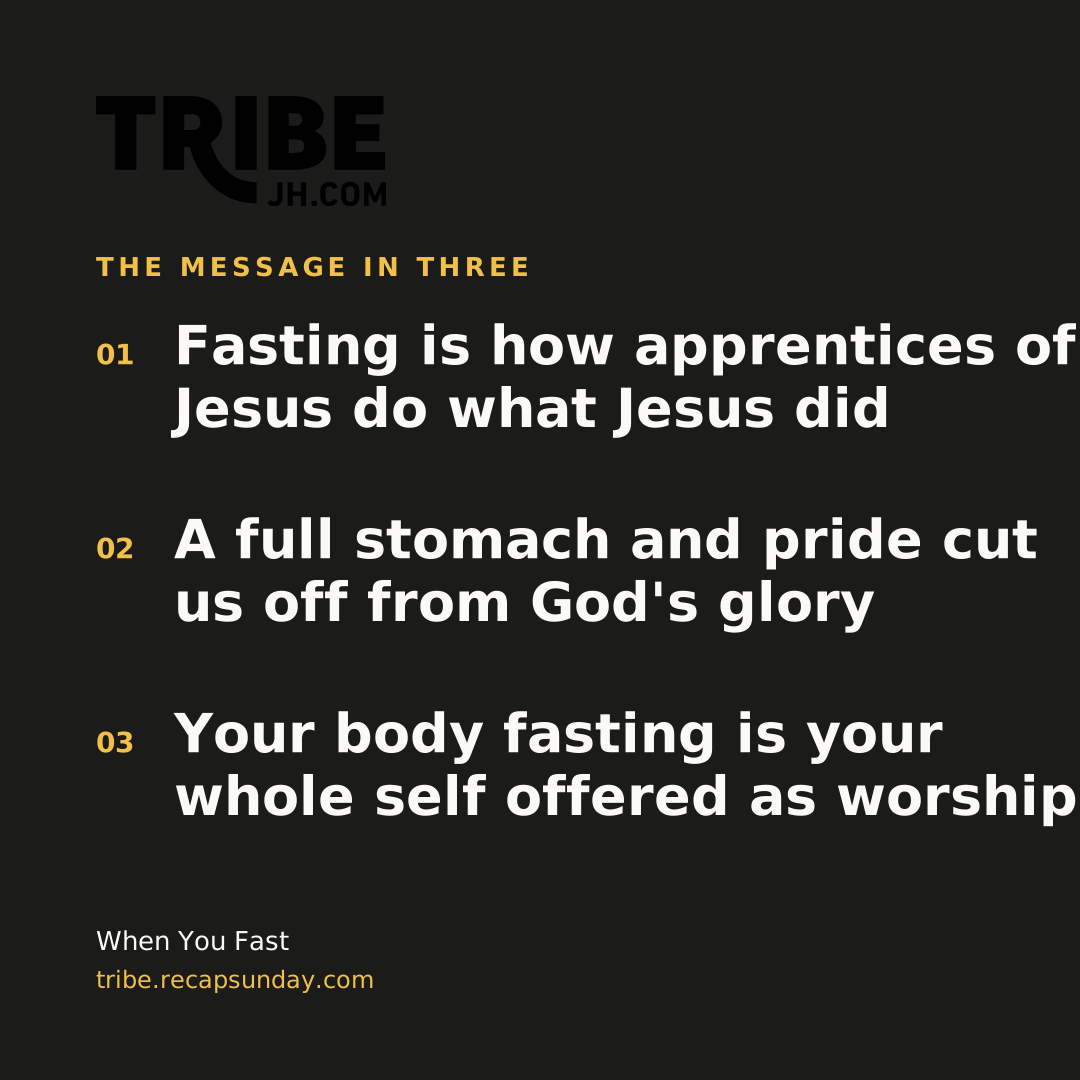
She gave five reasons to fast. The first is that we are apprentices of Jesus. Just as her husband followed a certified electrician during his apprenticeship and learned to do things exactly the way that person did them, following Jesus means doing life the way he did. He fasted, and he assumed we would too. In Matthew 6 he does not say "if you fast" but "when you fast," placing it alongside prayer and giving as an expected rhythm, not an exceptional one.
The second reason is to offer ourselves to Jesus. Romans 12:1 calls us to present our bodies as a living sacrifice, and Joy argued that the word "bodies" there means the whole person, not just the spiritual part. Fasting is one of the most direct ways to do that because you physically feel the sacrifice. The third reason, growing in holiness, is where she spent the most time. She walked through Deuteronomy 8, where Moses tells Israel that God let them go hungry in the wilderness specifically to humble them, because a full stomach and pride travel together and pull us away from dependence on God. Arthur Wallace, in a book she recommended called "God's Chosen Fast," puts it this way: fasting is a discipline of the body with a tendency to humble the soul. She also pointed to Ezekiel 16:49, which lists the sin of Sodom not primarily as sexual sin but as arrogance, abundant food, and careless ease.
Woven through the holiness section was a parallel track of what science has discovered about what fasting actually does inside the body. At thirteen to fifteen hours the body switches from burning glucose to producing ketones, which fuel the brain, reduce anxiety and inflammation, and bring a degree of calm. Around seventeen to seventy-two hours the cells go through autophagy, a process a doctor named Otsumi won a Nobel Prize for describing, in which the body finds damaged cells, bad mitochondria, and viruses and eliminates or repairs them. At twenty-four hours the gut resets and produces stem cells. At forty-eight hours the dopamine system resets. At seventy-two hours the immune system reboots entirely, which some doctors are now using alongside chemotherapy. Joy's point was not to make fasting sound like a health trend but to show that what Isaiah 58 promises, that healing will quickly appear, has physical evidence behind it, and that God designed the body to work this way all along.
The fourth reason is to amplify prayer. When the flesh is quieted and the spirit is elevated, connection with God becomes clearer, which is why the disciples in Acts 13 fasted before making major decisions about who to send where. The fifth reason is solidarity with the poor. Isaiah 58 ties fasting directly to sharing food with those who have none. Joy mentioned that Tribe has set up a giving designation for the Wind River food pantry in Riverton so that the money saved on meals during the twenty-one days has somewhere to go.
She closed with the story of Dunkirk in May 1940, when King George called the entire nation to prayer and fasting as 338,000 allied troops sat trapped on a beach. Hitler inexplicably halted his advance ten miles short, fog covered the beach, the English Channel went calm, and small private boats crossed over to bring the soldiers home. People who lived through it called it the miracle of Dunkirk. Joy offered it as an example of fasting as a response, the same pattern seen in Esther and in Nineveh, and as an invitation to believe that the same kind of door can open now. She then asked everyone to sit quietly, pray, and write down whatever came to mind when they asked God what he was calling them to do in the twenty-one days for Israel.
Touch points
Things you could actually do this week.
If you want to take part in the twenty-one days for Israel starting September 8, pray and ask God what he wants you to specifically deny yourself during that time, then write down whatever comes to mind.
Try skipping one meal this week as a water-only fast, and when the hunger hits, use it as a prompt to pray rather than a reason to stop.
Email joy@tribejh.com to get the PDF of fasting resources, podcasts, and book recommendations Joy put together for people who want to keep going deeper.
If you already give through the Tribe website, look for the Wind River option in the designation dropdown and direct what you would have spent on a skipped meal toward the Wind River food pantry.
Pick up a copy of Arthur Wallis's God's Chosen Fast or John Mark Comer's The Ruthless Elimination of Hurry, both of which Joy drew on heavily in this message, and start reading before September 8.
Doing a Bible study?
Here is a guide we have prepared for you: the passages
in order, questions for the group, and room to write.
Brian opened by saying he wants disruption of the normal pattern to crack open a door in your heart for an encounter with God. What does that kind of encounter look like for you, and what tends to get in the way of it?
Joy talked about Moses asking to see God's glory right after one of the hardest things he had ever been commanded to do, and God responding that he would cause his goodness to pass by. Has there been a time in your own life when you only saw God's goodness on the other side of something really hard?
La reunion comenzó con un tiempo de adoración y una reflexión breve de Brian Hunter sobre Moisés en el monte Sinaí. Brian recordó que cuando Moisés le pidió a Dios que le mostrara su gloria, acababa de vivir algo devastador: había ordenado a los levitas matar a quienes adoraban el becerro de oro. Desde ese lugar de agotamiento y confusión, Moisés clamó a Dios, y Dios le respondió prometiendo hacerle pasar toda su bondad. Brian señaló que muchas veces no experimentamos la gloria de Dios porque todavía no hemos hecho la cosa difícil que él nos pidió, ya sea soltar un ídolo, tener una conversación incómoda o alejarnos de algo que nos daña.
La mayor parte del mensaje estuvo a cargo de Joy, miembro fundadora de Tribe y ex líder de Tribe Kids. Joy habló extensamente sobre el ayuno como parte de una iniciativa de veintiún días llamada "Veintiún Días por Israel", que comenzaría el 8 de septiembre. Explicó que el ayuno, en su sentido bíblico y también según lo que la ciencia moderna está descubriendo, es una práctica que transforma el cuerpo y el espíritu al mismo tiempo. Distinguió el ayuno verdadero, que es abstenerse de comer y beber solo agua, de otras formas de negación personal que tienen valor pero no son técnicamente un ayuno. Presentó cinco razones para ayunar: ser aprendices de Jesús, ofrecernos a él como sacrificio vivo, crecer en santidad, amplificar nuestras oraciones y solidarizarnos con los pobres. También mencionó los descubrimientos científicos sobre lo que ocurre en el cuerpo durante el ayuno, desde el cambio metabólico a las cetonas hasta la autofagia y el reinicio del sistema inmune, como evidencia de que Dios diseñó el cuerpo para responder a esta práctica. Terminó invitando a cada persona a preguntar en oración qué quiere Dios que haga durante esos veintiún días, y aclaró que quienes tienen una relación difícil con la comida deben buscar orientación médica y pastoral antes de ayunar.
Al final, el pastor Murray oró sobre las ofrendas y la congregación se reunió para orar por Christian, un joven de la familia de Tribe que parte a la universidad en California.
---
Pasajes bíblicos mencionados:
Mateo 6:16-18
Romanos 12:1
1 Corintios 6:19
Isaías 58
Deuteronomio 8:2-3, 11-14
Ezequiel 16:49
Hechos 13:1-3
Juan 8:37
Mateo 4:1-11
Read the full transcript16,738 words
Church, you could miss an encounter with the Lord. And when we do something different to disrupt the normal pattern and routine, it cracks open a little door in your heart that there's a greater opportunity for you to actually meet with the Lord. Does what I'm saying make sense? I want us to be a community. I want us to be a family, and I want the God of the Bible to come and father our hearts for a moment.
And when he fathers us, it might look like rebuke, but you've never felt more love. It might look like encouragement. It might look like hope. It might look like answer. And when when Steve is up here and the band is up here, we're doing everything we can to do two things.
Minister unto the lord primarily but then also to just open up your heart a little more so that he can just whisper your name. Jesus, meet with us here. We don't want religion. We don't wanna just check the box. We wanna have an encounter with you.
Did you hear what I was saying? Yeah, know you're behind the veins but that's what we want. That's just what we we want. We wanna we wanna disrupt the the the standard, the normal. I wanna make it hard for people to check the box.
And so I I just love your your heart, Steve. Because we're we're so united in that. In in that. Yeah. Get that religion.
Let's just have Jesus in here. Thank you for leading us into his presence. We got more to see, but like Steve's just such a dear brother. Jesus, we just want you. Move in this place.
Disrupt what needs to be disrupted. Comfort what needs to be comforted. Okay, I
said it. You. You have come to feel this play. And we wait for give you glory. Give you glory, Jesus.
No wonder the elders bow down.
Just think as we finish. Who loves the presence of the Lord? Man. You know, when Moses when Moses went to the top of the mountain, who knows that famous line, Lord, show me your glory. And and I've heard it in different worship songs, and it always sounds so, like, anthemic and awesome, awesome, like, show me
your glory. Yeah. It's always, like, on
a mountaintop, which it wasn't a mountaintop,
but it always is, like, you know,
a little sensational and just so amazing, which it is amazing. But, you know, when when Moses asked God that question, show me your glory, who knows what had just happened? Remember when he goes down, they're worshiping the calf? And what did God command Moses to do? Levites, grab a sword and slaughter your relatives and your friends.
And can you imagine the smell of the camp camp of bloodshed, the cries of orphans? Now you gotta get rid of bodies. And this is the God we sing to that commanded Moses to do this. So Moses now goes back up to the mountain, probably depressed, confused, bewildered. God, you are a monster.
What did you just have me do? So I imagine Moses is up there just done, and he just can't even believe it. I mean, we can't even fathom what, as a leader, what that would feel like to have to get that order from the general. So he's up there, and he just says, God, I need to see your glory. And what did God say?
He goes, I'm gonna cause all my what? My goodness to pass by you. Moses, I know your heart's jacked up right now because of some hard things you've had to do, but I'm actually gonna tell you the secret of my glory. I'm good. Hang with me.
I'm good. You know, sometimes in our life with discipleship and consecration before the Lord, he asks us to do things that are hard. And sometimes we're not experiencing his glory because we haven't yet done that thing that he told us to do. We haven't yet cut that thing out of our life. We haven't yet avoided that situation.
We haven't yet had that hard conversation. We haven't yet given up that idol. And it's not that we have to earn anything, but God's like, look, if you'll do the hard thing, I will cause my glory to pass by you. I want you to circumcise your hearts. And so just as we finish, I just if it's okay, I just wanna play a song.
We'll switch over to Joy, just a song that kinda it's an original song, if that's okay. You can sit down. But it's about
the glory of God. Is that okay? Alright.
It might be a little tricky. I I haven't played it in a long time. I actually haven't led worship on a stage like this in maybe I don't know
how long.
The nerves are just are just getting out. Okay.
The one that the world rejected, the one who bore our grief. I have heard him whisper in the tree. The one with beauty beyond our vision, the one with healing in his wings. I have heard him when child sing. And I have heard the sound of glory.
It's a sweet melody of love unfolding. And have you heard the sound of glory? It's a sweet symphony of love unfolding in our time. The one with kindness for the stranger, the one who fell so we could fly. I have heard him in the open sky.
The one with beauty beyond our vision, the one who fell so we could fly. I have heard him in the open sky. The one without any selfish ambition, the one who broke the yoke of man. I have heard him in the barren land. And I have heard the sound of glory.
It's a sweet melody of love unfolding. And have you heard And what comes so easy to children should never be forgotten. And what comes so easy to children should never be thrown away. But somehow we lose it and somehow it dies. And somehow we abuse it, we listen to the father of lies.
And what comes so easy to children should never be forgotten. And what comes so easy to children should never be thrown away. Somehow, we lose it, and somehow, it dies. And somehow, we abuse it. We listen to the father of the lie.
Father, we pray in Jesus' name, Lord, that again, we would all taste and drink of your glory. Lord, we thank you for the first love. Lord, we thank you when you cracked our hearts open in all of our shame and guilt and darkness and benevolence and dysfunction. Lord, you broke in with love and it was sloppy. Lord, but we meant it.
Lord, we meant it. And so I pray, Lord, for everyone in this room. Thank you, Jesus, for touching us new and afresh with your goodness. In Jesus' name. Amen.
And I'm gonna hi. I'll go ahead and have that on here. Thank you. I know. Oh, really?
Okay. Good. I'm super nervous, so that's a good sign. Good morning. I'm gonna go ahead and start talking while you guys are getting settled again, also to give Connor a chance.
Or does this have a thing on it? Never mind. We're gonna leave it. Okay. For those of you who have not met me, and there's quite a few in here actually that I have, not seen before, my name is Joy.
And just to give you a little bit of history of me and tribe, been here since the very beginning and have been a part of, the vision and vision and the planning of Tribe and now how it's come into fruition. Here was, as Brian mentioned, on staff for quite a while and worked with and led Tribe Kids, just up until I handed it over into the very capable hands of Carla back in January. And God has been, originally, this time off from being a part of the staff has been, framed in a sabbatical, as a chance for me to take some time off and to just really focus on God and the things that God has been doing and restoring in my life as I have been reprioritizing according to his way, have really just blown me away. And in that vein, one of the things that I've been learning a lot about is fasting to to such an extent that I talk about it ad nauseam and my husband is at the point where I think he's, like, super saturated with fasting information. He's like, oh my word.
Stop. Anyways, and so I've got a lot of information to share with you today. And I I know that Brian usually sets this up as a conversation, and, and and I do want you guys to be able, to share. And, just so you know, I'm going in I'm about to go into teacher mode, and I'm gonna load you up with a lot of really good information. And I would encourage you, take notes if you can, but you might have to write really fast.
And if you can't, take it to the tape. Let's try and get it all here on tape, and then you guys can go back and listen to the podcast or watch the YouTube again and kind of parse it out and really, like, dig out what, what we're talking about today and and then, asking God where how it applies to you. All of this became a part of our conversation, and I was invited, to share with you guys about fasting because of what Tribe is doing as a church. We're calling it twenty one days for Israel. Is that the right words?
Twenty one days for Israel. If you did not, were not able to join us last week, Brian Pastor Brian laid a very beautiful foundation for God's heart for Israel and how important it is and why it's important for us to have a similar heart for Israel. And, but the problem is not the problem is, that's the wrong way of saying it. But, many of us, it kind of hits a record scratch when we hear that. Like, I'm supposed to have a heart for Israel.
Like, I got a lot going on right now. I don't really know, like, how does that actually, like, apply to me? And so what we're doing is we're taking twenty one days beginning September 8. We're taking twenty one days to as Brian will talk about later on, but it talks about in John eight thirty seven, to make room in our heart for Israel. To take some of he used this last week, which I thought was such a beautiful illustration.
This is our lives. This is my life right now, just filled to the literal brim. And so when somebody comes to me and says, God wants us to make room in our heart for Israel. I'm just like, where? Where is that gonna go?
And so in the twenty one days, we're going to, all commit to whatever the holy spirit is leading you to do, to deny yourself on some level that would take out something from your life so that you can make room in your heart for Israel. And so one of those opportunities to do that, I believe is fasting. And I purposely say one of those opportunities because we're gonna get into we're gonna get deep into the weeds of what fasting really is. And, fasting and denying yourself something, is different, that's what we're gonna talk about today, and that's one of the reasons that we're calling it twenty one days for Israel. We're not saying a twenty one day fast for Israel because there is an invitation to fast, but there's also an invitation to do other things to deny yourself, to take things out and make room in your heart for Israel.
So we're gonna talk about specifically what fasting is and how that can make room in your heart for Israel. And then also, want you to hear that there are other ways. The invitation is open, and we'll talk a little bit about, for some of us, the best thing isn't to fast actually, but there is still opportunity for all of us to make room in our hearts. And so that's what, that's what the twenty one days is, and that will begin on September 8. And one of those ways is to talk about fasting, And so that's where I come in to come and share with you what has been burning on my heart.
One of the things that I did just recently is I completed a four week small group with members of Tribe, and it was a very special time. And we spent four weeks deep diving into what fasting is all about. We used, a curriculum called practicing the way, and it talked specifically about fasting. It is, designed and organized by John Mark Comer whose name you may recognize. He was a pastor in Portland for many, many years.
He wrote The Ruthless Elimination of Hurry, which is a book that rocked my world and changed my life, and he goes into very specifics about that. And so a lot of what I am about to share with you is a regurgitation of what I've learned from him. So I will shamelessly steal his information, and he said that was okay. But also, so that you know as far as resources go, there are lots of resources that at the end, I'll kinda mention that you can go to to dig into this even deeper. Okay.
I'm going to just take just a moment to pray real quick. I have a lot of information. I need the Holy Spirit's help to cut it down. Lord God, Holy Spirit, you're welcome here. I thank you for your presence that I can tangibly feel right now, and I thank you for that.
You're such a good god. You're living in us and with us, and we just welcome you here. And I know, Lord, that this is, your teaching, and so use me as a willing vessel, cut my words down to the most important ones, and speak to us today. Prepare our hearts to hear what you have to say. In Jesus' name, amen.
Okay. On I've also just finished reading a book called Living Fearless by Jamie Winship. This has nothing to do with fasting. But it is another book that has changed my life and I would highly recommend for everybody. He talks about, in that book, identity, and he talks about finding your true identity as far as what, God says about you, what does God call you, how does God see you, what name does he use for you, and then as well as identifying false identities.
Because whatever we believe our identity to be, we will operate from that. We'll make our decisions, we'll speak, we'll we'll do all of our things, we'll raise our family, we'll get into relationships operating from that identity, whether it be false or true. And so in the book, it goes through an exercise where you just pray and you ask God, God, what is your identity? What do you call me? And when I prayed that prayer, one of the times that I prayed that prayer, I felt God immediately say, I call you armor bearer.
And I was like, armor bearer? What is that? I don't even okay. So I wrote it down and then I took some time to study it and I still have much to learn. But one of the things that stuck out to me about an armor bearer, especially in the bible, is that an armor bearer was right up at the front lines with the general leading the army and then handing the armor or handing the proper weapons to him as he goes off to fight.
And he's right there. The armor bearer is right there with him and equipping that general to fight their best fight. And I strongly believe that as we talk about fasting, this is one of my armor bearer moments. I feel like I am taking one of the best weapons or tools that God has given us, and I'm about to hand it off to you guys because I know all of you guys are on the front lines fighting, and I'm and I'm here to say, here you go. This is the one.
This is the one to use now. I keep thinking of a golf caddy when I think when I talk about this, and but I think it, like, loses a lot of its power there. But but, similarly, I'm getting the perfect club, and I'm handing it to you right now, okay, So that you can go out and you can play your best game of life ever. K? So that's that's that's my heart's desire, and that is why this will look a little bit different in style because I want to load
you
up with so much good information so that you can go and take it. But before we jump into too much information, I do wanna just kind of get a read on where we're coming from. When I say the word fasting, what do you think of? What have you been possibly taught? And I ask that you keep it short selfishly just so that I can or what comes to mind?
Do you know? Maybe even if you want to share with us, how fasting has or has not been a part of your life? I've who's got my mic today? Kat's got my mic. So if you guys could if you're willing to raise your hand and just share briefly, any thoughts about that.
The word to me just means doing without. Okay. Doing without. Yes. Anybody else have anything?
I'd always seen it as something that, like, super Christians would do or, like, elite Christians. And I was like, oh, I don't know that I got what it takes. And I'd see my dad do it whenever there's, like, a big decision
to make.
So it was like a
Okay.
Like, a way to be holy and, like, hear the Lord clear.
Yes. Yes. There's elements of truth in all of that. Oh, okay.
What I think of is abstaining from calories for a dedicated period of time.
Abstaining from calories. Very specific. Thank you.
I've been fasting twice a week for about three months now
with you. I
also do this program, so I know what it is. I'm not gonna cheat. But, and it's been life changing. So I think life changing when I think of fasting.
I love that. We got some more up here in the middle.
I'm gonna be very transparent. Fasting pain and
shaky. Yes. Yes. And hangry. I'm not a great parent when I fast.
Okay. We got yep.
So I used to think of fasting as giving up Oh.
Till I
realized that I was feeding myself God's food for me and God's word. And it really took on a whole new meaning for me instead of always worrying about giving up something.
Yeah.
I was concentrating on what I was getting.
Oh. It's a good one. All of these are really good and important, I think. Yep. We've got hands everywhere.
This is awesome.
So I only take it as a biological thing where you allow your digestive glands to relax for a while, and if you do it every now and then, it's good because every part of our body needs, you know, some of the other rest. But then every religion has it. I have
been with
a lot of religions. Everyone has it, and they just attach it to spirituality, you know, kind of being religious. But yeah, this is the main reason.
Thank you. But I'm gonna pause one second. We're gonna get to the other comments, but I wanted to stop on that because this is what I found really interesting. I have heard about fasting lately or most recently primarily with other religions and most religions outside of the western church, it is a primary part of of their religion. And we're hearing it a lot from health professionals, purely from a a a scientific or a biological standpoint, fasting is is in vogue right now.
And they're just talking about the physical benefits of it. Intermittent fasting is a really big, craze right now, but then there's other levels of it. And we're gonna talk about that because I think that that's important to note that I believe that, what scientists are discovering specifically about fasting right now and doctors are discovering and and what's going on in our body is actually just providing proof that what God's been telling us all along in here is true and is explaining a little bit from a scientific viewpoint why these things are actually happening, and we'll talk about that specifically. But it is interesting that it has become in vogue in the health world, and it's always been a big part of other religions. But for some reason, this is part of my title, where did it go?
When I say where did it go, I mean primarily in the Western church here in America specifically. Where did it go? Why are we the only one kind of the only ones not incorporating it in, because it has been, like, reserved for the super Christians and, like, every once in a blue moon, you have a really big decision to make. That's how I grew up too. When you have a really big decision to make, you're supposed to do it or maybe then you fast, but not, like, every day.
It it got relegated to very, like, legalistic. Talk about that too. Okay. Some more comments about fasting, and I wanna kinda throw in also, like, what do you, people have been sharing what they think fasting is, and then if there's any, like, anything else you've been taught about how you fast, feel free to share that as well. So do we have any more that people want to throw in when we talk about the word fasting?
What does that mean, and what does that look like?
This is a little different, but when I think about some of the scriptures around fasting, I think of fasting also as being something that's hidden.
Mhmm. Mhmm.
That it's not something we wear on our Yeah. You know, but that it's to be something that's hidden and between us and the Lord.
That is exactly what I was taught as well all throughout my life. And it was based on this scripture, if you can pull up Matthew six. This is actually the very first time that when Jesus was asked about fasting, this was his response. This is the first time he ever speaks of it, and this is early in, early in the gospels, they address it. Now, I want to give you some context for this in this specific area.
He's also talking of talking to them about the role of giving and the role giving to the poor and the role of, prayer as well. So prayer, giving, and fasting, he's covering all of these. He speaks specifically to fasting in this passage. Could somebody read that, either off the screen or from your own bible? Matthew six sixteen through 18.
And when you fast, don't make it obvious as the hypocrites do. For they try to look miserable and disheveled so people would will admire them for their fasting. I tell you the truth that it that is the only reward they will ever get. But when you fast, comb your hair and wash your face, then no one will notice that you are fasting except your father, who knows what you do in private. And your father who sees everything will reward you.
Thank you. So here if we just take these verses, out completely, I think we miss the greater context of what Jesus is trying to say, and also we miss the fact that this is in the context of when he's talking about pray, praying and giving as well. We never think, like, well, I need to, like, give in secret or I need to, like, pray in secret constantly. Like, we pray in community as well. We just prayed I just prayed right here on the stage.
So, is that is that his point here? And I would I would would stress I would say no. I'd push back a little bit on that, and that that was uncomfortable for me to hear the first time that, that I heard this teaching because I thought it was supposed to be something we don't talk about it. Like, we don't talk about Bruno. We don't talk about when we're fasting.
Okay? It's just that's just you cover it up. But here he's talking about our motive, and it's very important, and we'll cover this in just a minute, but the motive comes first. What do we see from the motive here with the pharisees? He says that they try to look miserable and disheveled.
Why? What does it say? So people will admire them. He's speaking specifically to the motive there. If your motive is to get accolades in your Christian walk, if your motive is to be a super Christian and is to show people what a great Christian you are and how God speaks to you and what great things God is doing because you are fasting, then Jesus says, that's the only reward that they will get.
I believe that he in here, he is not saying hide yourself every time that you fast. And one of the reasons that I believe that he's not saying that is because of the rest of the old testament whenever we talk about fasting. There are instances where they talk about people fasting on their own, but can anyone think of any times in the bible when people fasted as a community? Anyone? Just shout it out.
Esther. K? So in Esther, Esther, the they were facing complete genocide like the the king was going or Mordecai was trying to get all the Jews killed. And so Esther calls a three day fast for the entire Jewish people to fast before she goes in and puts herself in at the king's mercy and ask for the lives of them back. The festivals, I heard that.
The Jewish festivals, the only time it's actually fasting is commanded in the bible is in, is for the day of atonement or Yom Kippur and that is a time set aside to sanctify yourself and prepare for Sukkot, which we'll cover, later on, which is another fun festival. But, but other than that, it is that's the only time that it's commanded, but then that, again, is the whole nation fasting as a group. It is not part of, an individual just between you and God. There is a place for that, and we'll talk about that. But, in this scripture, there's two things that stand out to me.
First of all, at the beginning, it says, and this is Jesus talking, when you fast, which means Jesus, what? What was his thoughts about fasting? He assumed it. He assumed we were gonna do it. He assumed.
He did not command it, but he expected it because he said, when you fast. He didn't say, and I command you to fast, and when you fast, then don't make it obvious. He just said, when you fast. He expected it just as he expected us to pray, just as he expected us to give alms to the poor. He expected us that that would be a regular rhythm in our life.
And then the other part that sticks out to me is at the end, it says, and your father who sees everything will reward you. There is a clear reward, and I think that this speaks to what the health industry right now is finding out in fasting is that there is a physical bodily reward for fasting, but then there is also a spiritual reward for fasting. Isaiah 58, we're gonna hit it often, but go ahead and open your Bibles and then definitely keep your thumb there for the rest of today because there's so many verses in there that we're gonna talk about. But this is one of the most famous passages that talks about fasting. And here is one of the things or some of the things that Isaiah outlines as part of the reward that comes from fasting.
After it says, when you fast here's the fast that I chose. This is earlier. I'm just gonna summarize. Loosing the bonds of wickedness, undoing the straps of the yoke, let the oppressed go free, break every yoke. And then it says, when you do that, here's your part of your reward, then your light, which is representative of spiritual understanding will break forth like the dawn and your healing will quickly appear.
Then your righteousness will go before you and the glory of the Lord will be your rearguard. Then you will call and the Lord will answer. You will cry for help and he will say, here am I. I'm not sure that there's anybody in this room that doesn't need at least one, if not all of those things right now in your life. Healing, spiritual understanding, and direction to know what to do.
You're maybe you're facing a time where you are facing a really big decision or hard or difficult time, and you're crying to the God trying to God, and you're like, where are you? I can't hear you. I don't know what you want me to do. Right here, we have a promise that if we take time to fast, God will say, here am I. He will answer us.
So there's some really fantastic rewards in there. But as we talked about before, it's really important to remember that our motive is not for reward. That is like a wonderful wonderful bonus. But our motive in fasting is always to offer ourselves to God. It is an act of worship.
So let's talk about that a little bit more. There are let's see. I'm gonna skip around a little bit. There are five reasons that we're gonna talk about today about why we fast, and the first reason is simply because we are apprentices of Jesus. This is something terminology that I stole from John Mark Comer.
Instead of using disciples, which is a little bit of a more archaic word or not archaic in a bad way, but just in a I don't really understand what that looks like because we don't have necessarily disciples today. We do have apprentices. My husband is an electrician and he had to do an apprenticeship for two years to learn electrical ways, and an apprenticeship looked simply like this. He would get up every morning, he would go to work, and he would follow somebody who was already a certified electrician, and he would try to do electricity and learn electricity exactly like that guy did it. And he would learn how to wire houses, he would learn how to I don't know the terminology.
Put together outlets. That's not the right way to say it. He would learn all these things, all these styles because he was just simply following him around and learning, and then there was an opportunity at some point where person he was apprenticing under would say, okay, here you go. Wire up this outlet. And would stand over and watch and make sure and and teach him like, oh, nope.
That doesn't go that way. That actually goes this way. Here's where this goes. Okay. Well, I really like this is the way this is there was a lot of, preferences in electricity that I thought was interesting.
Like, some people like to do it this way and some people like to do it that way, and so it all depended on what you're the person you were apprenticing under. What they did, that was what you followed. And that is when Jesus calls us to be his disciples, he's calling us to be his apprentices. He's calling us to say, come and follow what I'm doing, watch how I do it, and then you go and do it that way. And so when he calls us to be, his apprentices and we're talking as we're talking about and preparing for twenty one days for Israel, as he as we're following him in the New Testament, he well, first of all, he is a Jew, and he has a heart.
And as we go through all of all of the bible, we find God's heart burning for Israel. And so if that is his motive, then let's try and figure out and let's follow him and like, okay, God, I see this is important to you, so as your apprentice, I'm gonna follow, I'm gonna do what you're gonna do. And then here in Matthew four one through 11, we're not gonna turn to it. I do have a slide at the end, just so you know, that will summarize all five of these with the scriptures and everything, so you can just take a picture and again, take it to the tape, go back and figure and dig into it more. But Matthew four one through 11 is when Jesus is fasting for forty days and forty nights before he starts his full time ministry.
Again, if we're apprentices, if we're following him around, if we're trying to make our life look like his life and do the things that he did, his first thing before he goes into ministry is to spend time in prayer and fasting. So there's number one reason why would we consider fasting to be a part of our life because we're apprentices of Jesus, because we want our lives to look like his. And he found it important, and he went into three of the most three and a half of the most intense years of his life, and he started it with fasting. There's something there. There's something there.
Alright. Our second reason for why we fast is to offer ourselves to Jesus. Now on a practical level, we can all think of if you've ever either purposely missed breakfast because you were fasting or accidentally missed breakfast and or another meal, and you start to feel that hunger and that discomfort inside of you, we understand that that sacrifice that God has called us to, how fasting could possibly fall into that. Right? We can feel that sacrifice in our body.
In Romans twelve one, it says hold on. Let me find it so I can read it to you. Offer Oh, I don't have it written down. Can someone look it up for me? Romans twelve one.
Sorry. That's the prayer that we can pray in a response to that verse, but the actual words of the verse are similar but different. Does anyone have it for me? Okay.
Therefore, I urge you brethren be by the mercies of God to present your bodies a living and holy sacrifice acceptable to God which is your spiritual service of worship.
Yep. Offer your bodies as a living sacrifice. There the word body is the word soma. That's where we get, our words like somatic and exercises. It's the idea there is your whole body.
Offer your whole body. I believe that too often we have separated our body as far as like the skin and the bones and the muscles and stuff and somehow separated that from who we are, But here, Paul is is encouraging us to offer our whole body, not just our spirit, not just our heart as a living sacrifice, but offer our whole body as a living sacrifice unto God. And so we can feel that sacrifice literally when we start to feel hungry, but fasting is an excellent way to tap into that form of worship where we literally offer our whole body and start to feel that hunger, feel that discomfort to God. And then in first Corinthians six nineteen, the bible says that your bodies are temples of the holy spirit who is in you, and then it ends with, therefore, honor God with your bodies with your bodies. And so when we get into, talking about fasting and I'm gonna define this now, and then I'll come back to it later.
But when I'm talking about fasting, I'm actually talking about like what our the person that we're apprenticing under Jesus modeled for us in those forty days and forty nights of fasting, he did not eat. Now the bible does say that he, the bible says he was hungry. The bible doesn't say he was thirsty. So I believe that his model for us was what we would call I think we'd call it a water fast, right, where it's just water. There's no food, but you can still drink water.
And so when we're talking about fasting, I'm talking about that, and I know there's weeds we can get off into. We'll get there. But, that's what I'm talking about specifically here. And then again, as we're talking about our bodies and we're offering our whole bodies to God, when we just practice something like self denial where we just take one thing out, like I'm not gonna eat sugar or I'm not gonna eat or I'm not gonna drink alcohol or whatever, that is not offering necessarily That is a wonderful thing and it has its place, And when we're talking about fasting, I'm talking about something different. Does that make sense?
That's that's all that I'm that's the line that I'm drawing right now. So we're offering our bodies as a living sacrifice. Jesus offered or Jesus modeled that for us, and then Paul says, we have one of our ways of worship is to offer our body as a living sacrifice. I actually use this prayer, God, I offer my body as a living sacrifice, just kind of as a a motivation and just to help me get through the more uncomfortable parts of fasting to remember to allow that feeling of hunger and that feeling of discomfort to remember, oh, it's because I'm offering my body as a living sacrifice. I'm actually feeling the sacrifice inside of me, and so it gives more, purpose to that for me to keep my eyes fixed on what this truly is about, and that's why we talked about it there.
Now, I also believe that our fasting, what we do and we're gonna I want you to think about this as we talk about some of the other things that happen when we fast. What we do with our body has an effect on our soul. When we talked about, last week when Brian was talking about in Hosea, and he was talking about God's heart and he for Israel, and he he gave it as a a pair an analogy he used is going into covenant of marriage. I thought that was such a beautiful thing because when we put it in that marriage context, all of the all of us who have either who are either married or have been married or been raised by people who are married, we have a context to understand that, and the reason that we have that context to understand it is because we have experienced it with our bodies. Our bodies have felt the love or the rejection, the the commitment, the pain that comes with the commitment, the lust and the desires, all of those things we have experienced with our bodies.
And so when Jesus uses or when in Hosea when he compares his love for Israel like a wedding, we can understand that more because our bodies have experienced it, and that's why he goes into that. And so for us, when we are, considering fasting in our lives, we're getting our bodies involved because what we do with our bodies has an effect on our souls. It is not something that you can, like, draw a line and somehow, well, this is just for my body, and this is just for my soul. Now, when we talk about fasting, I'm gonna talk about the physical benefits as well because I don't think there is that line. They are they're meant to work together.
They're meant to be all part of the experience of fasting. Okay. So this offering ourselves to Jesus is at the beginning because, again, motive. This is the most important thing one of the most important things I want you to walk away with. Our motive is to offer ourselves as a sacrifice, as an act of worship to God, and that's what our motive is for fasting.
Now, I'm gonna give you lots of other great reasons to fast, but the motive is not for all these other great reasons. The motive is to offer ourselves to Jesus. Got it? Okay. Told you I'm gonna ram through.
Here's all the stuff. Okay. So one of the effects of fasting now I've listened to a lot of podcasts that talks just purely from a health and physical standpoint. I want you to know what's going on in your body. At about thirteen to fifteen hours into having just water, your body does something at a cellular level that is so fascinating.
So we all know from biology class that our body runs off of glucose. Right? That's what gives us energy. So as we're eating food and we're getting glucose in, our body is burning that and turning it into energy to keep going. At about thirteen to fifteen hours, if we stop, and we've stopped and we're which if you think about it, you're like, wait a second.
If I eat an early dinner and eat a late breakfast, I actually hit that thirteen to fifteen hour mark. Awesome. I think that's I think that's what God designed. At about thirteen to fifteen hours, depending on your body, you will burn off the glucose that's readily available from eating, and then your body will be like, whoops, now we need a different fuel source because the glucose is out. And not completely out, but we've burned through the stuff that's readily available, so now we need to switch over the the bible.
Science calls it metabolic switching, and we need to create a different kind of fuel for our body to work off of, and those are called ketones. Ketones is what the keto diet is all based on. And it's this idea of metabolically switching, giving your body a chance to stop living off of glucose all the time and to switch over into into getting our energy from ketones. Listen to the benefits of ketones. Ketones fuel our brain.
This is this is what the doctor said. It takes away the hunger feeling. I have not had that experience, but that's what they say. It adds actually some euphoria and calm to our brain so that if you're battling things like anxiety and depression, it helps reduce that. It, brings up testosterone.
It helps you burn fat. It decreases inflammation. It helps keep your blood sugar low. All these things that we're like, oh, I want some of that. That sounds awesome.
Right? These are all the things that when we switch over and our body needs to switch over, to burning ketones, all these benefits that are happening. And that's just the thirteen to fifteen hour, that's just what a lot of people why people are capitalizing on intermittent fasting, this idea of having a longer window where you don't eat. Now, it's interesting because our American society has created, a relationship that to food that is all based on what? Like, what are we supposed to do to be healthy?
Like, three meals a day. Right? Breakfast is the most important meal of the day. Do you know who made that phrase up? Kellogg's.
It it has zero scientific backing. It was literally just a ploy to get you to eat their product at breakfast so they weren't competing with dinner and lunch foods. It snacks, and there was a big there was another big diet craze I was talking about, like, keeping your metabolism up. So we eat every, like, I don't remember what it was, thirty minutes or something, lots of snacks throughout the day. So we have created this system in this society where we're like, oh, we have to, constantly feast, and we're just and we're just putting more food and putting more food and putting more food in.
But actually, God's designed our bodies to work optimally when we feast and fast in in a cycle and allow our bodies to get to those ketones, and that's just that's just the beginning, but we're gonna move on. I'll get back to more in just a second. Third reason that we fast, to grow in holiness, and this is this is really where making room in our hearts, like we were talking about, if we're making room in our hearts for Israel through this time of denying ourselves, this is really where fasting makes plays a big part in this to make room in your heart for Israel, but to make room in your heart for other things as well. Romans eight thirteen, can I get somebody to read that, please? And then John eight thirty seven is the verse that talks about making room in your heart, so we're not gonna hit that one, but, Romans eight thirteen.
Anybody? Where'd my mic go? Thank you.
Four. If you are living according to the flesh, you must die. But if by the by the spirit, you are putting to death the deeds of the body, you will live.
K? So oh, there's so much to say here. If you're going to live by the flesh, we will die. Now let's talk about what that means. Pastor Brian just talked about this not too long ago about what it means.
The flesh is like the the part of you that has a propensity towards sin. Paul talks about it later on in the Bible where he says, the part of me I, like, I want to do things that I want to do, I don't do, and the things that I don't wanna do, I want to do. An archaic example, If you guys have seen, like, the old school cartoons, there's kinda like the angel on one shoulder telling you to do one thing and then, like, the little demon on the other shoulder telling you to do one thing, the flesh would kind of be like that demon. It's that whispering, that's that voice inside of you, it's that urgent desire like, I wanna do these things, but they are leading towards destruction. And here in Romans, it says, it will If you live according to the flesh, if you're constantly following those desires, then you will die.
But if by the spirit, you put to death the misdeeds of the body, you will live. It says, by the spirit, we put to death the misdeeds of the body. There is a a willpower inside of us that Paul addressed when he said, man, the things that I want to do, I don't do, and the things I don't wanna do, I do. And he's talking about if I just go off of my own power, my own willpower, and try myself to make good decisions, in general, the flesh wins out. I end up doing the things that I don't want to do because willpower alone is not enough to defeat it.
The Bible says right here in Romans eight thirteen, if by the spirit you put to death the misdeeds of the body, you will live. As we are operating or as we practice fasting where you are literally not eating, the bible calls it on a different level, the bible says it's like starving our flesh, and it's not and it's physically, yes, we're not eating, but it's it's taking the power from the I'm just gonna keep this is my demon and this is my angel. This is the flesh and this is the spirit. I it's literally taking the power from the flesh, starving the misdeeds of the flesh or sacrificing the flesh so that my spirit can rise up. Where do I get that?
You guys, this this blew me away. Turn in your bibles, keep your finger in, if you still have it in Isaiah 58, keep it there. But turn in your bible to Deuteronomy eight. A couple years ago, I took, tribe kids through reading our entire bible in a year, and, man, they were awesome and rose to the challenge. And we're talking first graders through fifth graders.
And and families, thankfully, partnered with me and worked together as a family. But we read through all of this stuff, and I did not see this at all when we read through it. Deuteronomy eight verses two and three. Can I get someone to read that? And then somebody else get ready for Deuteronomy eight verses 11 through 14.
Deuteronomy eight verses two and three. Come on, guys. I got lots more to tell you.
Remember how the Lord your God led you through the wilderness for these forty years, humbling you and testing you to prove your character and to find out whether or not you would obey his commands. Yes. He humbled you by letting you go hungry and then feeding you with manna.
K. He I'm gonna stop right there. He humbled you by letting you go hungry. There the principle of starving the flesh so that our spirit could rise up, here is here is the roots of where that comes from. When we are constantly being fed, our we're feeding our we're literally feeding our flesh as far as comfort too.
Think about this, when we have a full belly and life is going good, where is our need for God on like a one to 10 scale? If the fridge is full and there's food there's three meals a day on the table and, the paychecks keep fueling that, our need for God tends to diminish, doesn't it? Because we feel comfortable, and that is probably one of our greatest I believe one of the greatest enemies for Christians in the Western church today is comfort. Because when we feel that comfort, our need for God, or we could say it a different way, our pride goes up. I don't need God.
I feel good. I'm good. And that comes part a big part of that is that idea of a full stomach. And so, Moses spoke specifically to that and said, he did let you get hungry because he was trying to teach you humility. He was not trying to, he was not trying to ruin your life.
He was not trying to restrict your life. I just saw, on Instagram or something, I'm talking about how boundaries are a good thing because if you took, like say, you take, like, a fish out of water and you put it on the land because you want that fish to explore this new area and this new territory so that it can know what else is out there in the world, how is that fish gonna thrive? It's not. It's gonna die. The boundary of the water is actually created for it to thrive, for it to live its greatest life.
And I believe that the boundary of fasting in the same way is put there as, like, bumpers in the bowling alley, not to restrict you and not to keep you from all these other wonderful things, but it's to put you in your best life. It's like on that bowling lane, it's to keep you right there on your best life of what God has designed for you. And so Moses says, listen, when we get too full, we get out of our best life, and so God was trying to show you that. And then he goes on to say in do in still in chapter eight verses 11 through 14. Chris, do you wanna read that too, please?
Yes.
Thanks.
But that is the time to be careful. Beware that in your plenty, you do not forget the Lord your God and disobey his commands, regulations, and decrees that I am giving you today. For when you have become full and prosperous and have built fine homes to live in, and when your flocks and herds have become very large, and your silver and gold have multiplied along with everything else, be careful.
When you are comfortable, be careful. Keep going. Was that it? Oh, can you read 14 too? Sorry.
Do not become proud at that time and forget the Lord your God who rescued you from slavery in the land of Egypt.
K. Here, Moses k.
Just really quick. Sorry. That's okay. Because in my version, it's not a warning. It says, your heart will become proud and you will forget the Lord if you're full.
Which version is that? NASB. I love it. Moses tells them this is back in Deuteronomy. How have I never seen this before?
Okay. So a lot of the information I'm also getting is out of this beautiful little book that you can get on Amazon for, like, $8. It's by Arthur Wallace called God's Chosen Fast, and he goes through all the scriptures that talk about fasting and explains them and details things out, and he was talking in this one. And he says, the Bible basically outlines for us, specifically speaking in to these verses that pride and a full stomach are bedfellows. And as we just read in in Deuteronomy, they lead us to destruction.
They do not lead us to our best life. He also says this is worth writing down. He says fasting is a discipline of the body with a tendency to humble the soul. Fasting is a discipline of the body, getting our bodies involved in this with a tendency to humble our soul. So as we fast, humility goes up and pride goes down.
If we live in a constantly feasted lifestyle where we're just eating and comfortable and eating and comfortable and eating and comfortable, pride goes up. And likewise, our ability to connect with God is disconnected. God is a spirit, we are a spirit, and so the way that we connect with God is as a spirit. So if we are sacrificing the deeds of the flesh so that our spirit can rise up, then our spirit, the one that has our connection with God, is able to communicate greater with God. Think about this on a physical level.
When we start to fast in our body, if we eat too much food and we're getting, excessive amounts of glucose and, like, specifically, we can think of, like, Christmas or Thanksgiving or whatever, what are the effects on our body? What? Yeah. We get super lazy. Laziness is in one of the versions of Deuteronomy eight.
Laziness, we feel lazy. We feel tired. We do not we lose our motivation. We wanna just go and take a nap. All of those things are those increasing our connection with God or even with others, or are they decreasing it and disconnecting us?
So when we have a chance to fast, we're allowing our spirit to be elevated, and and even on a physical plane, we can actually connect better with others, but then also our spirits are elevated so that we can connect better with God going back to what it said in Isaiah 58, I'll call on the Lord and he will answer because my spirit is elevated and my flesh has been quieted a little bit. Okay. Let's go to another oh, no. No. No.
We oh, you guys have to look at this one. Ezekiel sixteen forty nine. Please, everybody, if you have a bible or if it's on your phone, please open and look at this. Another verse that blew my mind I did not know was there. Ezekiel sixteen forty nine.
Gretchen, can you read it in NASB? I don't know what it says in NASB, but I'm guessing it's good. This is talking about this is talking about a lot of stuff, but the prophet is talking about the misdeeds of Israel, the consequences, mostly negative consequences to pay for it in this chapter, and he's talking about even your sister Sodom and talking about the sins of Sodom that we know, well from Sodom and Gomorrah and Moses' brother was it brother? Aaron? Aaron, going there.
Go ahead. Just 49? Just 49. Yeah. Behold, this was the guilt of your
sister Sodom. She and her daughters had arrogance, abundant food, and careless ease, but she did not help the poor and needy.
That was their sin. The source of the sin of Sodom is and another version it says pride, gluttony, or, Gretchen just read x abundance of food and laziness. Ezekiel sixteen forty nine. John Mark Comer, when he talks about, fasting, the one that I'm stealing so much information from, as a as a pastor and as a counselor, he often, advises people that are in sexual sin specifically to fast first before, before they get into counseling because it it's this idea of let's get the let's sacrifice the flesh and elevate our spirit because that pride and that full stomach make it disconnect us and make it difficult for us to hear from God. So let's try and get some of that out of the way.
You know, even in the he talks about even in the seven deadly sins, the first one listed and seven deadly sins is not, listed out in the Bible. Right? I think the mystics or somebody put that together. But what's interesting is that when they created that list, the number one sin, the very first sin does anyone remember what it is? It's gluttony because they recognized and he had it set up like dominoes.
They recognized that that deadly sin of gluttony was like a domino had a domino effect and knocked into and led the way into all these other deadly sins in their life. This is the reason that living chasing a life, chasing after comfort, chasing after that full stomach, and not allowing ourselves to get comfortable as Steve so wonderfully, introduced for me, but doing the hard thing like Moses going back up after having killed, I think it was like 3,000 people that they that they killed before he went back up, and both of those, that was sandwiched in a fast too. Forty days up on the mountaintop on Mount Sinai where he got the law, which was hugely significant, and then comes down, deals does this really hard thing in obedience to God, goes immediately back up, spends forty more days, fasting and praying because of how important and powerful it is. And I would venture to say if he hadn't spent those forty days fasting before he got there before he came down, he would not have been able to obey on the level that he needed to because his his flesh would have been higher than his spirit, and he wouldn't have been able to have that, the strength and the courage to do that.
So, again, this is a warning that if we are chasing after that, feasted lifestyle and we never make room for fasting, the bible is very clear in its warnings of what it leads to and the destruction it leads to in our life. But yet we've gotten so far from it. It's very interesting to me that we've gotten so far from it. Alright. Let's go back to a physical, what is happening biologically.
Just recently, in 2015, doctor Otsumi got a Nobel Prize because he understood or because he understood as he was studying our bodies and what it goes through in fasting, what was going on on a cellular level, and he created this term autophagy, or he discovered this idea of autophagy. Autophagy and this happens about seventeen to seventy two hours into fasting. So as you're getting in deeper and deeper into that window of not introducing glucose, not introducing food into your body, and staying in a fasted state, he said that in, at that time, our body is, designed he didn't I'm gonna use Christian words to talk about this. He discovered that our body is designed to thrive and optimize when it needs to. So we've gone from burning glucose to burning ketones.
Those ketones we need both. We don't we can't live off of just ketones, but we have switched fuels that is helping our body along in that. And then when we get a little bit past that, then our body goes into autophagy where, it says, okay. I know I still don't see any glucose coming in. We're working off of ketones, but now we gotta optimize.
Let's get rid of anything that might be, slowing us down or making this more difficult for us to function right now. This is your cells talking. And so your cells go through an autophagy, and they basically, like, take out the trash. They go and find bad mitochondria. They go and find, viruses.
They find damaged cells, and they start repairing them or literally eliminating them so that our body is more optimized to live in this state where we're not getting the glucose yet that we know and are conditioned to expect. Our body is literally taking out the trash. Here we are fasting we fast to grow in holiness. What is holiness? Holiness is being pure.
Holiness is being set apart. Our bodies are a picture for us of getting that junk out of our lives so that we can live in holiness and in connection with God so that our spirit can be elevated. So good. So good. Okay.
Alright. Yes. Yes, please. Okay. She asked, will I differentiate between living in comfort and living in your best life?
I think it goes back to, it goes back to, I offer my body as a living sacrifice. God has called us to, not live unto ourselves, which would be living in comfort. Our focus is on, oh, I feel a hunger pain, gotta take care of that. Our focus is on, oh, this bed is so uncomfortable, I think I'll buy a new one. Our focus is on the different things that we see in our physical world and making that the focus of our life is just constantly fixing that so that we can live in comfort versus where God has called us into living our best life is keeping our eyes fixed on him as apprentices of Jesus, doing our life the way that he has called us to do so that things like autophagy can actually work in our body.
Things like switching over to ketones can work. We have spent a lot of time as a nation chasing comfort and chasing fulfilling whatever our flesh desires, and suicide is on the rise, depression is on the rise, obesity is on the rise. It's not working. Addiction is on the rise. But all of those are based on chasing comfort as opposed to chasing God's best and keeping our eyes fixed on him and offering our bodies as a living sacrifice.
Oh, another fun thing about autophagy, if you are fully in a fasted state and there's no glucose because your body is working off of other stuff, you science has just recently discovered you can't get sick. If a virus is introduced into your body, that virus immediately goes and looks for the glucose so that it can grow and multiply. And if it's not there, that virus is dead on arrival. There's nowhere that it can go. Very interesting.
Okay. Alright. Let's move on. Next next is number four is to amplify our prayers. I'm gonna I'm gonna fly through these last couple because of time, but here, the prayer that I have is God speak to me, I am listening.
Again, as we talked about or sacrificing our flesh and elevating our spirit, we're increasing that connection with God. We can go back to Isaiah I'm not going to switch back but it's listed on there. Isaiah 58, then your light will break forth like the dawn and your healing will quickly appear. These are all of the promises that are available. Now again, don't forget, our motive is not so that our healing can quickly appear.
Our motive is what? Yeah. Worship to God, offering ourselves as worship. So we're not doing it for these benefits but these are benefits that also come along with it. K?
So, in acts thirteen one through three, we're not gonna turn there, but the, this is after Jesus has ascended back into heaven, the disciples are trying to figure out, like, who do we send where, and what do we do now, God, and and so they the Bible says here in Acts 13 that they stopped and they prayed and they fasted, and then the spirit spoke to them, and then they laid hands on the people that were supposed to go out and they sent them out. That it gave them that extra connection with God to know, okay, these are big decisions that we gotta make, I gotta go and do that. So like Jay was saying, there is an element of that that I grew up with as well that, like, fasting is when you have to make a big decision. For some reason, the way that I was raised, it fasting was limited to just that, just when I have to make a really big decision, then I fast. But, and that is true.
Those things that it does increase our connection and it does help us hear I think hear God again on a cellular level if we're not loaded down with the glucose, it actually clears out ourselves so that we can think clearer, and when we're operating with those ketones, we can think clearer. That is also, again, a picture of what's happening spiritually as well. We can discern clear. Our our spiritual minds are also able to work better. Let's see.
Okay. A little bit more on the physical. We're talking about amplification. Here's some more things that scientists have discovered with even longer fast. If you get to a twenty four hour fast, your gut goes through a complete reset.
That means that stem cells are being produced, and stem cells are not, I don't understand very much about cells even though I tried to teach biology, didn't do a good job, but I do know that stem cells are not limited specifically, like, we have skin cells and we have blood cells, but stem cells can go into any of the different types of cells. It's like the wild card, and you can use them your body can use them wherever. So if your skin needs repairing, the stem cells can come in and start working. If your blood needs cleansing or whatever, the stem cells can help do that. If there's a there's pain or there's hurt in your body, the stem cells can work towards that.
So at twenty four hours, you begin to see an uptick in that in your body. At thirty six plus hours, this is my favorite one, but the I'm I'm telling you all of this, and let me be very honest with you. Fasting is hard. I don't like it. It's really difficult.
It's really there's I I have not I know some people's bodies are like, oh, yeah. I went seventy two hours. No big deal. That's not me. That's not me at all.
I it's difficult, but I do keep these things in front of me, and I still keep walking in obedience to do it. At thirty six plus hours, again, our body is designed to optimize. So now we have our gut reset, we're working off of ketones, our body is taking out the trash, and then at thirty six plus hours, your body goes, it's like that point in the storm at the and you're in a ship, and you gotta get rid of all the extra baggage that's on board to help the ship, your body does that to the fat in your body. And it goes, what else can we do to optimize? We gotta get rid of this fat.
This is slowing us down. This is not optimal for us. And bonus, thank you, Jesus, that first fat that it goes for is our belly fat. Who doesn't want that to go? But that's that's exactly how our body has been designed, and then it does work with other things as well.
But I'm putting this before you as something as a reminder, like, this is uncomfortable, but the like it says in Matthew six, your father who sees you in heaven will reward you. It is not for nothing. K? At forty eight hours, you get a full dopamine reset, which means that we've got dope we have dopamine receptors, and actually what, doctors are finding now in America is that we are pretty much dopamine saturated, which means that, like, if you are you are designed that when you eat food, you get that good feeling like, oh, that was delicious. That makes me feel good.
That's supposed to happen, but because we're dopamine saturated, we now have to eat twice as much food or more for us to feel feel that dopamine hit that food is designed to give us because we have we're so saturated with dopamine. So at forty eight plus hours, our bodies get a full dopamine reset, and now when you do introduce food back in, that dopamine that you would get from just one cookie instead of the whole bag of cookies, is reset again, that you can feel that on a more healthy level, and it doesn't take all that extra to try and get us to, feel good from it. And then at 72, they have found that on a full water fast for seventy two hours, our immune system resets. This is incredible. Our white blood cells reboot and go to work new.
Doctors who are starting to understand this, again, purely from a physical standpoint, doctors who are starting to understand this are actually using this in chemotherapy, and so when they prescribe chemotherapy, they are also putting people on a three day water fast because once they get out of chemotherapy, now they are coming out instead of their immune system being almost completely killed off by the chemo chemotherapy. Because of the three days of fasting, their immune system is reset and comes out stronger after that. How cool is that? And that is, again, just purely from a physical standpoint, but when we're talking about amplifying our prayers, when God says, I'll reward you, when Isaiah 58 promises your healing will quickly appear, there it is. Our bodies it's it's been here all along, and the bible has been telling us all along that there is a reward to it, and now science is going coming through and backing it up and saying, here's literally what's happening in your body.
We serve a good god. We really do. Okay. Number five, another, reason to fast is to stand in solidarity with the poor. On a practical level, we when we choose to fast as a regular rhythm, maybe we're skipping one or two or three meals a week or whatever, then we have that, that time that we were this is different for if you're a mom because if you're a mom, you don't necessarily get that time back because you're still feeding the rest of your family.
But, we get that time, but we possibly have need less groceries. We have less, less things that we need to meal plan for, and so we on a practical standpoint, there is a there is leftover resources, and the bible says, and this again goes back to Isaiah 58, is this not the kind of fast I have shown I have shown you to share your food with the poor? That's part of it. It's in there. It's, there are all sorts of physical benefits, getting our body involved, but also God's heart.
We're talking about being apprentices of Jesus, loving what Jesus loved, doing what Jesus did. He cares about the poor, the orphans, the widows. He tells us over and over again. He makes room for them. He shows how the big c church is supposed to take care of them, and so fasting is a very easy, transition over into also obeying him and standing with the poor.
And so you can just literally take the time or the money that you would use for the food that when you're fasting, and just set that aside and give that to the poor. Now we talked about when we did the fasting group, it's a little bit more difficult here in Jackson to see physically with our eyes the poor and the hungry because we don't we just don't see it. It's still here, but there are a lot of great resources for it. I work with the Whole Food Whole Foods Rescue. I volunteer with them, that bring in all excess food from all the stores and and restaurants.
Last year, 2022, they averaged rescuing over 900 pounds of food a day from Jackson that was unused. It's it's excessive here. So again, it's hard for us to see that and to understand and go like, well, if I save $10, where what am I gonna do with it? So never fear, we've got an option for you. We have actually just recently set up in tribe giving.
This is, again, on a purely practical level, but it is an obedience as an apprentices of Jesus. This is something that Jesus modeled for us in a practical way that we can apply it. If you answer his call or his or begin to model your life after him and create a rhythm of fasting, there will be extra resources. Use that money and give it to the poor. At Tribe, what we've chosen to do is on the website, when you choose to give, you can choose to designate there's, like, ties and offerings, and I don't remember what the other things there are that are listed on there.
There's, a drop down menu where your money goes toward. There's one called Wind River, or and it says under there specifically, this money is going to the Wind River, food bank. So we've partnered with Foundations for the Nations based in Riverton who are surrounded by people who are I don't understand why this is the new word, but food insecure. I guess that's a nicer way of saying hungry, but, we and it doesn't I just it's an it's important, and it's a need, and it's not a judgment. So let's rise to the occasion and and help take care of it.
Okay? Like, this isn't it doesn't need to be, like, a politically correct thing. It's a Jesus thing. Let's take care of the poor and the hungry. And so, you can designate that extra few dollars that you save each week and, put it there, and it'll go to that food pantry because they see it on a daily basis.
They work with primarily the peep the indigenous peoples on the, reserve, the Wind River Reserve that's right there, who need food, who need different things, and will come to them, and foundations from the nations will freely give it and and make sure that they are taken care of. And then other times, they'll cook food, and then they'll go out on the streets, they'll give it to the people who aren't coming in. So that's a practical way that we can be obedient as well as, apprentices true apprentices of Jesus. Okay. Let's go into defining what a fast is.
I touched on this, and I'm just gonna talk about it a little bit more, and then we're gonna wrap up. So what is a fast? We'll start with what it is not. A fast is not something that you have to do alone. There is a place and there are instances of people fasting alone, and this is what I thought was the only option for fasting.
When Moses went up on Mount Sinai, he was alone. He wasn't, he wasn't doing it in community, so there is precedence for that. David fasted as well. We talked about king David. We see that in a lot of different instances in the Bible.
Jesus fasted alone as well. But actually, at the time of Jesus, historically speaking, at the time of Jesus in the churches, fasting was a twice a week regular, rhythm for them, and Jesus followed that. So we have that rhythm of that he did fast on a regular basis, but you don't have to do it alone. And then this is what I wanna push against a little bit. We are providing an opportunity and inviting you to be, to take part in twenty one days for Israel.
And if you choose, like, I'm going to make more room in my heart for Israel by not watching social media or not getting on social media. Awesome. That's wonderful, and it's powerful, and that is good, but that is under the term or I'm gonna call it abstinence, and there is plenty of room for that in the twenty one days for Israel, but I just want to make a line and say that's not a it's not a fast. It's wonderful. It's good.
It's just not a fast. K? Because we tend to find, again, if we're chasing comfort, we're like, ugh, not eating sounds really hard and really uncomfortable, so I'll just I'll just get off my phone because that feels more comfortable. Right? And so I'll fast from my phone, but that's that's not a fast.
K? I'm just I'm not judging. I am not trying to get into a fight with you or anything. I just I'm just drawing a boundary to say that's just not a fast. It's wonderful.
It has power, and there are things that, will happen with that, and it can make room in your heart for Israel, like what our goal is. It's just not a fast. K? That's all I'm saying. And then under there stepping on your toes.
I'm stomping on them right now. Also, it's not a restricted diet. A lot of people refer to the Daniel fast as, oh, okay. I'm gonna do a Daniel fast. Actually, the word fast is not anywhere in the book of Daniel.
That's weird. Where did we get Daniel fast from? I don't actually know where why it switched to Daniel fast. Probably Kellogg's. Yep.
But it is it that is that is a a restricted diet. Again, that has power. That is denying yourself. That can make room in your heart for Israel. Wonderful.
All I'm saying is that's just not a fast. The word fast, there it is in the Greek, I was just taking a jab at that. The word, the n e is a negative pretext prefix, sorry, that is at the beginning of the word, and then the base word, that it comes from, means to eat. So fast is literally not eating. That's where the Greek word that we get fast from, and that's where I get that idea from, and that's why I I'm pounding it in so hard.
Okay. So what is fasting? Fasting is an invitation. It is no food and only water. I will say, again, like, if we're talking on a biological, basis, for me, fasting, I also I do drink this is getting off into, like, logistics, but I do drink black coffee in the morning when I'm fasting.
But black coffee, for a majority of us, there may be a couple of you whose bodies may not work this way, will not, will not spike your glucose levels and take you out of that fasted state. Now if you add sugar, if you add your sweetener, if you add your creamer, you're out of your fasted state. And so for me, I'm just as we're working our way into a greater rhythm, that is setting for me personally me up for success more because it's not as, I'm not dealing with a caffeine headache on top of everything else. So, only water or things that don't get you out of that fasted state. Fasting can be done alone, and it can be done in community.
It is a rhythm. Like I said, Jesus was at the time of Jesus, it was a twice a week. It's this beautiful picture on Wednesdays and Fridays because there's that idea of fasting on Wednesday, where Jesus dies for our sins, and then three days later, he's raised up again. So we fast on Wednesday, fast on Friday, kind of book in those three days, and then go into Sabbath where it's a feast and a celebration because Jesus has risen risen. And so we have that rhythm on a weekly basis of putting our body, experiencing with our body that the message of salvation.
How cool is that? And then, fasting also can be used as a response. And oh gosh. I'm gonna read this to you real quick. We see in Esther, fasting was used as a response to the potential of all the Jews being exterminated.
In, Jonah, my one of my favorite stories, Jonah calls a fast, or Jonah goes to Nineveh finally after being spit out of the fish, and and the king immediately responds with a fast and says, all of us, adults, kids, and animals, are going on this fast. Isn't that interesting? It literally says that in the Bible. So it's a response to something. And and then in more recent history, fasting as a response has also happened.
I'm gonna read through this really quickly. In May 1940, this is during World War two, the Nazis had just overrun France. 338,000 allied troops were in retreat and trapped on the beach at Dunkirk. So I've got a picture of all these troops at Dunkirk. They are basically This is like the last line of defense, and they're just sitting as like sitting ducks on this beach, all 338,000 of them.
This is kind of the last line before they cross the English Channel and before Blitz Creek crosses the English Channel and goes into goes into England. The prime minister, Winston Churchill at the time, was basically gearing up for the whole army to get annihilated. And on May 24, when King George heard of this impending, invasion, he called, and this is a part of that has been left out of our history books, but he called the entire nation to prayer and fasting. And so tens of thousands of people flocked to Westminster Abbey and to their local churches and prayed and fasted for the deliverance of their nation as they saw that it was probably going to be the end right here. And on that day, Hitler issues this baffling order to his generals and says, we need to stop.
Let's stop the assault. And just 10 miles from here, 10 miles from Dunkirk, this beach, the Blitzkrieg stops. Then, a fog rolls over the beach so that no longer can Hitler and his men see all these troops that are on the beach so that they could bomb them and somehow attack them from a distance, the fog completely covers them up. And then, unexplainable to anybody, the English Channel which is known for being riotous and full of waves and choppy and very difficult to navigate and get over, historians say it became like bath water. It completely calmed, and that was the only thing between these troops that were left on Dunkirk trying to get back home to England.
Now, in England, they can take, which they normally would not be able to take, they can take small boats and personal vessels, and they can come over under the cover of that fog and and begin to help move all these troops back over into safety back at home. All of these things happen. Now, there's a movie that Christopher Nolan put out called Dunkirk. The fasting element is left out of that, and they just simply call
it
Dunkirk. But people who lived through this time and watched all of these things happen or lived through all these things happening called it the miracle of Dunkirk. The miracle is just one on top of the other, and all as a the nation responded with fasting, open this door for a miracle to happen. This is what we're inviting you to in fasting. Again, these boundaries, God is not calling you to restrict you or to take away your life.
He's calling you to these miracles to be able to work and connect with him. On a practical level, I'm just gonna put this up real quick. We've we've hit on this, but steps for success to set you up for success in fasting, do it in community, talk to people, do it with others. Expect resistance. It's gonna be hard.
Like I said, it's still I've been doing it for over a year and it's still hard. I did it on Tuesday and I had the worst headache and it just knocked me out. It's like, are you kidding me? At some point, this is supposed to get easier. I don't know if it is.
So expect resistance. So keep the messages like this or podcasts that talk about fasting and the benefits of fasting, different scriptures, prayers that you have, keep those like right in front of you because when it gets harder, that is not necessarily the Holy Spirit saying, see, this is too hard, you better stop. I'm pretty sure most of the time it's the enemy getting nervous. Ugh, I don't want them to keep doing this because then they're gonna get more breakthrough that I don't want. And so I believe that a lot of times it's the enemy trying to put up that resistance because it's making him scared that you're gonna get the breakthrough that he doesn't want you to see.
So keep those things in front of you to hold the line. If you are interested, I'm gonna put together a PDF that has podcasts and book titles and, any other teachings and stuff, TV shows that I've found that kinda help keep my eyes on the prize, as motivation for, fasting. So you can just email me joy@tribedayh.com, and I'll send you that PDF for lots of resources that you can use in that in that situation. I would also suggest that you, as you're considering fasting, consider it. How am I going to make this a rhythm in my life, not just a one off?
So that probably means start small. When we're talking about food specifically, that means start with just the meal or two meals or something like that instead of going for the twenty one days. But I believe there's some people in here that are up against the wall. And again, as you are on the front lines of the battles in your life, as your armor bearer, I'm gonna challenge you. Whoo.
This is a tough heavy weapon to carry and this is a big one, but maybe, maybe in this twenty one days for Israel, maybe God is telling you specifically, it looks like a fast. It looks like twenty one days of no food. And your healing will quickly appear. Then your light will break forth like the dawn. Then you will call to the Lord, and he will answer and say, here I am.
If God is calling you to that, don't walk away from it. Don't walk away from it. I'm gonna pray now and pray very simply for God to speak to each one of us, each one of you, and tell and as we pray, God, what do you want me to do for these twenty one days of Israel? It and then we're going to stop and listen, and what pops up into your head, regardless of if you think it is God or not, or crazy or not, I want you to write it down. And because I think it's God.
But I want you to consider and open your heart. God, what do you want me to do to deny myself during these twenty one days of Israel? And for some of you, it might be some form of a fast. It might be, you know, twenty four hours on a weekly every week, or it might be all twenty one days, or it might be a week within those twenty one days. But I want you to consider as we pray and ask God and what he tells you, you have an opportunity now to obey.
Okay. So let's pray. Lord, thank you for this incredible tool that you have given us. And we join with the prayer of Moses, and we do cry from our hearts, God, show us your glory. What is the hard thing that we need to do to access a greater level of your glory.
I know, Lord, that it could be fasting, it could be other stuff, but it could be fasting. And so for those for all of us in here, we quiet our minds, we put ourselves at your mercy, and we say, Lord, what would you have me to do for these twenty one days for Israel? And now we're gonna stop and listen. And now I I would strongly suggest you write it down and put it in your phone right now, whatever it was. And go back to it.
You can always go back to it and and pray again. Like, God, is that you? Okay. Or was that pizza talking? Or that was that my hungry stomach?
Because I'm hungry now because it's lunchtime. I forgot to address the huge elephant in the room that I think is super important, so I just wanna touch on it. But there are many people and very very potentially people in here who struggle with an unhealthy relationship with food. And I think that it's very important to acknowledge that and also say, oh, that's hard. I'm so sorry.
That is really hard. And the words that I just said could be very triggering to you or could put you in a difficult position based on what you're dealing with right now. Let's go back to I want you to frame it with God is a healer, and our motive for fasting is to offer our bodies as a sacrifice to God. So if fasting from food is not a sacrifice to God right now because of the healing that you still need in that relationship with food, then you take this time and go to God and say, God, what do you want me to offer from my life as a sacrifice to you right now? And I believe that he will guide you, and also, I believe that you should get medical professionals involved and counselors involved because it's not something that we can just again, by willpower, I'm just gonna somehow, like, get stronger than what my flesh wants to do.
Nope. So bring community in, bring professionals in, and there again, this is an invitation, this is not a judgment, this is not gonna make you a better Christian only if you fast, That is not what we're saying at all. This is an invitation to access some really incredible power. And I believe, even from a medical professional standpoint, one podcast I listened to talked about when she deals with people like that, she says, okay, first step, we're gonna heal your relationship with food. Then, we're gonna talk about fasting.
We're not gonna take fasting completely off the table, but there are different steps and ways to handle that. That is a very important and serious thing, and and I don't want to say all of this and just somehow, like, throw you off into a box somewhere else. No. We're welcoming you in as well, and God's inviting you to healing. So there are opportunities for that.
It will look different, and that's okay. Okay? Alright. I'm going to hand it over to pastor Murray.
Thank you, Joy. That was so good. Worship was great today. Your message was so good today. Thank you for challenging us.
I'm so glad that you challenged us. And then I just get to make the joke and ease the what we were thinking and chewing on that. Speaking of chewing on, the guy Atophagy, you know, I I couldn't help but to notice the word toffee. I was in Atophagy, so pray about that. Let's bring our tithes and offerings to the Lord as we sacrifice a portion of our finances to honor the Lord.
Jesus, we love you. It's a privilege for us to to give because as we give away, man, we just we let go of what we cannot hold on to so that you can give us what we could never earn ourselves. Let's pray over the offering. Thank you, Jesus. We give with a heart that says we love you and that we trust you.
God, I ask that you would receive these finances, use them to evoke the beauty of the bride here at tribe, in Jackson Hole, the surrounding region, all the way out to Riverton, and to the uttermost bounds of the earth. I just ask that your, the finances that come in to this particular church would be felt and reverberated around the world. We pray these things in Jesus' name and everybody said, amen. Huxley, would you bring me my phone right there? I was gonna try really hard to remember the announcements, but I need to reference a text message.
Share several announcements with you, and then we'll get you out of here. There. Okay. Number one, Lanisha leads prayer here at Tribe, Sunday mornings at 08:45. And so if you'd like to join us for prayer, Lanisha heads that up, wave at us, and you did like the world's smallest hand.
There's your hand. And, they meet back here in the conference Room, so that'll be at 08:45. Next Sunday, September 3, we're gonna have church as normal, then we're going to load up on the tribe bus, and we're gonna go down to Bondurant for a worship gathering. That we'll meet at the TMC. You can find that address on our website.
We meet here for church, but our home base of operations is out of the TMC. That'll be at 12:30. We'll drive down there. They'll have a food truck, and then we'll, just enjoy Jesus and worship together with other churches in the valley, and then we'll be back around 9PM. We ask that you would RSVP to that event if you wanna jump on the bus and go down there with us, and the phone number is the number that you get the tribe text from.
So wherever you get the tribe text from, 5053 are the last four digits, you can just reply to that. We'll also send out our text reminder about that later in the week. Those are all of the announcements that I have for you. Again, Joy, thank you so much for for bringing the word today. Thank you, Steve, for bringing worship.
The last thing that I'd like you to do is join with me in prayer for a very special key member of our tribe family that's going off to college, and he's behind the scenes. Christian, would you come here just real quick? He's heading off to college this week. It's the first of several lacks heading off, so I guess we should also probably pray for their parents as well. But Christian is head I just wanna need you to hug you.
Christian is heading off to college. His family leaves on Tuesday to take him to school in California, and I've known Christians since I was taller than him. Just been for for a while, but he's, like, so tall, and his character is as strong as he is tall. And so, let me just pray for Chi Chi right here, and, then I'll pray for you guys and we'll get out of here. Lord Jesus, thank you for Christian.
Thank you for the man that you are raising him up to be. A man of steadfastness, a man of character, a man who has a a a soft place in his heart for you, Jesus, and a man who's so talented using digital arts to be creative. God, I ask that you would bless him. Give him favor with his roommates, teachers at school. Give him favor, Lord, with people that he encounters as he heads off to college.
God,
we
ask for a double portion of blessing on, how you've gifted him creatively and that he would use those gifts to make your name famous. Father, I pray for his mama, for his daddy, that they're gonna that Christians absence at school will leave a big hole in their hearts, but you would fill it with face time and emails and lots of shared memes on social media together. Thank you for giving us Christian and now we give him to a great school. We can't wait to see him back at fall break, in Thanksgiving break, and Christmas break. I love him and I'm proud of him.
We just pray a blessing over him. In Jesus name and all and all of those who agree, say. Alright. Love you. I won't give you a good game, but I will pray for you if you stand up.
Again, thank you, Joy. Thank you, Steve Strube. Would that be alright if I prayed for you? Lord Jesus, I command a blessing over all of our tribe fam. Thank you for renewed health for Bob that is here.
We love you and thank you Jesus for strength filling him. And I pray a blessing over each and every person of our tribe family here today. We pray these things in Jesus name, the strong son of God. And everybody said, hey, I want you to go out, have a great week, and remember, you got this.